

Cross-functional communication in a startup: a communication plan your product, sales, marketing and support teams will actually use
Cross-functional communication is how information moves between the teams that share one outcome: product tells sales what is shipping, support tells product what is breaking, marketing knows the launch date before the press does. In a startup it rarely fails because people don't talk. It fails because nobody owns the handoffs, every message goes into the same chat, and decisions live in someone's head.
Quick answer: list every handoff between your teams, give each one a single named owner, agree which channel each kind of message goes to (chat for urgent, a shared doc for decisions, a task tool for work, meetings only to unblock), fix a rhythm (a 30-minute weekly cross-team sync, a monthly numbers update, a launch brief two weeks before every release), and review the plan once a month. The template below fits on one page.
Write FREE SEO-optimized Blog Articles! Our Article Writer ensures your blog is loved by both Google and your readers, turning those clicks into customers.
👉 Write your article here
Signs your departments have stopped talking to each other
Communication problems between departments show up as business problems first. If you recognise two or more of these, the fix is a plan, not another tool:
Source: Fe/male Switch process template for early-stage teams.
There is an old rule behind all of this. In 1968, Melvin Conway wrote that organisations which design systems end up producing designs that copy their own communication structures. If your product and support teams never talk, your product will show it: features nobody can support, help pages that describe last year's version.
The cross-functional communication plan template
Copy this table into a shared doc and replace the examples with your own teams. Each row is one handoff. If a row has no owner, it will not happen.
Example plan for a team of 5 to 25 people; drop rows you don't need. If you have no separate teams yet, the same rows work as a checklist for the founder.
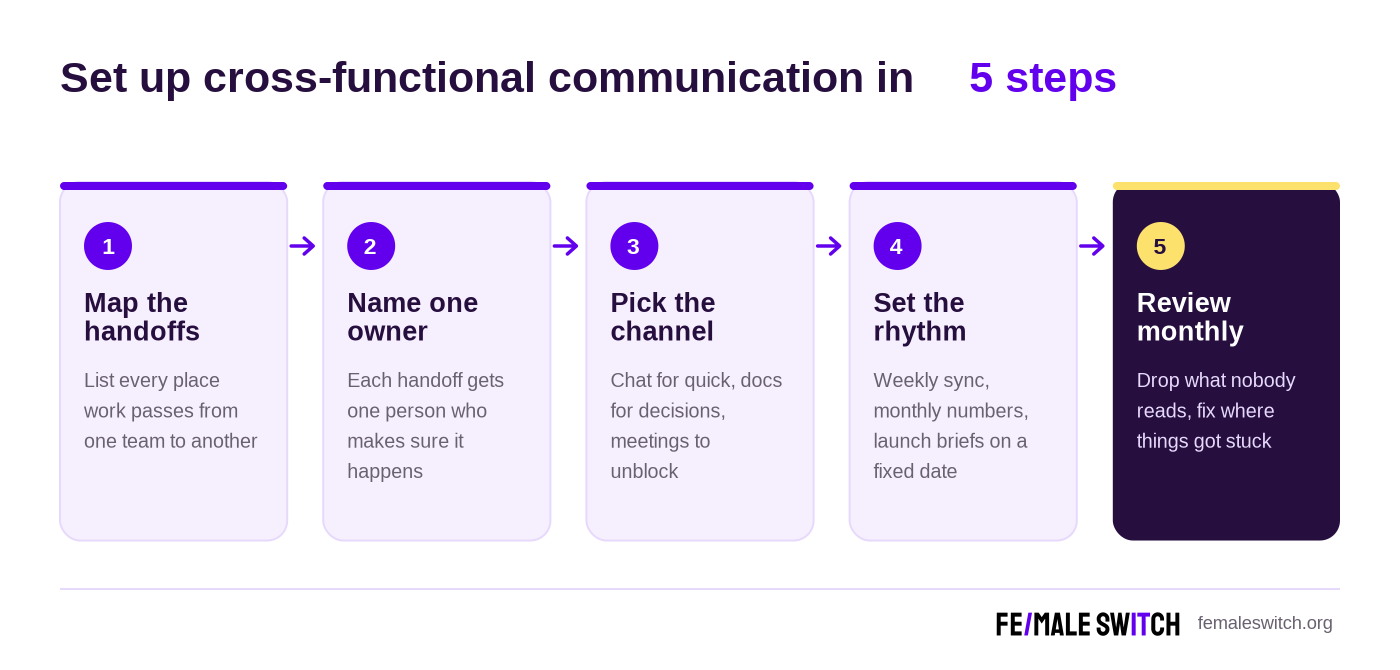
How to set it up in one afternoon
- Map the handoffs. Ask each lead: "Where do you wait for another team, and where does another team wait for you?" Write each answer as a row.
- Name one owner per row. A person, not a team. The owner doesn't do all the work; they make sure the handoff happens and chase it when it doesn't.
- Pick one channel per message type. Use the channel matrix below and write it into a one-page working agreement with expected reply times, quiet hours and how to escalate something urgent. The rule that matters most: decisions go into a document, not a chat thread.
- Set the rhythm. Put the weekly sync and the monthly updates in everyone's calendar for the next three months, so they survive busy weeks.
- Review it monthly. Ask two questions: what did nobody read, and where did something get stuck? Delete the first, fix the second.
For the tools behind each channel, see communication tools for remote startup teams and project management tools for small teams.
Which channel for which message
Most interdepartmental communication problems are channel problems: an urgent issue sits in an email, a decision gets lost in chat. Agree this once and write it into your working agreement.
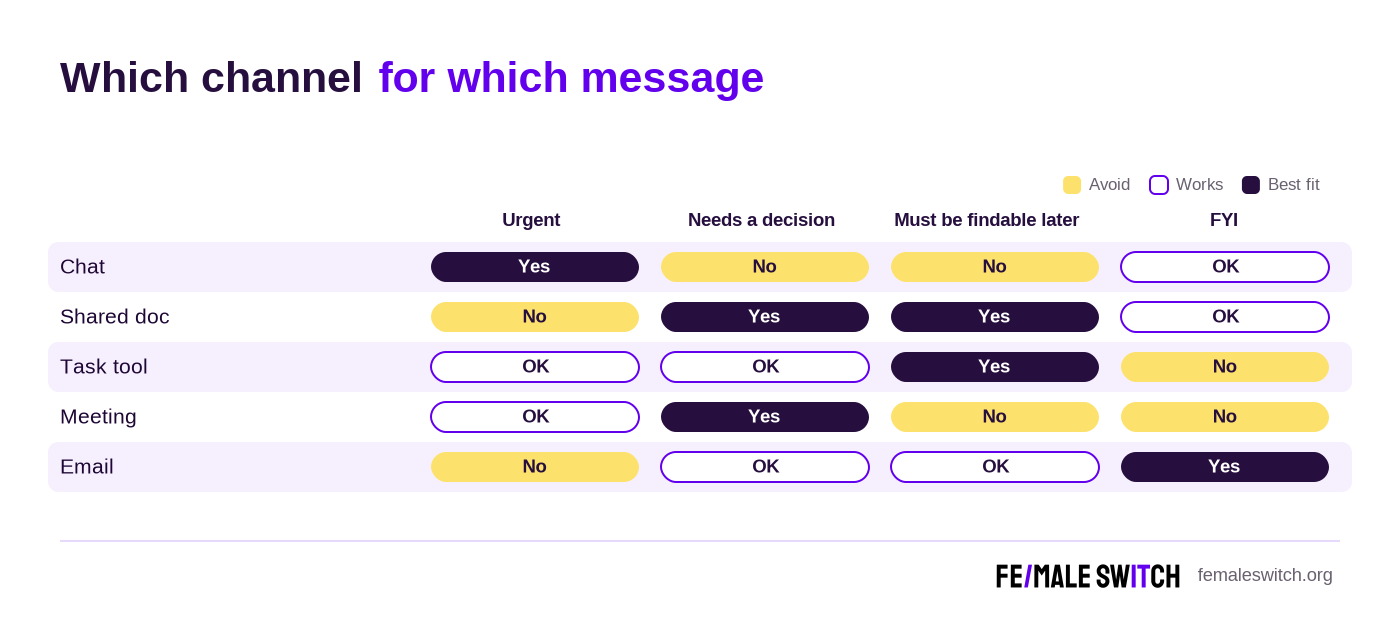
Remote-first companies take this further. The GitLab handbook is a public example of writing things down first and defaulting to asynchronous communication; a startup doesn't need its scale, but borrowing the habit of a written decision log pays off early.
Decisions: who decides, and where it is written down
Half of the friction between departments is about decisions: who made it, when, and whether it is final. Two light tools fix most of it.
- A decision owner for each project. The DACI framework from Atlassian's team playbook names a Driver (runs the process), an Approver (makes the call), Contributors (give input) and the Informed (told afterwards). One Approver, not a committee.
- A decision log. One shared doc with four columns: date, decision, who decided, link to the discussion. When someone asks "why did we do this?", the answer is a link.
As the team grows, the way you lead these decisions has to change too; adapting leadership styles as teams expand covers that shift.
The launch handoff: the one meeting you should never skip
Launches are where cross-functional communication breaks most visibly, because every team needs something different from the same release. Send this brief two weeks before release day and walk through it in the weekly sync.
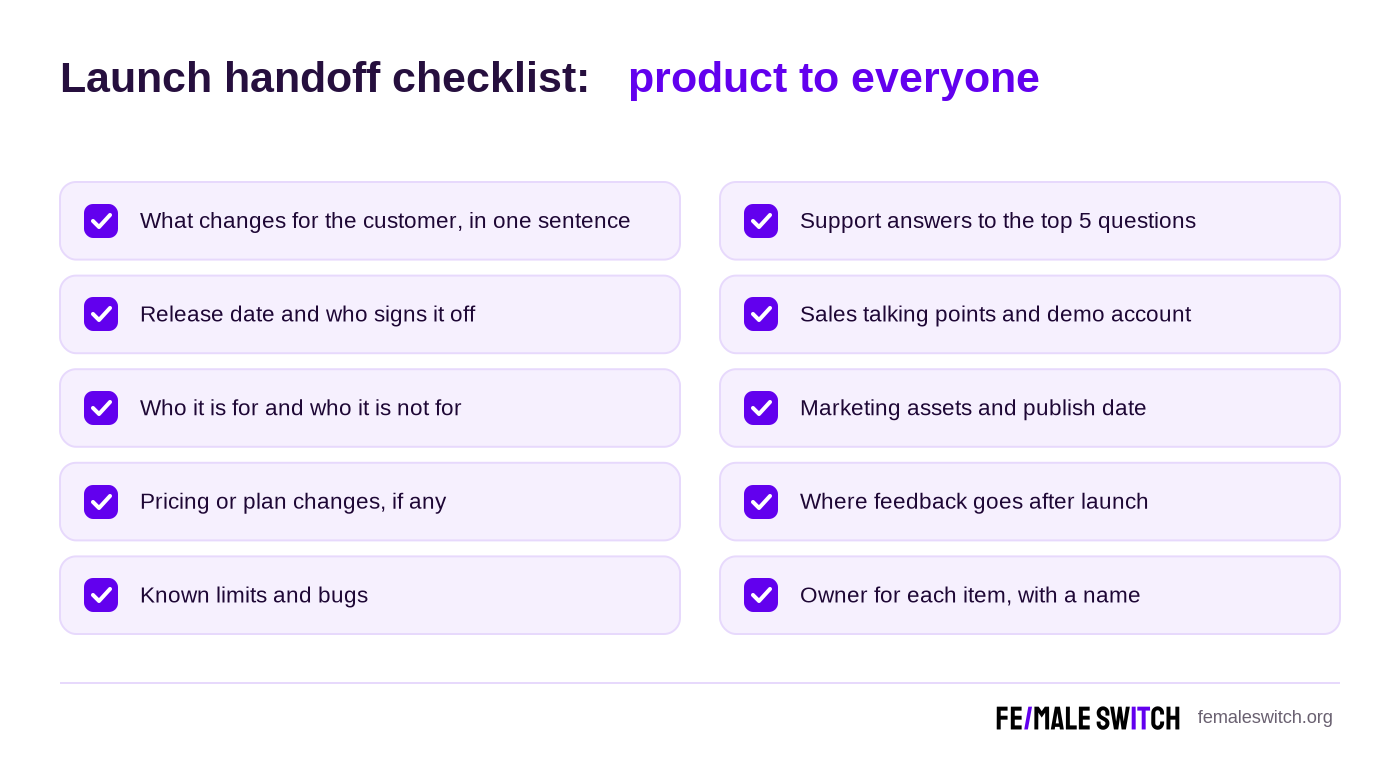
For the launch itself, use the product launch checklist. To turn the launch brief into permanent help pages, see technical documentation and user guides.
Mistakes that make cross-department communication worse
- Buying a tool to fix a people problem. A new chat app moves the same confusion to a new place. Fix owners and rhythm first, tools last.
- One channel for everything. When urgent incidents, jokes and decisions share one stream, people mute it, and then they miss the incident.
- Updates in meetings. Reading status updates aloud wastes everyone's time. Write them; meet to decide.
- Owners that are teams. "Marketing owns the launch brief" means nobody does. Write a name.
- No reply-time agreement. Without one, some people answer at midnight and others in three days, and both feel the other is the problem. Put reply times and quiet hours in the working agreement.
- Never deleting anything. Recurring meetings and reports pile up. The monthly review should remove at least one thing that nobody uses.
- Forgetting new hires. The plan lives in the founder's head until someone writes it down. Link it from your operations manual and walk every new person through it in week one.
Good communication habits are cheapest to build when the team is small. See how to build company culture from day one and, when you hire several people at once, hiring during growth.
Dreaming of startup success but too scared to get started?
Join the Fe/male Switch women-first startup game and turn that dream into your reality. With tailored guidance, support networks, and a plethora of resources, we'll nurture your ascent to the startup stratosphere! And we have AI co-founders, PlayPals!
Join F/MS now.
FAQ on cross-functional communication
What is cross-functional communication?
It is the flow of information between teams with different jobs that share one outcome, such as product, sales, marketing, support and finance. In practice it means clear handoffs, agreed channels and a regular rhythm for updates and decisions.
Why is communication between departments hard in startups?
Roles change fast, people wear several hats, and knowledge lives in chat threads and in the founders' heads. Without named owners for each handoff and an agreed place for decisions, information gets lost as soon as the team passes five or six people.
What should a communication plan template include?
For each handoff: what is shared, from which team to which, the channel, how often, and one named owner. Add a short working agreement with reply times per channel, quiet hours and how to escalate urgent issues.
How is an internal communication plan different from a cross-functional one?
An internal communication plan usually covers messages from leadership to all staff, such as company news. A cross-functional plan covers the working handoffs between teams. A startup can keep both in one document.
How often should cross-functional teams meet?
For most startups, one 30-minute weekly sync for team leads is enough, as long as updates are written beforehand and the meeting is used only for blockers and decisions. Launches add one handoff meeting two weeks before release.
What is a team working agreement?
A one-page document the team agrees on: which channel to use for what, expected reply times, quiet hours, meeting rules and how decisions are recorded. It turns unwritten habits into shared rules that new hires can read.
How do I improve communication between departments without more meetings?
Move updates into writing, keep a decision log, give every handoff an owner, and use a task tool for requests between teams. Then cancel any recurring meeting that only shares information.
Which tools help with cross-functional communication?
A chat app for urgent questions, a shared document space for decisions and plans, and a task or project tool for work between teams. The tool matters less than agreeing what goes where.
About the Author
Violetta Bonenkamp, also known as MeanCEO, is an experienced startup founder with an impressive educational background including an MBA and four other higher education degrees. She has over 20 years of work experience across multiple countries, including 5 years as a solopreneur and serial entrepreneur.
