
Product roadmap examples: 5 formats, filled in for one startup
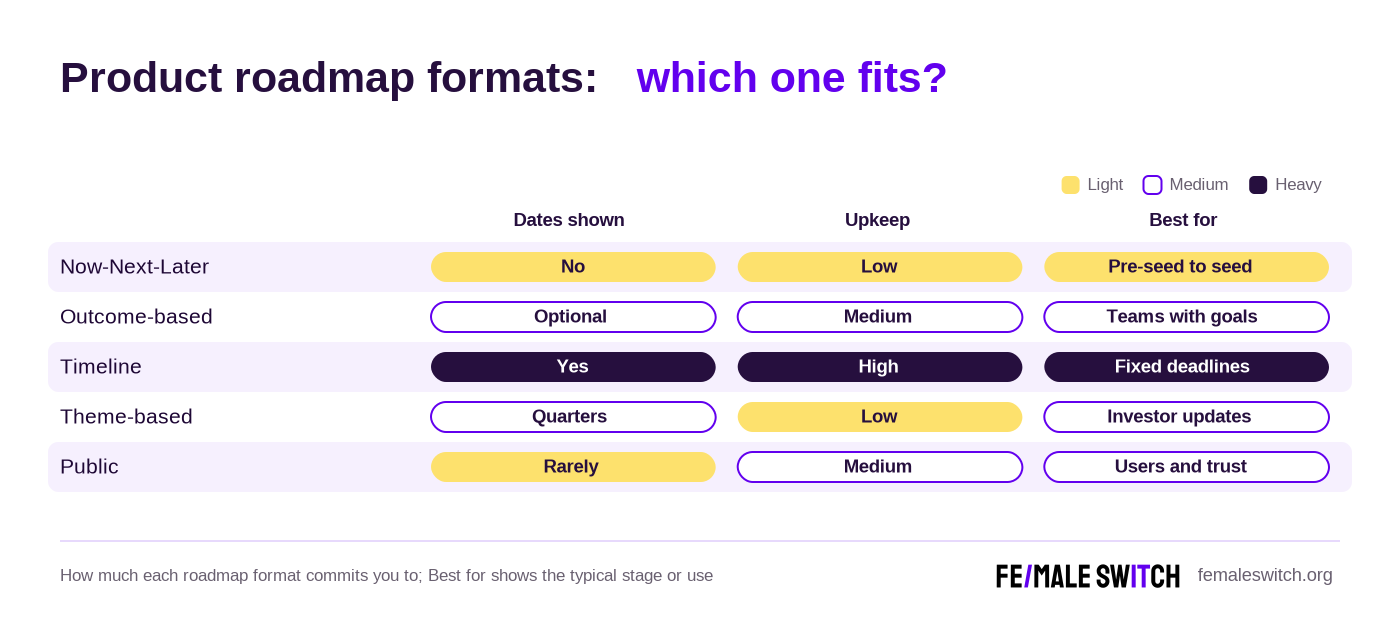
A product roadmap shows what you will work on, in what order and why, without promising every date. The five formats startups use most are Now-Next-Later, outcome-based, timeline, theme-based and public roadmaps. Below, each one is filled in for the same small startup so you can compare them side by side, followed by a copy-ready product roadmap template and the checks to run before you share it.
Quick answer: before product-market fit, use a Now-Next-Later roadmap: three columns, no dates, every item written as a customer problem tied to one goal. Add an outcome layer (goal, metric, bets) once you have a team, switch to a quarterly timeline only for fixed deadlines such as a funding round or a legal date, and publish a public version when users ask what is coming.
Chat with your AI friend PlayPal, and experience a whole new level of companionship! Discover fun conversations, advice, and endless support—all at your fingertips! Chat with PlayPal NOW!
Roadmap vs backlog vs release plan
Most roadmap problems start with mixing up three different documents. Keep them apart:
Source: common product management usage. The roadmap stays short and strategic; detail belongs in the backlog. For a full walkthrough of building your first one alone, see product roadmap essentials for solo founders.
The example startup
All five examples use one illustrative company: a two-founder SaaS that helps freelance designers send invoices and chase late payments. It has about 300 paying users, one developer and a goal of reducing churn before raising a seed round. The items are invented for the example; the formats are real.
1. Now-Next-Later roadmap example
The Now-Next-Later format was created by ProdPad's Janna Bastow as an alternative to timeline roadmaps: work sits in three time horizons, from what you are doing now to what you will explore later, and every item ties back to an objective. No dates, so you don't promise what you can't know yet.
Source: illustrative example. Read it left to right: confidence drops as you move to Later, and items only move left when evidence and capacity allow.
2. Outcome-based roadmap example
An outcome-based roadmap starts from the result you want, not the feature list. Each goal gets a metric and a few bets you think will move it, so the team can swap a bet that isn't working without rewriting the plan.
Source: illustrative example; figures are the startup's own targets, not benchmarks. This format works well once you have measured product-market fit and enough usage data to set a baseline.
3. Timeline (quarterly) roadmap example
Timeline roadmaps put items on months or quarters. They are the right tool when a date is fixed from outside: a launch event, a seed round, a contract or a legal deadline. Executive roadmaps are often organised this way. Keep only the next quarter detailed and the rest broad.
Source: illustrative example. The risk: every box reads as a promise. Write "if" conditions into later quarters, as in Q4 above.
4. Theme-based roadmap example
A theme-based roadmap groups work into a few big themes per quarter instead of listing features. It is the easiest format to put on one slide for an investor update, because it shows direction without detail.
Source: illustrative example.
5. Public roadmap example
A public roadmap shows users what is coming. A good real example is GitHub's public roadmap: each item carries a release phase such as preview or generally available, exploratory items are labelled "in design" with no timeframe, and delivered items get a "shipped" label with a link to the changelog post. For a startup, a public page with three columns (Exploring, Building, Shipped) and an upvote or comment option is enough. Leave out dates and anything that would tip off a competitor.
Product roadmap template (Now-Next-Later)
Copy this into a doc, spreadsheet or board tool. One row per goal, no more than three goals:
Source: template based on the Now-Next-Later format. The "not in this roadmap" cell is the most useful one: it records what you said no to and why.
How to build your roadmap in 5 steps
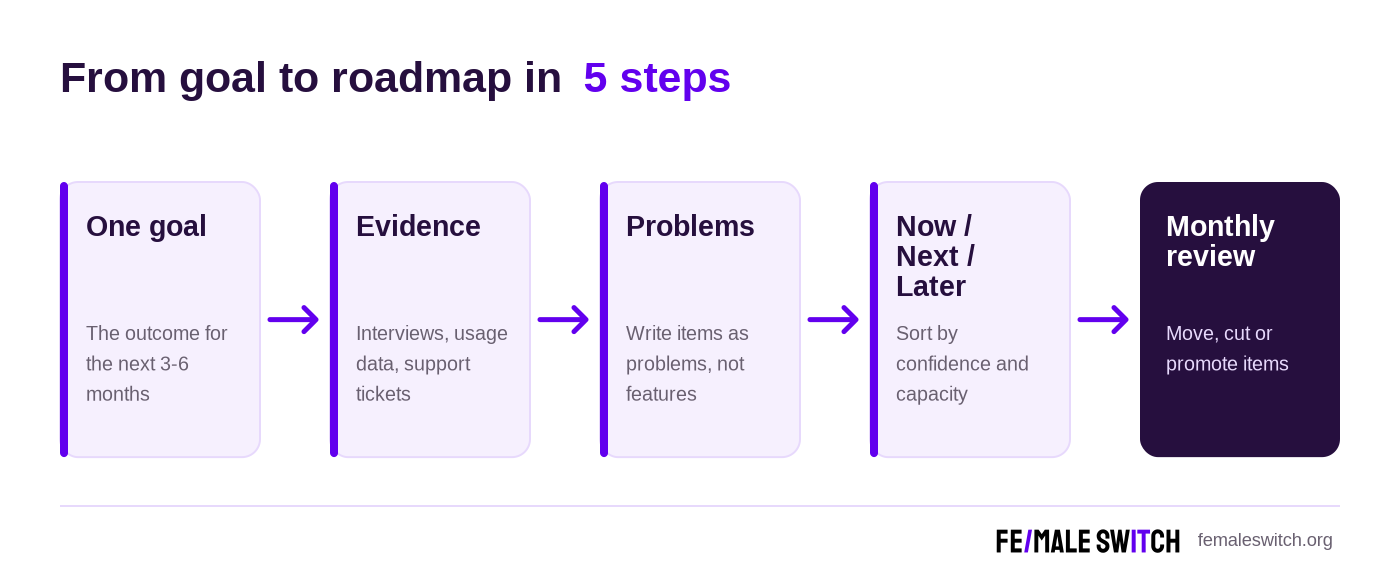
- Pick one goal for the next three to six months. Before launch that is usually validation; after launch, retention or revenue.
- Collect evidence. Interview potential customers, read support tickets and look at usage data. Compare your product with competitors to see which features are table stakes.
- Write items as problems. "Users miss failed payments" leaves room for the best solution; "build dunning module" doesn't.
- Sort into Now, Next and Later. Now holds only what you have people and money for. Keep the first version as small as a minimum viable product.
- Review every month. Move items when evidence changes and run the work itself on a simple board; see Kanban vs Scrum for startups.
Product roadmap mistakes to avoid
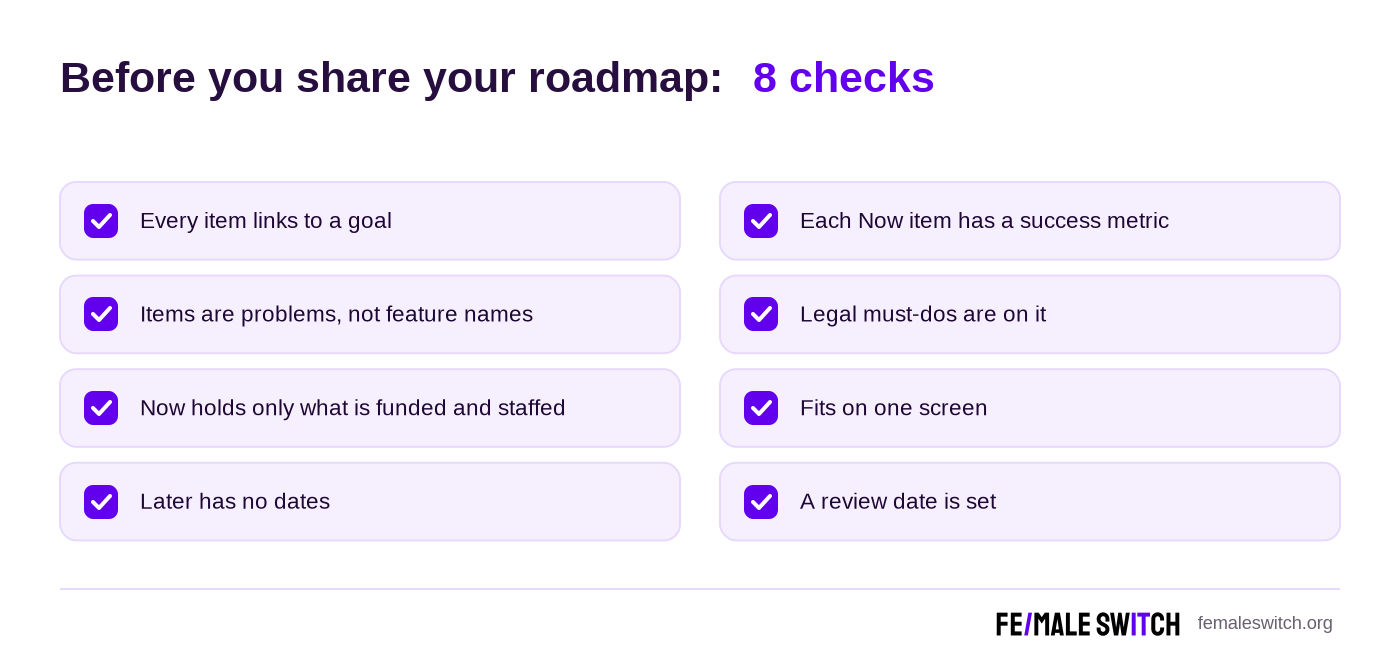
- A feature list with dates. That is a release plan. Without goals, nobody can tell whether an item still matters when plans change.
- Overpacking Now. If Now holds more than the team can finish this cycle, nothing in it is really a priority.
- Dates on Later. Anything you haven't validated shouldn't carry a date, especially on a roadmap investors or users see.
- Building it alone. Share a draft with your co-founder, developer and two or three customers before you call it final.
- No success metric. Each Now item needs a number that tells you whether it worked, or you can't learn from the roadmap.
- Forgetting must-dos. Security fixes, privacy requirements and accessibility work belong on the roadmap too, or they get pushed out by new features.
- Never removing anything. An idea that has sat in Later for two reviews with no new evidence should move to "not in this roadmap".
Want to test your roadmap thinking on a real idea first? The Fe/male Switch startup game takes you from problem to first customers step by step.
Dreaming of startup success but too scared to get started?
Join the Fe/male Switch women-first startup game and turn that dream into your reality. With tailored guidance, support networks, and a plethora of resources, we'll nurture your ascent to the startup stratosphere! And we have AI co-founders, PlayPals!
Join F/MS now.
FAQ on product roadmap examples and templates
What is an example of a product roadmap?
A Now-Next-Later roadmap for a small SaaS: Now = dunning emails to stop failed payments, Next = recurring invoices, Later = multi-currency payouts, each tied to a goal such as cutting churn. The five examples above show the same startup in five formats.
What should a product roadmap include?
The goals it serves, the problems or initiatives you will work on, their rough order or time horizon, a success metric for near-term items, and a review date. Detailed tasks belong in the backlog.
What is a Now-Next-Later roadmap?
A roadmap with three columns instead of dates: what you are building now, what is validated and comes next, and ideas to explore later. It was created by Janna Bastow of ProdPad as an alternative to timeline roadmaps.
What is an outcome-based roadmap?
A roadmap organised around results, such as lowering churn from 6% to 4%, with the features listed as bets that might achieve them. It keeps the team focused on impact rather than output.
What is the difference between a roadmap and a backlog?
The roadmap explains which problems you will solve and why over the next months; the backlog is the ordered list of tasks and stories the team works through in the coming weeks.
Which roadmap format is best for an early-stage startup?
Now-Next-Later, because it shows priorities without promising dates you can't yet know. Add quarters only when an outside date is fixed.
Should a startup make its roadmap public?
It can help with trust and feedback once you have users. Show broad stages (exploring, building, shipped), leave out dates and anything sensitive, and keep the internal version separate.
How often should you update a product roadmap?
Review it monthly before product-market fit and at least quarterly after. Update it whenever new evidence changes your priorities.
About the Author
Violetta Bonenkamp, also known as MeanCEO, is an experienced startup founder with an impressive educational background including an MBA and four other higher education degrees. She has over 20 years of work experience across multiple countries, including 5 years as a solopreneur and serial entrepreneur.
