
TL;DR: What does the Anthropic IPO filing show?
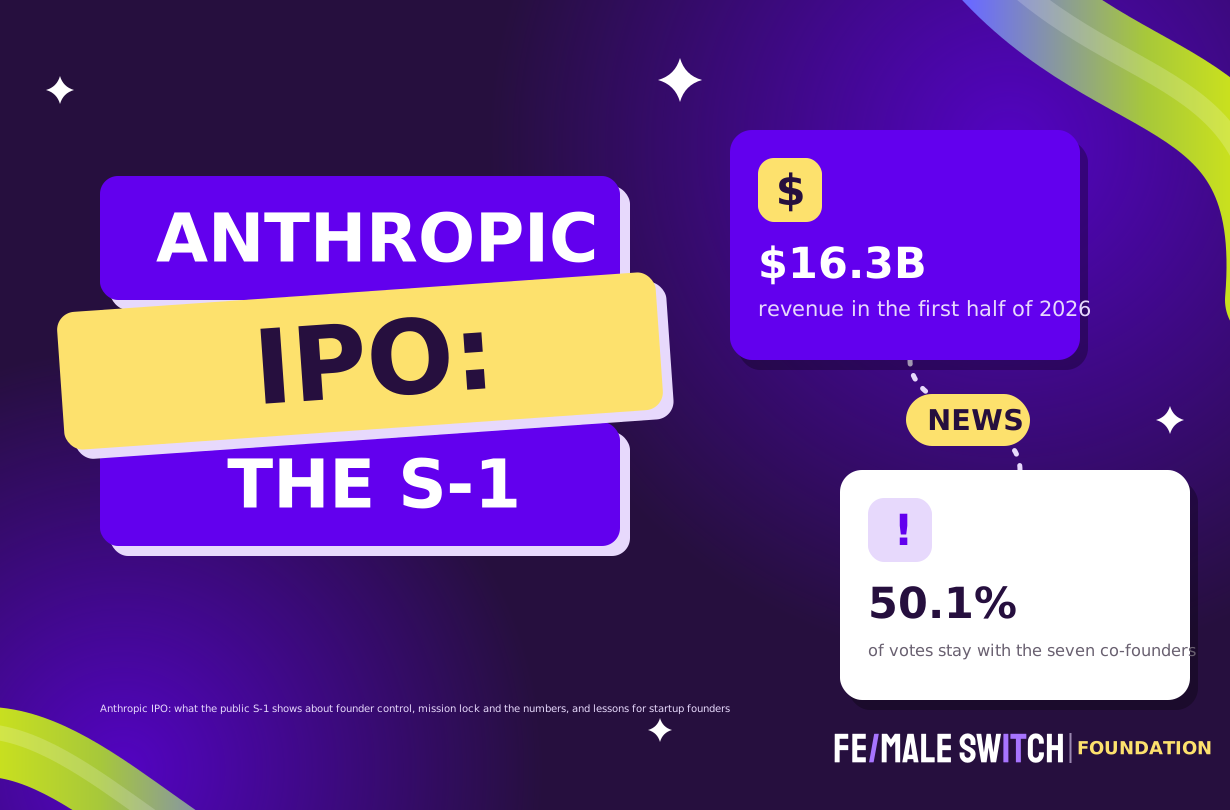
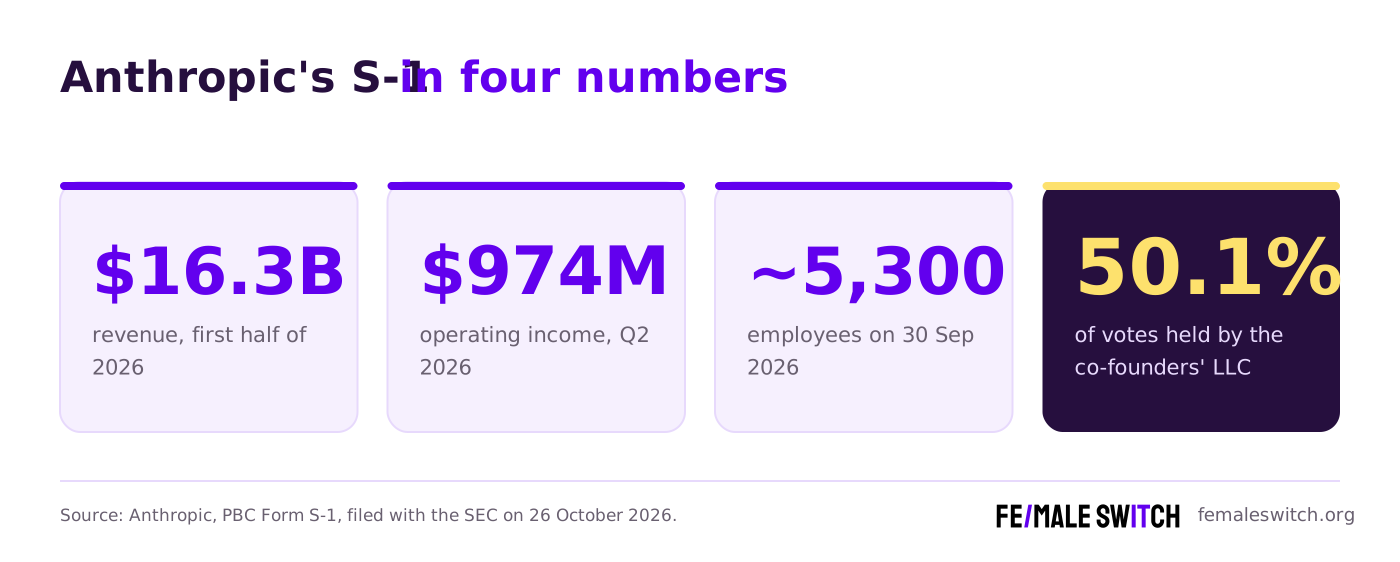
On 26 October 2026 Anthropic, the company behind Claude, published its S-1, the prospectus a company files with the US Securities and Exchange Commission before it lists shares. It plans to list on the Nasdaq under the ticker ANT, with Goldman Sachs and Morgan Stanley leading 22 banks. Revenue hit $16.3 billion in the first half of 2026, and the second quarter brought a $974 million operating profit. The $80.7 billion net loss is mostly paper losses on convertible notes and SAFEs. The founders keep 50.1% of the votes through one special share, and an independent trust picks most of the board. For founders, the filing reads like a manual on keeping control and a mission while raising huge sums.
Developing story. Last updated 27 Oct 2026, 10:30 CET. We'll update this article as Anthropic files the price range, the number of shares and the listing date with the SEC.
The Anthropic IPO got its first real document on Monday. After months of confidential drafts and a leak to The Wall Street Journal a week ago, Anthropic filed its full prospectus in public, and the searches followed fast: in Germany one of the rising terms was simply "gs" next to "anthropic", and Goldman Sachs is the first bank named on the cover. I read the filing as a founder, so you won't find share-price talk here. You'll find what Anthropic did to keep control, lock in its mission and stay lean, and what a first-time founder can copy from it.
What did Anthropic file, and when?
Here is what we know so far, all from the S-1 itself and the SEC's filing list for Anthropic, PBC:
- 26 October 2026: Anthropic, PBC filed its Form S-1 in public. A first confidential draft went to the SEC on 1 June 2026, followed by five amendments between July and early October.
- Where it lists: Class A shares on the Nasdaq Global Select Market, ticker ANT. Anthropic also plans to sell shares to the public in the UK, Switzerland, Canada, Australia, Japan and some EU countries, with no listing on any exchange there.
- Who sells it: 22 banks. Goldman Sachs and Morgan Stanley come first on the cover, followed by J.P. Morgan, Citigroup, Barclays, Wells Fargo and others, including BNP Paribas, Crédit Agricole and Société Générale.
- Still blank: the price range, the number of shares, the amount raised and the third-quarter revenue figure.
- The company: founded in 2021, about 5,300 employees on 30 September 2026, and $141.1 billion raised in total by 30 June 2026, with $131.7 billion in cash and short-term investments.
The numbers match what leaked. Our sister site covered the leaked draft of the Anthropic IPO filing from the builder's side when The Wall Street Journal reported it on 20 October. The public version adds the parts the leak didn't show: the full voting structure, the customer data and the company's own explanation of its losses. For the customer tiers, revenue by region and the compute Anthropic has committed to buy, see Anthropic's S-1 in numbers on our sister site.
What do Anthropic's numbers look like?
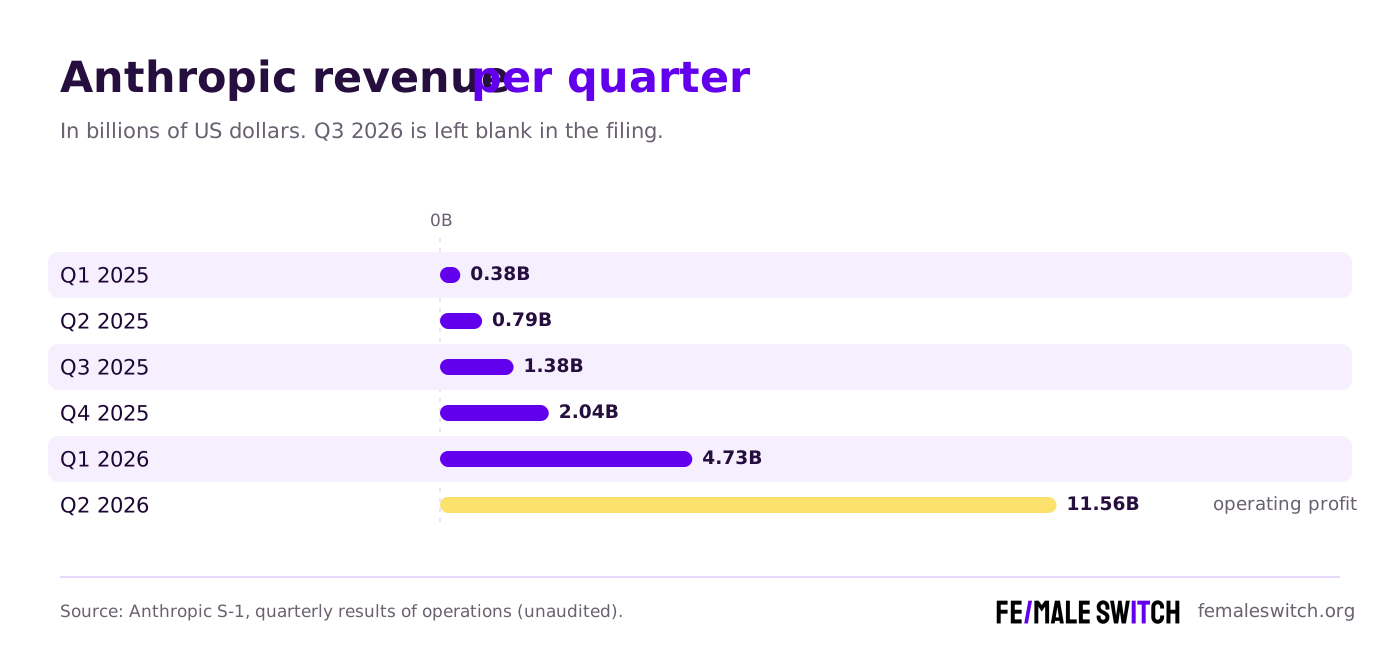
Three numbers in the filing say more than the headline loss. Revenue grew 1,368% year on year in the second quarter while compute costs grew 300%. Revenue per employee over the last twelve months passed $6.6 million, up from $1.4 million a year earlier. And net revenue retention, the money existing customers spend this year compared with last year, stood at about 900%. More than 11,900 customers paid Anthropic $100,000 or more over twelve months, and about 250 paid $10 million or more.
The scary loss needs one sentence of context. Anthropic raised part of its money through convertible notes and SAFEs (simple agreements for future equity, the same instrument many pre-seed startups use). When the company's valuation rises, the accounting value of those instruments rises too, and that increase is booked as a loss. So the more investors thought Anthropic was worth, the bigger the reported loss got.
How do Anthropic's founders keep control after the IPO?
This is the part of the filing every founder should read twice. Anthropic stacks five share classes and two outside bodies so that money can come in without control going out:
On top of that, Anthropic is a public benefit corporation (PBC) under Delaware law. Its directors must balance shareholders' money interests, the interests of people affected by the company, and a written purpose: "the responsible development and maintenance of advanced AI for the long-term benefit of humanity". Because the trust picks most of the board, Nasdaq treats Anthropic as a "controlled company", and the filing says it will use that status only to let its nominating committee include non-independent members.
Then there's the giving. Anthropic put 5% of its fully diluted shares into its own Anthropic Public Benefit Fund, and the board may add up to 2% more each time the share price rises 50% above the previous step. Each co-founder has pledged 80% of their personal equity to charity, and staff can pledge equity that the company matches.
What we don't know yet
- The price range and size. The share count, the price range and the amount raised are blank. They arrive in a later amendment.
- The listing date. Anthropic hasn't set one. The SEC has to declare the filing effective first, and the roadshow to investors comes before pricing.
- Third-quarter revenue. The filing leaves the figure for July to September 2026 blank.
- Who the trustees will elect. The filing names the structure, and the board after listing will show how the trust uses it.
Timeline
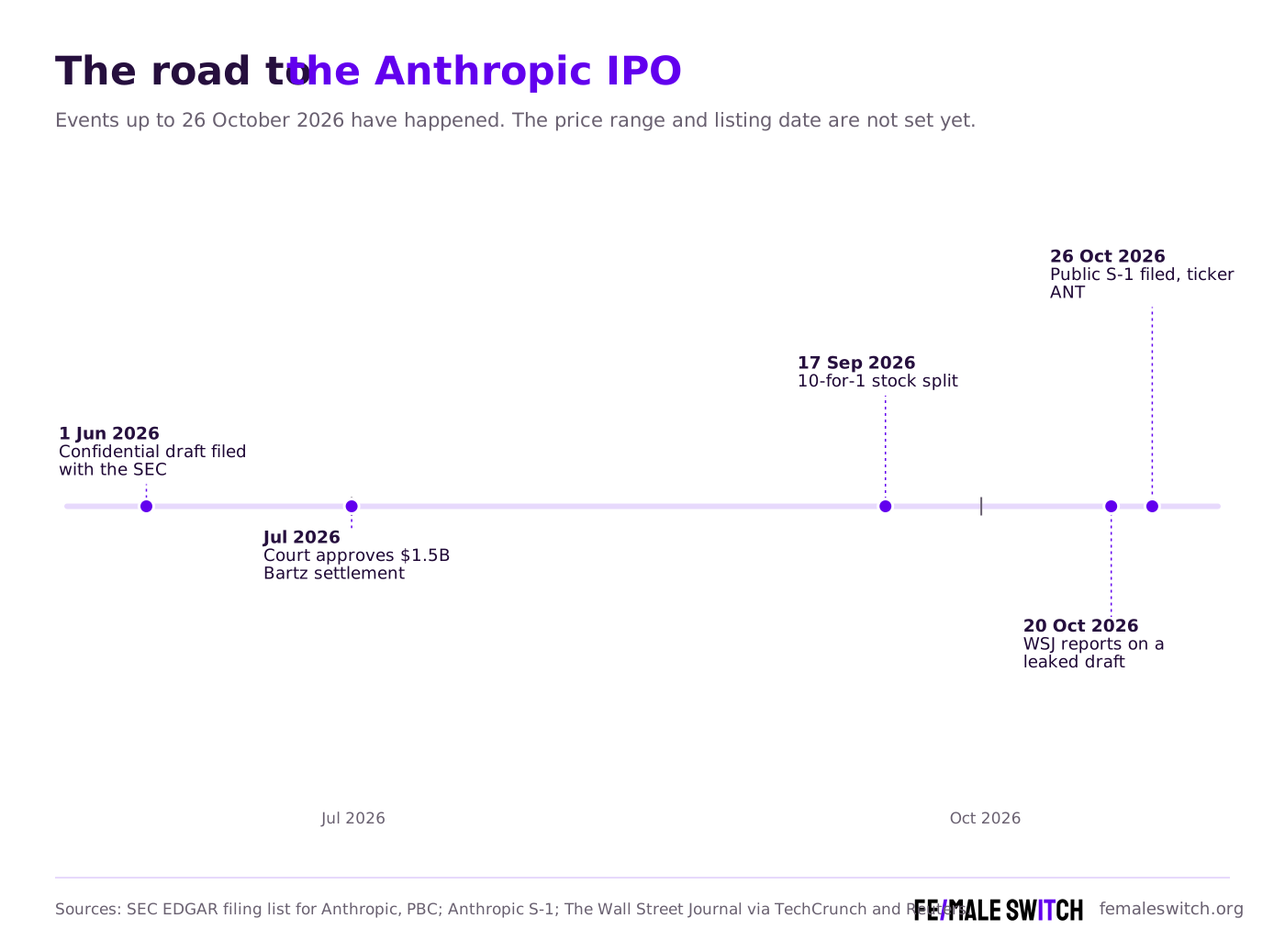
- 2021: Anthropic is founded.
- 2023: the Long-Term Benefit Trust is set up.
- 1 June 2026: first confidential draft filed with the SEC.
- July 2026: the court approves the $1.5 billion settlement of the Bartz copyright class action, agreed in September 2025.
- 17 September 2026: a 10-for-1 forward split of Class A and Class N shares.
- 20 October 2026: The Wall Street Journal reports on a leaked draft.
- 26 October 2026: the public S-1 is filed.
- Next: an amendment with the price range, then the roadshow, pricing and the first trading day.
What can startup founders learn from Anthropic's S-1?
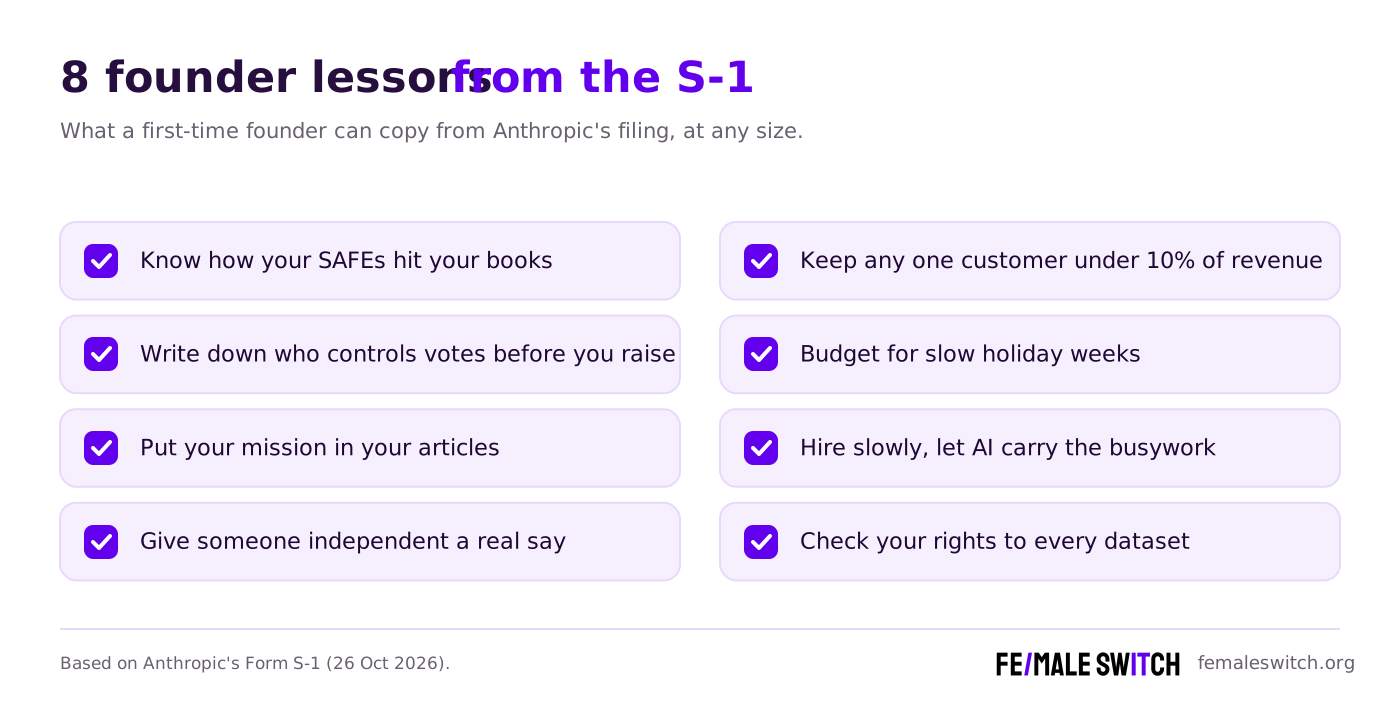
Let's break it down. You're not raising $141 billion, but the same tools exist at seed stage, and they're cheapest to set up before your first round:
- Know what your SAFEs do to your books. Anthropic's $72.4 billion paper loss in six months came from convertible notes, derivatives and SAFEs rising in value. Your pre-seed SAFE works the same way on a small scale, so ask your accountant how it shows up before an investor asks you. Our guide to revenue-based financing versus equity compares the money that doesn't convert at all.
- Write down who controls the votes before you raise. One founder share with 50.1% of the votes keeps Anthropic's seven co-founders in charge of ordinary shareholder votes after listing. In the EU, the multiple-vote share directive, adopted in 2024 as part of the EU Listing Act, lets companies listing on SME growth markets use shares with more than one vote, and member states must turn it into national law by early December 2026. Start with a clear equity split between co-founders and a shareholder agreement that says who decides what.
- Put your mission in your articles. A PBC must weigh its stated purpose by law. Europe has its own versions: Italy's società benefit since 2016 and France's société à mission since the PACTE law of 2019. Our piece on impact startups covers why investors in that space ask for it.
- Give someone independent a real say. Anthropic's trust has no money in the company and elects most of its board. A small startup can start with an advisory board that includes one person with no stake in the outcome.
- Keep any one customer under 10% of revenue. No single customer passed 10% of Anthropic's revenue in the nine months to 30 September, and the top five made about 25%. The share from customers outside the top five rose from 64% to 79% between the first and third quarters.
- Budget for slow holiday weeks. Customer spend fell about 20% in the two weeks to 2 January 2026 compared with the two weeks before, because code freezes slow everything down. If your customers are companies, plan your cash for December now.
- Hire slowly and let AI carry the busywork. Anthropic credits its $6.6 million revenue per employee partly to how much its own teams use Claude. Before your next hire, list the tasks an AI tool could take over first.
- Check your rights to every dataset. The $1.5 billion settlement of the Bartz copyright class action sits in Anthropic's 2025 costs, and music publishers have sued over song lyrics too. Copyright claims scale with the size of your data, so keep a record of where every dataset, image and text you train on or resell came from.
One more lesson sits between the lines. Anthropic set up its trust in 2023, three years before its first confidential IPO draft. Structures like these are cheap to add when the cap table has three names and very hard to add when it has three hundred, so if you care about control or mission, put it in writing while you still own most of the company. If an exit is your plan instead, our guide to planning for an acquisition is the better starting point.
What does the Anthropic IPO mean if you use Claude?
Nothing changes in your account this week. What changes is that Anthropic now has to publish its numbers and risks every quarter, so you'll learn much more about prices, capacity and plans than before. The S-1 lists risks such as changes to usage and rate limits and the retirement of older models, and a dependence on a few cloud providers, and our sister site walks through the Anthropic S-1 risk factors for builders one by one. If your product runs on Claude, keep a second model tested and read the quarterly reports. European users should also watch what Anthropic says about EU availability: features such as Claude Duet launched in the US only.
Building your first startup on a budget?
The Fe/male Switch startup game takes you from idea to first paying customers in weekly quests, with an AI co-founder and a community of founders.
👉 Start the game
FAQ: the Anthropic IPO
When is the Anthropic IPO?
Anthropic filed its public S-1 on 26 October 2026 but hasn't set a date or a price range yet. Those come in a later amendment, after the SEC declares the filing effective and the company presents to investors.
What is Anthropic's ticker symbol?
Anthropic has applied to list its Class A shares on the Nasdaq Global Select Market under the symbol ANT.
Who is leading the Anthropic IPO?
Goldman Sachs and Morgan Stanley are listed first among 22 banks on the cover of the S-1, followed by J.P. Morgan, Citigroup, Barclays and Wells Fargo.
How much revenue does Anthropic make?
$16.3 billion in the first half of 2026, up from $1.2 billion a year earlier, and $11.6 billion in the second quarter alone. Full-year 2025 revenue was $4.6 billion.
Why did Anthropic report an $80.7 billion loss?
Most of it, $72.4 billion, comes from the rising accounting value of convertible notes, derivatives and SAFEs as Anthropic's valuation went up. The operating loss for the half year was $693 million, and the second quarter showed a $974 million operating profit.
Who controls Anthropic after the IPO?
The seven co-founders hold one Class F share with 50.1% of the votes on ordinary shareholder matters, and the Long-Term Benefit Trust elects a majority of the board. Public shareholders get one vote per Class A share.
