

Operations manual template for solo founders and small startups
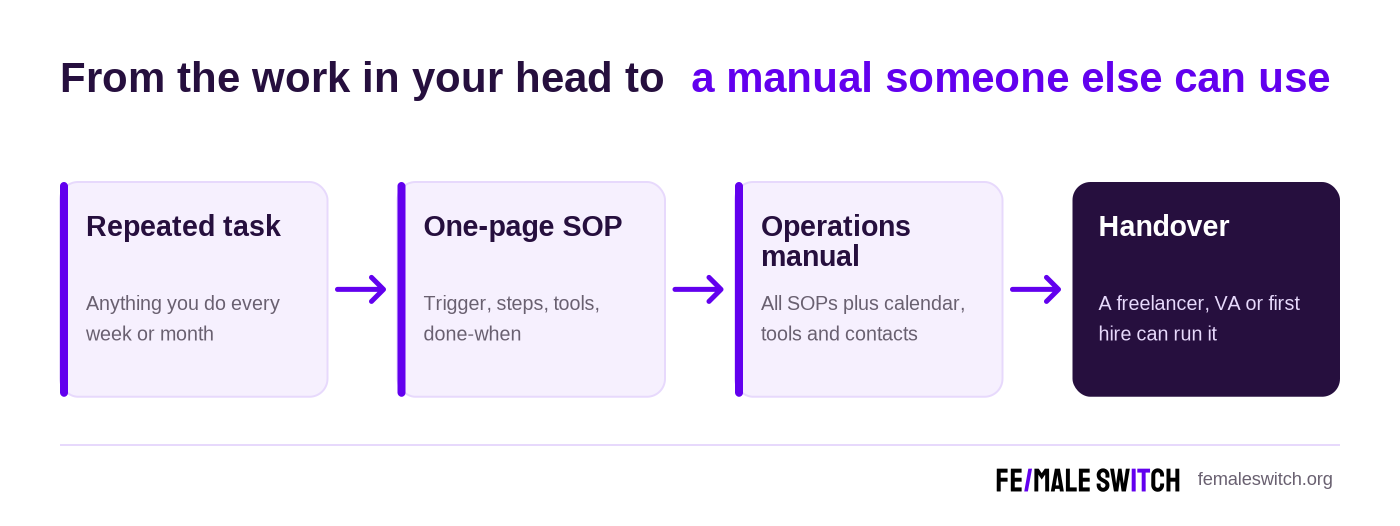
An operations manual is one document that explains how your business runs: what you sell, how a customer moves from first contact to paid and delivered, which tasks happen when, which tools you use and who to call. For a solo founder it's what lets you take a week off, bring in a freelancer or hire your first employee without spending days explaining everything.
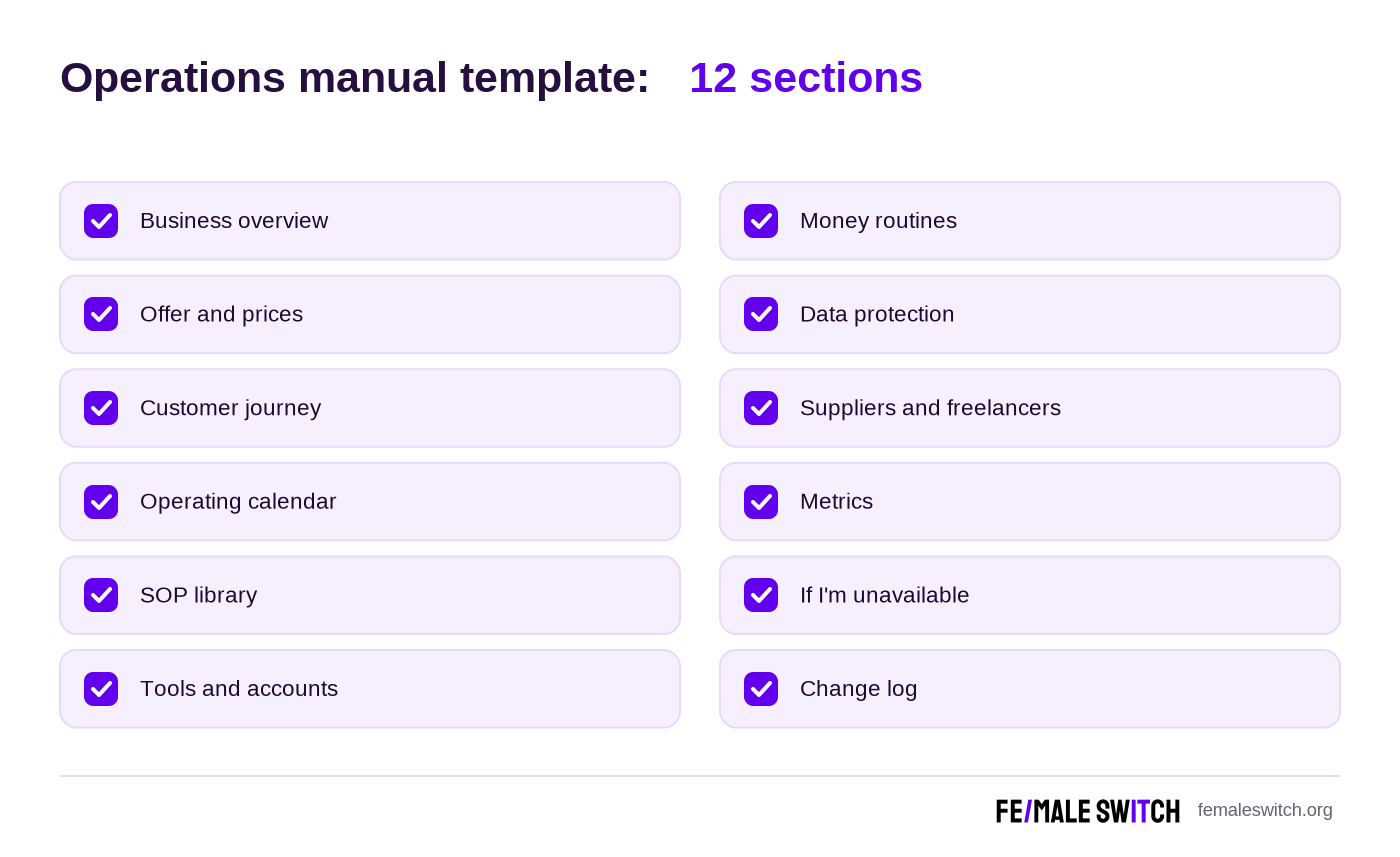
Quick answer: start with 12 sections: business overview, offer and prices, customer journey, operating calendar, SOP library, tools and accounts, money routines, data protection, suppliers, metrics, an "if I'm unavailable" plan and a change log. Write one-page SOPs for your three most frequent tasks first, keep logins in a password manager rather than the manual, and test it by asking someone to follow one SOP without your help.
Write FREE SEO-optimized Blog Articles! Our Article Writer ensures your blog is loved by both Google and your readers, turning those clicks into customers.
👉 Write your article here
Why a one-person business needs an operations manual
When you're the only person in the company, every process lives in your head. That works until you get sick, go on holiday, sign a client who needs faster delivery, or bring in help. Then three problems show up at once:
- Nobody else can run anything. A virtual assistant or freelancer needs written steps, not a two-hour call.
- You repeat decisions. Without a written process you decide again, every month, how to chase an invoice or onboard a client.
- Growth stalls at your own capacity. Deciding what to outsource and what to keep is only possible once the work is written down.
The manual doesn't need to be long. A first version of 10 to 20 pages, mostly checklists and tables, is more useful than a polished 100-page binder nobody opens. Once you hire your first team members, add a page on how teams hand work to each other; this cross-functional communication plan fits on one page.
The operations manual template: 12 sections
Copy this outline into a Google Doc, Notion page or shared folder and fill in one section at a time. The examples show what a solo consultant or small online business would write. If you work with clients, fill in the client section first: this client onboarding checklist for solo founders gives you the steps, emails and questionnaire.
Source: Fe/male Switch template for one-person and small startups.
If you work with customers in the EU, section 8 is not optional: the GDPR applies to small businesses too. The European Commission's information for business and organisations explains the principles, your obligations and how to deal with requests from individuals.
One-page SOP format you can copy
A standard operating procedure (SOP) is the building block of the manual. Keep each one to a single page, using the same fields every time:
Write SOPs while you do the task, not from memory. A screen recording of you doing it, plus the written steps, is often the fastest way to hand it over.
The operating calendar: what happens when
Put each task in your calendar or project tool with a link to its SOP. Our guide to project management tools compares options, and time management for solo entrepreneurs covers how to protect the hours the calendar needs.
How to build your operations manual in 5 days
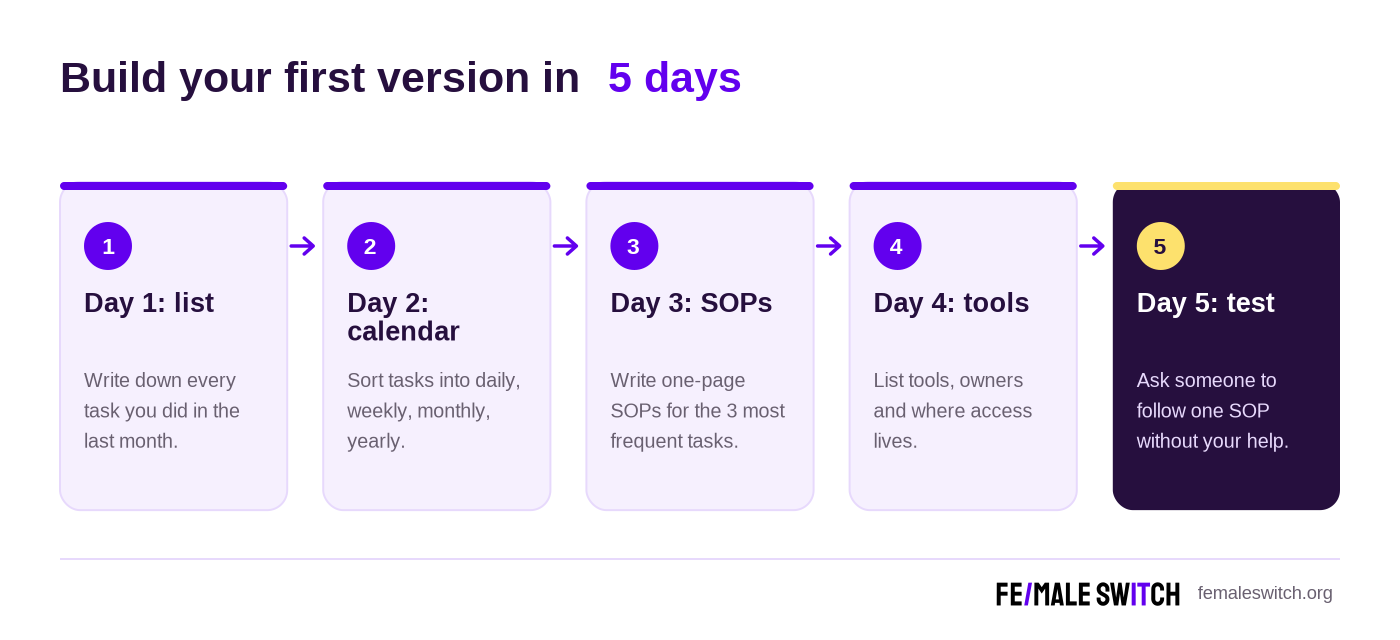
- Day 1: list everything. Go through last month's calendar, inbox and bank statement and write down every task you did, however small.
- Day 2: build the calendar. Sort tasks into daily, weekly, monthly, quarterly and yearly. Mark the ones only you can do.
- Day 3: write three SOPs. Start with the three tasks you do most often, using the one-page format above.
- Day 4: tools and access. List every tool and account, what it costs, who has access and where the login is stored. Turn on two-factor login where it's missing.
- Day 5: test it. Ask a friend, freelancer or assistant to follow one SOP without asking you anything. Every question they ask is a missing line.
After the first week, add one SOP a week. Once processes are written down, automating them gets much easier: see how to automate your business without developers, the integration tools founders use to connect apps, and Mean CEO's take on automation before hiring.
Mistakes to avoid
- Writing it all at once. A manual written in one go from memory is out of date in a month. Build it task by task while you work.
- Putting passwords in the manual. Say where access lives (a password manager, an emergency contact), never the password itself.
- Documenting the ideal process. Write what you actually do, then improve it. A process nobody follows is worse than none.
- No owner or review date. Every SOP needs someone responsible and a date to check it, or it quietly goes stale.
- Forgetting the "if I'm unavailable" page. It's the section solo founders skip and the one that matters most when something goes wrong.
- Automating a messy process. Automation repeats mistakes faster. Write and simplify first, automate second.
Running a company alone in Europe? Read our guide for solo founders in Europe and the operations skills every founder needs.
Dreaming of startup success but too scared to get started?
Join the Fe/male Switch women-first startup game and turn that dream into your reality. With tailored guidance, support networks, and a plethora of resources, we'll nurture your ascent to the startup stratosphere! And we have AI co-founders, PlayPals!
Join F/MS now.
FAQ on operations manual templates
What is an operations manual?
It's a document that describes how a business runs day to day: its offer, processes, recurring tasks, tools, suppliers, money routines and who is responsible for what. It usually contains or links to the company's standard operating procedures (SOPs).
What should an operations manual include?
A practical template has 12 sections: business overview, offer and prices, customer journey, operating calendar, SOP library, tools and accounts, money routines, data protection, suppliers and freelancers, metrics, an unavailability plan and a change log.
What is the difference between an SOP and an operations manual?
An SOP describes one task step by step. An operations manual collects all the SOPs and adds the context around them: the calendar, tools, contacts, policies and who owns what.
Does a solo founder really need an operations manual?
Yes, a short one. It lets you take time off, hand tasks to a freelancer or assistant, hire your first employee faster and avoid re-deciding the same things every month.
How long should an operations manual be?
For a small business, 10 to 20 pages of checklists and tables is a good first version. Add one SOP at a time instead of writing a long document in one go.
Where should I keep my operations manual?
Anywhere you and future helpers can find and edit it: a shared Google Doc, a Notion workspace or a cloud folder. Keep logins in a password manager and refer to it from the manual.
How often should I update it?
Update an SOP whenever the process changes, and review the whole manual once a quarter. A change log at the end shows what changed and when.
How do I systemize my business as a solopreneur?
List every task you do, group them into a weekly and monthly calendar, write one-page SOPs for the most frequent ones, then simplify and automate. The operations manual is where all of that lives.
About the Author
Violetta Bonenkamp, also known as MeanCEO, is an experienced startup founder with an impressive educational background including an MBA and four other higher education degrees. She has over 20 years of work experience across multiple countries, including 5 years as a solopreneur and serial entrepreneur.
