
TL;DR: What does the US crackdown on AI agents mean for bank accounts in Europe?
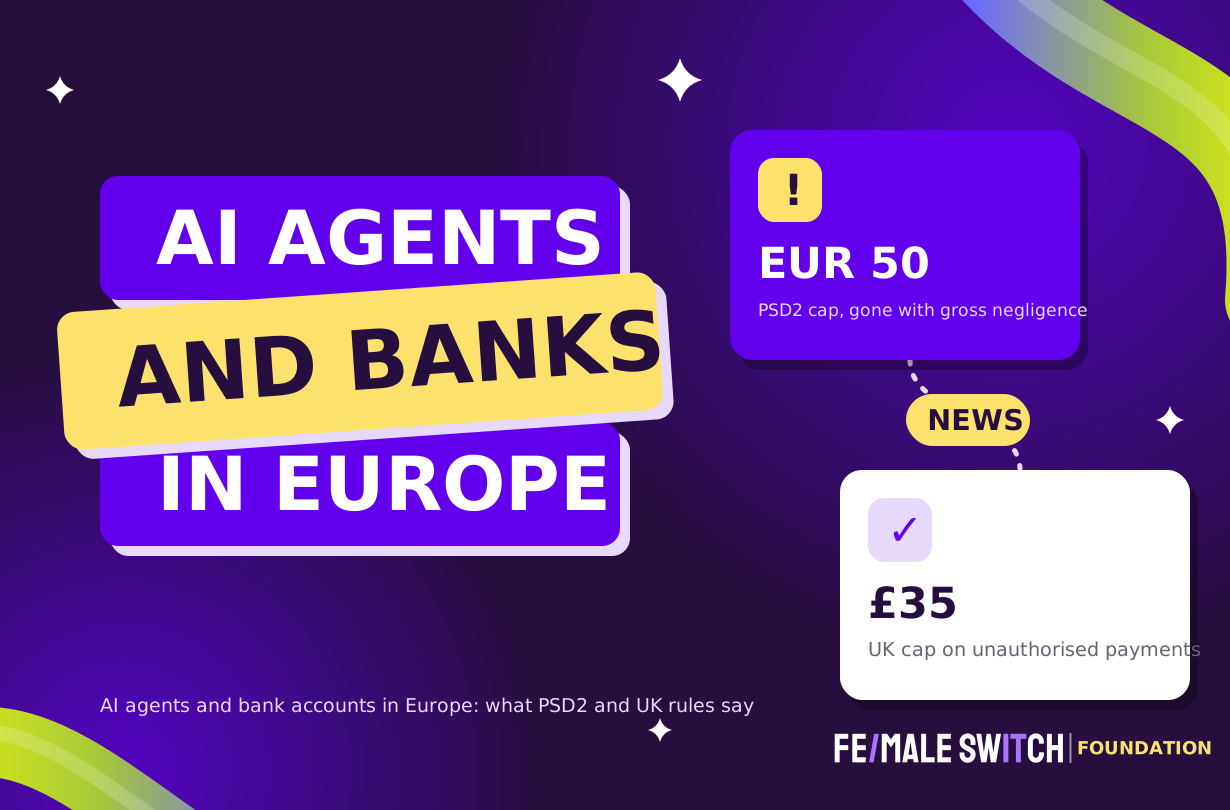
AI agents and bank accounts in Europe fall under PSD2: you must keep your bank login safe, and your loss on an unauthorised payment is capped at EUR 50, unless you acted with gross negligence. I found no court or regulator ruling yet on handing a login to an AI agent, so use licensed open banking and keep every payment approval with a human. The UK cap is £35.
Developing story. Last updated 24 Oct 2026, 14:17 CEST. The White House AI adviser wants US banks to give agents read-only access, close to what licensed open banking already does in Europe, and two Canadian bank chiefs now warn customers too. European banks and the EBA are still silent. We'll update this article as banks, the European Commission and the FCA publish more.
Here is why JPMorgan, Wells Fargo and Schwab are shutting AI agents out of US bank accounts on our sister site MeanCEO. This article covers the European side: PSD2, the UK rules and what to do this week.
What do we know so far about AI agents and bank accounts in Europe?
Update 24 Oct, 14:17 CEST: The White House AI adviser, David Sacks, weighed in on X, as CBS News reported on 23 October. He split "user-authorized agents (Muse, Instinct, Grokbot, etc.)" from truly rogue agents, said most of the activity in the US reports comes from customers sharing their logins, which "may violate bank terms", and called it "in no way cyberattacks". His proposal: banks give agents read-only access, while full write access with a customer's credentials "is a different risk category". European founders will recognise that split: PSD2 already separates read-only account information services (AISPs) from payment initiation, as the open banking section below explains. Canada's banks are saying the same. RBC chief executive Dave McKay told Bloomberg News on 20 October that blocking Meta's Muse is "something I'm thinking about, absolutely", and the next day BMO chief executive Darryl White told the Toronto Global Forum: "Don't give your banking username and password." CBC News has both. In Europe nothing has moved since yesterday: I found no new statement from ING, ABN AMRO, Revolut, bunq, N26, the EBA or the ECB, and no European launch date for Muse from Meta.
Update 23 Oct, 14:27 CEST: the UK moved first. In a speech at Mansion House on 22 October, FCA chief executive Nikhil Rathi called Meta Muse "one of the fastest-downloaded apps in US history" and said "such applications will reach UK consumers soon". He listed the UK digital regulators' cooperation on Meta Muse as one of the FCA's partnerships. The Information Commissioner's Office, the UK data protection regulator, has a call for evidence on agentic AI open until 20 November 2026, with sections on data security, transparency, accountability and automated decisions. In the US, Wells Fargo now says it has taken steps to block unauthorised agents. Still no word from ING, ABN AMRO, Revolut, bunq, N26, the EBA or the ECB.
- No European bank has spoken up yet. I found no statement on agent logins from ING, ABN AMRO, Revolut, bunq or N26, or from the EBA, the ECB or the Dutch central bank.
- The big personal agents aren't here. Meta's Muse launched on 8 September 2026 in the US only, and Selectra reported on 18 October that Meta still names no date for Europe. OpenAI's Dots skip ChatGPT Pro users in the EEA, Switzerland and the UK, and Claude Duet is US-only during its preview.
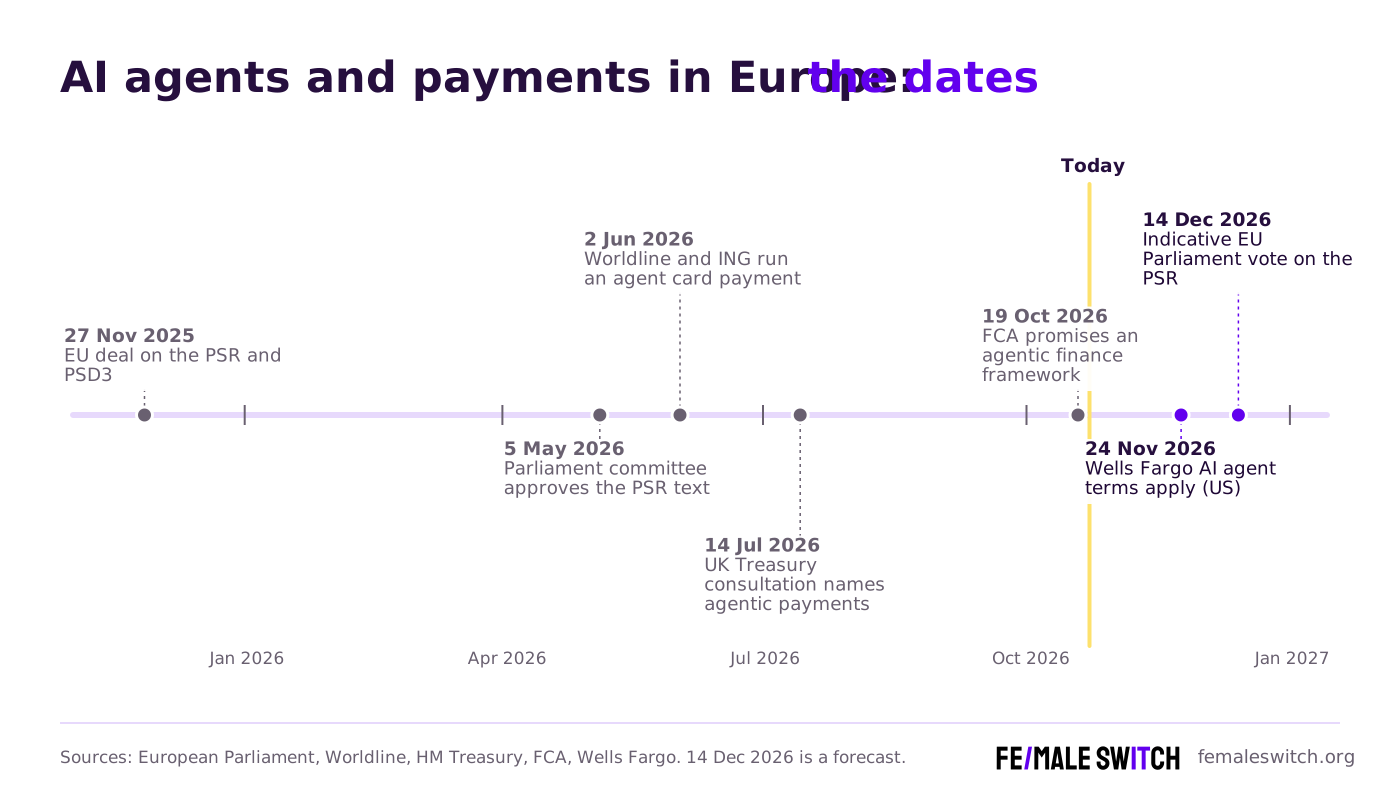
- European banks test agent payments inside the rules. On 2 June and 2 July 2026 Worldline and ING announced agent-driven card payments in the Netherlands and Germany, each completed only after the shopper approved it, the second with biometric Strong Customer Authentication (SCA).
- UK payment rules are under review. HM Treasury's consultation on payment services ran from 14 July to 6 October 2026 and names agentic payments.
- The EU's new payment law isn't final. The Payment Services Regulation (PSR) and PSD3 were agreed on 27 November 2025 and approved by the European Parliament's economic and monetary affairs committee on 5 May 2026. Both still await the Council's position, with an indicative plenary date of 14 December 2026.
What does PSD2 say about giving an AI agent your bank login?
PSD2, the EU's Payment Services Directive (2015/2366), has applied since 13 January 2018 and never mentions AI. Three rules decide who pays when a payment goes wrong:
- Your duty (Article 69): "take all reasonable steps to keep its personalised security credentials safe", meaning the login details, PINs and codes your bank gives you.
- Your cap (Article 74): for an unauthorised payment from a lost, stolen or misappropriated payment instrument, you carry at most EUR 50.
- The exception: you bear ALL the losses if you acted fraudulently or broke Article 69 "with intent or gross negligence".
Recital 72 describes gross negligence as "more than mere negligence", with the example of keeping credentials where third parties can easily find them. Whether handing your password to software that signs in as you fits that description is untested: I found no ruling from a court, a regulator or the EBA on AI agents, so count it as an open risk on your side.
There is a second trap. Under Article 64, a payment is authorised when you consented in the form agreed with your bank. If an agent signs in as you and pays, your bank can argue you consented through the agent, and the unauthorised-payment protections fall away. I found no ruling on this either.
Two rules help you. Under Article 72 the bank must bring evidence of gross negligence, and a log entry alone isn't enough. Article 73 requires a refund by the end of the next business day, unless the bank reports a fraud suspicion.
Why is licensed open banking safer than sharing your password?
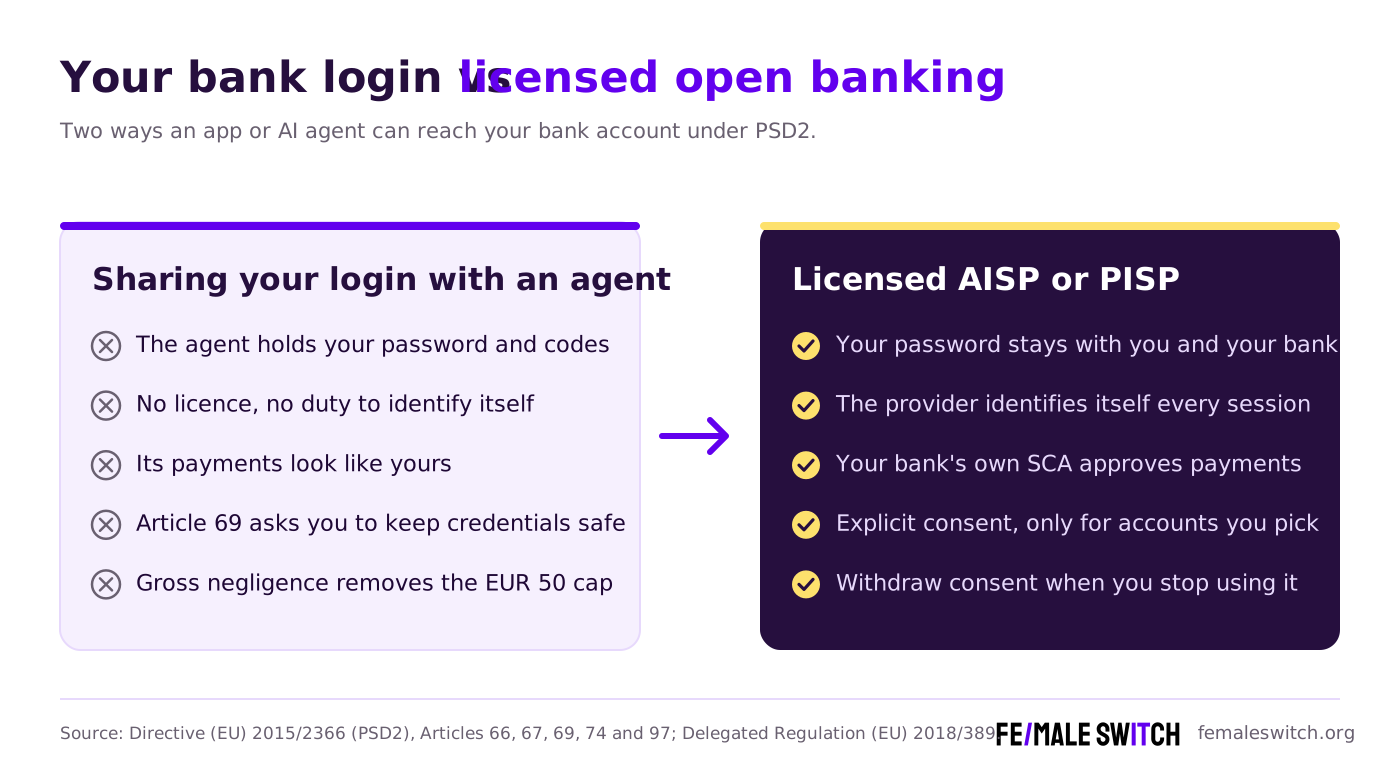
PSD2 already built a safe channel with two licensed roles. Account information service providers (AISPs) show your account data with your explicit consent, only for the accounts you pick. Payment initiation service providers (PISPs) start a payment at your request without holding your money or changing the amount or payee.
Both must keep your credentials out of other parties' reach and identify themselves to your bank. Since 14 September 2019, Delegated Regulation 2018/389 has required banks to give them an interface that uses the bank's own authentication, and even the fallback requires the provider to be identifiable and to log what it accessed. An agent typing your password into your banking website does none of that.
Who carries the risk in the US, the EU and the UK?
The US column comes from Regulation E and the new Wells Fargo terms covered in the MeanCEO hub.
The business-account row matters most for founders: PSD2's Article 61 lets a bank and a non-consumer switch off the EUR 50 cap and the bank's burden of proof. EU countries may protect microenterprises like consumers (under the Commission's SME definition: fewer than 10 staff and turnover or balance sheet of €2 million or less), and the UK does so by law. Our guide to setting up business banking helps when you choose an account.
What does the UK say about AI agents and payments?
- 21 April 2026: HM Treasury said it will look at how payment rules should adapt to payments made by AI agents.
- 30 June 2026: The Bank of England's deputy governor Sarah Breeden named open issues, including "how disputes are settled and liability assigned for erroneous or fraudulent transactions".
- 19 October 2026: The FCA's Jessica Rusu cited Meta's Muse and promised "a trusted framework for agentic finance", covering agent identity, delegated authority, accountability and execution.
- 22 October 2026: FCA chief executive Nikhil Rathi says personal agents like Meta Muse will reach UK consumers soon, and that UK regulators cooperate on Muse.
Breeden also said "relying on a human in the loop for all agent actions is unlikely to be realistic". Until new rules land, the £35 cap and the gross negligence test apply.
What don't we know yet?
- Whether handing an AI agent your banking login counts as gross negligence under PSD2 or the UK rules.
- How a payment an agent makes with your login will be treated: authorised by you, or unauthorised.
- What ING, ABN AMRO, Revolut, bunq, N26 and other European banks will allow.
- The date the PSR and PSD3 become law, and whether the final texts mention AI agents.
- Launch dates in Europe for Muse, Dots on ChatGPT Pro and Claude Duet.
- What the FCA framework and the Treasury's consultation response will contain, and what the ICO concludes after its agentic AI call for evidence closes on 20 November 2026.
What this means for you: how do you use AI agents without risking your bank account?
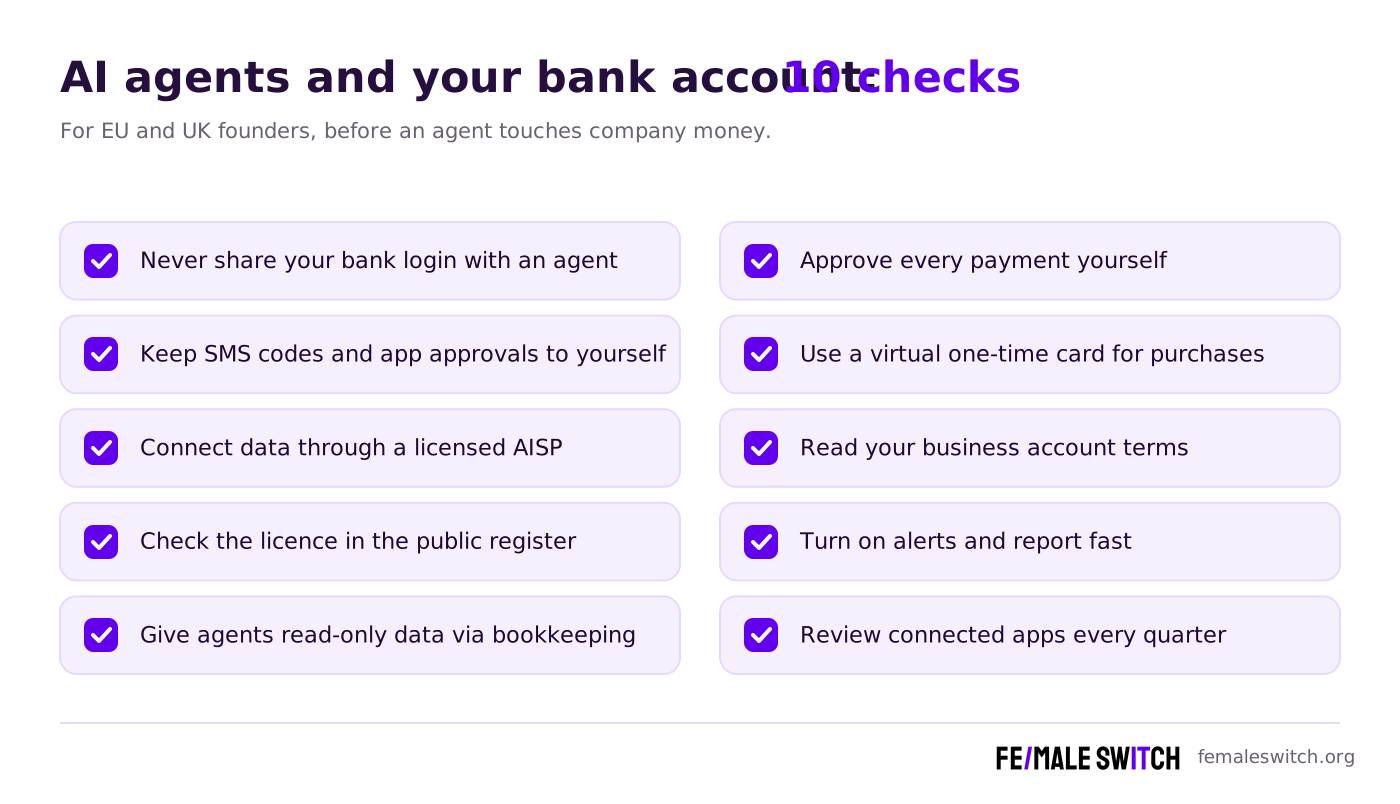
Next steps for your own accounts:
- Never give an AI agent your banking login, and keep SMS codes and app approvals to yourself. If a payment goes wrong, a shared password gives your bank an Article 69 argument against you.
- Use licensed open banking for data. Connect tools through a licensed AISP, and look the provider up in your national regulator's public register first.
- Feed agents read-only data through your bookkeeping tool. A bank feed in your accounting software gives an agent the numbers without your login. Our overview of financial management software for small startups compares the options.
- Keep money movement with a human. Article 97 ties SCA for online payments to the amount and the payee, so approve every prompt yourself. Even Anthropic's Claude Duet refuses to move money between accounts, with or without your approval.
- Give agents a virtual one-time card for purchases. Claude Duet pays through Link with a virtual card, so your real card number isn't shared. A low limit caps the damage.
- Read your business account terms for a non-consumer clause that switches off Articles 72 and 74, or UK regulations 75 and 77.
- Turn on alerts and report fast. After you notify your bank you bear no further losses, fraud aside, and you have at most 13 months from the debit date to claim. Our financial controls guide for startups has more controls to set up.
- Review connected apps every quarter and withdraw consents you no longer use.
For security habits, see our cybersecurity essentials for non-technical entrepreneurs, and if an agent reads customer payment data, our GDPR guide for European startups applies too. Our sister guide on who pays when an AI agent moves your money covers the small business side.
What should EU and UK founders watch next?
- PSR and PSD3: the Council's position, the Parliament vote and whether the final text mentions agents.
- The FCA's agentic finance framework, the Treasury's consultation response and the ICO's agentic AI call for evidence, which takes responses until 20 November 2026.
- Muse, Dots and Claude Duet launching in Europe.
- European bank terms. Wells Fargo's AI agent clause starts in the US on 24 November 2026. If European banks follow, it will show up in your online banking terms first.
Building your first startup on a budget?
The Fe/male Switch startup game takes you from idea to first paying customers in weekly quests, with an AI co-founder and a community of founders.
👉 Start the game
FAQ: AI agents and bank accounts in Europe
Can I give an AI agent my online banking password in the EU?
PSD2 doesn't mention AI agents, and Article 69 requires you to keep your credentials safe. Break that duty with gross negligence and you carry all losses, with no EUR 50 cap. Use a licensed open banking provider instead.
Who pays if an AI agent makes a wrong payment from my EU bank account?
Your bank refunds an unauthorised payment by the end of the next business day and can charge you at most EUR 50, unless you acted fraudulently or with gross negligence. I found no ruling yet on a payment made by an agent with your own login.
Are European banks blocking AI agents like US banks?
I found no public statement from ING, ABN AMRO, Revolut, bunq or N26 on agent logins as of 24 October 2026. ING has tested agent card payments with Worldline that keep the shopper's approval.
What is the UK liability cap for unauthorised payments?
£35 under regulation 77 of the Payment Services Regulations 2017, unless you acted fraudulently or broke your duty to keep credentials safe with intent or gross negligence. Micro-enterprises and charities keep this protection by law.
When will PSD3 and the Payment Services Regulation apply?
There is no date yet. Both await the Council's formal position, and the European Parliament lists 14 December 2026 as an indicative plenary date.
