
TL;DR: what did EU governments agree on EU Inc?
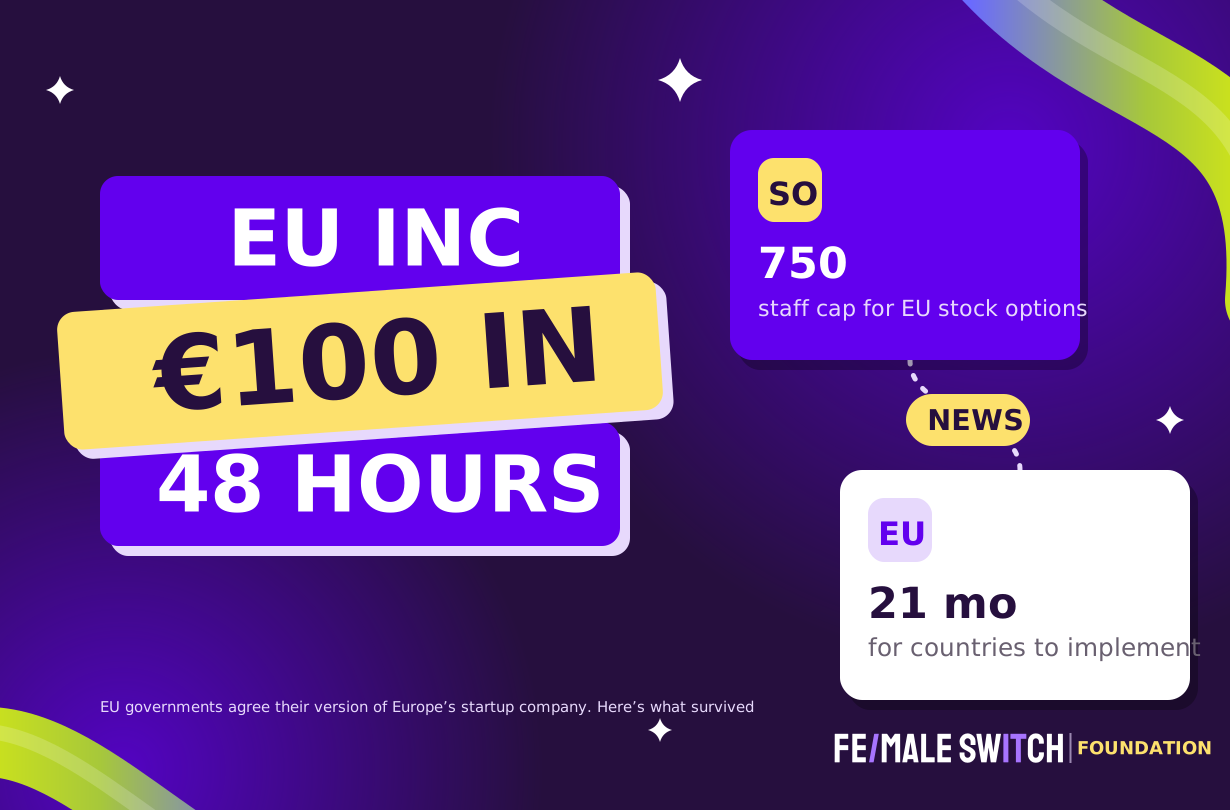
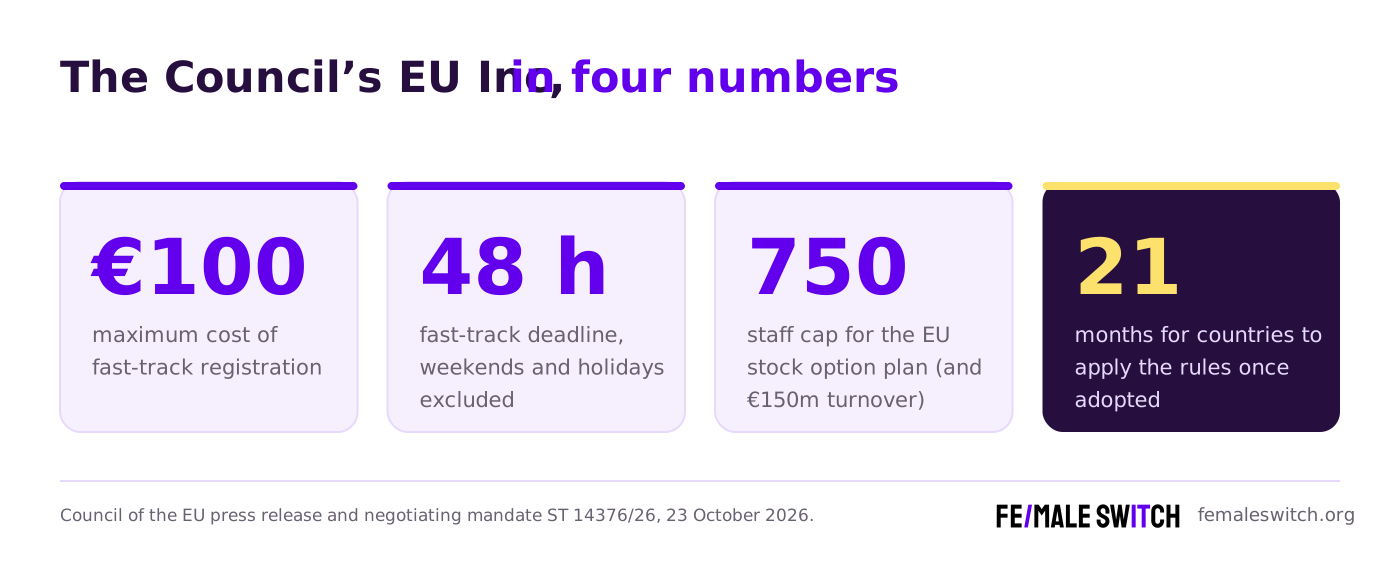
On 23 October 2026 the Council of the EU agreed its position on EU Inc, the planned optional European company form. The headline promise survived: register online within 48 hours (weekends and holidays excluded) for at most €100, using EU templates. But governments cut back the rest: EU stock options only for companies up to 750 staff and €150 million turnover, no central EU register, no insolvency chapter, and 21 months for countries to apply the rules. This is a negotiating position (Proposed), not law. Parliament still has to agree its own version, with a committee vote planned for 5 November. Background: our report on EU leaders’ year-end deadline for EU Inc.
A week ago, the founders behind the EU-INC campaign said the EU Inc they had fought for “no longer exists”. On Friday, EU governments answered with a deal of their own. It keeps the part most first-time founders care about, a cheap company you can set up online in two days, and trims much of what investors and fast-growing startups wanted.
Here’s what the Council actually agreed, what changed since the Commission’s proposal in March, and what it means if you are bootstrapping a company in Europe today.
What happened on 23 October
EU ambassadors confirmed the Council’s negotiating mandate on Friday 23 October. The Council’s press release says companies choosing the new “28th regime” will “be able to register online within just two days, at a maximum cost of €100” and operate across the single market as an “EU Inc.”.
Ireland, which holds the Council presidency, steered the deal. Taoiseach Micheál Martin called it “a measure that will make a real and practical difference to start-ups and SMEs looking to scale up across the EU”. Enterprise minister Peter Burke called it “a significant milestone”.
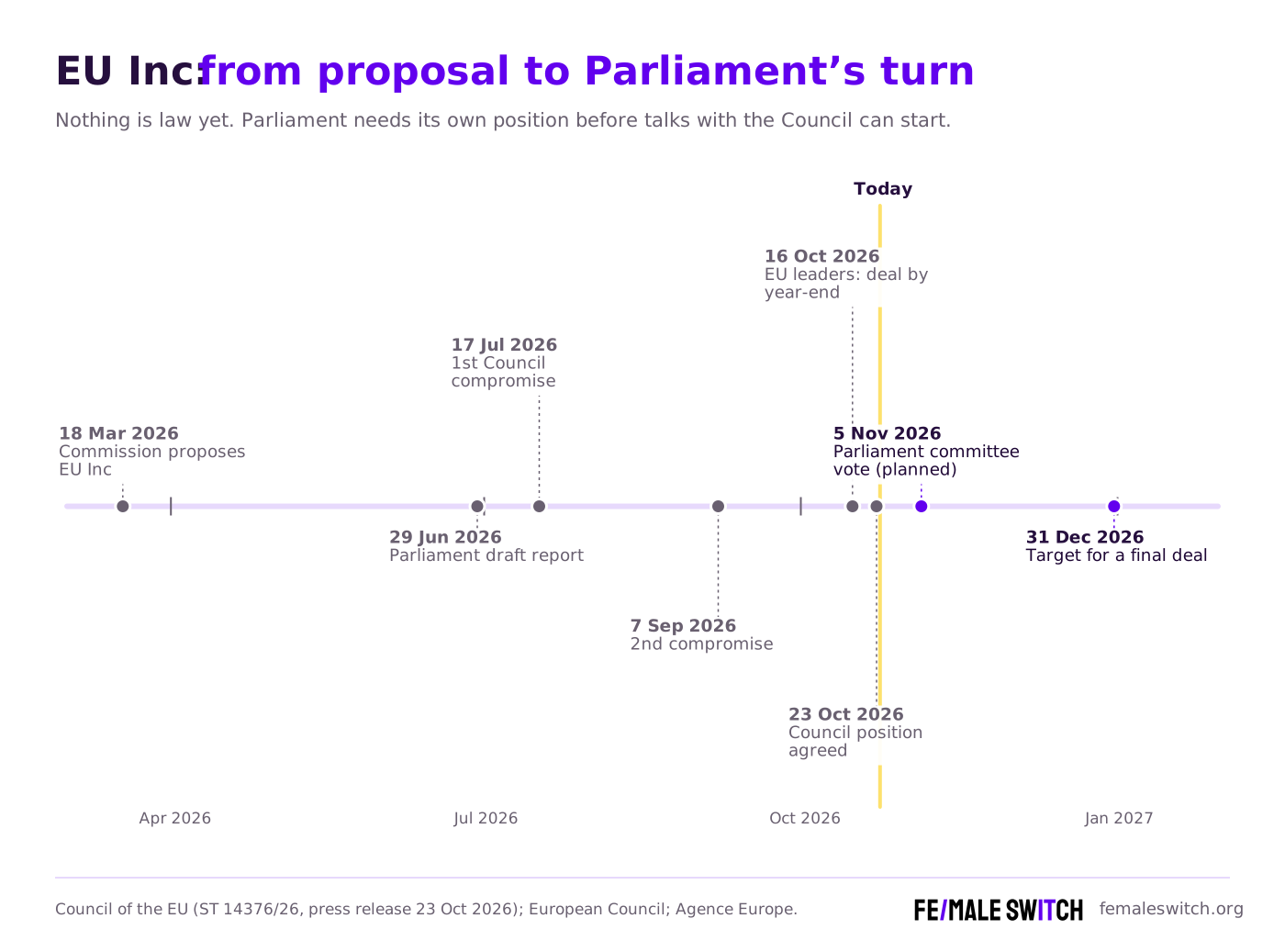
The mandate document (ST 14376/26) shows how the text got here. The Irish presidency published three compromise texts, on 17 July, 7 September and 16 October, before ambassadors signed off. The mandate lets the presidency negotiate with the European Parliament, but those talks “can start as soon as the Parliament adopts its position”. Status: Proposed.
What survived: the €100, 48-hour company
For a solo founder, the core of EU Inc is intact. The Council text describes two ways to register:
Source: Council negotiating mandate ST 14376/26, recital 22 and the formation articles. Two more founder-friendly points stay in the text. An EU Inc “should not be required to have a capital greater than EUR 0”. And countries may not demand “a notarial deed” for a share transfer to be valid; electronic signatures are enough. Germany’s Startup-Verband welcomed exactly that, Trending Topics reported.
Compare that with today. Germany’s Bundestag voted this month to allow GmbH share transfers by video call with a notary, from 2027. Under the Council’s EU Inc text, that transfer would need no notary at all.
What changed since the Commission’s proposal
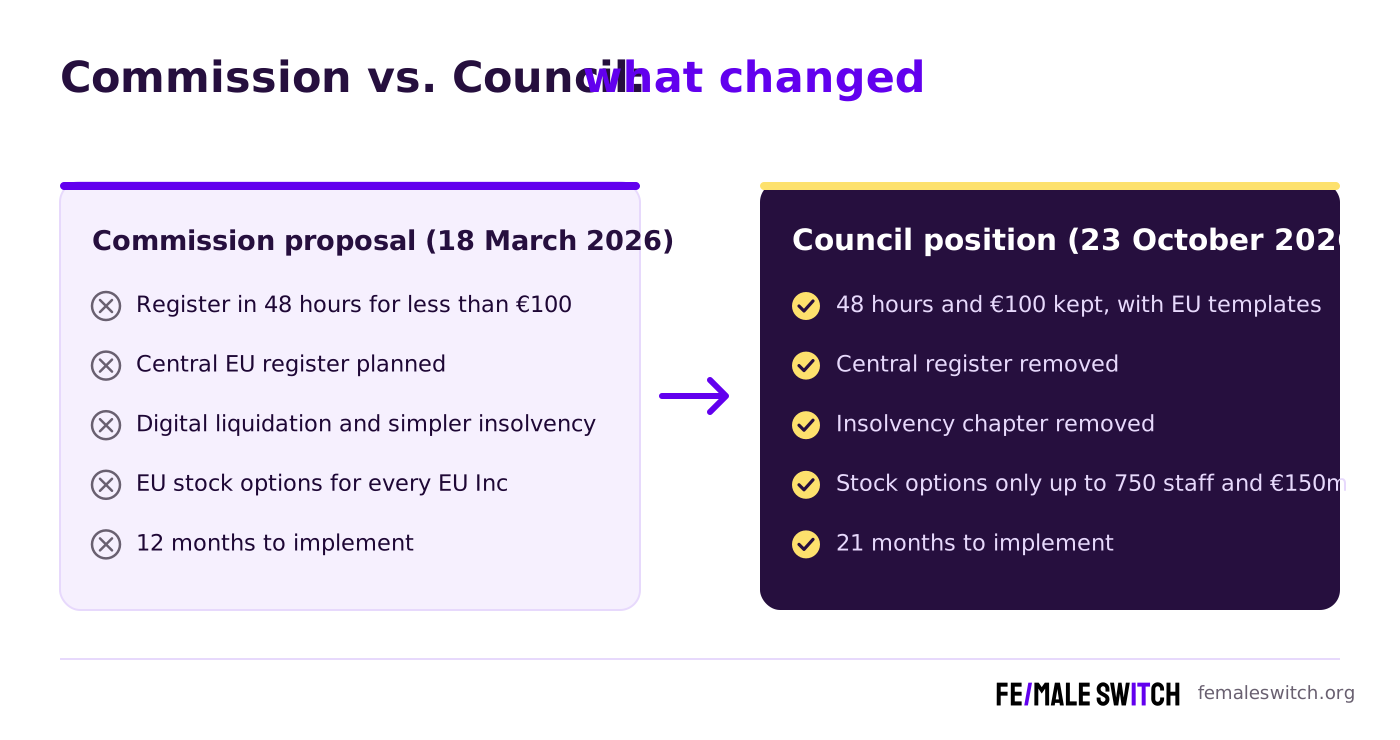
The Commission’s proposal of 18 March promised a company “within 48 hours, for less than €100 and with no minimum share capital requirements”, plus a central EU register, digital liquidation, simpler insolvency for innovative startups, and EU-wide stock options taxed only when sold. Governments kept the first part and rewrote much of the rest.
Sources: Commission press release IP/26/614; Council mandate ST 14376/26 and press release, 23 October 2026. The mandate also adds a new anti-abuse article (103a) on “wholly artificial arrangements” and lets authorities “stop the clock” on checks.
The stock option cap: who loses out?
Stock options were the part founders and investors pushed hardest for. In July, the presidency’s first compromise limited the EU plan to companies with fewer than 1,000 employees, EU-Startups reported. The final Council text goes further: “Small Mid-Caps, i.e. 750 employees and 150m EUR annual turnover”. It also removes a non-discrimination provision and protects national rules on anti-abuse, tax residency and exit tax.
Christoph Stresing of Germany’s Startup-Verband told Trending Topics that successful scale-ups cross the thresholds quickly and lose the advantage just when they need it most. Governments also attached a statement that agreeing to “narrow provisions affecting taxation” here is an exceptional case, not a precedent.
For most readers of this blog, the cap changes little in practice. A bootstrapped company with five or fifty people is far below 750 staff. What matters more is timing: you can’t use any of this until the rules apply, and until then employee equity runs through national schemes. Our guide to equity distribution in startups covers the basics.
When could you actually register an EU Inc?
Not soon. The Council gives member states 21 months to apply the regulation once it is adopted. Trending Topics notes the Commission had proposed 12 months and concludes EU Inc “would not be available before 2028, even if negotiations wrap up quickly”. That 2028 date is an estimate; it depends on when a final deal is reached and published.
Parliament is the next hurdle. Its legal affairs committee (rapporteur René Repasi) has struggled over employee participation. Its committee vote has been postponed twice (see our report on the first postponement) and is now planned for 5 November, according to Agence Europe. EU leaders asked both sides on 16 October to finish negotiations by the end of the year (Debated: a political target, not a legal deadline).
Who is unhappy, and why
- Startup campaigners: the EU-INC initiative wrote on 15 October that months of talks had “removed the core of the proposal”. Without a broad stock option solution, they argue, a US Delaware company would remain the better choice for many founders.
- Trade unions: the European Trade Union Confederation protested in Brussels in September, fearing companies could use EU Inc to get around national labour and social standards, according to Trending Topics.
- Notaries: they lobbied heavily before the decision, warning of straw-man companies and money laundering. The new right to refuse registration answers part of that.
- Lobbying volume: Trending Topics counted more than 300 lobby meetings on EU Inc, led by startups (at least 79), unions (at least 52) and notaries (at least 37).
Status of each of these positions: Debated. Only the Council text is a formal position so far.
What this means for you
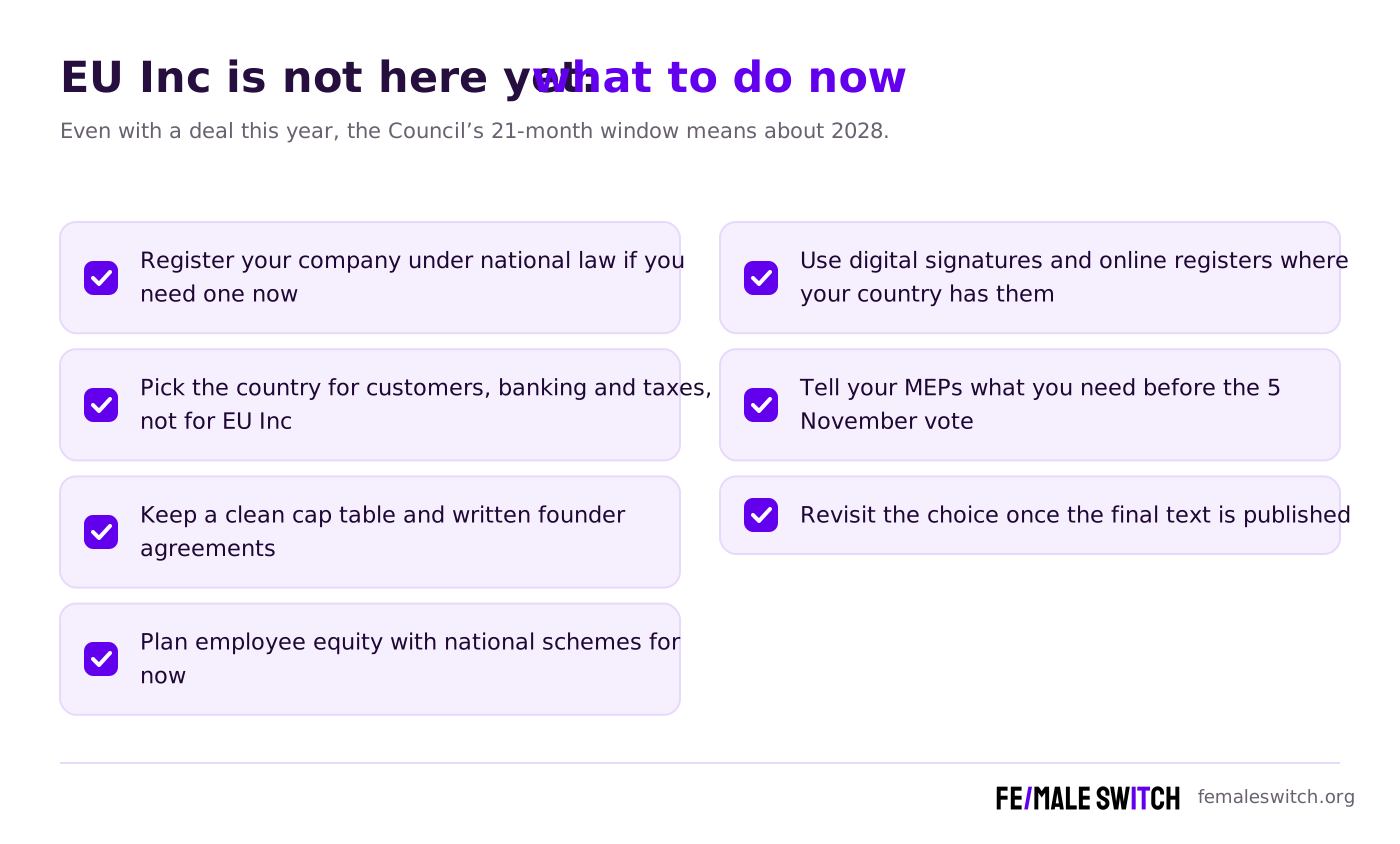
If you are starting or running a small company in Europe, EU Inc is worth following, but not worth waiting for.
- Don’t delay your company for EU Inc. If you need a legal entity now, for invoices, a bank account or a grant, register under national law. Our legal basics for founders in the Netherlands show what that involves in one country; most of Europe offers a cheap private limited company or sole trader option.
- Choose your country for today’s reasons. Customers, banking, taxes and language should drive the choice. EU Inc may later make cross-border expansion easier; until then, our guide to expanding across Europe covers the practical steps.
- Keep your paperwork clean. A clear cap table, signed founder agreements and digital records will make any later move into a new company form much simpler.
- Plan staff equity with what exists. The EU stock option plan, even capped, is years away. Use national schemes or simple profit-sharing for your first hires.
- Solo founders gain the most from the €100 track. Three in four new European companies are now founded by one person, per Cherry Ventures data in our report on solo founders in Europe. A template-based, online, €0-capital company is designed for exactly that profile.
- Have your say before 5 November. MEPs are still writing Parliament’s position. If notary-free transfers, €0 capital or stock options matter to you, tell your MEPs, or support groups that speak for small founders. See our overview of EU policy changes that affect women founders.
Want to practise setting up and running a company before you register one?
The Fe/male Switch startup game takes you from idea to first paying customers in weekly quests, with an AI co-founder, so you make the big early decisions (legal form, pricing, first sales) in a safe space first.
👉 Start the game
What to watch next
- 5 November: Parliament’s legal affairs committee vote, and whether employee participation is settled.
- Plenary: after the committee vote, Parliament still has to confirm its negotiating mandate before talks with the Council can start.
- Trilogues: whether the stock option cap, the central register and insolvency come back in negotiations.
- End of 2026: whether the EU meets its own target for a political deal.
FAQ: EU Inc after the Council’s position
What is EU Inc?
EU Inc is a proposed optional European company form, the so-called 28th regime. Founders could choose it instead of one of the 27 national company laws and use one set of corporate rules across the EU single market.
How much will it cost to register an EU Inc?
Under the Council’s position, the fast-track registration with EU templates costs at most €100 and must be completed within 48 hours, excluding weekends and public holidays. The standard track takes up to 5 working days.
Does an EU Inc need minimum share capital?
No. The Council text keeps the Commission’s idea that an EU Inc should not need capital above €0.
Is EU Inc law now?
No. The Council agreed its negotiating position on 23 October 2026. Parliament must adopt its own position, then both sides negotiate a final text. Even then, countries would get 21 months to apply it under the Council’s version.
When can I set up an EU Inc?
Probably not before 2028, according to an estimate by Trending Topics based on the Council’s 21-month implementation period. The exact date depends on when a final deal is adopted.
Will EU Inc companies get EU stock options?
Under the Council’s position, yes, but only companies with up to 750 employees and €150 million annual turnover can use the EU employee stock option plan. Parliament may still push for a different scope.
