
TL;DR: what does Cherry Ventures' Heartbeat report say about European founders?
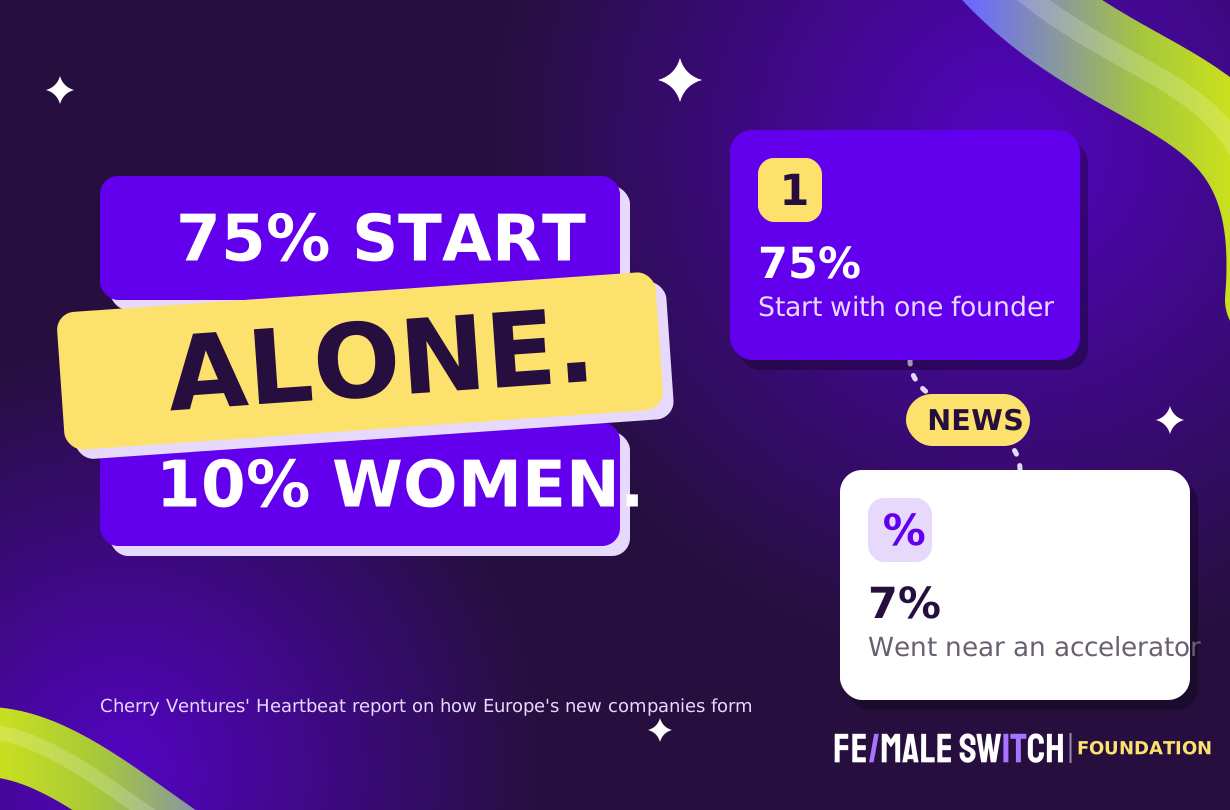
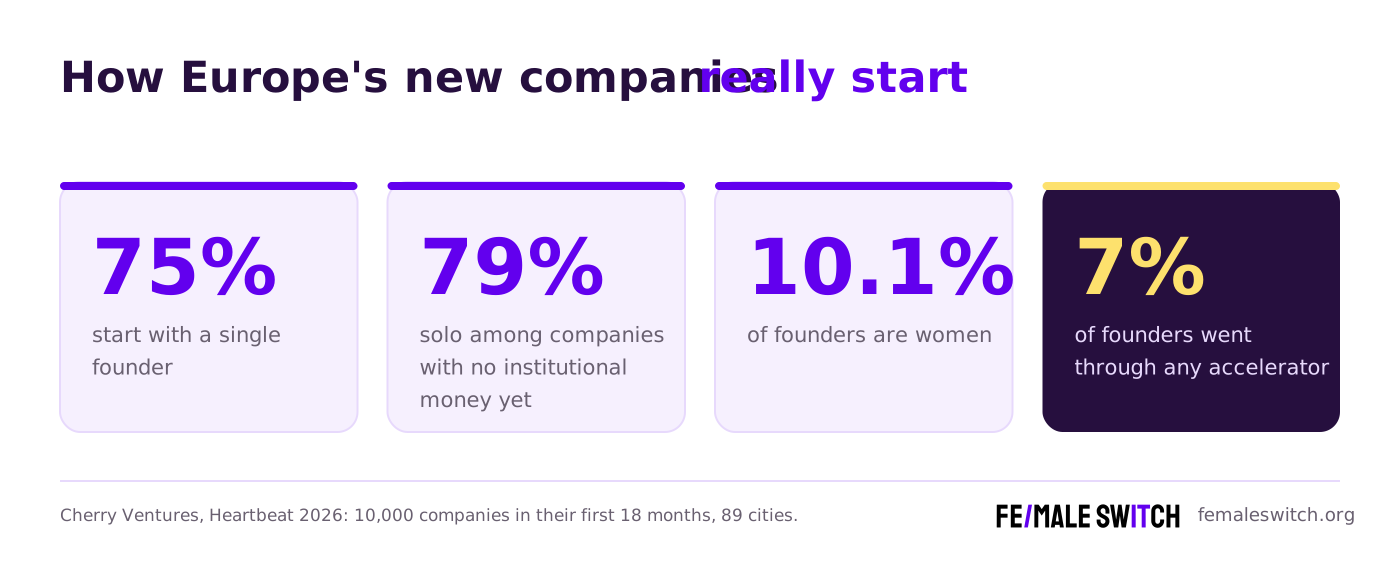
Heartbeat, a new report from Berlin VC Cherry Ventures, tracked 10,000 European companies in their first 18 months, both bootstrapped and VC-funded, across 89 cities. 75% start with a single founder, rising to 79% among companies that haven't raised institutional money. Only 7% of founders have been through any accelerator. Women are just 10.1% of founders, 7.5% in AI and 16.6% in health. If you're building alone and bootstrapping, you're not an outlier: you're the European norm. Here's what the data says and what to do with it.
For years, the startup world has told you to find a co-founder, join an accelerator and raise a round. A new dataset suggests most of Europe's new founders do none of these things.
Cherry Ventures' Heartbeat report looks at the layer most startup data misses: companies in their first 18 months, before they turn up in a funding database or on a demo-day list. What it found should change how you think about starting alone, and about where women founders stand.
What happened
On 13 October 2026, Trending Topics reported on Heartbeat, a new report by Cherry Ventures, the Berlin-based early-stage VC firm. The investors tracked 10,000 companies with 10,000 founders in 89 European cities, which together raised more than €5 billion. The sample covers all industries and includes bootstrapped as well as venture-backed companies.
To count only the formation stage, Cherry looked back no more than 18 months from each company's founding and included companies with at most one institutional round. The data comes from the firm's own dealflow, cross-checked against Crunchbase, Dealroom, Harmonic and Evertrace.
The report's summary is blunt. "Starting a company in Europe has got cheaper, so companies are starting smaller," Cherry writes. Its typical European founder "is likely male, starts by themselves and holds a Master's".
Finding 1: three in four founders start alone
Of every 100 new companies in the sample, 75 have one founder, 19 have two and only 6 have three or more. The split depends on money:
Sources: Cherry Ventures, Heartbeat 2026. Base: 6,978 companies with founder records.
"The 'minimum viable company' has shrunk," the report says. "Most of the institutions around them still assume a team of three." Cherry credits cheaper tools and AI-assisted building for turning the single founder from a stage a company passes through into, for much of the sample, "the company itself".
There's a catch, and the report names it: this is a snapshot at formation. Some solo founders will add a co-founder within six months. And funded companies are far less likely to be solo (46%), which says something about who investors back. If you're weighing the choice, our guide to solo founder vs co-founder walks through the trade-offs.
Finding 2: women are 10.1% of founders, and the 13% figure means something else
Women account for 10.1% of the founders in the sample. The share depends heavily on the field:
- AI applications: 7.5% women, the lowest of any large category, even though AI-first software is now the biggest category of all.
- Health: 16.6% women, the highest.
Cherry's explanation: "Where a credential is the gate, more women get through. Where a network is the gate, fewer do."
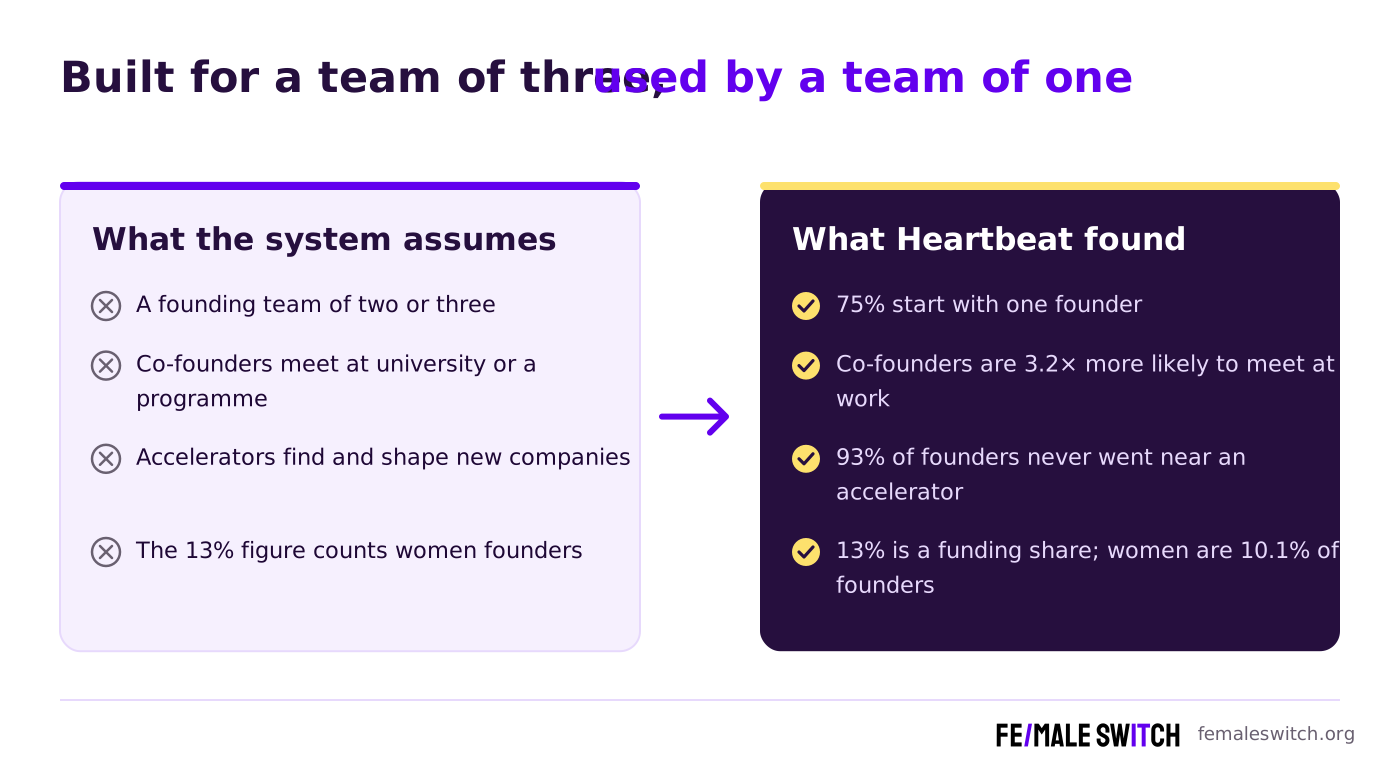
The report also corrects a number you've probably seen many times. The 13% that is usually quoted is the share of European venture funding that goes to companies with at least one female founder. That counts money, not people. Heartbeat counts people, and the people count is lower.
This fits what other data shows. Last week's GEM Women's Entrepreneurship Report found women start businesses at nearly the same rate as men but rarely reach the scale stage. For the funding side, see our female founder statistics for Europe.
Finding 3: 93% never went near an accelerator
Of the 10,000 founders, 657 had any accelerator affiliation: 7%. Y Combinator accounts for 185 of them and Antler for 58. Most startup coverage begins when a company joins a cohort or does a demo day, which means the other 93% stay invisible to it for a long time.
Where a second founder does appear, the two usually met at work. Co-founders were 3.2 times more likely to share a former employer than a university (257 pairs against 80). McKinsey produced the most founding pairs (7), followed by Cambridge, TU Munich, ETH Zurich and Imperial College London (5 each), then Meta and Google (4 each). "Europe's large employers are running its most effective co-founder matching scheme entirely by accident," the report says.
Founders also hold Master's degrees 4.3 times as often as MBAs. In deeptech, PhDs outnumber MBAs almost ten to one.
Finding 4: AI has overtaken SaaS, and Amsterdam leads per head
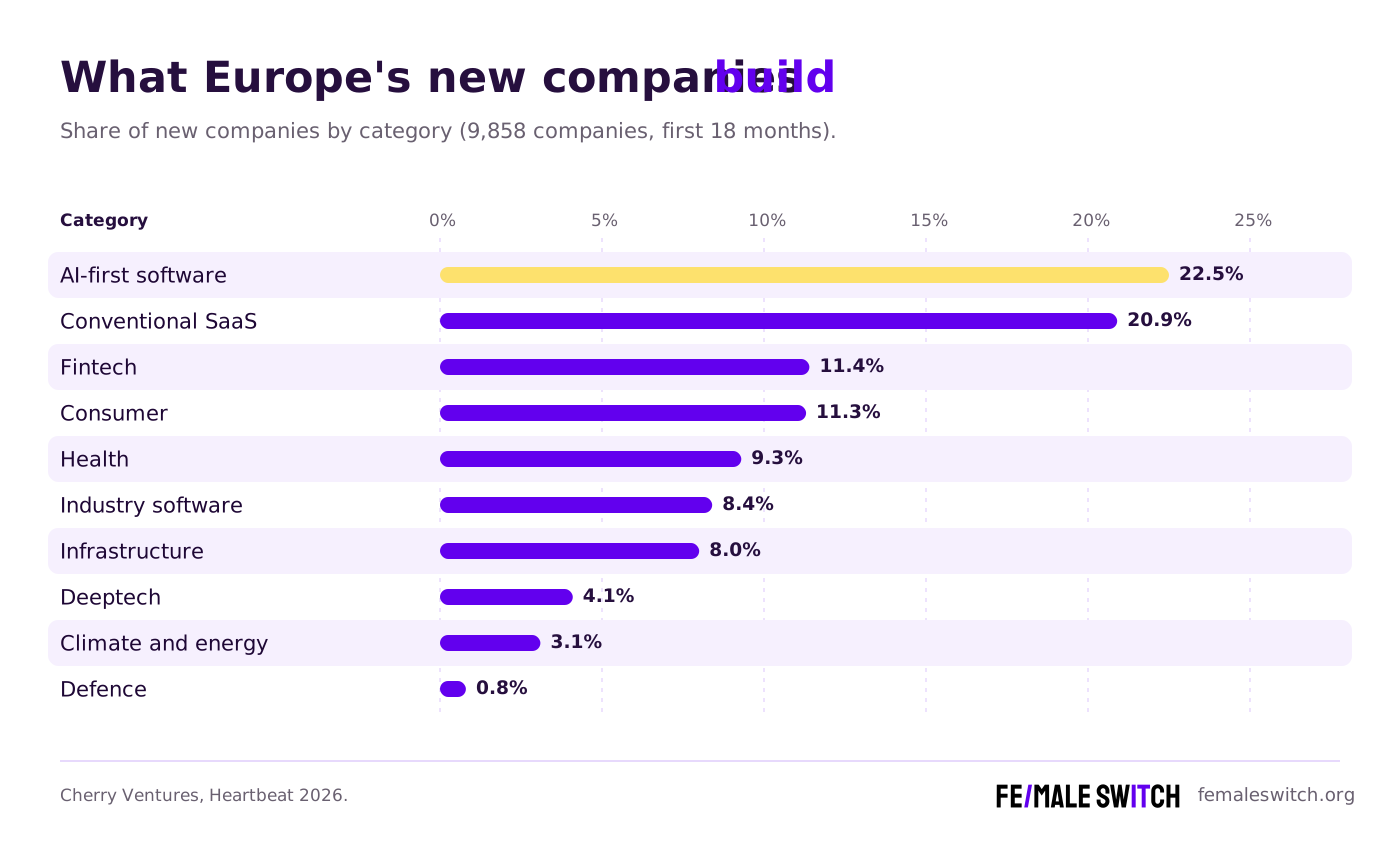
AI-first software is now the largest category of new companies at 22.5%, just ahead of conventional SaaS at 20.9%. Cherry notes that both build for the same jobs (sales, hiring, legal work, analytics), and sales and marketing software is the biggest group in each. Defence, despite record investment, is only 0.8% of new companies.
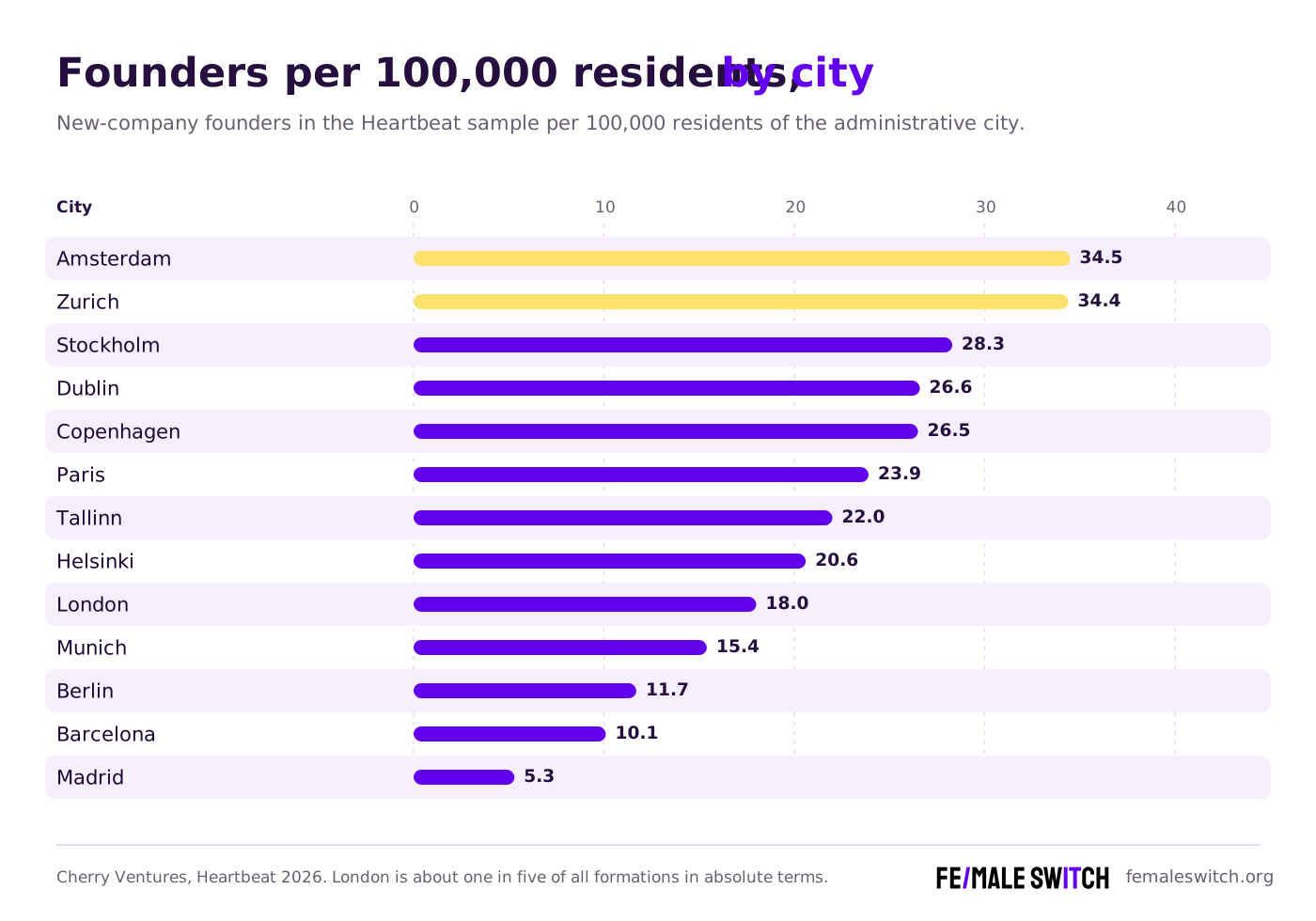
Measured against population, Amsterdam (34.5 founders per 100,000 residents) and Zurich (34.4) lead Europe, about twice London's rate (18.0) and three times Berlin's (11.7). London is still the biggest hub in absolute terms, with about one in five of all new companies. Munich forms climate companies at nearly twice the European rate and hardware companies at about twice the rate.
Finding 5: where you studied changes the cheque
Heartbeat also traced founders moving between Europe and the US. Of the San Francisco founders in the sample with a university record, 72% were educated in Europe, and 29 of the 44 funded San Francisco companies raised exactly $126,225, the standard accelerator cheque. In the other direction, 86 founders building in Europe were educated in the US.
Source: Cherry Ventures, Heartbeat 2026 (founders building in Europe).
Funding rates differ just as sharply: 56.4% of the San Francisco cohort had raised money, against 11.2% of companies in Europe. In other words, close to nine in ten of Europe's new companies haven't raised yet, which is why Europe's Q3 2026 VC numbers tell only part of the story.
What this means for you
If you're starting alone, without investors, Heartbeat says you're in the majority. The question is how to make that work on purpose rather than by default.
- Stop waiting for a co-founder. Three in four founders start alone. Build the first version, find the first customers, and add a partner later if the work needs one. Here's how to bootstrap as a female founder.
- Build systems, not a team. A solo company survives on routines, templates and automation. Start with building systems when you're the only employee.
- Look at work for co-founders, not events. If you do want a partner, the data says former colleagues are your best pool. Our guide on how to find a co-founder as a woman covers how to approach them.
- You don't need an accelerator to be real. 93% of founders never joined one. Apply if a programme fits, but don't treat a rejection as a verdict.
- Credentials help women get in. Women's share is highest where a qualification is the entry ticket (health, 16.6%) and lowest where networks decide (AI, 7.5%). If you're entering a network-driven field, build that network deliberately and early.
- Use the right number. When you pitch or write about the gap, say "women are about 10% of new European founders" and "companies with a female founder get about 13% of VC funding". They measure different things.
For the rules that shape where you register a solo company, see our update on the EU Inc vote.
Starting alone? Get a co-founder that never sleeps
The Fe/male Switch startup game takes you from idea to first paying customers in weekly quests, with an AI co-founder and a community of founders.
👉 Start the game
FAQ: the Heartbeat report and solo founders in Europe
What is Cherry Ventures' Heartbeat report?
Heartbeat is a 2026 report by Berlin VC Cherry Ventures on how European companies form. It tracks 10,000 companies in their first 18 months, with 10,000 founders across 89 cities, including bootstrapped and VC-funded companies.
How many European startups have a single founder?
75% of the companies in the sample start with one founder, 19% with two and 6% with three or more. Among companies with no institutional money yet, 79% are solo; after a first round, 46% are.
What share of European founders are women?
Women are 10.1% of the founders in the Heartbeat sample: 7.5% in AI applications and 16.6% in health.
Is it true that 13% of European founders are women?
No. According to Cherry Ventures, the 13% usually quoted is the share of European venture funding going to companies with a female founder. It measures money, not people.
Do most founders go through an accelerator?
No. Only 657 of the 10,000 founders (7%) had any accelerator affiliation. Y Combinator accounted for 185 and Antler for 58.
What are the limits of the Heartbeat data?
It is a snapshot at formation, so some solo founders will add co-founders later. It comes from one VC firm's dealflow, cross-checked against public databases, so companies that never appear in that dealflow are missing.
