
TL;DR: Why are founders leaving Europe, and what does EU Inc have to do with it?
Founders leaving Europe are few, and they are the ones Europe can least afford to lose: 3.3-4.3% of VC-backed startups relocate abroad, mostly to the US, says the European Commission's Joint Research Centre (JRC). EU Inc, the single European company form promised since 2024, was meant to keep them. EU governments cut its central register and insolvency chapter in October 2026, and on 19 November its own champions asked for its withdrawal. My view: the process is a fiasco, and ambitious founders read it as a message about Europe.
Here is what happened at Slush and what the Council cut from EU Inc, on our sister site MeanCEO. Below is my opinion on what the saga tells founders, backed by data.
Why are founders leaving Europe?
I have lived, studied and built companies in several European countries, the Netherlands and Malta among them, and I have written EU, Dutch and Maltese grant applications. I chose to stay. I also understand every founder who left, because Europe makes you rebuild your company's paperwork each time you cross a border.
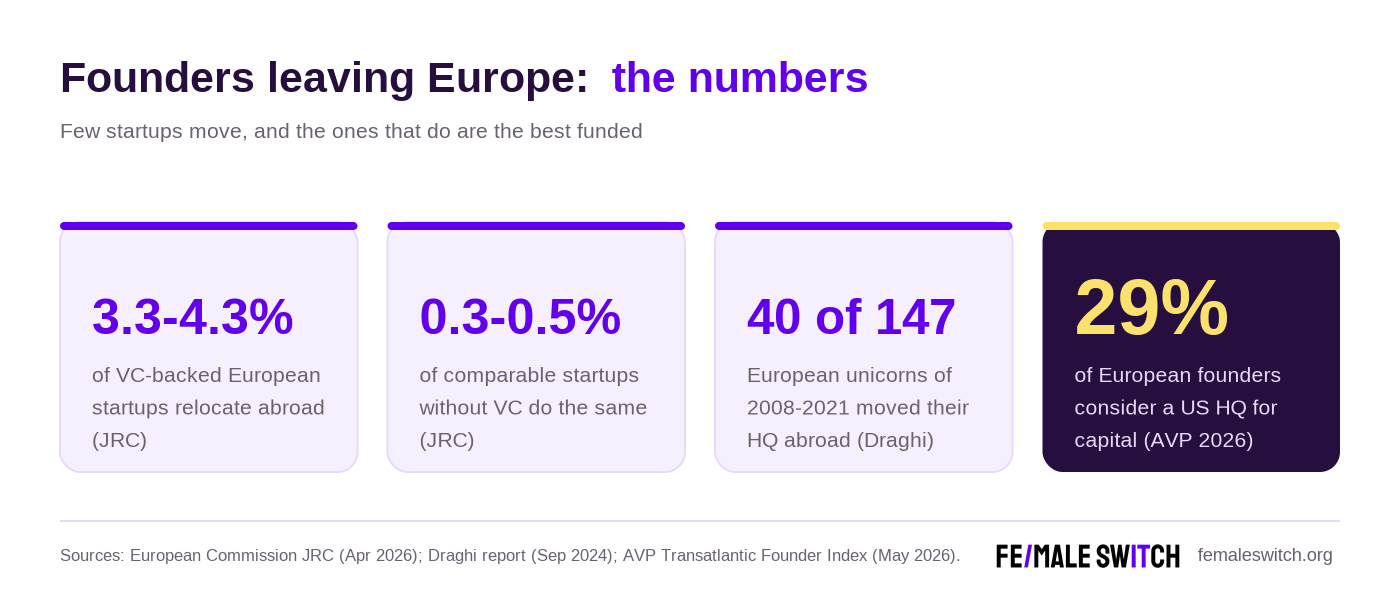
Mario Draghi's report on European competitiveness (September 2024) counted 147 unicorns founded in Europe between 2008 and 2021; 40 moved their headquarters abroad, "with the vast majority moving to the US". Companies that want to scale up here meet "inconsistent and restrictive regulations" at every stage, he wrote, and the EU raises just 5% of global VC funds, against 52% in the US.
Founders feel it. In the AVP 2026 Transatlantic Founder Index (27 May 2026, 100+ founders), 29% of European founders said they were considering a US headquarters to improve access to capital. They rated that access 5.5 out of 10; US founders gave it 7.7.
Atomico's State of European Tech 2025 survey found that about 15% of founders have moved their headquarters and another 42% considered it and stayed. More than 60% of them named access to capital as the main reason.
How does building a startup in Europe compare with the US in 2026?
Here is the gap in five verified numbers:
Europe has the founders. Atomico's 2026 report counts a record of about 40,000 new tech founders this year and $81bn invested, reported by tech.eu. Atomico's Tom Wehmeier: "Nothing is missing - the capital, talent and demand are all here, but they're locked or misallocated."
What did EU Inc promise, and what is left?
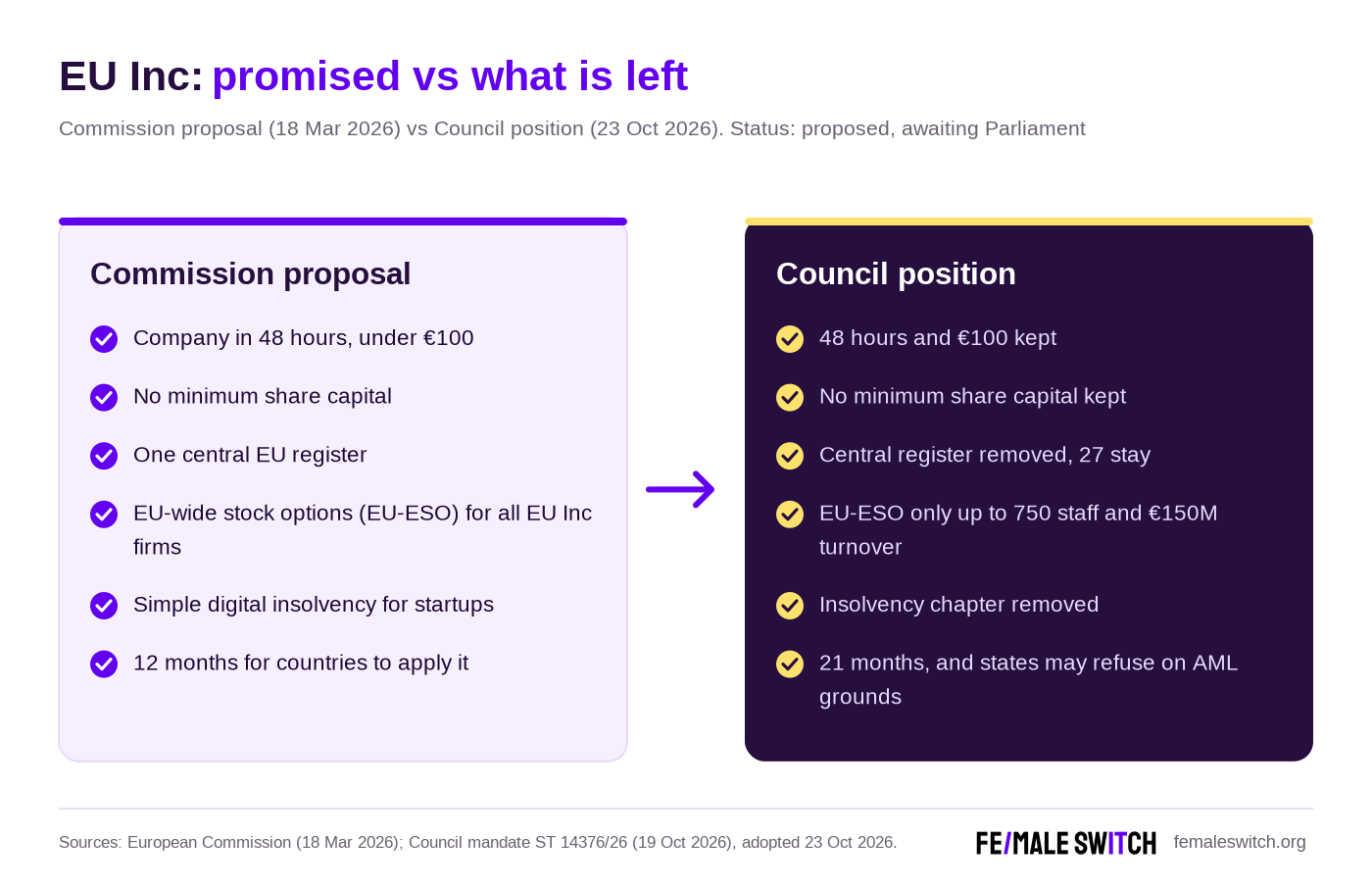
Enrico Letta asked for a European code of business law in April 2024, and Draghi suggested a voluntary 28th company rulebook that September. After the EU Startup and Scaleup Strategy of 28 May 2025, the proposal came on 18 March 2026: a company in 48 hours for under €100, no minimum capital, one central register, EU-wide stock options and a simple digital insolvency procedure.
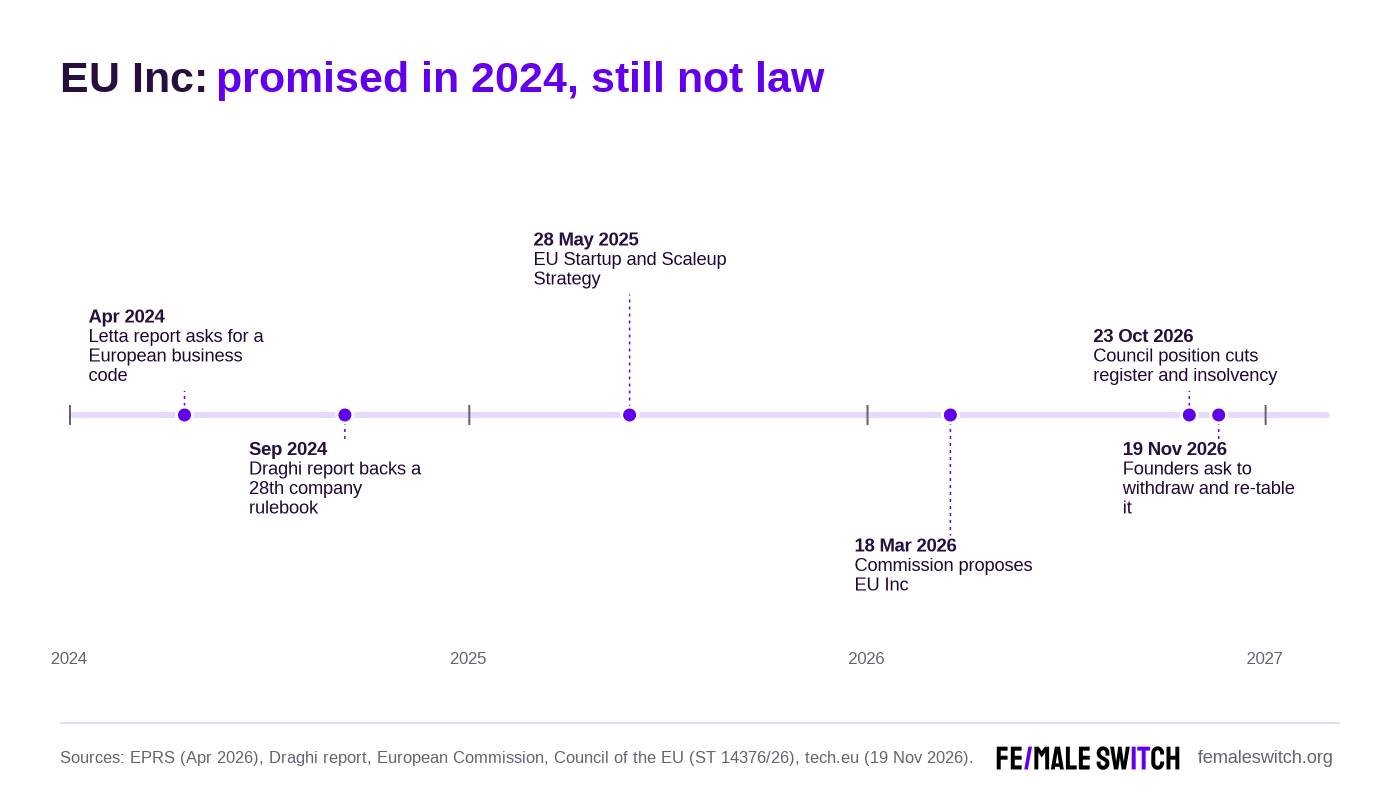
Then national governments rewrote it. The Council's negotiating mandate (adopted 23 October 2026) removed "the central register and the requirement for real-time tracking", deleted the insolvency chapter, limited EU stock options to companies with up to 750 employees and €150M turnover, let states refuse registration on money-laundering grounds and gave them 21 months to apply the rules. Details in our posts on the Council position, the postponed Parliament vote and the year-end deadline.
On 19 November at Slush, EU-INC and Startups for Europe asked Ursula von der Leyen to withdraw and re-table the proposal, tech.eu reported. Andreas Klinger of EU-INC: "Founders don't need a European regulation that delivers on paper but fails in practice." Status: Proposed. Parliament has not voted, and final talks can't start before it does.
My view, stated plainly: two years of reports, strategies and summits produced a text that keeps the cheap registration and drops the parts that make a company truly European. The cuts leave registers, insolvency courts and the tax treatment of stock options in national hands. Each choice can be defended on its own. Together they tell a founder that Europe still thinks in 27 pieces.
Who actually leaves Europe?
Honesty first: most startups stay. The JRC study "Is Europe losing its startups?" (7 April 2026) puts the relocation rate at 3.3-4.3% for VC-backed startups and 0.3-0.5% for comparable firms without VC. 97% of relocating VC-backed companies keep operations in Europe, and about three quarters of their CEOs physically move.
Look at who those 3-4% are. A second JRC study (September 2026) found that ventures that moved to the US obtained more VC and were more likely to exit through an acquisition. In Atomico's 2025 survey about 23% of Series B+ founders had moved, against one in ten first-time or bootstrapped founders, and the share of seasoned European founders with a US headquarters rose from 10% in 2016 to 18% in 2025.
The European Investment Bank's interviews with 91 founders and executives show how it works. Of the companies that moved, 55 went to the US and 13 to the UK, all of them partially: a US holding or a flip on top, engineers still in Europe. They named capital, large unified markets, simpler rules and sales talent, and many said they "would have preferred to stay".
Accelerators now build the move in: Entrepreneurs First's The Bridge offers European early-stage founders an eight-week residency in the San Francisco Bay Area, first cohort set for April 2026. So when I say ambitious founders leave and don't look back, I mean this: the engineers stay in Europe, while the holding, the board and the upside move to the US.
Some come back, at a price. Berlin's Langdock dismantled its US holding and became a German-registered SE for several million euros, Euronews reported in September 2026.
What does it cost a small founder to work across 27 countries?
The Commission counts 27 national legal systems and more than 60 company legal forms, and says setting up a company can take weeks or even months. The entry ticket:
Germany's minimum comes from §5 of the GmbH Act, and registration is the cheap part. Hire a developer abroad and you take on that country's payroll, social security and labour law. Sell to consumers across borders above €10,000 and VAT moves to the customer's country, though the One-Stop Shop (OSS) lets you declare it in one place (Adopted). Stock options are taxed country by country, and the Council text protects national exit tax rules. Our guides on bootstrapping costs in Europe and the startup legal checklist by country have the details.
What did building across Europe teach me?
Moving between EU countries never felt like moving within one market. Each move meant a new company register, a new accountant and new tax deadlines, and every grant programme I applied to had its own eligibility and reporting rules. Each step is doable, and each one eats time a small team should spend on customers. A founder with no lawyer on staff gains the most from one register and one stock option scheme, and the Council's version gives small founders a cheap start and little after it.
What does Europe still do well for founders?
The counter-arguments are real:
- Most founders build here. More than 80% build from Europe, and the share of all European founders with a US headquarters slipped from 10% in 2016 to 8% in 2025 (Atomico).
- The talent is good and affordable. Relocated founders told the EIB they were satisfied with European technical talent, so they keep engineers here.
- EU Inc's base survived. 48 hours, a €100 cap, no minimum capital and stock options under 750 staff remain in the Council text.
- The money is coming, slowly. The Scaleup Europe Fund targets €5 billion. At Slush, Johannes Reck, one of 35+ tech leaders behind a joint declaration, said: "We chose to build in Europe, and we are ready to double down."
What would make founders stay in Europe?
- One central register. It was in the Commission's text; put it back. (Proposed, then cut.)
- EU-wide stock options without a 750-employee cap. Companies need them most once they pass that size. (Proposed, now capped.)
- A digital insolvency procedure. Fast failure makes fast founding safe. (Proposed, then cut.)
- One payroll and social security filing point for small cross-border teams, on the VAT One-Stop Shop model. (Debated, no legal text.)
- A date for the Parliament's legal affairs (JURI) committee vote. Our grant-grants.com overview of which EU rules for startups are being relaxed tracks the rest.
Before you move your parent company, check the funding cost: our sister site explains what a Delaware flip does to your EU grants, including the EIC Fund rule on where the company receiving its equity has to be based.
What this means for you
- Incorporate now in a national form. EU Inc registrations are years away. See how to pick your first jurisdiction in Europe.
- Choose your country on capital and formalities. €25,000 for a GmbH or €0.01 for a BV matters to a bootstrapped founder.
- Keep your structure portable. A clean cap table, standard documents and IP owned by the company make any later move cheaper. Read our guide to equity and stock option plans.
- Decide on a Delaware flip with your eyes open. The EIB warns a flip can trigger capital gains tax for existing shareholders. Read when a Delaware flip makes sense for a European founder first.
- Use the One-Stop Shop for VAT once cross-border consumer sales pass €10,000.
- Watch the JURI vote and the Commission's answer. They decide whether EU Inc gets rewritten, stalls or dies.
Building your first startup on a budget?
The Fe/male Switch startup game takes you from idea to first paying customers in weekly quests, with an AI co-founder and a community of founders.
👉 Start the game
FAQ: founders leaving Europe
Why are founders leaving Europe?
Mainly for capital. More than 60% of founders who moved or considered moving named it as the main reason (Atomico, 2025), and European founders rate their access to capital 5.5 out of 10 against 7.7 in the US (AVP, 2026).
How many European startups relocate to the US?
Few. The JRC puts the rate at 3.3-4.3% of VC-backed startups and 0.3-0.5% of firms without VC, with the US as the main destination. 97% of relocating VC-backed companies keep operations in Europe.
What is the EU Inc fiasco?
EU Inc was proposed on 18 March 2026 as one optional European company form. In October the Council removed its central register and insolvency chapter and capped its stock options; on 19 November its backers asked for its withdrawal.
Is EU Inc law yet?
No. It is a proposal. Parliament has not voted, and the Council text gives member states 21 months after entry into force to apply it.
Should a European startup do a Delaware flip?
Only with a clear reason, such as investors who require it. A flip can trigger capital gains tax (EIB), and reversing one cost Langdock several million euros.
What does Europe still offer founders?
Good technical talent, a record of about 40,000 new tech founders in 2026, and EU Inc's surviving base: 48 hours, at most €100, no minimum capital.
