
TL;DR: do small online sellers need an authorised representative for packaging in every EU country?
Legally, yes, for now. Since 12 August 2026, the EU packaging regulation requires a seller who ships packaged goods directly to customers in another EU country to appoint an authorised representative there. But in new guidance for small businesses, published on 9 October and updated on 12 October 2026, the European Commission asks member states to enforce this “in a constructive and pragmatic way and abstain from sanctioning operators” while lawmakers decide whether to suspend the rule. The European Parliament is scheduled to debate the suspension on 19 October and vote on 20 October. EU governments haven’t agreed their position yet. Registration in each country still applies either way. If you’re selling online, also read our guide to launching an online shop without code.
If you sell candles from Lisbon to customers in Lyon, or ship handmade jewellery from Utrecht to Vienna, you are a packaging “producer” in each of those countries. That has been true for years in some places. Since August, the EU’s new packaging rules made one costly part of it the same everywhere.
Two developments matter now for every small seller who ships across borders. Brussels has published plain-language guidance for small businesses, and the European Parliament is scheduled to vote on Tuesday on a change that could remove one of the most expensive steps. Here’s what changed, what still applies, and what to do before the vote.
What happened: Brussels tells countries to go easy on small sellers
The Commission’s new page, “EPR for packaging for small businesses”, explains extended producer responsibility (EPR) in plain words: businesses that place packaged goods on the market must help pay for collecting and recycling that packaging when it becomes waste. Its page data show it was published on 9 October 2026 and updated on 12 October; the trade site Packaging Europe reported on it on 15 October.
The page makes four points that matter for small sellers:
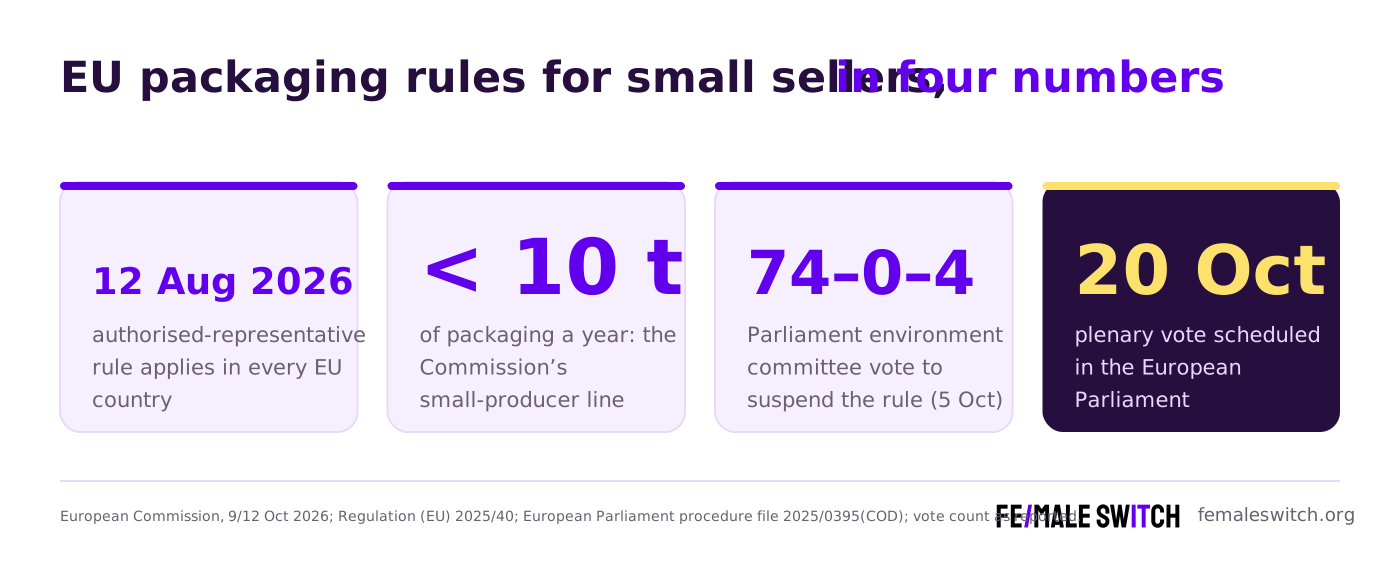
- Small producers already get flexibilities. The packaging regulation (PPWR) “already includes flexibilities and exemptions designed to make life easier for small producers producing less than 10 tonnes of packaging per calendar year.” In the regulation’s text, the explicit 10-tonne rule is lighter annual reporting (Article 44(8)).
- Countries can make it cheaper. Member states and producer responsibility organisations can waive registration fees, set “proportionate, flat EPR-fees”, cut paperwork, offer fast-track procedures and help desks, and reduce record-keeping, inspections and audits for small producers.
- National registration still applies. You must keep following the EPR registration rules of the country where your packaging is likely to become waste. National rules “may be more favourable.”
- The authorised-representative rule applies, but enforcement should be soft. “Since August 2026 the requirement applies to all Member States.” The Commission has proposed to suspend it and has called on member states to “abstain from sanctioning operators” while the proposal is examined.
Status: the representative rule is Adopted law and applies today. The Commission’s request not to sanction is guidance to member states, not a legal exemption. Germany’s packaging register, for example, says of the representative duty: “There is no exemption from this obligation.”
The rule small sellers want gone
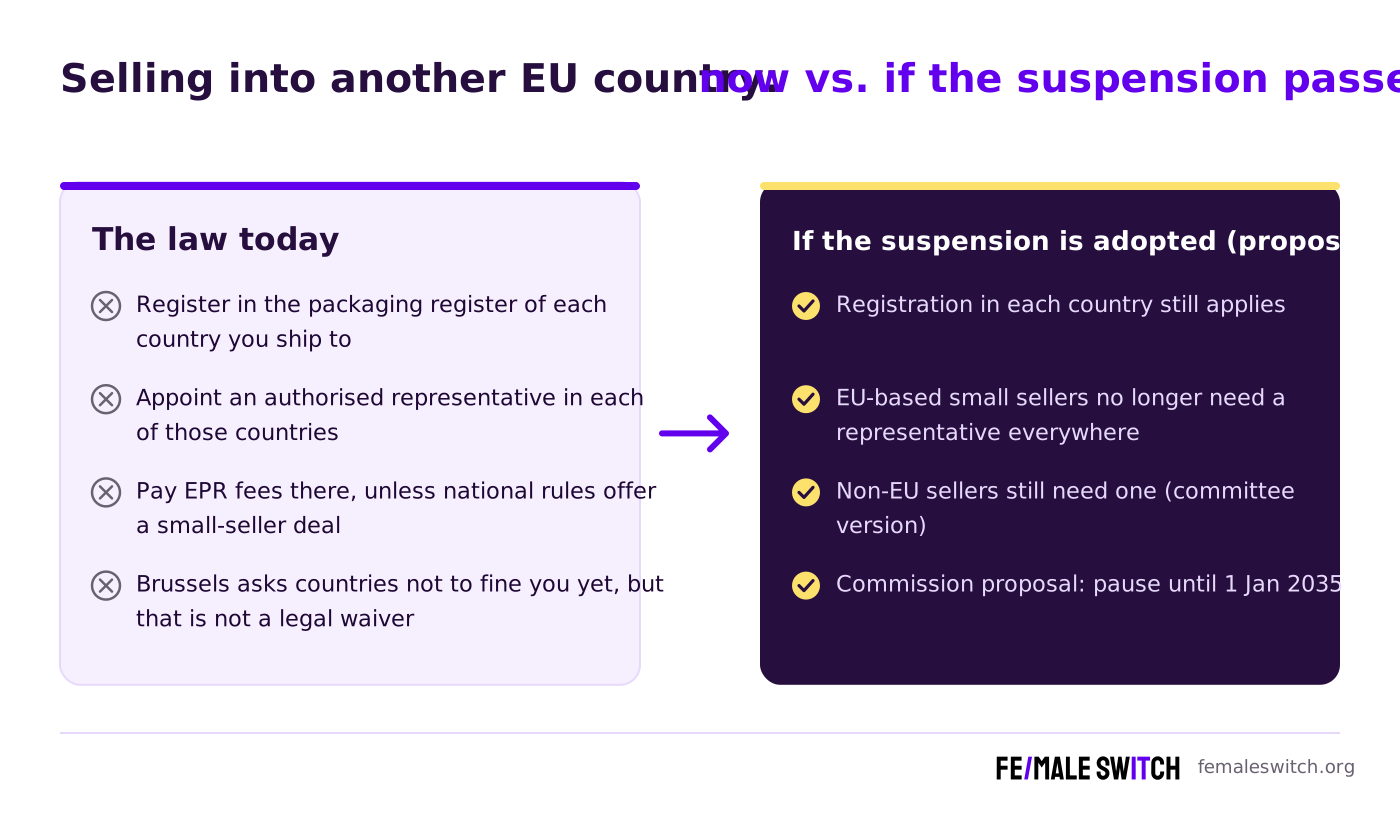
Article 45(3) of Regulation (EU) 2025/40 says a producer who sells packaged goods directly to end users in another EU country must appoint, “by written mandate, an authorised representative for the extended producer responsibility in each Member State” where it sells, other than its home country. For a small online shop that ships to five countries, that means five registrations and five representatives.
The small-business federation SMEunited put numbers on it in late September, as quoted by Packaging Europe: registering can cost over €500 per country, and a representative another €200 to €800 per country. Its president, Davide Galli, said: “SMEs cannot wait years for solutions.”
In December 2025, the Commission proposed a fix. Its proposal COM(2025) 982, part of the environmental omnibus package, would suspend Article 45(3) “until 1 January 2035”. EU-based producers selling in another member state could then “choose whether they appoint an authorised representative”, while countries could still require one from producers outside the EU. Status: Proposed.
Where the vote stands: Parliament, Council and the 20 October date
The European Parliament’s environment committee backed the suspension on 5 October by 74 votes to 0, with 4 abstentions, according to trade press reports. It narrowed it: according to LexisNexis, the committee wants the suspension limited to EU-based micro and small enterprises with fewer than 50 employees and a turnover or balance sheet under €10 million, while non-EU companies would still need a representative. One outlet reported a wider SME scope, so check the final text after the vote.
Parliament’s procedure file 2025/0395(COD) lists a plenary debate on 19 October and a vote on 20 October 2026. A vote would fix Parliament’s position; it would still have to agree a final text with EU governments.
Those governments are the harder part. A Council note dated 28 September records that ambassadors had decided to discontinue work on the two suspension proposals and look at EPR “comprehensively” in a future Circular Economy Act. Several countries pushed back, floating a small-producer threshold of “600 kg to 10 tonnes per year per producer”. Trade press reported that after the environment ministers’ meeting on 12 October, the Irish Presidency said technical work on a temporary solution was continuing.
Sources: European Commission; European Parliament procedure file; Council document ST 13583/26; trade press.
Who is for it and who is against it
Online retail groups want the suspension fast. Marlene ten Ham, CEO of the Dutch e-commerce association Thuiswinkel.org, told Packaging Insights that “there is a real risk that smaller businesses will simply stop selling cross-border because the compliance burden outweighs the commercial opportunity.” The retail federation EuroCommerce called the committee vote a “first step in the right direction” and asked for a 12-month grace period.
Not everyone agrees. In the same article, Gunda Rachut, president of EUNR, warned that “those who comply with the law end up subsidizing those who do not.” Her worry is online retailers outside the EU, where enforcement is hard. That is why the committee kept the representative duty for non-EU sellers.
What already applies in four countries
The EU sets the frame, but each country runs its own register and fees. Here is what four common destination markets say on their official pages:
Sources: verpackungsregister.org, ondernemersplein.overheid.nl, usp.gv.at, data.gouv.fr. Platforms: the Commission says online platforms are not yet required by EU law to ask for your EPR number, but German law already makes marketplaces and fulfilment providers check your LUCID registration.
The bigger picture: why Brussels cares about your parcel
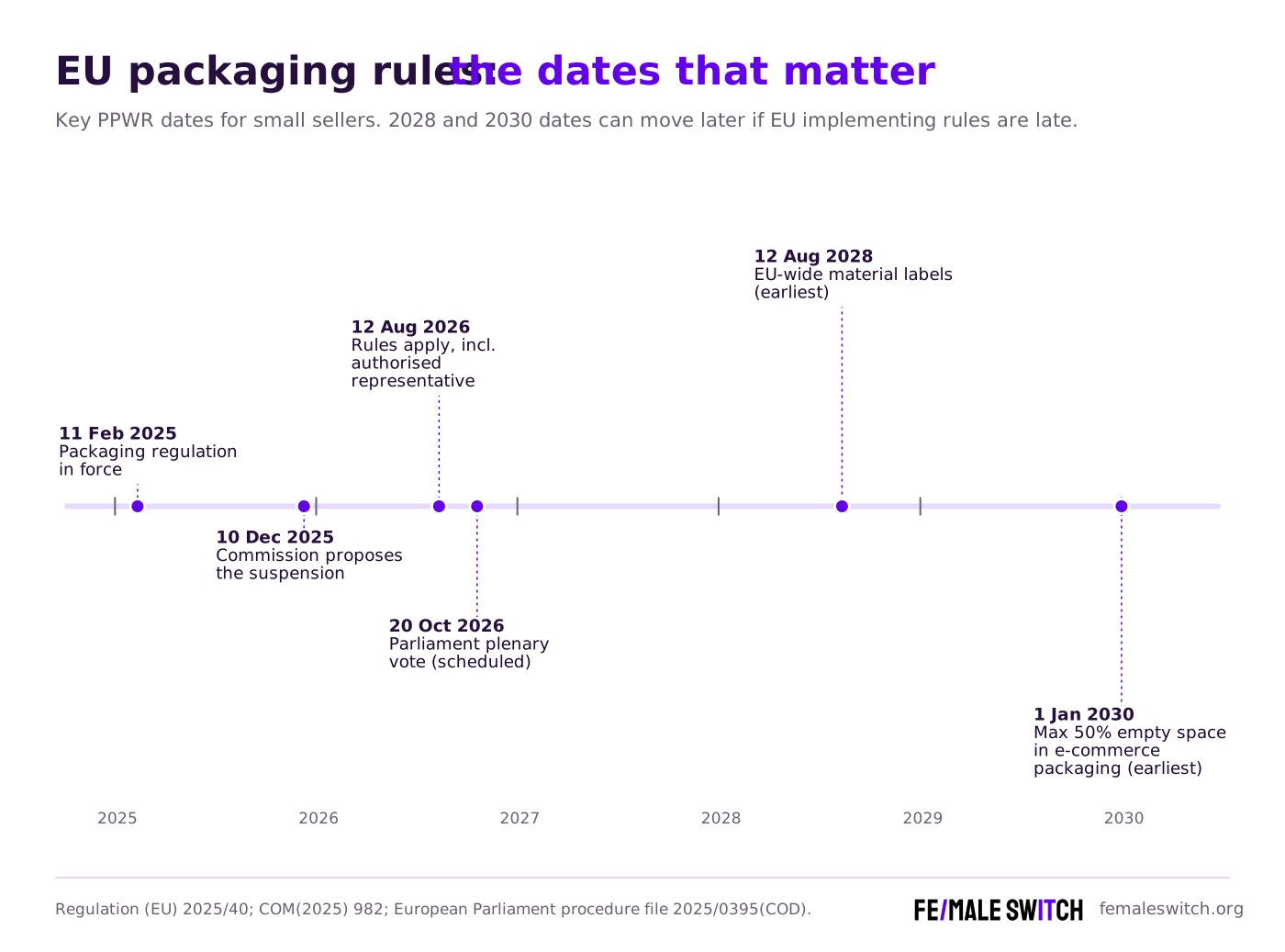
The EU generated 79.7 million tonnes of packaging waste in 2023, or 177.8 kg per person, and paper and cardboard made up 40.4% of it, according to Eurostat. The EU recycled 67.5%, against a target of 70% by the end of 2030. E-commerce is part of the plan: from 2030 at the earliest, e-commerce packaging may contain at most 50% empty space, and filling material such as bubble wrap or paper counts as empty space.
So the representative question is only the first fight. Material labels, recyclability grades and the empty-space limit come next, and they will reach every small brand that ships products. If you build sustainability into your product now, those rules will cost you less later.
What this means for you
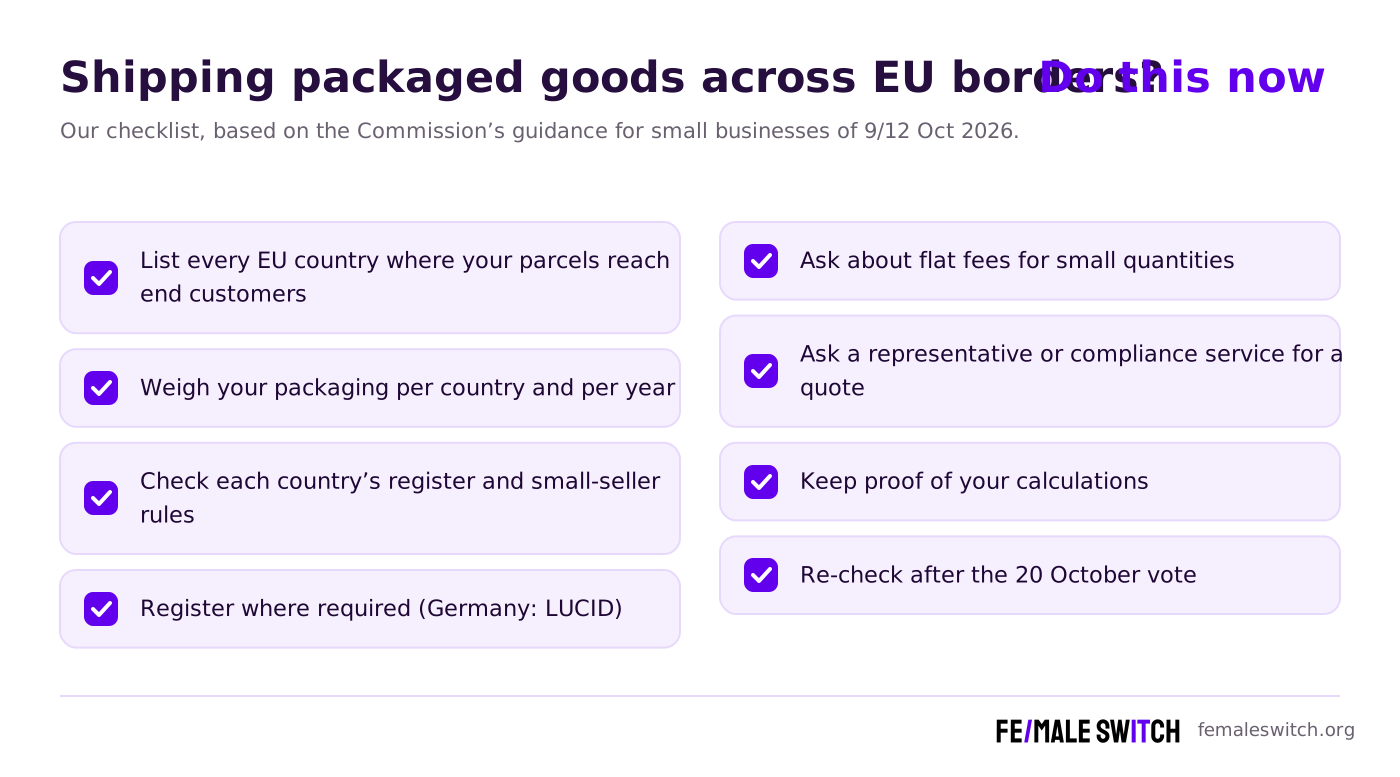
- Map your countries. List every EU country where your parcels reach end customers. Each one is a country where you count as a producer. Our guide to international expansion in Europe helps you decide which markets are worth it.
- Weigh your packaging per country. The 10-tonne line, the Dutch 50,000 kg line and any future threshold are all counted per year. A small shop is usually far below 10 tonnes, which is where the lighter rules apply.
- Register where required. The Commission’s line on sanctions doesn’t cancel registration. In Germany, register in LUCID before you sell. Packaging fees are a cost like VAT; see our tax essentials for Europe.
- Don’t sign a long representative contract this week. If the suspension passes, EU-based small sellers may not need one everywhere. Ask for short notice periods, and keep the contract in your legal templates and resources folder.
- Ask about flat fees. Countries and schemes may offer flat, proportionate fees to small producers. Ask before you pay the standard rate.
- Watch the other EU rules for online sellers. Brussels is also tightening rules on sales tactics, as we reported on fines for fake countdown timers, and on company law, see the EU Inc vote. Our overview of EU policy changes for women founders ties it together.
Practise the boring parts before they cost real money
The Fe/male Switch startup game takes you from idea to first paying customers in weekly quests, with an AI co-founder, so you plan costs, pricing and cross-border sales before your first parcel leaves the door.
👉 Start the game
What to watch next
- 20 October: whether the Parliament plenary adopts the committee version, and the final scope (small firms only, or all SMEs).
- The Council: whether EU governments agree a position, possibly with a tonnage threshold, so that talks with Parliament can start.
- EU registration rules: the Commission will set uniform registration and reporting rules; countries then get 18 months to adapt their registers.
- The Circular Economy Act: where a wider EPR reform may land.
FAQ: EU packaging rules for small online sellers
Do I need an authorised representative for packaging in other EU countries?
Under Article 45(3) of the packaging regulation, yes, since 12 August 2026, if you sell packaged goods directly to end users in another EU country. The Commission has proposed suspending this and asks countries not to sanction operators meanwhile.
Has the EU suspended the authorised-representative rule?
No. As of 18 October 2026, the suspension is only proposed. The European Parliament is scheduled to vote on 20 October, and EU governments still have to agree their position.
What does the 10-tonne rule mean?
The Commission says producers placing less than 10 tonnes of packaging a year get flexibilities, such as lighter annual reporting. Countries can also offer flat fees, fee waivers and less paperwork.
Do I still have to register in each country?
Yes. The Commission says you must keep following national EPR registration rules in each country where your packaging becomes waste. Germany, for example, requires registration in LUCID.
Does this apply to sellers outside the EU?
Yes. The packaging rules cover producers from third countries too, and the Parliament committee’s version keeps the representative duty for non-EU sellers.
What packaging rules come next for e-commerce?
EU-wide material labels from 12 August 2028 at the earliest, and from 1 January 2030 at the earliest, a maximum of 50% empty space in e-commerce packaging, with filling material counted as empty space.
