
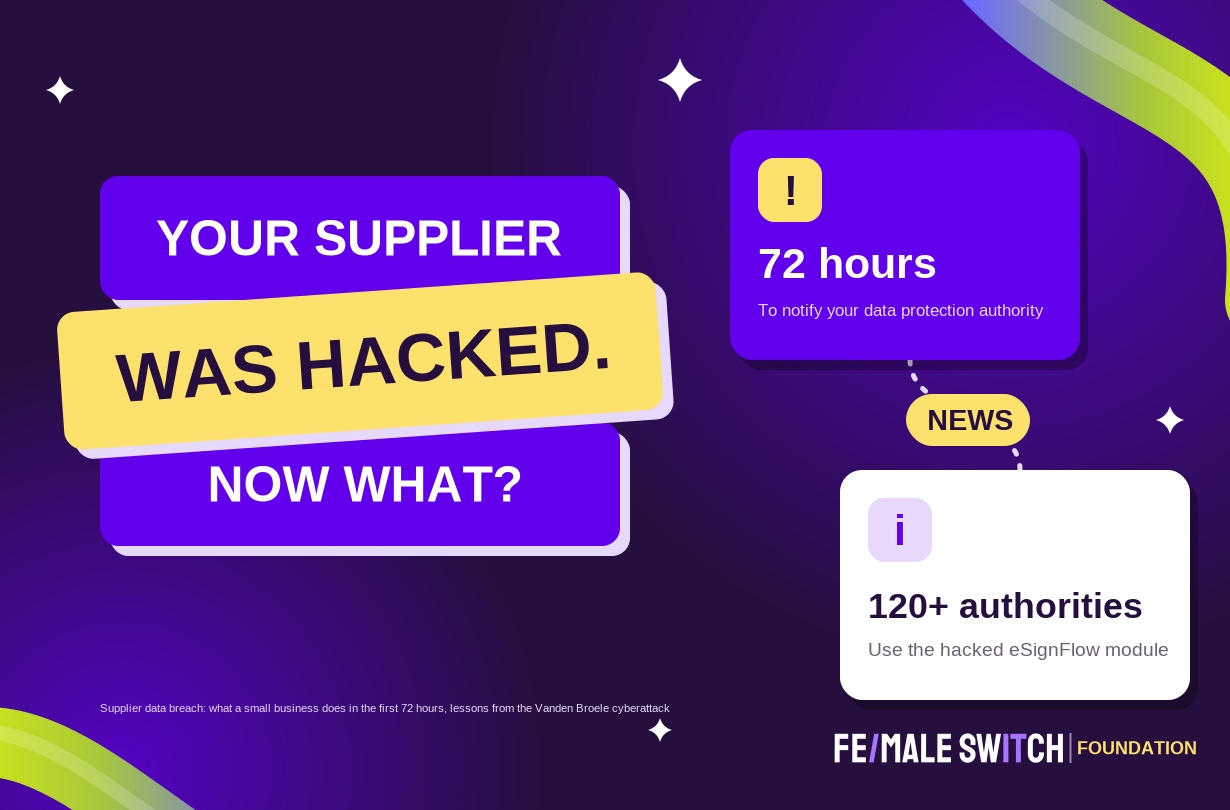
TL;DR: What does a small business do after a supplier data breach?
When a software supplier that holds your customers' data gets hacked, the GDPR duties sit with you, the data controller. Get the facts in writing, log every step, decide within 72 hours whether to notify your data protection authority and warn customers about fake payment requests.
Last updated 13 Nov 2026, 10:30 CET. Vanden Broele's incident FAQ now says signers' national register numbers were exposed and some full documents were downloaded (see the updates below). On 13 November the full root-cause analysis, expected in the week of 9 November, was still not public.
A supplier data breach lands on your desk the moment a tool you pay for gets hacked, and the Vanden Broele cyberattack on Belgian municipalities shows how it plays out; our hub article has the full story. This guide covers the customer side, for founders, freelancers and small businesses whose data sits in someone else's software. Public services get hit as well: the FOD Financiën cyberattack of 28 October left Belgian starters waiting for VAT numbers and set off a wave of fake tax emails.
What we know so far
Update 13 Nov, 10:30 CET: no new facts. The supplier's incident FAQ still shows its update of 30 October and says the full root-cause analysis per attack route is still being worked on. We found no public statement from the CCB or the data protection authority and no claim by an attacker. We have stopped our regular checks; the open questions are listed below.
Update 4 Nov, 08:00 CET: the supplier's own incident FAQ (last updated 30 October) shows why "get the facts in writing" comes first. Its first letter of 25 October said signers' national register numbers were stored in a converted form; the FAQ corrects that: the form is easy to calculate back, so customers should assume the attacker knows the numbers. It also says full documents were downloaded at a small number of organisations, and a re-analysis found user lists were downloaded at more. Each customer got a secured folder with its own overview and a model letter for the people involved on 26 October, and the FAQ tells customers to judge per group whether to inform people and whether to report to the data protection authority (or, under NIS2, the CCB). The attacker came in through a management environment reachable from the internet; no ransom was demanded. The FAQ itself warns that the numbers in its letter, the overview and its own export differ, and that an overview without downloads is no guarantee. Pelt expected the full root-cause analysis in the week of 9 November; it was not public on 13 November.
Update 31 Oct, 22:40 CET: the first municipalities have finished their own impact checks, and they show why each customer has to do this work itself. Overijse said on 28 October that names and document titles could be seen, but residents' addresses, phone numbers, national register numbers and email addresses could not, and it found no downloads. Essen checked 585 references to its documents and found two residents whose national register number may have been visible, AD reported on 29 October, and it is informing both. Geel and Oosterzele also warned residents about phishing and fake payment requests, and Oosterzele says it reported the incident to the CCB itself on 26 October, on top of the supplier's report. The attack method, the attacker and the total number of municipalities hit are still not public, and as of 31 Oct neither the CCB nor the data protection authority has commented publicly.
Update 29 Oct, 14:15 CET: Vanden Broele says more than 2,300 organisations use eSignFlow, according to Security.NL, so the software reaches far beyond the 120-plus local authorities first reported. Mol has also told residents to watch for suspicious emails, texts, calls and payment requests. Security.NL adds that a security hole, now closed, was used, with no further details. The number of municipalities hit is still not public, and as of 29 Oct neither the CCB nor the data protection authority has published a statement.
- The supplier: Belgian software company Vanden Broele was hacked. The affected product, eSignFlow, lets more than 120 local authorities have documents signed digitally, according to VRT NWS. The company puts the total number of organisations using it at more than 2,300.
- The data: mainly metadata, the signer's name with the document title. CEO Bram Van Impe says "the situation differs greatly per municipality".
- The response: the company closed the access, replaced all access credentials and software connections, and reported the incident to the Centre for Cybersecurity Belgium (CCB), the data protection authority and the police.
- The warnings: Genk, Peer, Hasselt, Steenokkerzeel, Leopoldsburg, Sint-Truiden, Beringen, Mol, Geel, Overijse and Oosterzele told residents to watch for phishing.
- The impact checks: the same breach hit customers very differently. Overijse found names and document titles but no ID numbers; Essen found two residents whose national register number may have been visible.
Open questions
- How many municipalities were affected, and which ones.
- The full root cause (the way in, a management environment reachable from outside, is known), and who the attacker was.
- Exactly which data leaked per municipality (Overijse and Essen have published their checks; most municipalities have not), and whether other systems were reached.
- Whether the CCB or the data protection authority will publish a statement.
Timeline
- 22 and 23 Oct 2026: the intrusion, according to ICT Magazine.
- Fri 23 Oct: Vanden Broele spots suspicious activity in the morning and takes eSignFlow offline around midday.
- Sat 24 Oct, evening: the hole is closed; the app returns with some restrictions.
- Mon 26 Oct: the hack becomes public and municipalities warn residents.
- Tue 27 Oct: ITdaily reports Steenokkerzeel residents have been unable to sign through eSignFlow since the weekend. Security.NL reports the company's figure of more than 2,300 organisations using eSignFlow, and Mol warns its residents.
- Wed 28 Oct: Overijse publishes its impact check: names and document titles visible, no addresses or national register numbers. Oosterzele warns residents.
- Thu 29 Oct: AD reports that Essen checked 585 document references and found two residents whose national register number may have been visible.
- Fri 30 Oct: Vanden Broele's updated incident FAQ corrects its first letter: signers' national register numbers recoverable, some full documents downloaded, no ransom.
- 31 Oct: no statement yet from the CCB or the data protection authority, and the number of municipalities hit is still not public.
Who is responsible when your software supplier is breached?
GDPR splits the roles. The business that decides why and how personal data is used is the data controller. The software company that stores or handles that data on its behalf is the processor. Your booking tool, invoicing app, CRM or e-signature service is a processor, and you are the controller for your customers' data inside it. Suppliers are also the favourite way in for automated attackers: the FBI's November warning about ARTEX lists third-party vendor logins among its entry points, and our guide to the doors AI hacking tools find at small businesses has a one-afternoon checklist.
The 72 hours in Article 33 start when you become aware, and Article 33(4) lets you send information in phases while the supplier is still investigating. In Belgium you file through the data protection authority's portal in Dutch, French or German; notifications sent by email are not processed.
What should you do in the first 72 hours?
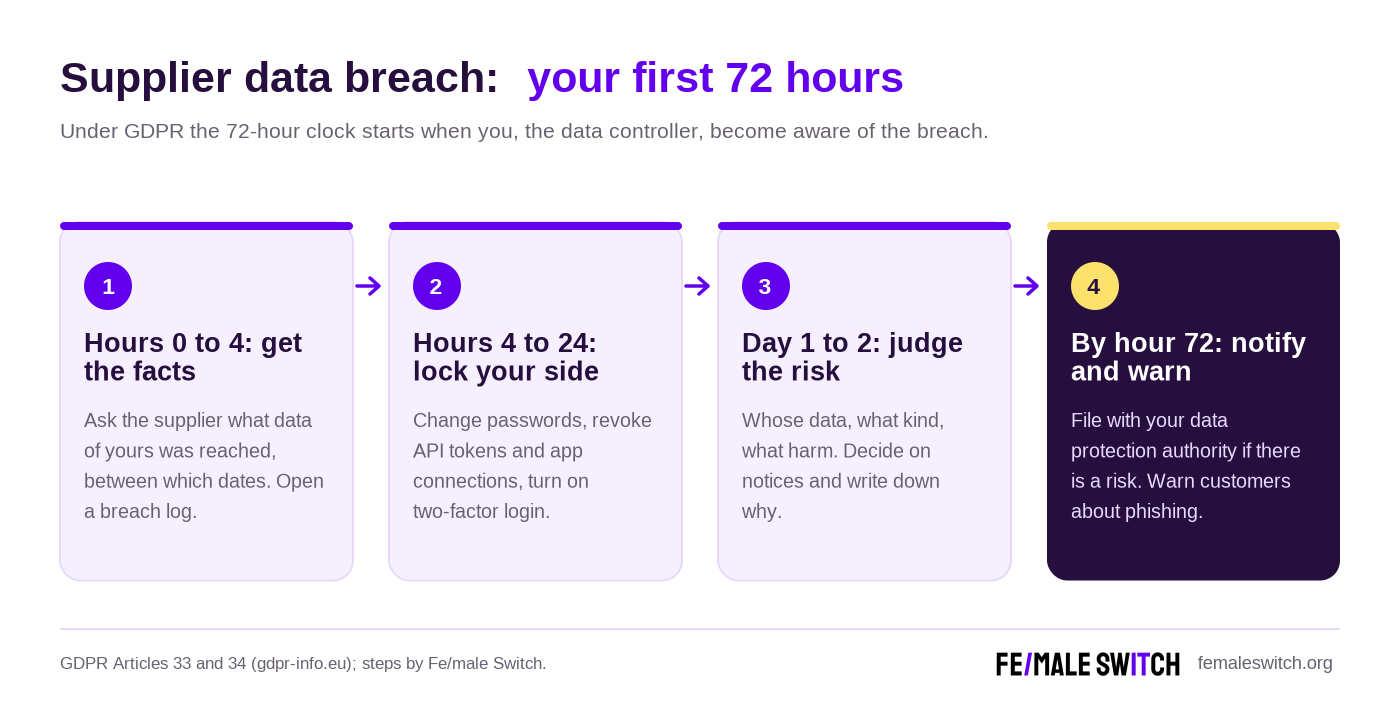
- Get the facts (hours 0 to 4). Email the supplier your questions and note the time you first heard.
- Lock your side (hours 4 to 24). Change passwords on that tool, revoke API tokens, disconnect linked apps and switch on two-factor login.
- Judge the risk (day 1 to 2). Names with document titles carry less risk than ID numbers or bank details.
- Notify and warn (by hour 72). File with the authority if people are at risk, tell them directly if the risk is high, and send every customer a phishing warning.
Which questions should you ask your supplier?
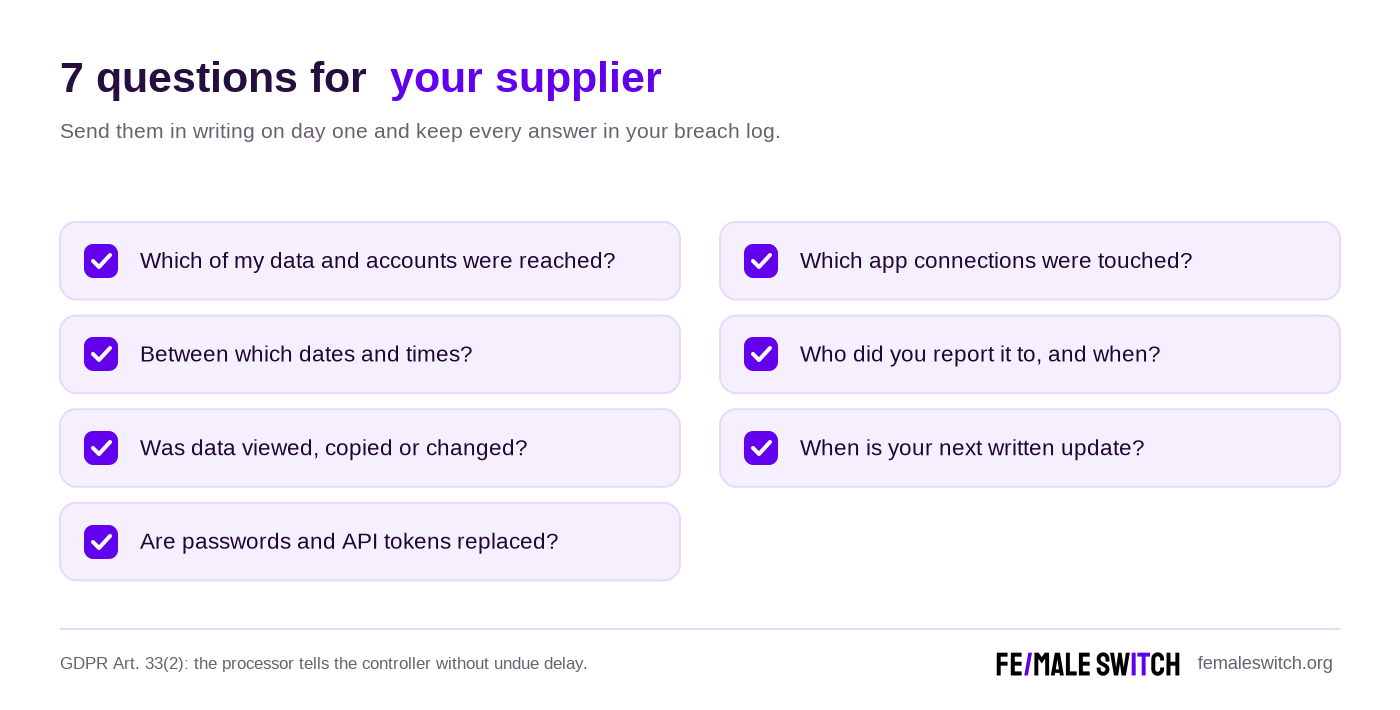
Push on connections to other software: in Belgium, Cipal Schaubroeck said its own systems escaped the hack, while some of its interfaces connect to the signature module. If the answer is "we are still investigating", log it and keep your own 72-hour clock running.
What should you write down for your own records?
Article 33(5) says the controller documents every personal data breach: the facts, its effects and the remedial action taken. Our data security practices for startups help you keep it in one place. Your log needs:
- the date and time you learned about the breach, and from whom;
- every supplier answer, with its date;
- which customers, staff or records are affected, and what kind of data;
- your risk decision and the reasons, including why you didn't notify if you didn't;
- what you changed, who you told and when.
How do you warn customers about phishing after a supplier breach?
Stolen names and document titles are enough to write a convincing fake email. Belgian municipalities warned residents about messages asking for personal data, payment details, passwords or codes, above all fake requests to pay a GAS 5 fine, the municipal parking fine. Peer's advice, via ITdaily, fits any small business: "If in doubt: do not respond, do not click and do not pay. Check first."
Here is a short message you can adapt and send the same day:
Subject: Security notice about [supplier]
Hi [first name], our supplier [supplier] reported a security incident on [date]. We are checking what it means for your data and will update you by [date]. We will never ask you for a password, a code or a payment to new bank details. If a message from us looks unexpected, call us on [number] before you click or pay. [Your name]
Leave out "your data is safe" until the supplier confirms it in writing. If the risk is high, Article 34 asks you to tell people in clear and plain language, with the likely consequences, your measures and a contact point.
Which clauses belong in your processor agreement?
Article 28 requires a written contract with every processor, covering the subject, duration and purpose of the processing, and lists what the processor must do. It sets no hour count for the breach notice, so add your own.
Source: GDPR Article 28. More in our Ogi Networks data breach article and our GDPR guide for European startups.
Does Belgium's NIS2 law apply to a small business?
Belgium's NIS2 law of 26 April 2024 covers organisations in listed sectors with 50 or more staff, or more than €10 million in turnover or balance sheet, so most small businesses fall outside it. Entities in scope warn the CCB within 24 hours and notify within 72 hours. That notice doesn't replace the GDPR notice to the data protection authority.
What this means for you
- List every supplier that holds customer or staff data, with its security contact. Third-party software was also the way in during the Cathedral Anthropic security test.
- Check each processor contract against Article 28 and add a breach notice deadline.
- Save a breach log template and the customer warning above in a shared folder.
- Bookmark your authority's notification page, so nobody searches for it in hour 70.
- Agree one team rule: no payment to new bank details without a phone check.
- Turn on two-factor login everywhere; our cybersecurity guide for non-technical entrepreneurs shows how.
Building your first startup on a budget?
The Fe/male Switch startup game takes you from idea to first paying customers in weekly quests, with an AI co-founder and a community of founders.
👉 Start the game
FAQ: supplier data breach
What is a supplier data breach?
A security incident at a company that processes personal data for you, such as a SaaS tool or IT provider, where your customers' or staff's data is accessed, copied, lost or changed.
Who reports a supplier data breach under GDPR?
You, the data controller, notify your data protection authority within 72 hours of becoming aware, unless people are unlikely to be at risk. Your supplier must tell you without undue delay.
When does the 72-hour clock start?
When you become aware of the breach, which for most small businesses is the moment the supplier's notice reaches you.
Do I have to tell my customers?
Under Article 34, yes when the breach is likely to put them at high risk. A phishing warning is a sensible step either way.
What happened at Vanden Broele?
Its eSignFlow signature module was hacked on 22 and 23 October 2026, exposing signer names and national register numbers, document titles and access codes, and at a small number of organisations full documents, according to the supplier's FAQ of 30 October. Municipalities warned residents about phishing.
Does the Belgian NIS2 law apply to my small business?
Most businesses with fewer than 50 staff and under €10 million in turnover or balance sheet fall outside it. GDPR breach rules apply either way.
