
TL;DR: What is AI-generated legal correspondence, and what should a small business do about it?
Complaints, GDPR access requests, employee grievances and legal letters are now drafted with AI tools, and a Dentons report published on 27 October 2026 says this flood of text hits in-house legal teams at companies such as eir, Mastercard and Wayflyer. A small business gets the same letters with no legal team. Log the date, find the two or three real asks, check every cited law and fact, and answer those points in plain language. GDPR requests still have to be answered within one month.
AI-generated legal correspondence became a search term in Ireland on Tuesday, after RTÉ and Irish Legal News covered a new Dentons report on how in-house lawyers use AI. Its most quotable finding is about the letters coming in: customers, staff and data subjects now use chatbots to write long, legal-sounding complaints, and companies have to answer them. If you run a small company in Europe, those letters reach you too, and you answer them yourself. Here is what the report found and a process you can copy.
What did the Dentons report find about AI-generated legal correspondence?
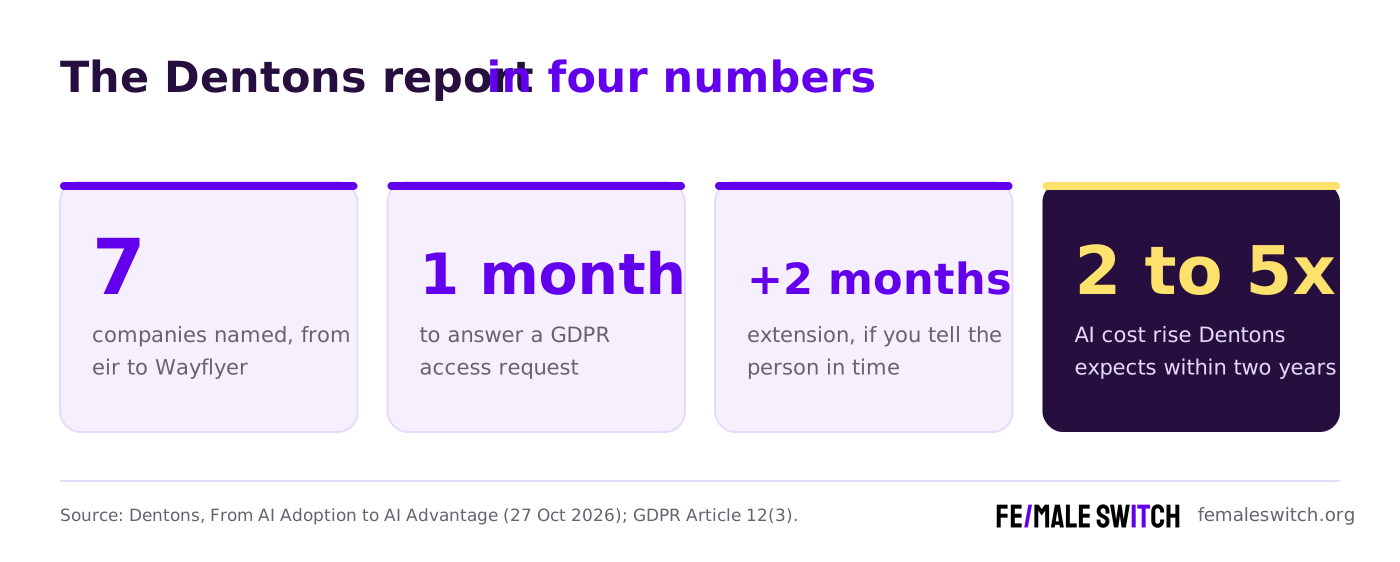
The report, From AI Adoption to AI Advantage, was written by Dublin technology partners Carlo Salizzo and David Kirton. It rests on in-depth interviews with in-house legal and compliance leaders at eir, Flipdish, Gilead Sciences, IMRO, Mastercard, Uniphar and Wayflyer, among others; RTÉ puts the total at ten companies in the US, UK and Ireland. Five themes came out of the interviews, and the third one is the reason for the searches:
"AI-assisted drafting now seems to touch the majority of incoming disputes, subject access requests, grievances and customer complaints, leading to increased workloads."
Here is what the interviewees described:
- Reading is cheap, sorting is expensive. eir's general counsel Sorcha Nic Mhurchú says the cost lies in "having to figure out, line by line, what is relevant".
- Polished text, weak substance. Wayflyer's Chief Legal and People Officer Deirdre MacCarthy: AI produces content that "sometimes looks good, but may not always be good", so people end up trading red lines between two AI tools.
- Grievances in legal language. Flipdish's Máire Neary expects employee grievances written fully or partly by AI, "extremely lengthy and framed in very legally sophisticated language".
- The same flood inside the company. At Uniphar, senior counsel Sergey Kinchin joined a call where five colleagues brought six AI-generated opinions on a regulatory question, and, in his words, the AI ended up confusing itself.
- No end in sight. Volume was "cited by virtually every interviewee", and nobody expected it to level off soon.
The foreword adds a detail every founder who has handled a complaint will recognise: the law obliges teams to answer this correspondence point by point, "even where only one or two points have substance", and then "another lengthy reply arrives just 20 minutes later".
Why does this hit small businesses harder?
Mastercard and eir have legal departments to absorb the extra pages, while a five-person startup has the founder, an inbox and a Friday afternoon. The tools that help a customer write a complaint are free, so sending a six-page, article-by-article letter costs almost nothing, while answering it still takes a founder hours. Dentons now sells companies a managed service for high-volume complaints, which tells you how big the problem has become at the top end.
Kirton names the risk on the other side: "genuine voices and genuine issues get drowned out in the noise of AI-generated arguments that are exaggerated, or just not based on fact". A real complaint about a late refund can sit inside four pages of invented legal claims. Your job is to find it and fix it fast, because that is the part a regulator or a court will look at.
Are AI-written letters legally valid?
Yes. A request or complaint counts by what it asks for, whoever or whatever typed it. The Irish High Court has already looked at AI on the sending side. In Farina v X [2025] IEHC 514, an influencer's lawyers complained that X's replies seemed to come from a computer system, possibly AI. Mr Justice Barrett saw "no legal requirement" for a solicitor's letter to be answered by a human and "no basis for judicial criticism", according to Pinsent Masons.
So you may use AI to draft your replies too. The responsibility for every fact and promise in them stays with you, and an AI-written letter that cites a law that doesn't exist still deserves a reply to its real request.
How do you answer an AI-written GDPR subject access request?
A subject access request (SAR) is a person's request under GDPR Article 15 to see the personal data you hold about them. Dentons lists SARs first among the correspondence AI now touches, and the deadlines in GDPR Article 12 don't change because a chatbot wrote the request.
A long AI-drafted SAR tends to list every right in Articles 15 to 22 at once. Answer the access request fully, and handle the other rights it mentions (erasure, objection, portability) only where the person clearly asks for them. Our GDPR guide for European startups shows where personal data sits in a small company, and the EU's planned simpler GDPR rules leave the access right in place.
How do you triage an AI-written complaint or legal letter?
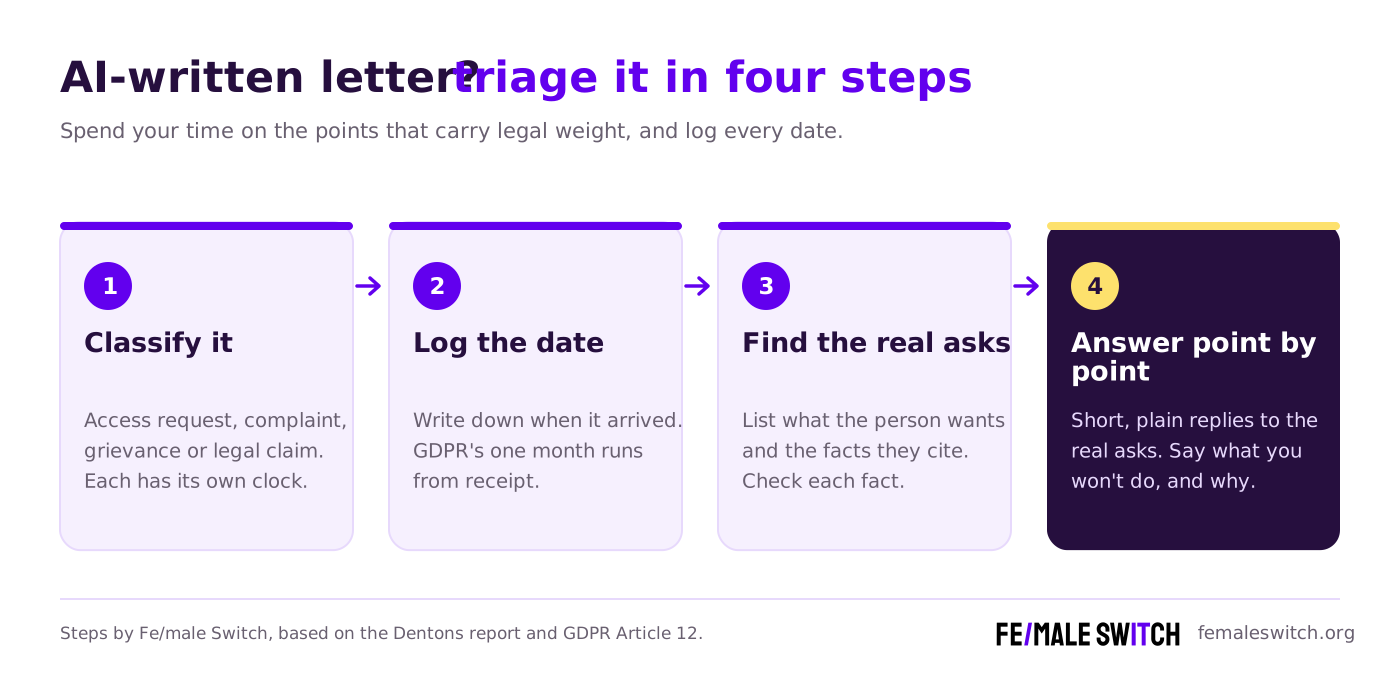
- Classify it. A GDPR request, a customer complaint, an employee grievance and a solicitor's letter each run on different rules and clocks.
- Log the date of receipt. Keep a simple register: date, sender, type, deadline, owner. This is your evidence later.
- Extract the real asks. Copy the letter into a table with three columns: what they want, the facts they cite, the law they cite. Most AI letters shrink to two or three rows.
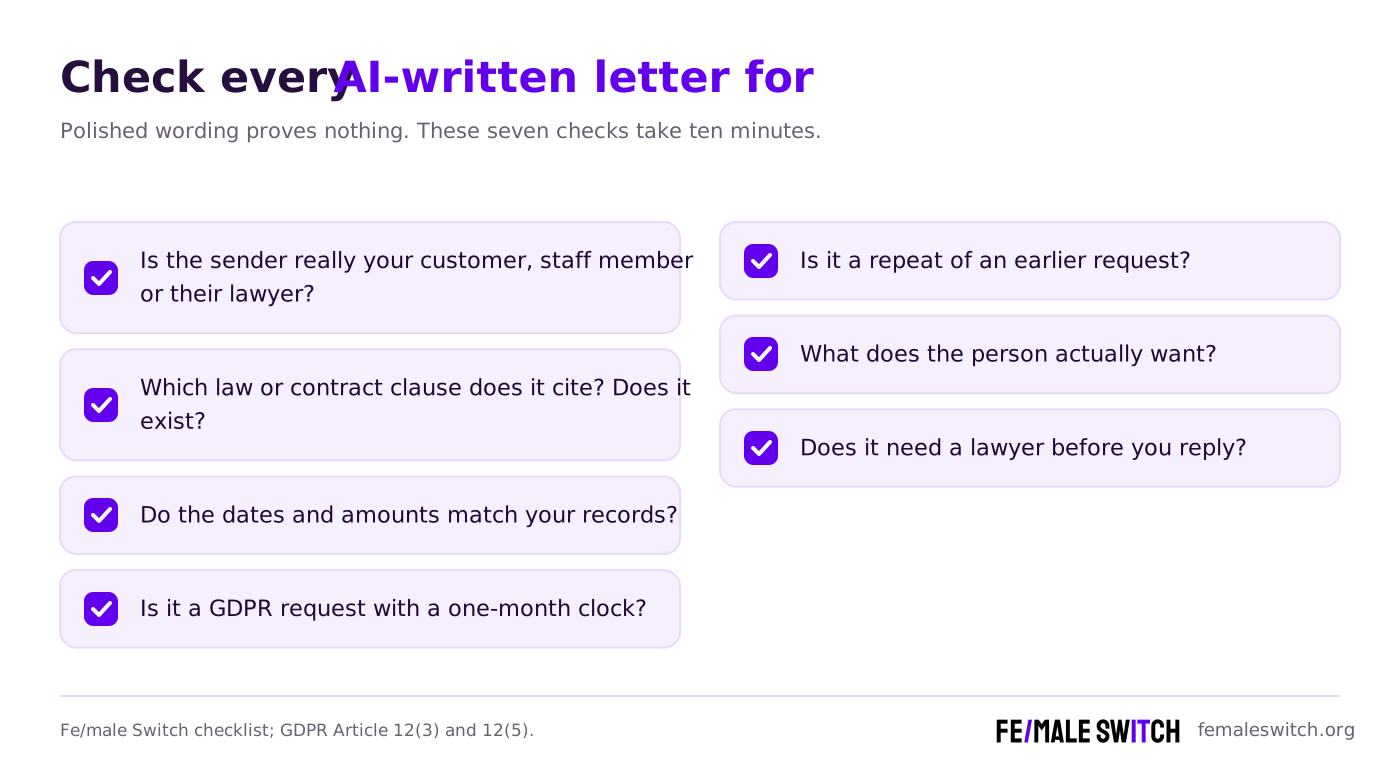
- Check every fact and citation. Compare dates, amounts and order numbers with your records, and open every article or case it names. Invented citations are common in AI output.
- Answer the substance first. Fix what is fair (the refund, the correction, the data copy) and say so in the first paragraph.
- Reply in plain language. Short paragraphs, one per real ask, and one sentence each on the points you reject with your reason.
- Escalate early. A threat of court action, a claim from a regulator or a grievance about discrimination goes to a lawyer before you reply.
Should you use AI to answer AI-written letters?
Some of the interviewed companies already do. IMRO's chief commercial officer Seán Donegan says he predicted two years ago that "the volume and tenacity of queries and complaints is going to increase exponentially", and in the last three months IMRO built a chatbot on its website to answer the generic questions. The companies in the report use AI for narrow, repeatable jobs such as invoice review, contract checks, customer screening and FAQ drafts, and almost none of them replaced a role with it, as Irish Legal News also notes. The same report warns that AI bills themselves are heading up, and our sister site explains why AI token costs rise even as prices fall, and how a startup budgets them.
For a small business that means three safe uses: summarising a long letter into its real asks, checking it against your records, and drafting a first reply that you then edit. Keep personal data out of free consumer chatbots; our list of free AI tools for small businesses in Europe includes GDPR notes for each tool. And never send an AI reply unread: Kirton says a long, legal-sounding letter fails to help the sender's case most of the time, and the same goes for yours.
What this means for you
- Set up a correspondence register today: date received, sender, type, deadline, owner, status. A spreadsheet is enough.
- Write three reply templates: SAR acknowledgement, complaint acknowledgement and a two-month SAR extension notice. Our legal templates for entrepreneurs are a starting point.
- Fix your complaint process before the flood. One named owner, a 48-hour acknowledgement and a written answer; our customer service guide for founders sets out the steps.
- Put the grievance process in writing before you hire your first employee, so a long AI-written grievance meets a clear, fair procedure.
- Budget a few hours of legal advice a year for the letters that cite court action or a regulator.
- Agree an AI rule for your own replies: AI drafts, a human checks every fact and signs.
Building your first startup on a budget?
The Fe/male Switch startup game takes you from idea to first paying customers in weekly quests, with an AI co-founder and a community of founders.
👉 Start the game
FAQ: AI-generated legal correspondence
What is AI-generated legal correspondence?
Complaints, GDPR requests, grievances, disputes and legal letters drafted fully or partly with AI tools such as chatbots. Dentons says AI-assisted drafting now touches most of the incoming correspondence at the companies it interviewed.
Which report is behind the news?
Dentons' From AI Adoption to AI Advantage, by Carlo Salizzo and David Kirton, published on 27 October 2026 and based on interviews with in-house legal leaders at companies including eir, Flipdish, Mastercard and Wayflyer.
Do I have to answer an AI-written GDPR request?
Yes. GDPR Article 12 gives you one month from receipt, extendable by two months when needed if you tell the person within the first month. Who drafted the request makes no difference.
Can I refuse a request because AI wrote it?
No. You may charge a reasonable fee or refuse only when a request is manifestly unfounded or excessive, such as a repeated request, and you must be able to prove it.
Is it legal to answer letters with AI?
Yes. In Farina v X (2025), Ireland's High Court saw no legal requirement for a solicitor's letter to be answered by a human. You stay responsible for what the reply says.
What is the fastest way to handle a long AI-written complaint?
Log the date, list the real requests and cited facts, check them against your records, fix what is fair, and reply in short plain paragraphs, one per real request.
