
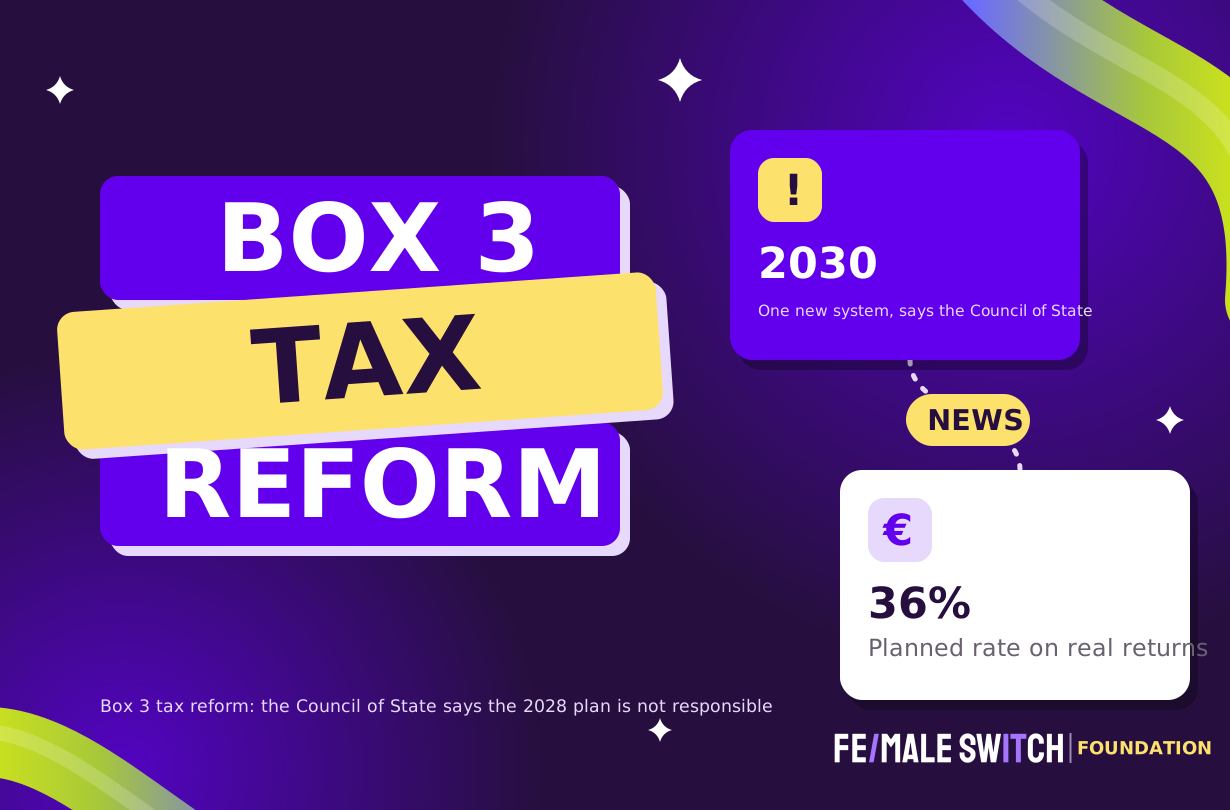
TL;DR: What happened to the box 3 tax reform?
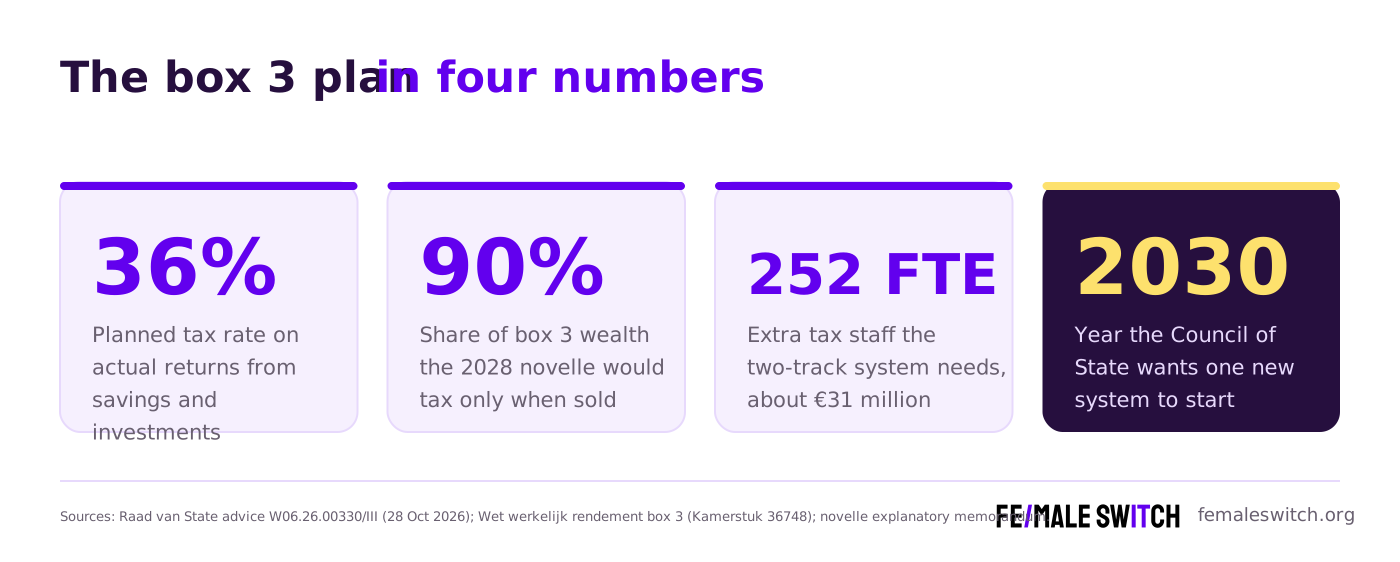
The box 3 tax reform in the Netherlands hit a wall on 2 November 2026, when the Raad van State (Council of State) published an advice telling the cabinet to withdraw the Wet werkelijk rendement box 3, drop its planned amendment and move to one new system in one go from 2030. The Tax Administration (Belastingdienst) judged the 2028 plan unexecutable. On 3 November an extra cabinet meeting approved a revised tax plan, and the cabinet's letters of that day confirm it: the new capital gains tax in box 3 moves from 2028 to 2029 at the latest, with 2028 still possible if talks with the banks show it can work, and the planned 2027 cut to the box 3 tax-free allowance is dropped. For founders, savers and angel investors nothing changes in 2026 or 2027: today's box 3 system with its counter-evidence rule stays.
Developing story. Last updated 6 Nov 2026, 10:45 CET. The cabinet's own letters of 3 November confirm that the new box 3 system starts on 1 January 2029, or 2028 if that proves workable. MPs question the cabinet on its box 3 amendment (the novelle) on Monday 9 November, and the Tweede Kamer votes on it and the whole tax plan on 12 November (see the update below). We'll update this article after the vote.
What is box 3 in the Dutch tax system?
What did the Council of State advise on 2 November 2026?
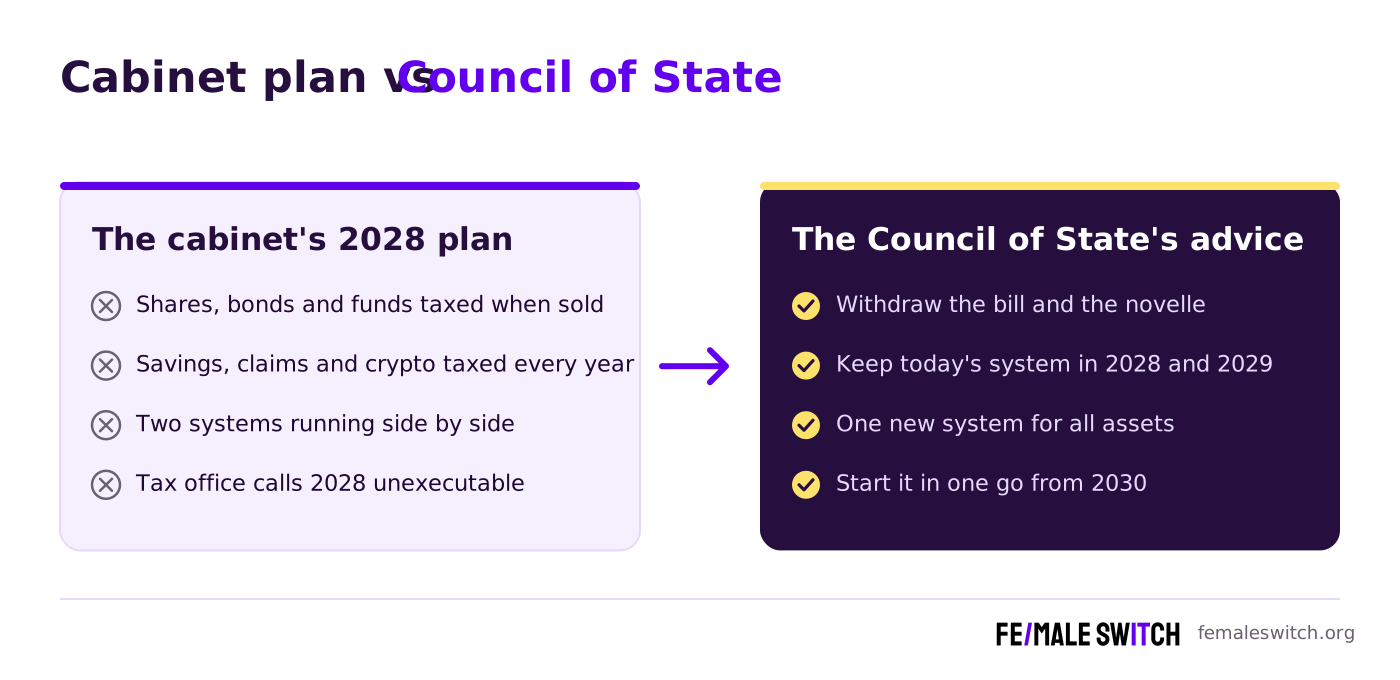
- Withdraw the Wet werkelijk rendement box 3, the actual-return bill that is waiting in the Eerste Kamer (Senate).
- Don't submit the novelle to the Tweede Kamer, and come back with a new bill.
- Switch to one new box 3 system in one go from 2030. Until then, today's presumed-return system with the counter-evidence rule stays in 2028 and 2029.
- Haste. A switch of this size pushed through as a quick amendment leaves both chambers too little time to weigh it.
- Two systems side by side. From 2028 shares would be taxed when sold, while savings and direct crypto would be taxed every year. The Council calls that split legally vulnerable: crypto held directly would fall under the annual tax, crypto held through a fund under the gains tax.
- The tax office can't run it. The Belastingdienst's execution test, received on 22 October, gave a red flag on all five points it checks. Banks can't supply capital gains data for 2028, and possibly 2029, so there would be no pre-filled return and no way to check what people report.
- Cost. The temporary two-track system needs 252 extra full-time staff and about €31 million on top of the planned reform.
- Funding gaps. The measures meant to pay for the plan lack political support, and no alternative is on the table.
What were the cabinet's box 3 plans for 2028?
How would the box 3 reform tax shares in startups?
- It was founded no more than five years ago.
- It runs only businesses started no more than five years ago.
- Its annual turnover is €30 million or less.
- Its shares are not traded on a regulated market.
- No more than 25% of it is held by a listed company or a company with turnover above €30 million.
What do we know so far?
Update 6 Nov, 10:45 CET: the Tweede Kamer's page for the novelle (37 053) now shows the timetable. MPs handed in their written questions on 5 November at 14:00, and the cabinet has to answer them before Monday 9 November, 10:00. That afternoon, from 16:00 to 23:00, the finance committee questions the state secretary on the novelle in a legislative meeting (wetgevingsoverleg). The vote on the novelle is on 12 November, together with the Belastingplan 2027 package. Also on 5 November, the Kamer's temporary committee on fundamental rights decided to start an advice track on the novelle, pointing to the Council of State's advice. In the tax plan debate, opposition MPs Klaver (PRO) and Dassen (Volt) tabled amendment 37 022 nr. 35 (received 4 November). Among other things it would add a 45% top rate in box 3 above about €80,578 of box 3 income from 2029, raise the top box 2 rate to 33% and cut the cap on loans from your own BV to €17,500. It is an opposition proposal (Proposed), not the cabinet's plan. Our Belastingplan 2027 guide for BV owners covers its box 2 side.
Update 5 Nov, 07:45 CET: we have now read the cabinet's own letters of 3 November, the letter from finance minister Eelco Heinen and state secretary Eelco Eerenberg and Eerenberg’s letter on the novelle. They confirm the reports below and add the timetable (all Proposed):
- The novelle "Uitbreiding vermogenswinstbelasting box 3" (Kamerstuk 37 053) went to the Tweede Kamer on 3 November. The cabinet keeps the actual-return bill and amends it, so it did not follow the Council of State's advice to withdraw both.
- The new box 3 system, including the novelle, starts on 1 January 2029, unless the coming weeks show that a responsible start on 1 January 2028 is possible.
- The timetable in Eerenberg's letter: in 2027 and 2028 today's presumed return with the counter-evidence rule stays; from 2029 a capital gains tax covers most box 3 wealth and an annual tax on value changes (vermogensaanwasbelasting) covers the rest; from 2030 a full capital gains tax applies to everything, through a separate bill still to come.
- The cuts to the tax-free allowance, the tax-free return and the presumed return "zal worden geschrapt" (will be scrapped), and the lower box 2 rate replaces them as funding.
- On 4 November the Tweede Kamer held the first round of the tax plan debate, from 15:30 to 23:00. It continues with the government's answers on 10 November, and the vote is on 12 November. By the morning of 5 November no outcome or adopted amendments had been reported.
Update 3 Nov, 22:30 CET: the cabinet met for an extra ministerraad on 3 November and approved a revised Belastingplan 2027, which it sent to the Tweede Kamer the same day. NOS and Accountancy Vanmorgen report the box 3 parts (Proposed):
- The new capital gains tax (vermogenswinstbelasting) moves from 2028 to 2029 at the latest. The cabinet keeps 2028 open "als dat haalbaar is", if talks with the banks show it can be done. That is still a year earlier than the Council of State's 2030.
- The planned cuts to the box 3 tax-free allowance, the tax-free return and the presumed return are dropped, according to Accountancy Vanmorgen.
- To cover part of the cost, the low box 2 rate falls temporarily from 24.5% to 23.5% and the top box 2 rate from 31% to 29%, for 2027 to 2030, in the hope that director-shareholders pay out more dividend from their BV. The cap on borrowing from your own company still falls from €500,000 to €100,000 in five steps from 2027.
- The minority cabinet of D66, VVD and CDA doesn't have a majority for the tax plan yet. The cabinet's own letters, which we read on 5 November, confirm these points (see the update above).
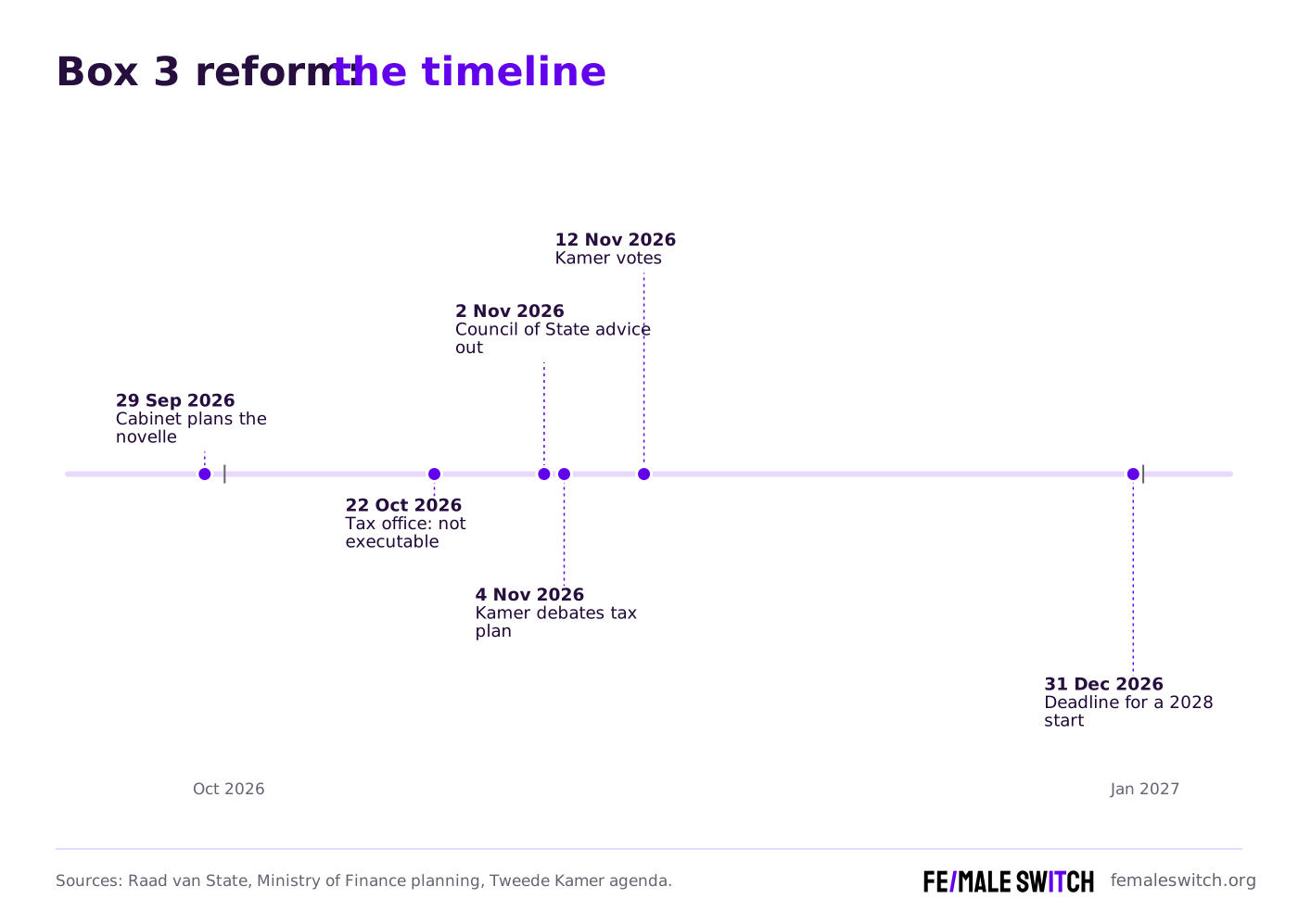
- 28 October: the Council of State adopts its advice on the novelle.
- 2 November: the advice is published. According to Accountant.nl, Eerenberg said he takes the criticism seriously and PM Rob Jetten said the cabinet is looking at the best moments to introduce it.
- 2 November, evening: NOS reports that coalition parties D66, VVD and CDA agreed among themselves on the tax plan and box 3, with the new capital gains tax delayed by one year according to insiders. That falls short of the Council's 2030 advice, and the coalition doesn't yet have a majority for the tax plan.
- 3 November: an extra cabinet meeting (ministerraad) approves the revised tax plan: the new box 3 system moves to 2029 at the latest, 2028 only if feasible, and the box 2 rates drop temporarily to cover part of the cost.
- 4 November: first round of the tax plan debate; Klaver and Dassen table amendment nr. 35 with a 45% top rate in box 3 from 2029.
- 5 November: MPs hand in written questions on the novelle; the fundamental-rights committee starts an advice track.
- 9 November (planned): legislative meeting on the novelle, 16:00 to 23:00.
- 12 November (planned): Tweede Kamer vote on the novelle and the Belastingplan 2027 package.
What we don't know yet
- Whether the new system starts in 2028 or 2029: the cabinet now says 2029 at the latest, and 2028 depends on talks with the banks.
- How the cabinet answers the Council of State's objection to two tax systems side by side: its 2029 plan still taxes most wealth on sale and the rest every year.
- What happens to the startup-share rule and its five-year test under the new plan.
- The final 2027 tax-free allowance and presumed return rate, now that the proposed cuts are dropped.
- How the Tweede Kamer votes on 12 November, and whether the Senate (Eerste Kamer) votes on the novelle before the end of December.
- Whether the Klaver and Dassen amendment, with its 45% top rate in box 3 from 2029, finds a majority.
What happens next in parliament?
What does the box 3 delay mean for founders and angel investors?
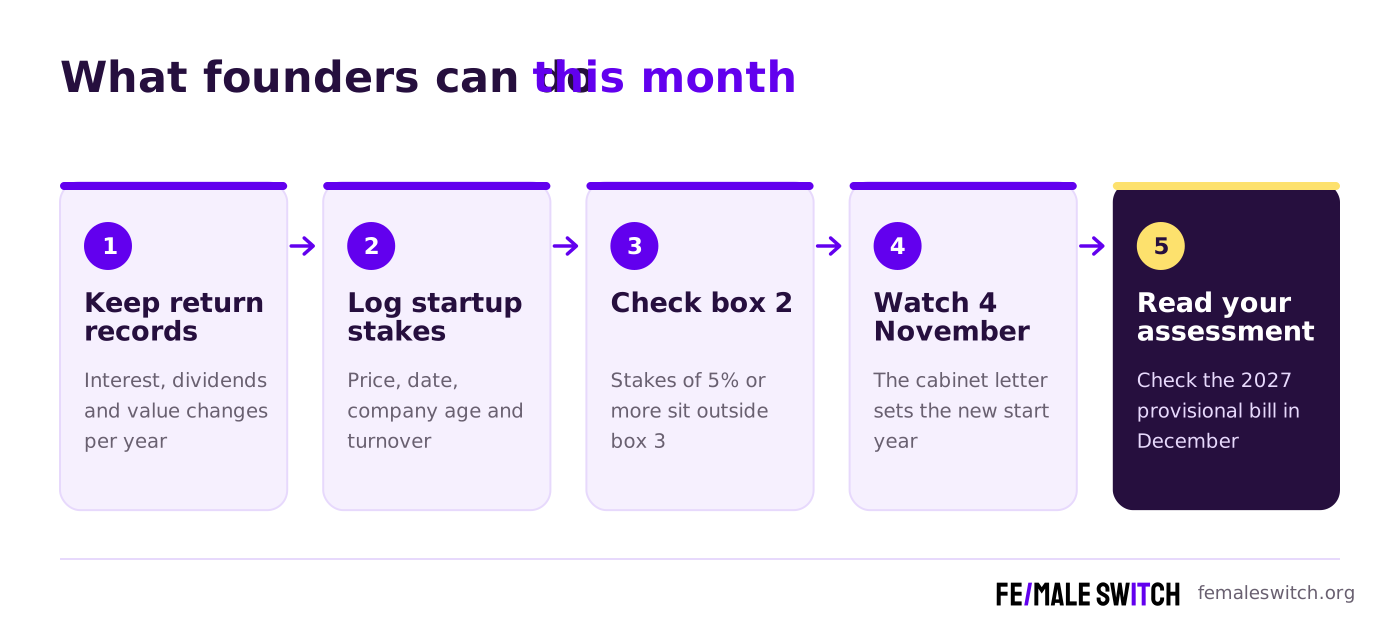
- Keep a record of your actual returns. Interest, dividends, rent and value changes, per year. You need them for the counter-evidence rule today and for any new system later. Our guide to tax essentials for startup founders in Europe covers the wider picture.
- Log every startup stake. Purchase price, date, the company's founding date and its turnover. Under the bill's startup-share rule, those five facts decide when you pay tax and how much.
- Know which box your shares sit in. Stakes of 5% or more in your own BV are box 2. Small tickets in other startups, crowdfunding shares and staff shareholdings are box 3. Our piece on fair equity splits explains how founder stakes are set up.
- Plan staff equity with the 2027 options bill in mind. If you want to give your first employees a stake, the proposed option rules start before any box 3 change. If you plan to raise from angels later, our guide to angel investors who back women shows where to find them.
- Follow the 12 November vote. The cabinet's 3 November letters set the start year at 2029 at the latest, but parliament still has to agree, and amendments can change the rates. We will update this article after the vote.
- Check your provisional assessment in December. If the 2027 numbers change late, the first bill can be off, and you can ask the Belastingdienst to adjust it.
Building your first startup on a budget?
The Fe/male Switch startup game takes you from idea to first paying customers in weekly quests, with an AI co-founder and a community of founders. You can test your pricing, costs and equity split in the game before real money is on the line.
👉 Start the game
