
TL;DR: what happened to the Dutch Zelfstandigenwet?
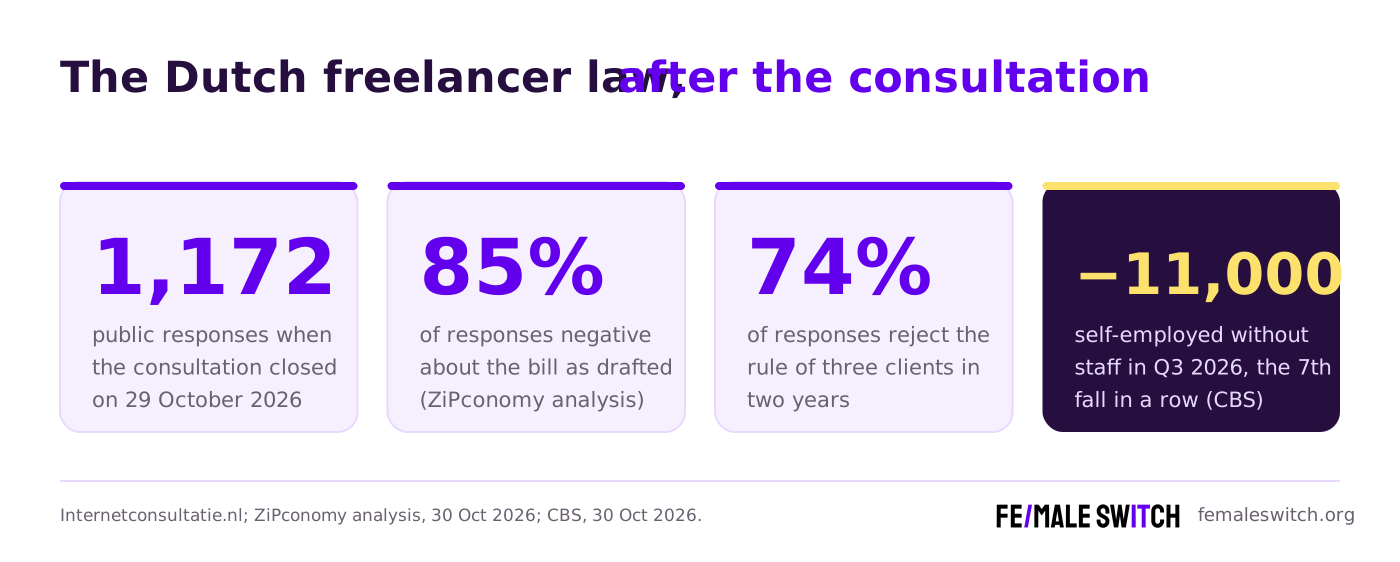
The public consultation on the Netherlands’ draft self-employed act closed on 29 October 2026 with 1,172 public responses. An analysis by the freelance news site ZiPconomy found 85% of them negative about the bill as written and only 5% positive, even though 41% back its goal. The biggest objection is the rule that you need three clients in two years: 74% of responses reject it, 97% among ICT freelancers. Minister Thierry Aartsen has already said the law “will be amended”. Meanwhile CBS counted 11,000 fewer self-employed without staff in the third quarter, the seventh fall in a row. The bill is still only Proposed, with a planned start in January 2028. Background: our explainer of the draft law.
Two weeks ago we wrote that Dutch freelancers had until 29 October to comment on the Zelfstandigenwet, the law meant to say up front when a freelancer is “in any case” not an employee. They did, in large numbers. At 470 responses on 9 October, the count ended at 1,172.
The verdict is clear, the minister has blinked, and the freelance market keeps shrinking. If you freelance, consult or run a one-person company in the Netherlands, or hire people who do, here is what the responses say, what is likely to change, and what to do while the law is rewritten.
What happened: 1,172 responses, mostly against
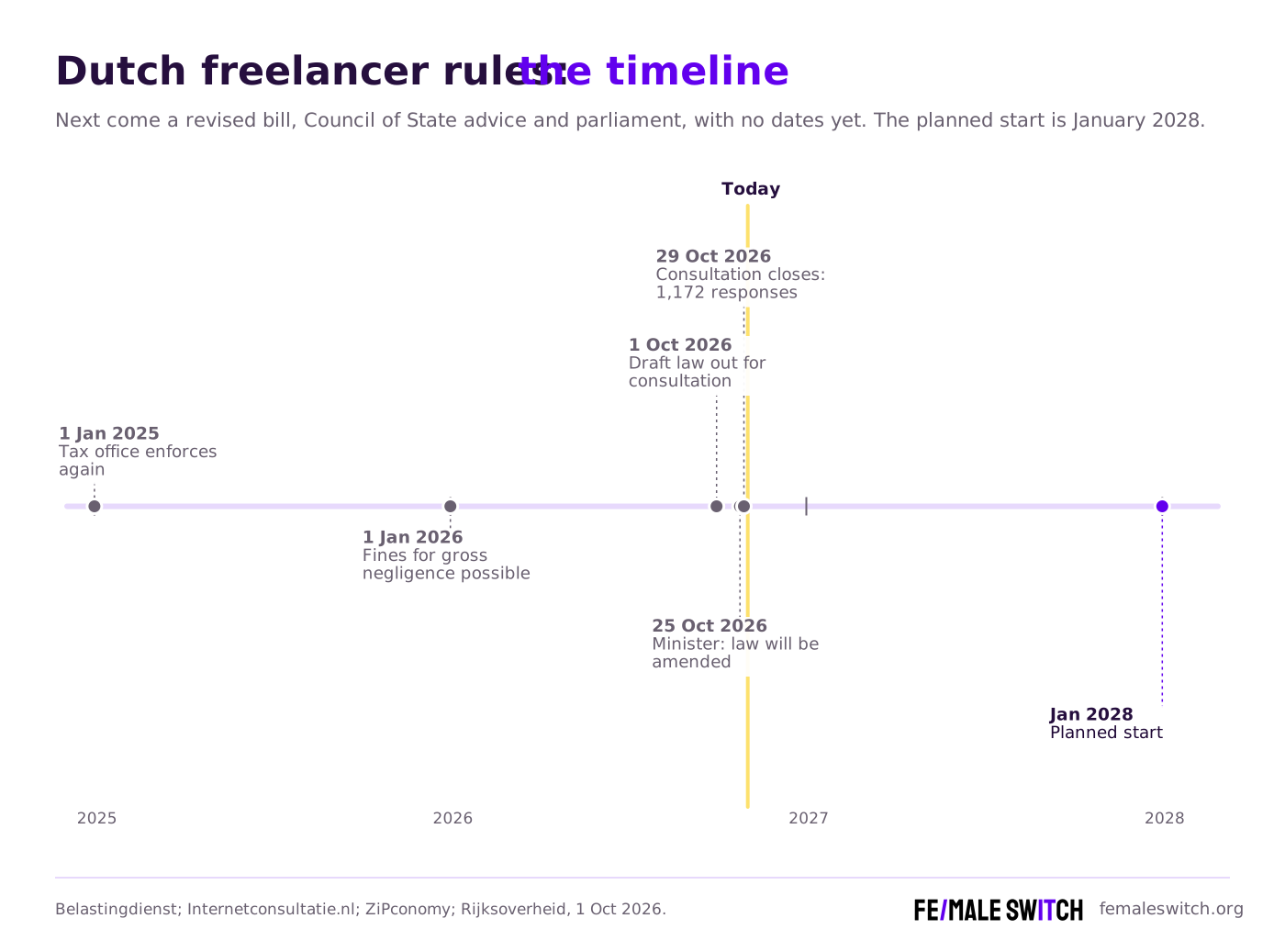
The government’s consultation page now shows the status “closed” and 1,172 public responses, the last one sent two minutes before midnight on 29 October. Responses are public, so anyone can read them.
On 30 October ZiPconomy published an analysis of all 1,172 responses, attachments included. It found that 85% were negative or very negative about the bill as drafted and only 5% positive. That is not because people reject the idea: 41%, or 481 respondents, explicitly support the goal of more clarity and a safe harbour for the self-employed, but 81% of that group still reject this version. Only 46 respondents reject the goal itself.
A caveat on method: ZiPconomy classified each response with the AI model Claude and checked a sample by hand. It counted every submission, duplicates included, and says the result is not an opinion poll. People who comment on a consultation are self-selected and usually the most worried. Still, the direction is hard to miss.
Sources: ZiPconomy analysis of the consultation responses, 30 October 2026. Two sectors dominate: ICT (297 responses, 25.3%) and interim, advice and project management (227, 19.4%).
The three-client rule is the biggest problem
To recap the draft: you reach the “safe harbour” if you pass a business test, including at least three clients over last year and this year and a minimum spend on cover for business risks, and a work-relationship test about who controls how, when and where you work. Our October explainer goes through all seven criteria.
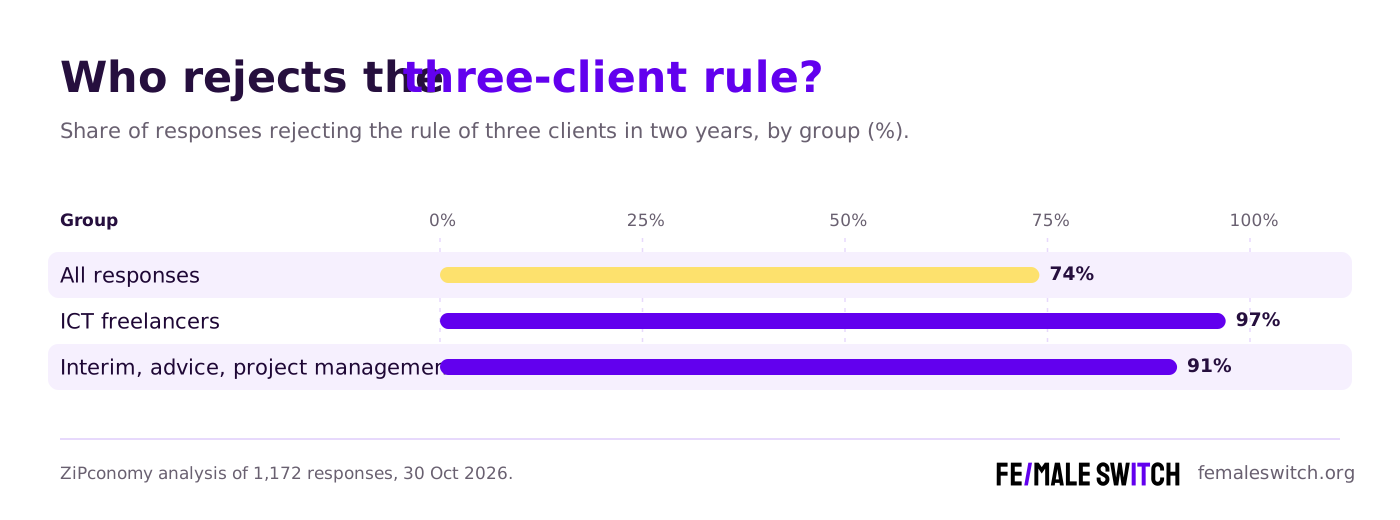
The rule of three clients in two years is the most cited objection: 74% of all responses reject it, rising to 97% of ICT freelancers and 91% in interim, advice and project management. Their point is simple. A specialist on a multi-year implementation project works for one big client because that is how the work comes.
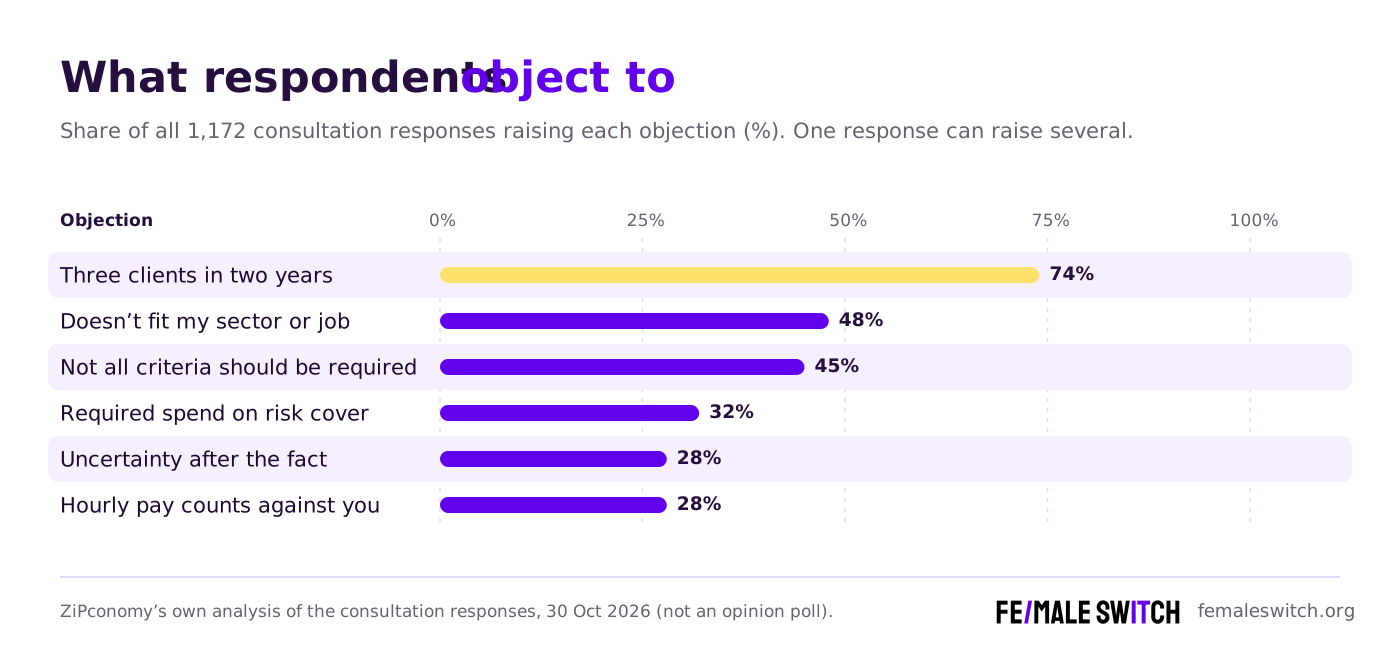
Other recurring complaints: the criteria don’t fit the respondent’s sector or job (48%), the required spend on risk cover (32%), the risk that a client or the tax office second-guesses you afterwards (28%), and a line in the explanatory notes that being paid per hour sits badly with working at your own risk (28%). 45% propose that not every criterion should be required, or ask for another route into the safe harbour.
The biggest fear is not the law itself but how clients will use it. A fifth of respondents expect clients to make the safe harbour a hiring condition, and a fifth fear a shift to secondment or payrolling. ZiPconomy points to research by Ipsos I&O for the ministry in which 41% of clients said they would no longer hire a freelancer who doesn’t meet the criteria.
What freelancers’ groups and employers asked for
ZZP Nederland ran its own survey with 3,033 participants and published its response on 30 October. In business services, 44.3% work on one or two large, long contracts, against 36.3% across all sectors, and 45.7% of those business-service freelancers say the number of clients is not a good test of being in business. 56.0% of participants who named a payment method are mostly paid per hour worked.
On risk cover, 69.1% rely on their own savings, investments or other assets, 54.7% have a pension product and 38.6% have disability insurance, ZiPconomy reported. ZZP Nederland wants such existing buffers to count. “A law only brings calm if freelancers and clients can both work with it,” said Frank Alfrink, chair of ZZP Nederland. The association also says its sample is not proven to be representative.
Sources: ZZP Nederland, 30 October 2026; ZiPconomy, 30 October 2026; ZZP Nieuws, 29 October 2026; LHV, 29 October 2026.
The minister: “the law will be amended”
Even before the consultation closed, Minister Thierry Aartsen (Work and Participation) told a ZiPconomy podcast, published on 25 October: “One thing is certain: the law will be amended. We will do that.” He named ICT as a sector where the rules pinch.
He also pushed back on one reading of the three-client rule: “You can perfectly well work for one long-term client. We then ask for two smaller assignments on top.” There is no minimum size for those extra jobs, he said. On the required spend on risk cover, the interviewer cited amounts of €3,000 to €4,000; Aartsen replied that “the amounts you mention are not in the law” and that the figure has not been set.
The order from here: the ministry processes the responses, the tax office, the UWV benefits agency and the Labour Inspectorate check whether they can carry out the law, the Council of State gives advice, and then the bill goes to the Tweede Kamer. None of these steps has a date yet. The government still aims for a start in January 2028. Until then, the current case-by-case test of “all circumstances” applies.
Status: the Zelfstandigenwet is Proposed (draft bill after consultation, no text sent to parliament). Enforcement against false self-employment under current law is Adopted and active.
Meanwhile, the number of freelancers keeps falling
On 30 October CBS reported that the number of self-employed without staff fell by 11,000 in the third quarter of 2026: “it has fallen for seven quarters in a row.” Unemployment rose from 3.9% to 4.0%. Almost 1.5 million people still have self-employment as their main job.
At the same time, people keep starting. The Chamber of Commerce counted 62,395 new businesses in the third quarter, 15% more than a year earlier, and 82% of them were freelancers. KVK counts registrations, including side businesses, so this is not a head count. The picture: many people still want to work for themselves, but fewer manage to keep doing it full time.
Enforcement is part of that story. The tax office says it has been able to impose fines for intentional or grossly negligent false self-employment since 1 January 2026, but will not impose fines for administrative failures in 2026. It does not reclaim payroll taxes for periods before 1 January 2025, unless there is bad faith.
What this means for you
- Don’t rebuild your business around three clients yet. The rule is the part most likely to change, and the minister has said so. If you have one big client, a couple of small extra jobs is what the current draft asks, not a minimum size.
- Keep evidence that you run a business. Your own invoices, your own tools, your own insurance or savings buffer, and contracts that leave you in control of how and when you work. Our guide to contracts and agreements shows what to put in writing.
- Rethink pure hourly billing where it fits. The hourly-pay passage may be softened, but day rates, fixed-price packages and project fees show business risk better. See how to price services versus products.
- Talk to your clients now. If a client is nervous, explain that missing a criterion does not make you an employee. Clients stopping work out of fear is the real short-term risk.
- Know the Dutch basics. Registration, VAT and the rules for one-person companies are in our legal basics for the Netherlands. If you also hire, check the 2027 Dutch minimum wage.
- Watch your neighbours too. Belgium is cracking down on unregistered side hustles, and our Budget 2027 roundup compares tax changes for freelancers in six countries.
Want to test whether your freelance work can become a real business?
The Fe/male Switch startup game takes you from idea to first paying customers in weekly quests, with an AI co-founder, so you can try out new offers, prices and clients before you bet your income on them. The free trial lasts 2 weeks.
👉 Start the game
What to watch next
- A revised bill: look for changes to the three-client rule, the hourly-pay passage and the risk-cover amount, and for a transition period, which care and construction freelancers asked for.
- The implementation tests by the tax office, UWV and the Labour Inspectorate.
- Council of State advice, then the bill’s arrival in the Tweede Kamer.
- The next CBS figures on self-employment, early next year.
FAQ: the Dutch Zelfstandigenwet after the consultation
Is the Dutch Zelfstandigenwet law yet?
No. It is a draft bill. The public consultation closed on 29 October 2026, and the bill still has to be revised, reviewed by the Council of State and passed by both chambers of parliament. The government aims for a start in January 2028.
How many people responded to the Zelfstandigenwet consultation?
1,172 public responses, according to the government’s consultation website. About 89% came from individuals, mostly freelancers, according to ZiPconomy’s analysis.
Do I need three clients to work as a freelancer in the Netherlands?
No. Under the draft, three clients in two years is one condition for the voluntary safe harbour. Missing it does not make you an employee; your work would be judged under the current rules. The minister has said one long client plus two small extra jobs would count, and that the law will be amended.
Will the three-client rule change?
Probably. 74% of consultation responses reject it, employers’ groups have suggested two clients, and Minister Aartsen said on 25 October that the law will be amended. No new text has been published yet.
How much must I spend on risk cover under the Zelfstandigenwet?
That amount has not been set. The draft leaves it to be decided later, and the minister said the amounts circulating in the media are not in the law.
Can the Dutch tax office fine me for false self-employment now?
The Belastingdienst says it can impose fines for intentional or grossly negligent cases since 1 January 2026, but no fines for administrative failures in 2026. It can reclaim payroll taxes back to 1 January 2025, not earlier unless there is bad faith.
