
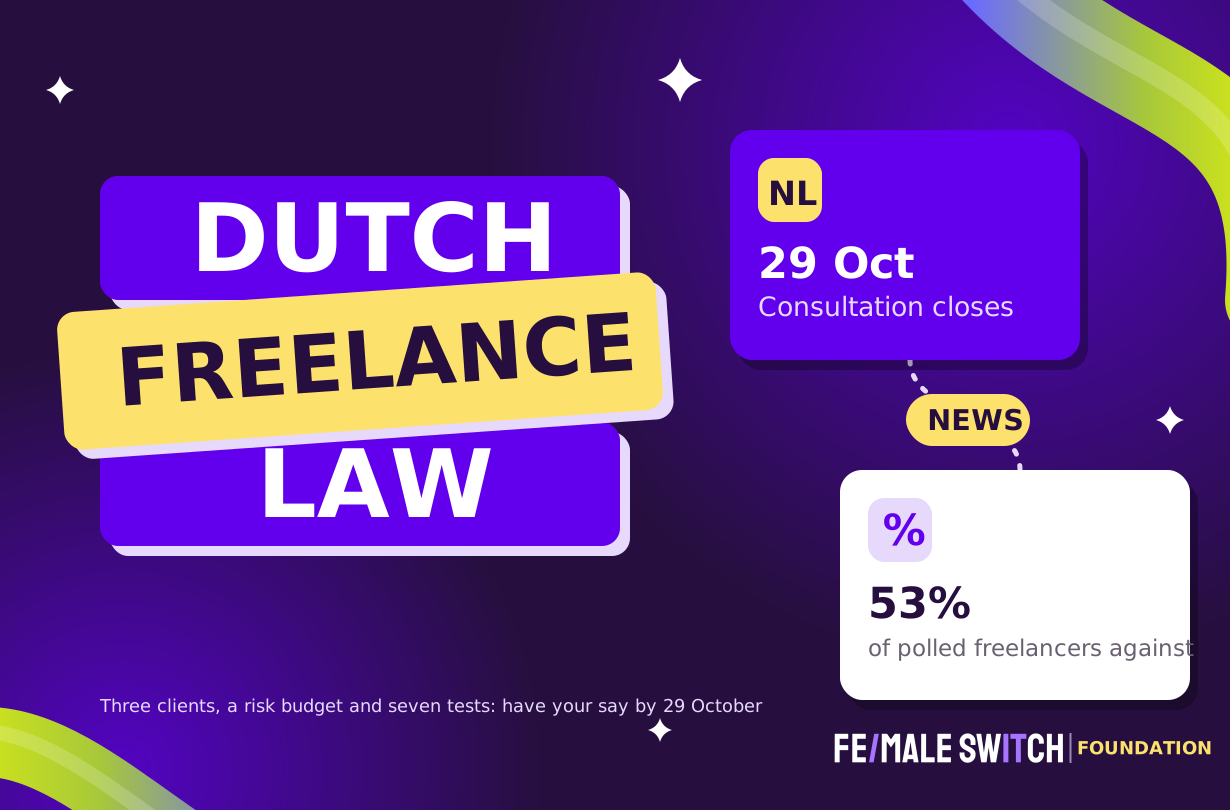
TL;DR: what is the Dutch Zelfstandigenwet, and why does 29 October matter?
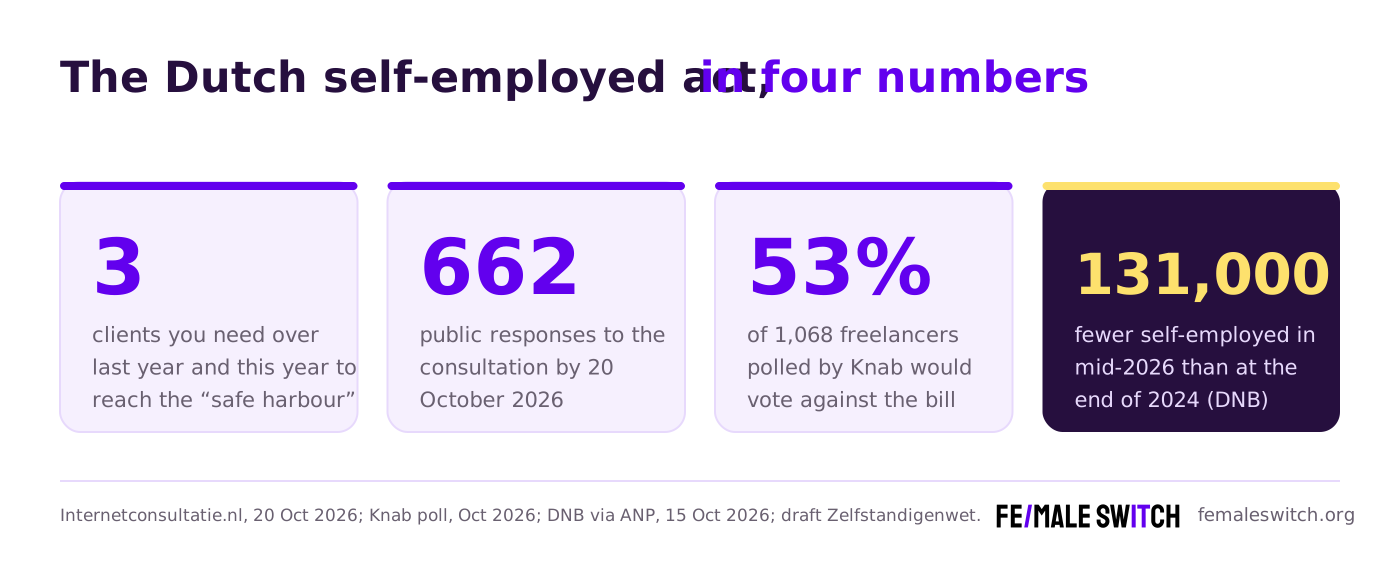
The Dutch government wants to write a “safe harbour” for freelancers into the Civil Code. If you have at least three clients, spend a minimum amount on cover for business risks, run your work like a business and control how, when and where you work, then you are “in any case” not an employee. The draft bill is open for public comment until 29 October 2026 and has already drawn 662 responses. In a Knab poll of 1,068 freelancers, 53% would vote against it. It is only Proposed: the planned start is 1 January 2028, and the minimum amount for risk cover is not set yet. Missing a criterion does not make you an employee, but freelancers fear clients will treat all seven as hard hiring rules. Background: our roundup of Budget 2027 for the self-employed in Europe.
More than a million people work as self-employed professionals in the Netherlands. Since January 2025 the Dutch tax authority has again been enforcing the rules against false self-employment, and the number of freelancers has started to fall.
The government’s answer is the Zelfstandigenwet, the self-employed act. It promises clear criteria up front. Freelancers are not convinced, and the window to tell the government why closes in nine days. If you freelance, consult or run a one-person company in the Netherlands, or plan to, here is what the bill says and what to do now.
What happened: a draft law, 662 responses and new questions in parliament
1 October: the draft goes out for comment. The draft bill, signed by Minister of Work and Participation A.A. Aartsen and State Secretary Claudia van Bruggen, went out for public consultation. “More than a million self-employed people work in our country,” Aartsen said in the government announcement. “With this law we give them the recognition they deserve and offer the clarity the market is asking for.” Anyone can respond until 29 October. The planned start is January 2028. Status: Proposed.
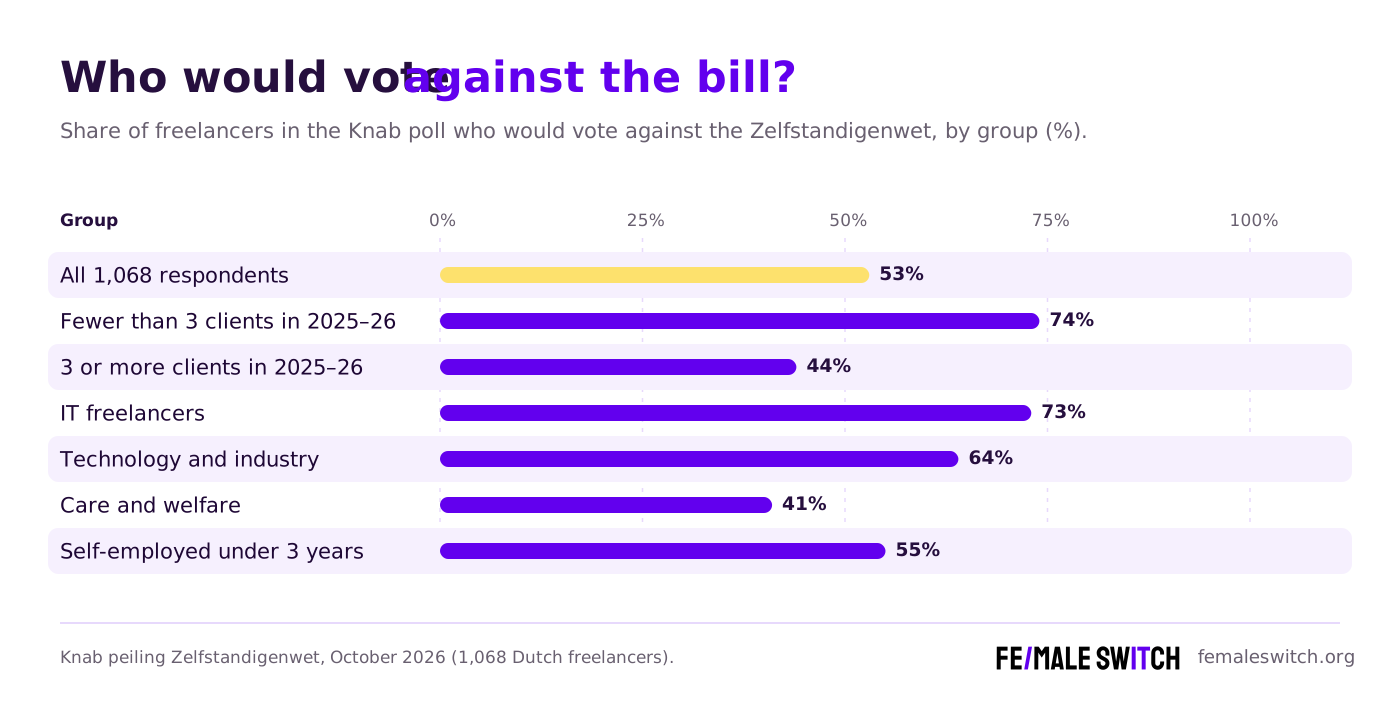
7 October: freelancers vote no in a poll. Bank Knab asked 1,068 Dutch freelancers how they would vote if they sat in parliament. 53% said against, 19% for and 28% don’t know. In April 2025, 71% of Knab’s respondents had backed the earlier private member’s version of the bill.
15 October: the backdrop. The Dutch central bank DNB found that there were about 131,000 fewer self-employed people in mid-2026 than at the end of 2024, accountant.nl reported. More than half of those who stop find other work within a quarter, and only 7% become unemployed. DNB links the fall in time to the end of the enforcement freeze in January 2025, but says it cannot establish that this was the main cause.
16 October: questions in parliament. MP Mariëtte Patijn tabled written questions (2026Z22529). According to ZZP Nieuws, she asks the social affairs minister whether the bill breaks the 2021 advice of the SER, the social and economic council of employers and unions, whether the social partners support it, and when the minimum amount and business criteria will be set. Status: Debated.
Today, 20 October: the consultation page shows 662 published responses.
What the bill says: two tests, seven criteria
The bill adds two paragraphs to article 7:610 of the Dutch Civil Code, the article that defines an employment contract. If you meet every criterion below, there is “in any case” no employment. The explanatory memorandum calls this the safe harbour. It sits next to the existing assessment, which looks at all circumstances, and does not replace it.
Sources: draft Zelfstandigenwet and explanatory memorandum (internetconsultatie.nl); Knab. The business characteristics and the minimum amount will be set by government decree.
Three details matter most for small founders. First, the minimum amount is literally a placeholder: the memorandum says the government will use the consultation to gather input on it. It also says the amount must not be so high that people who freelance next to a job, or who work few hours for other reasons, could never meet it. Second, for disability cover the government wants to follow the planned mandatory disability insurance for the self-employed (Baz), which it does not expect before 1 January 2030. Until then, a policy would have to pay out within 104 weeks if you can no longer earn the minimum wage because of illness, disability, pregnancy or childbirth. Third, the agency rule: if your contract is with an intermediary, all its end clients count as one client; if the agency only matches you and you sign with each client, each one counts.
Why freelancers are worried
On paper, failing the safe harbour changes nothing: you can still be self-employed under the existing rules. The fear is about clients. “On paper, two routes stay open,” said Casper Zwart of Knab. “But if clients only accept the safe harbour, all seven criteria become a hard entry requirement.” Only 25% of the freelancers polled think clients will hire freelancers more easily because of the bill; 48% disagree.
Knab also cites Ipsos I&O research for the social affairs ministry: 41% of clients expect to stop using a freelancer who doesn’t meet the criteria.
The three-client rule is the biggest obstacle. 30% of respondents had fewer than three clients in 2025 and 2026 combined; among IT freelancers it was 69%. Overall, 51% oppose the three-client rule and 42% support it. Long projects are the problem: an IT project manager told Knab that projects can run for 18 months to two years.
How the Netherlands compares
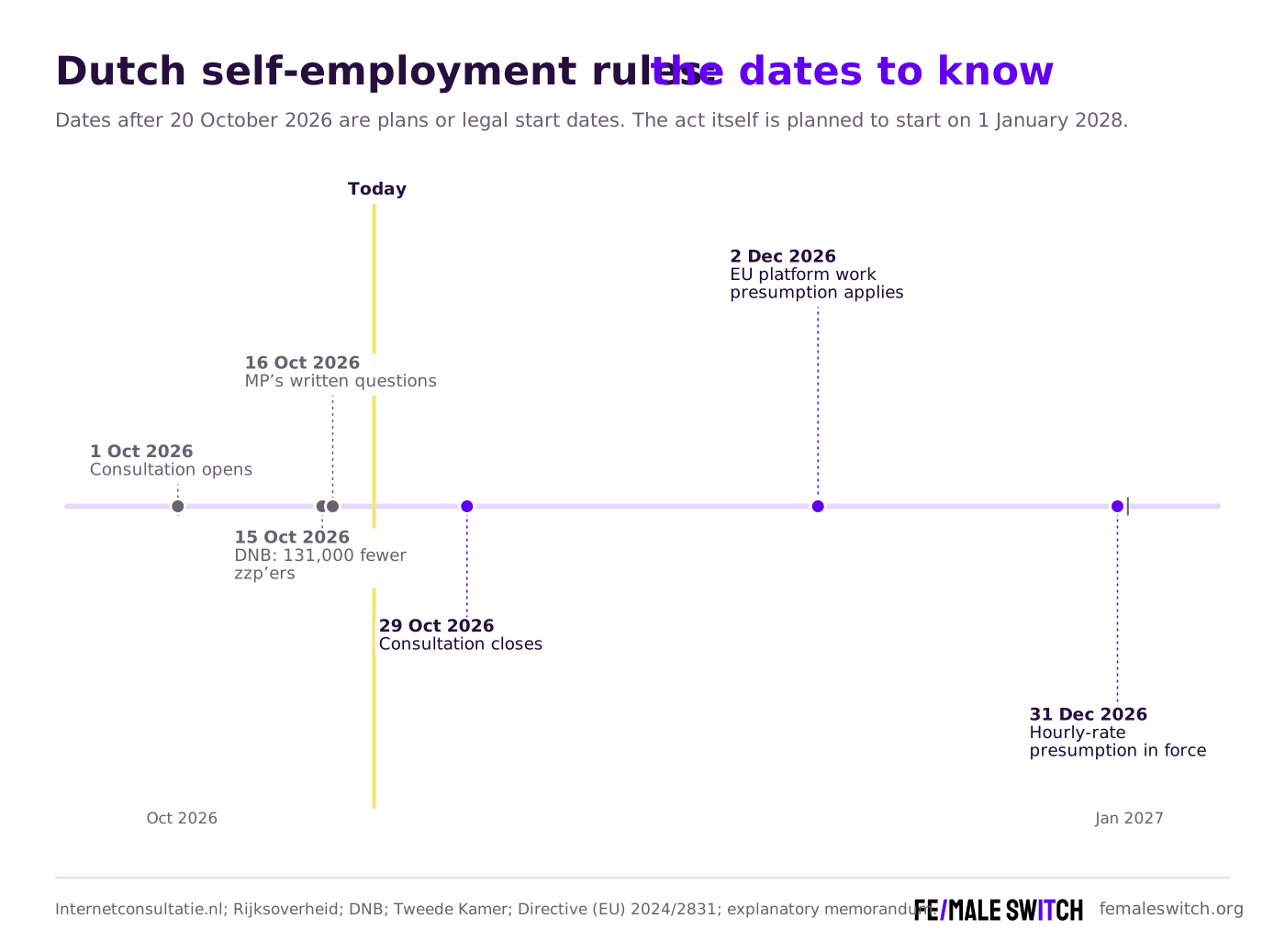
Other rules are moving at the same time. Under the EU Platform Work Directive, a legal presumption of employment for people working through digital labour platforms applies from 2 December 2026. In the Netherlands, a separate presumption of employment for work paid below an hourly-rate threshold enters into force on 31 December 2026. Germany is still arguing about its own version, as it did over maternity protection for self-employed women this month.
Sources: explanatory memorandum; Directive (EU) 2024/2831; ZZP Nieuws; VGSD. The German draft was reported in March 2026; the freelancers’ association VGSD calls it very unlikely to pass in that form.
The difference is the price of certainty. The Dutch draft asks you to spend a minimum amount on cover you choose yourself. Germany’s leaked draft would tie certainty to pension contributions. Either way, the cost of running a one-person business properly is going up, and it is worth pricing in now.
What this means for you
Nothing changes legally before 2028, and the bill can still change. But clients read the news too. Here’s what to do now.
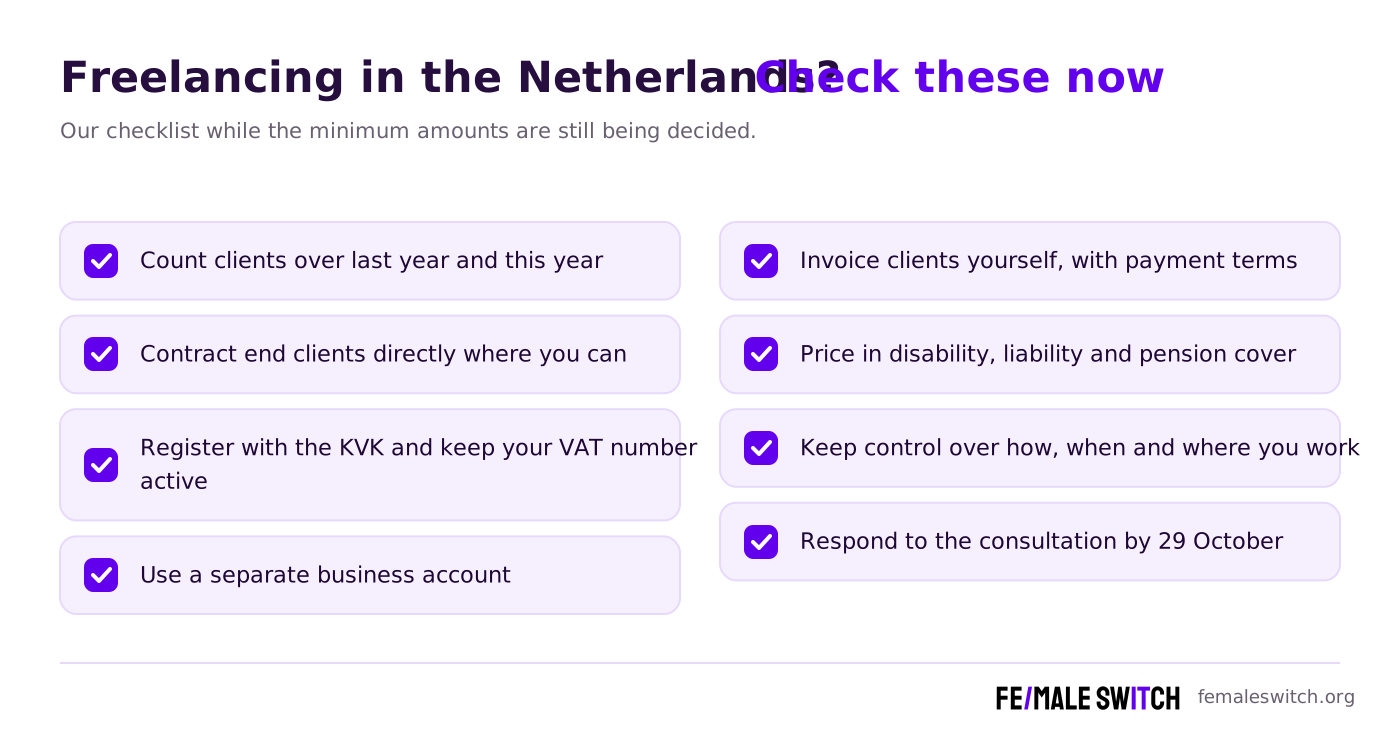
- Respond by 29 October. The minimum amount is still open and the government has asked for input. If you freelance part-time, next to a job or around children, say so: the memorandum itself says the amount must stay reachable for people who work few hours.
- Count your clients. Look at last year plus this year. One long project with a single client won’t pass the three-client test, so consider whether a second or third smaller client is realistic. Our guide to pricing services versus products can help you package smaller jobs.
- Check how your contracts run. Work through an agency that signs the contract counts as one client. Where you can, contract directly with end clients. Our contracts and agreements basics cover what to put in writing.
- Get the business basics right. KVK registration, an active VAT number, a separate account, your own invoices with payment terms. See legal basics for the Netherlands and setting up business banking.
- Budget for risk cover. Disability, liability and pension cover will likely become part of the test. Our tax essentials for European founders help you plan what you set aside.
- Solo founders: this is your law. Three in four new European companies are solo-founded, as we reported in solo founders in Europe 2026. If you sell your time while you build a product, the safe harbour decides how easily clients will hire you.
Freelancing to fund your startup?
The Fe/male Switch startup game takes you from idea to first paying customers in weekly quests, with an AI co-founder, so you can test a product idea while client work pays the bills.
👉 Start the game
What to watch next
- 29 October: the consultation closes. Published responses stay readable on internetconsultatie.nl.
- The government’s answers to the written questions of 16 October, including when the minimum amount and the business criteria will be set.
- 31 December 2026: the hourly-rate presumption enters into force.
- The decree: the minimum amount for risk cover and the business characteristics, to be set by government decree.
- Germany and the EU: whether Berlin turns its status reform into a bill, and how member states apply the platform work presumption from 2 December.
FAQ: the Dutch Zelfstandigenwet in October 2026
What is the Zelfstandigenwet?
It is a Dutch draft law that adds a “safe harbour” to the Civil Code. If a freelancer meets seven criteria, such as at least three clients, a minimum spend on risk cover and freedom over how, when and where they work, there is in any case no employment contract.
When does the Zelfstandigenwet start?
The planned start is 1 January 2028. It is still a draft: the public consultation runs until 29 October 2026, after which the bill goes to parliament.
How do I respond to the Zelfstandigenwet consultation?
Anyone can respond on internetconsultatie.nl until 29 October 2026. Responses you mark as public are published during the consultation; 662 were visible on 20 October.
How are the three clients counted?
According to the explanatory memorandum, genuine clients from last year and the current year up to the moment of the test count together, so starters can qualify. An agency that holds your contract counts as one client.
How much do I have to spend on insurance or pension?
The amount is not set yet. The government will fix it by decree after the consultation and says it must stay reachable for people who freelance next to a job or work few hours.
Am I an employee if I don’t meet the criteria?
No. Missing a criterion only means you don’t get the safe harbour. Your situation is then judged under the existing rules, which can still conclude that you are self-employed.
