
TL;DR: did Germany just give self-employed women maternity leave?
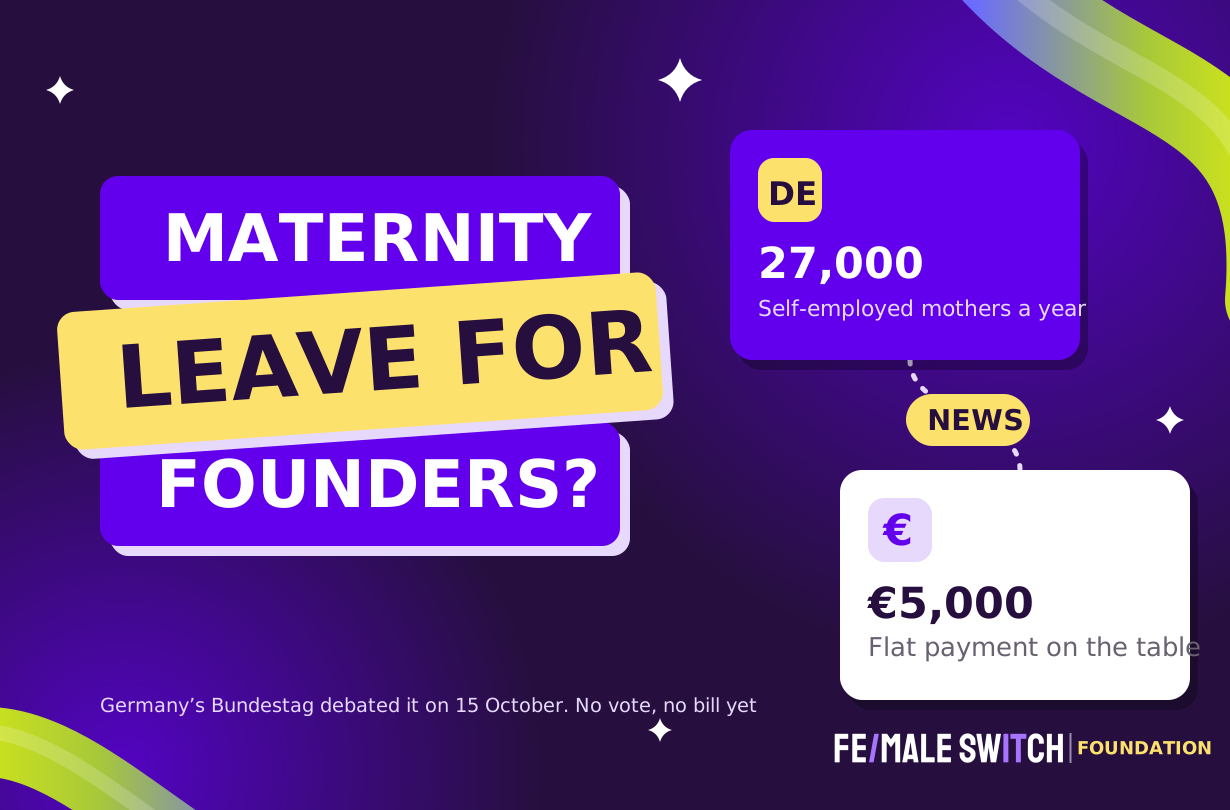
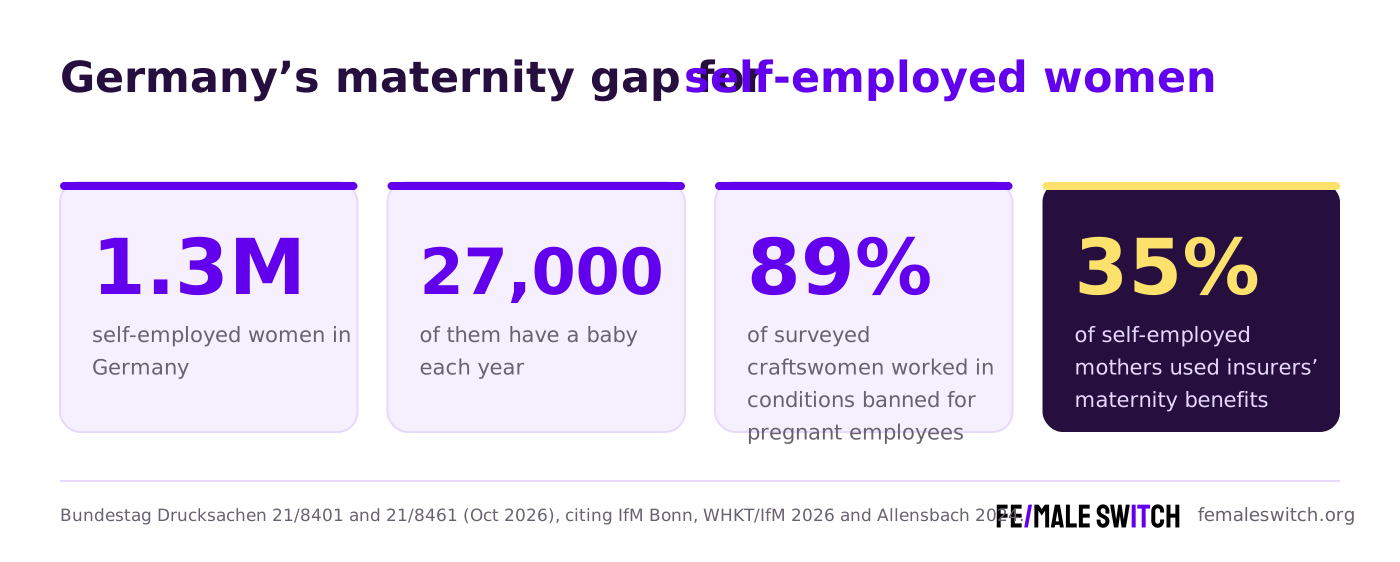
No, not yet. On Thursday 15 October 2026, the Bundestag debated four opposition motions for an hour, two of them on maternity protection for self-employed women. There was no vote: all four went to the family committee. The Greens want a €5,000 flat payment for every self-employed mother; the Left wants all self-employed people to pay into the U2 levy that already funds employees’ maternity pay. The coalition promised a solution in 2025, but no bill exists. About 27,000 self-employed women in Germany have a baby every year, so here’s what was said, what other EU countries already do, and how to protect yourself now. Read our earlier analysis of maternity leave and startup founding.
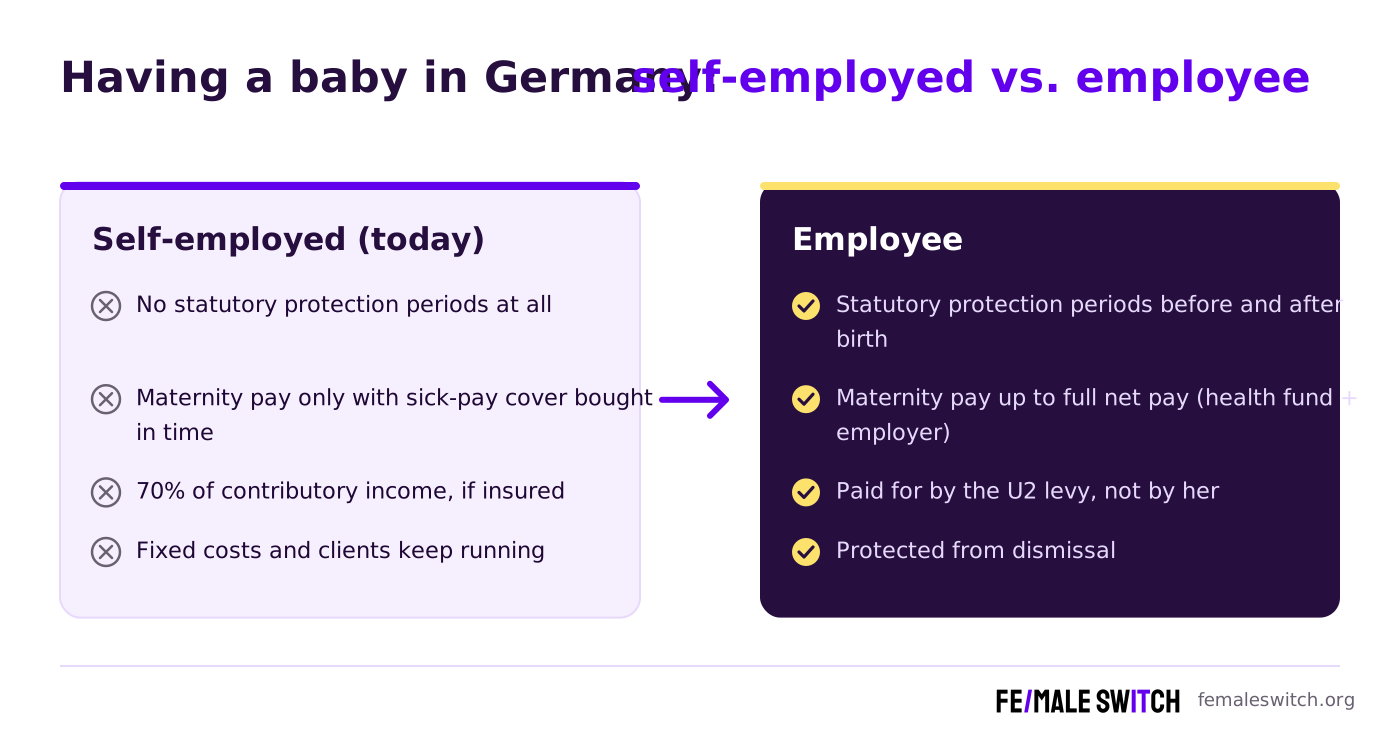
If you work for someone else in Germany, the law stops you from working in the weeks before and after giving birth, and pays you while you’re off. If you run your own business, none of that applies. You decide when to stop and when to come back, and you pay for the gap yourself.
On 15 October, that gap reached the floor of the Bundestag. Here’s what happened, and what it means if you’re a founder, freelancer or solo business owner thinking about a family.
What happened in the Bundestag on 15 October
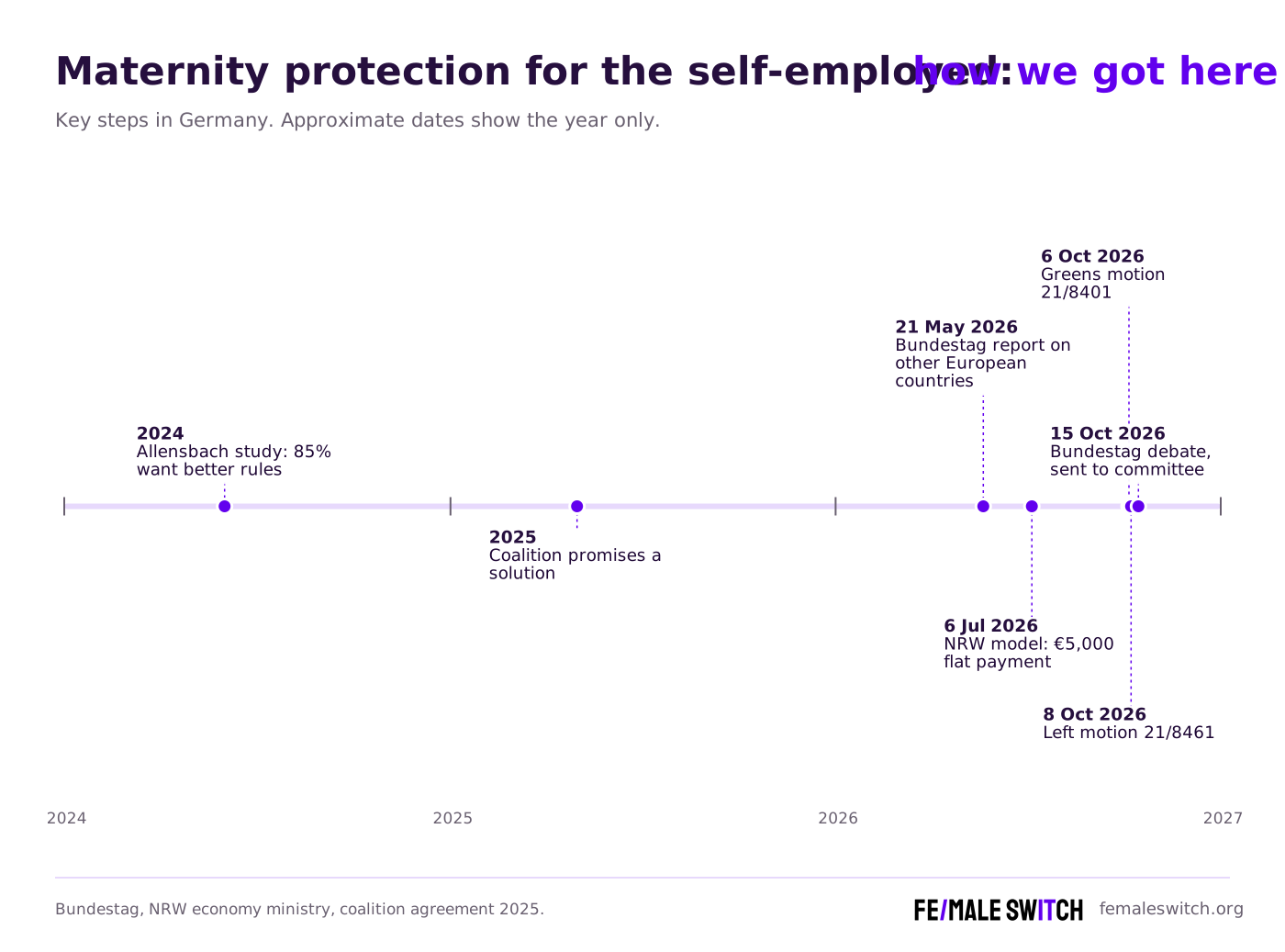
The Bundestag held a one-hour family-policy debate on four motions from the opposition, according to the Bundestag’s own report:
- Greens, 21/8401: “Mutterschutz für Selbstständige schaffen”, create maternity protection for the self-employed, with a €5,000 flat payment.
- Left, 21/8461: “Mutterschutz für Selbstständige ermöglichen”, open the U2 levy to all self-employed people.
- Greens, 21/8568: no cuts to family benefits, including the planned cut of Elterngeld from 14 to 12 months.
- Greens, 21/8314: support for single parents and action against child poverty.
After the debate, all four motions were referred to committees, with the Committee on Education, Family Affairs, Senior Citizens, Women and Youth in the lead. Nobody voted on the substance. A motion like this asks the government to act; it isn’t a law, and it doesn’t create any rights on its own.
Who said what
The quotes below come from the Bundestag’s summary of the speeches (our translation from German; the full transcript was not yet published on 16 October).
- Josephine Ortleb (SPD, governing coalition) called the missing protection a problem left unsolved for decades: “We can no longer accept this, because it touches a fundamental question of fairness.” She said the EU, the coalition agreement and the Basic Law all require every mother to be protected equally, and that neighbouring countries already have solutions.
- Kathrin Gebel (Left): “Every year we leave 27,000 mothers who are self-employed standing alone in the rain!” and “Half of the women are back at work less than four weeks after the birth!”
- Christoph Naser (CDU/CSU, governing coalition) spoke about family policy in general: “Anyone who makes big promises must also say how they will be paid for.” He said the coalition is focusing on early-childhood education, with €9 billion for daycare.
- Sebastian Maack (AfD) said the motions were stuck “in the first stage of cell division” and lost in generalities.
So the coalition’s junior partner, the SPD, openly backs a fix, while the CDU/CSU speaker stressed the cost. That tension is the story to watch.
What’s on the table
Three models are now in play. None of them is law. Here’s how they compare:
The €5,000 figure comes from a feasibility study by the West German Chamber of Crafts (WHKT) and the IfM Bonn, funded by North Rhine-Westphalia. The NRW economy ministry puts the cost of the personal payments at €135–190 million a year, based on about 27,000 pregnancies, plus up to €135 million for help with replacement workers.
The Greens’ motion also says Family Minister Karin Prien has not delivered the improvements she announced at the start of the year. The Left’s motion asks the government to table a bill “without delay”. In the 2025 coalition agreement, CDU/CSU and SPD wrote that they want maternity protection for the self-employed “analogous to the maternity protection periods for employees” and would “promptly examine” levy-based financing.
What self-employed mothers get today
Under current law, you only get maternity pay if you insured yourself for it in time. The economy ministry’s founder portal explains the two routes:
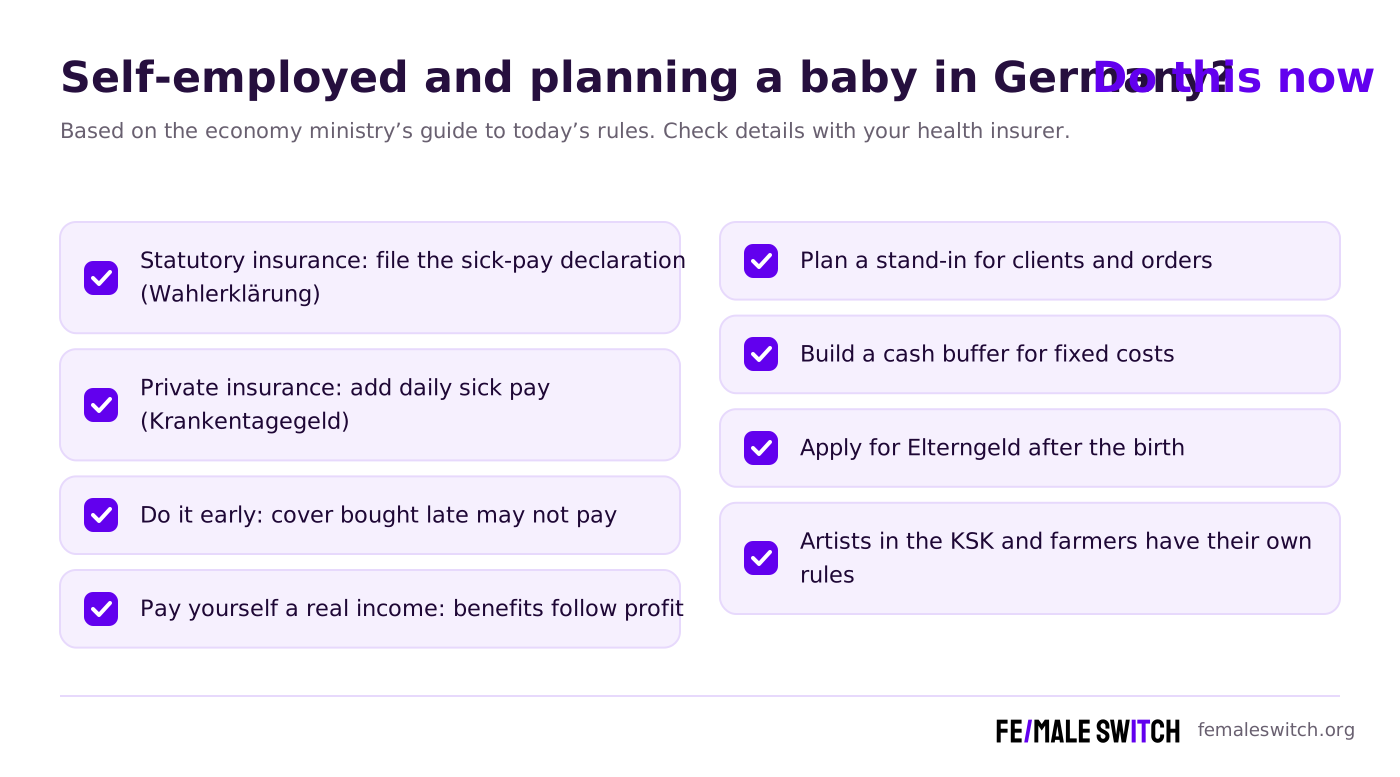
- Statutory health insurance: as a voluntary member, you file a Wahlerklärung for sick pay. You then pay 14.6% instead of 14.0% of your contributory income, at most €34.88 more a month in 2026, and you’re entitled to maternity pay during the protection periods. According to the Left’s motion, that maternity pay is 70% of your contributory income.
- Private health insurance: you need a Krankentagegeld (daily sick pay) policy. Without it, you get nothing during maternity leave.
- The catch: both depend on your income. If your business makes little or no profit yet, you get little or nothing, which hits early-stage founders hardest. The statutory option also binds you for three years.
Only 35% of self-employed women who had a child used these insurance benefits, according to a 2024 Allensbach study for the family ministry. For employees, the health fund pays €13 a day and the employer tops it up to full net pay. That top-up is funded by the U2 levy, which is exactly the system the Left wants to open to the self-employed.
How other European countries do it
EU Directive 2010/41/EU (Adopted) already requires member states to make sure self-employed women can get a maternity allowance for at least 14 weeks, though it can be voluntary. Several countries go much further. These figures come from the Bundestag research service report of 21 May 2026:
Sweden’s rule for new businesses is worth noticing: it solves exactly the “no profit yet, so no benefit” problem that German founders face. For more on how rules for women founders differ across the EU, see our overview of policy changes for women in the EU.
What this means for you
- Don’t wait for a law. Even if the committee moves fast, a bill would still have to be written, passed and funded. If you’re planning a baby in the next two years, insure yourself under today’s rules.
- Check your health insurance this month. Statutory: ask about the Wahlerklärung and optional tariffs. Private: ask about Krankentagegeld and when it starts paying.
- Pay yourself a real income. Benefits follow your profit. Founders who reinvest everything and show a tiny profit get tiny benefits. Our guide to tax essentials in Europe covers the basics.
- Plan the business, not just the leave. Who serves your clients for eight weeks? Can you pause subscriptions, automate delivery or bring in a freelancer? See how to balance family and business.
- Watch the budget, too. The planned Elterngeld cut from 14 to 12 months is part of the same fight. Our 2027 budget roundup for the self-employed tracks the other changes.
- You’re not alone in this. Women start businesses later and often around family life, as the GEM women’s entrepreneurship report showed this month. Look for government support for women entrepreneurs where you live.
Our sister site femaleswitch.com covered the motions before the debate in Germany debates maternity pay for self-employed women.
What to watch next
- The family committee: whether it holds a hearing on the two maternity motions. No date has been published.
- The Elterngeld and maternity protection reform: the government’s draft is still in talks between ministries. If self-employed women are added, that’s the real news.
- The full transcript: the Bundestag’s plenary record of the 15 October sitting will show every speech, including the coalition’s.
Build a business that can survive a pause
The Fe/male Switch startup game takes you from idea to first paying customers in weekly quests, with an AI co-founder, so you learn to build systems that don’t depend on you being there every day.
👉 Start the game
FAQ: maternity protection for self-employed women in Germany
Do self-employed women in Germany get maternity leave?
Not by law. The Maternity Protection Act covers employees, trainees and students. Self-employed women decide themselves when to stop and restart work, and only get maternity pay if they have sick-pay cover through their health insurance.
What did the Bundestag decide on 15 October 2026?
Nothing on the substance. It debated four opposition motions, including two on maternity protection for the self-employed, and referred all of them to committees, led by the family committee.
What is the €5,000 Mutterschaftsausgleich?
A flat payment for every self-employed woman on maternity leave, proposed by a WHKT/IfM Bonn feasibility study for North Rhine-Westphalia and taken up in the Greens’ motion 21/8401. It is not law.
What is the U2 levy?
A levy employers pay that funds maternity pay top-ups for employees. The Left’s motion 21/8461 wants all self-employed people to pay into it, so they would be covered too.
How can I get maternity pay as a self-employed woman now?
In statutory health insurance, file a Wahlerklärung for sick pay (at most €34.88 more a month in 2026); in private insurance, take out Krankentagegeld. Benefits depend on your income, so arrange it early.
Which EU countries protect self-employed mothers?
Denmark, Finland, France, Sweden and Spain all give self-employed mothers paid maternity benefits, according to the Bundestag research service. EU Directive 2010/41/EU requires at least the option of 14 weeks.
