
TL;DR: what do the 2027 budgets mean for freelancers and solo founders?
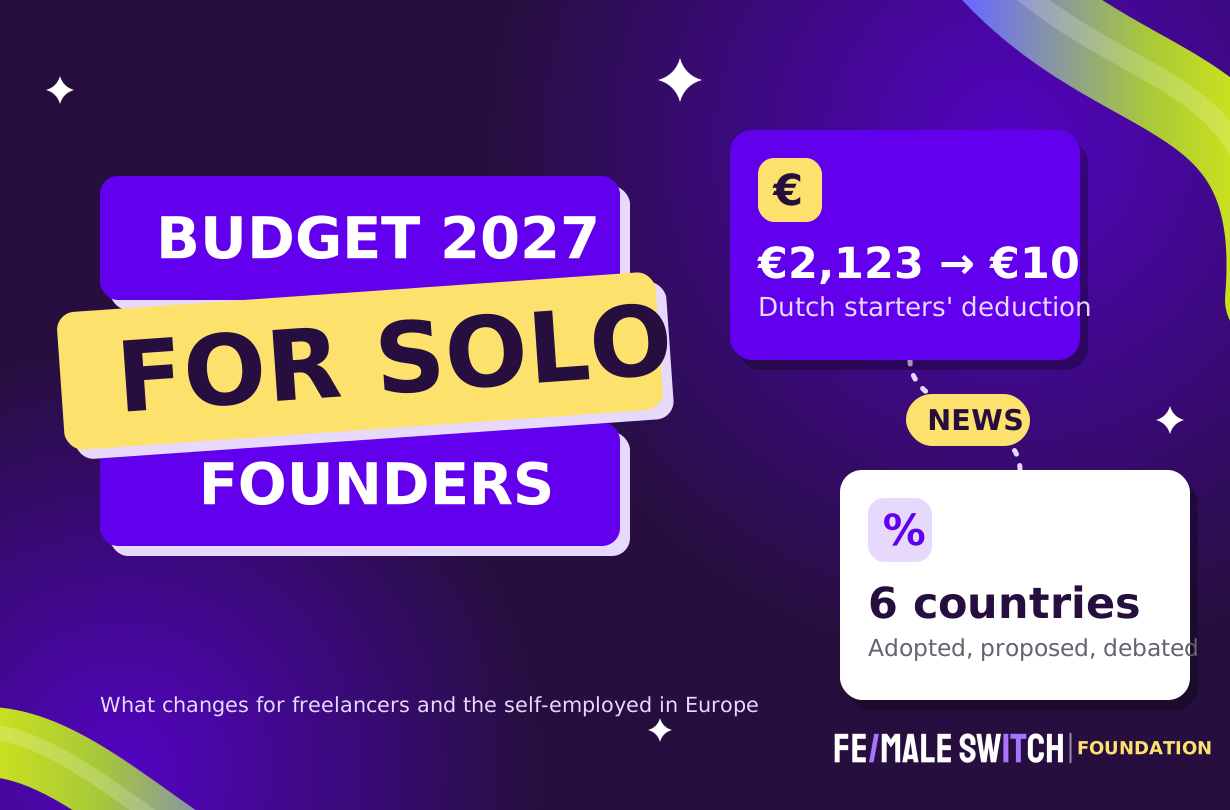
Autumn is budget season, and 2027 brings real changes for the self-employed. The Netherlands wants to cut the starters' deduction from €2,123 to €10 and scrap it in 2028. Italy is debating a higher flat-tax ceiling, while its employment-income limit drops back to €30,000. Spanish autónomos will pay a higher MEI surcharge, France proposes help for business takeovers, Ireland cut capital gains tax to 31%, and Germany is discussing compulsory pensions for the new self-employed. We mark each measure as adopted, proposed or debated, so you know what is certain.
Every autumn, European governments present their budgets, and every autumn the self-employed have to work out what changes for them. This year the changes are bigger than usual, especially in the Netherlands. Here is what's in the 2027 budgets for freelancers, sole traders and solo founders in six countries, and what you can do now.
One warning before we start: many of these are proposals. Budgets change in parliament. We label each measure: Adopted means it's already law, Proposed means it's in a bill, and Debated means a politician or party has suggested it but there is no legal text yet.
Netherlands: the starters' deduction all but disappears
The Dutch cabinet presented its Tax Plan 2027 (Belastingplan 2027) on Prinsjesdag, 15 September 2026. Both chambers of parliament still have to vote on it.
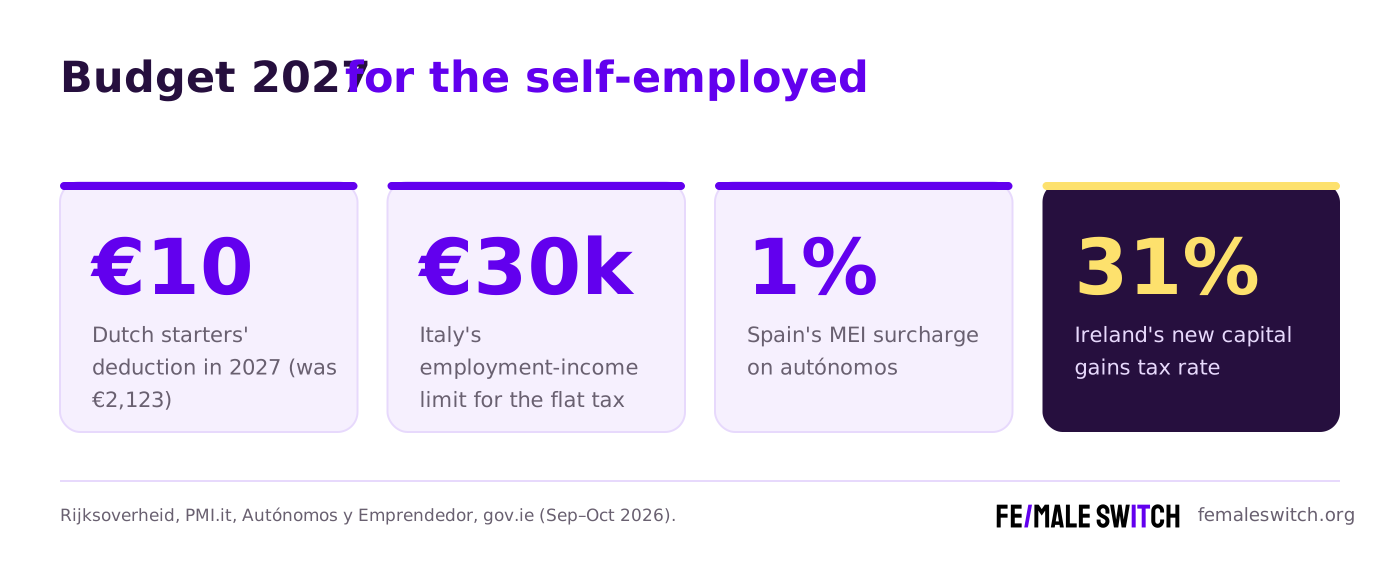
- Starters' deduction (startersaftrek): from €2,123 to €10 in 2027, and abolished from 2028. The €10 exists only because the tax authority's systems can't process zero, according to ZZP Nederland. Status: Proposed.
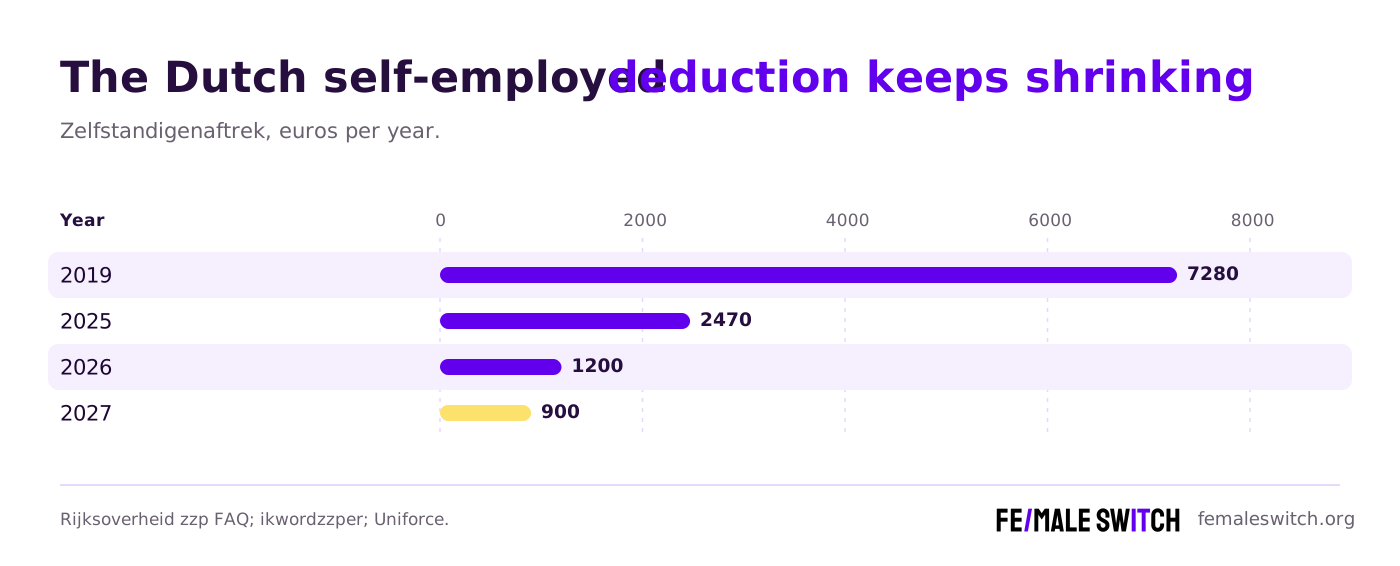
- Self-employed deduction (zelfstandigenaftrek): from €1,200 to €900 in 2027, the next step in a phase-out that's already law. In 2019 it was €7,280. Status: Adopted.
- SME profit exemption (MKB-winstvrijstelling): unchanged at 12.7% of profit.
- Box 3 (savings and investments): the planned tax on actual returns is on hold, and a new proposal is expected in spring 2027. Status: Debated.
The bigger change for Dutch freelancers isn't in the budget. Three things are moving at once:
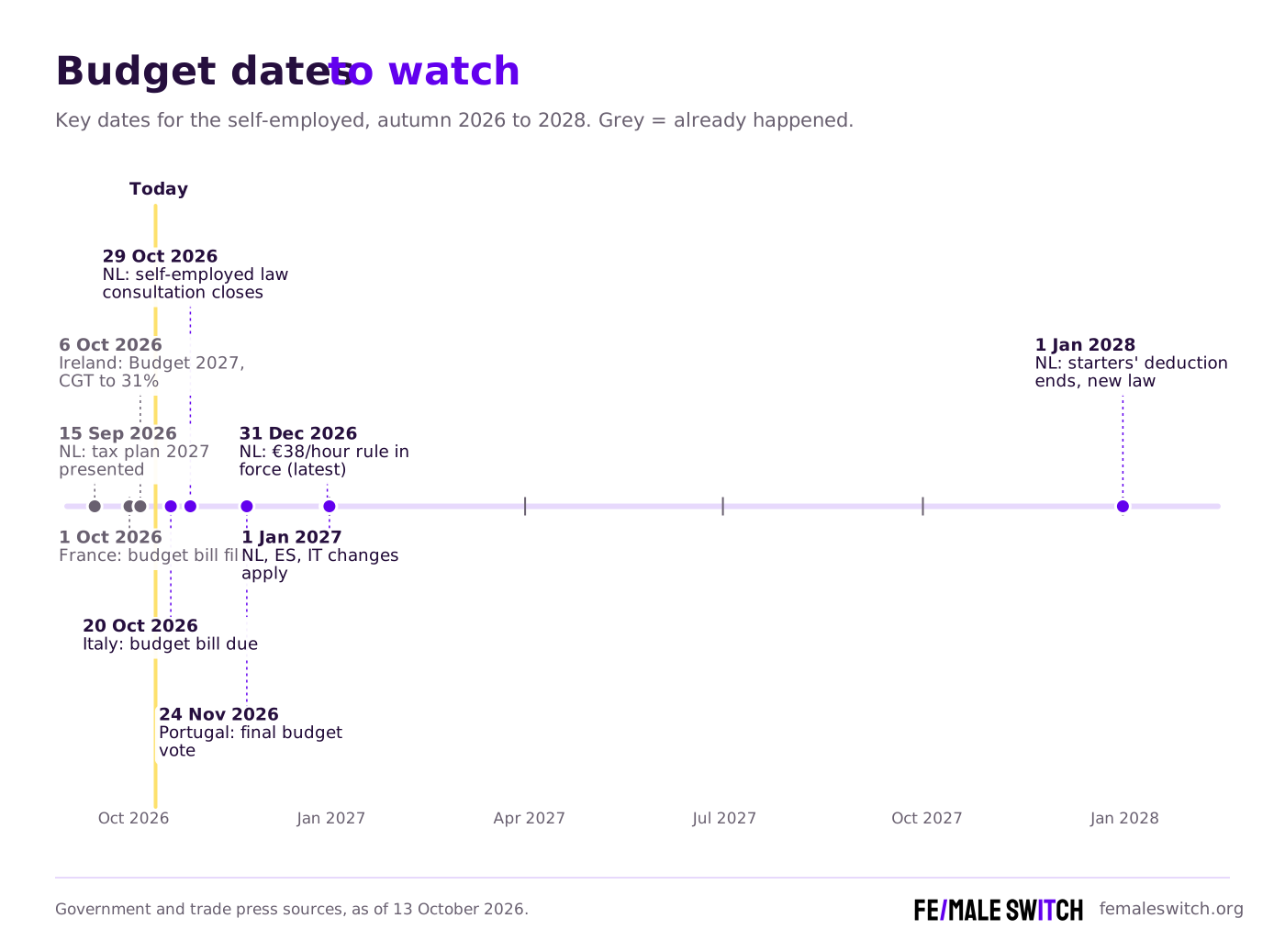
- The €38 rule. A new law presumes an employment contract when a self-employed person earns less than €38 an hour (2026 price level). It was adopted in June 2026 and is expected to take effect by the end of 2026. Status: Adopted, not yet in force.
- Enforcement is back. The Belastingdienst ended its enforcement pause on false self-employment on 1 January 2025. Since 2026 it can fine clients for culpable conduct.
- A new self-employed law (Zelfstandigenwet). The draft, open for public consultation until 29 October 2026, introduces two tests, including having at least three clients across the current and previous year. It's planned for 1 January 2028, with no transition period, according to Salaris Vanmorgen. Status: Debated (draft bill).
- Compulsory disability insurance (BAZ). The bill is in parliament: a premium of 5.4% of profit, capped at about €171 a month, with an opt-out for private insurance. The earliest start is 2030. Status: Proposed.
Starting a business in the Netherlands? Read our legal basics for the Netherlands. Freelancing there? Read what the draft Zelfstandigenwet means for Dutch freelancers, from the three-client test to the 29 October consultation deadline.
Italy: a €100,000 flat tax is on the table, but not yet law
The Italian government approved its public-finance plan on 2 October 2026, with a deficit of 3.4% of GDP in 2027. The budget bill itself is due in parliament by 20 October.
- Flat-tax (forfettario) ceiling from €85,000 to €100,000. A proposal from the Lega; the Economy Ministry is open to it but would need to negotiate with Brussels, because the EU VAT Directive caps the small-business VAT exemption at €85,000. Status: Debated.
- Employment-income limit back to €30,000. In 2026, flat-tax users could also earn up to €35,000 as employees. From 2027 the limit returns to €30,000, and 2026 income counts. Status: Adopted.
Why it matters: according to PMI.it, a professional with €95,000 in fees saves about €7,600 a year in the 15% flat-tax regime compared with ordinary income tax. That's why the €100,000 debate is so heated.
Spain: autónomos will pay a little more
- MEI surcharge from 0.9% to 1.0% of the contribution base on 1 January 2027, already set by law and paid entirely by the self-employed. On a €1,000 base, that's €10 instead of €9 a month. Status: Adopted.
- No new contribution tables yet. The income-based tables for 2027 are undefined, and Social Security hasn't negotiated with the self-employed associations for more than a year, according to Autónomos y Emprendedor. 2026 kept the 2025 tables.
- Flat rate for new autónomos (tarifa plana): €80 a month in 2026 for the first 12 months. From 2026 the amount is meant to be set in each year's state budget.
The self-employed association ATA is asking for a pause on any contribution increases until protection for the self-employed improves.
France: help for buying a business, little for micro-entrepreneurs
France's 2027 budget bill (PLF 2027) was filed on 1 October 2026 and is now being debated. According to KPMG Avocats, its main measures for small businesses focus on business takeovers (all Proposed):
- Takeover package (Pacte Papin), 2027–2029: an extra depreciation of 30% on new equipment for SMEs that are taken over, and 60% for micro-enterprises.
- Transfer duty of 0.1% when employees with long service buy the business they work for.
- Platform workers: the social security budget would make platforms deduct contributions at source for delivery riders and drivers from 2027.
What isn't changing: VAT franchise thresholds stay at €85,000 for goods and €37,500 for services, after the planned single €25,000 threshold was scrapped in 2025.
Ireland: lower capital gains tax and longer start-up reliefs
Ireland presented Budget 2027 on 6 October 2026. From the Finance Minister's statement:
- Capital gains tax down from 33% to 31% for disposals from 7 October 2026. Status: Adopted (in effect, to be confirmed in the Finance Bill).
- Earned Income Credit up by €125 for the self-employed, to €2,125 from 2027.
- Start-up reliefs extended: the SURE relief, the Employment and Investment Incentive, the Start-up Capital Incentive and Angel Investor Relief, subject to new EU state-aid rules. Corporation tax relief for start-ups runs to the end of 2030.
- Revised Entrepreneur Relief stays at 10% on gains up to a €1.5 million lifetime limit.
Germany: compulsory pensions for new self-employed?
Germany has no budget measure for the self-employed this autumn, but a bigger debate is under way. A government pension commission recommended in June 2026 that new self-employed people, from a cut-off date, join the statutory pension scheme without an opt-out, with half contributions for the first three years. Existing self-employed could opt out. The labour ministry wants a law this autumn, with 1 January 2027 as the earliest start, according to the self-employed association VGSD. There is no draft bill yet. Status: Debated. Maternity protection for self-employed women is the other open German file: on 15 October 2026 the Bundestag debated a €5,000 flat payment and sent it to committee, as explained in our report on maternity leave for self-employed women in Germany.
The small-business VAT threshold (Kleinunternehmer) stays at €25,000 of revenue in the previous year and €100,000 in the current year.
Portugal: no changes specific to the self-employed
Portugal's 2027 budget went to parliament on 8 October 2026, with a final vote on 24 November. Income tax brackets rise by 3.88%; we found no measure specific to the self-employed (recibos verdes).
All changes at a glance
What to do now
- Starting in the Netherlands? If you start in 2026 and meet the hours criterion (1,225 hours a year), you can still claim the €2,123 starters' deduction for 2026. Talk to an accountant about the timing.
- Check your rates. Dutch freelancers below €38 an hour risk being treated as employees. If you're close, it may be time to raise your prices.
- Have your say. The Dutch self-employed law consultation is open until 29 October 2026. Consultations are where small details get changed.
- Italian flat-tax users: watch your employment income in 2026, since it counts towards the €30,000 limit for 2027.
- Spanish autónomos: budget a small rise in contributions from January, and review your contribution base against your real income.
- Everyone: put aside tax money every month. Our guide to tax essentials for startup founders in Europe and the article on managing cash flow as you grow explain how.
Comparing countries before you start? See the cost of bootstrapping in different European countries on mean.ceo. This article is general information, not tax advice; check with a local accountant before you act.
Build a business that can pay its taxes
The Fe/male Switch startup game takes you from idea to first paying customers in weekly quests, with an AI co-founder and a community of founders.
👉 Start the game
FAQ: budget 2027 for the self-employed
Is the Dutch startersaftrek being abolished?
The Tax Plan 2027 proposes cutting it from €2,123 to €10 in 2027 and abolishing it from 2028. Parliament still has to approve it.
How much is the zelfstandigenaftrek in 2027?
€900, down from €1,200 in 2026. This reduction is already law.
Will Italy raise the forfettario limit to €100,000?
It's being debated. The Lega has proposed it and the Economy Ministry is open to it, but the EU VAT Directive caps the small-business VAT exemption at €85,000, so it would need talks with Brussels.
Do autónomos pay more in 2027?
Yes, slightly. The MEI surcharge rises from 0.9% to 1.0% of the contribution base on 1 January 2027. The 2027 contribution tables have not been set yet.
What did Ireland's Budget 2027 do for the self-employed?
It raised the Earned Income Credit by €125 to €2,125, cut capital gains tax from 33% to 31% from 7 October 2026, and extended start-up reliefs such as SURE and Angel Investor Relief.
Will the self-employed in Germany have to pay into the state pension?
Possibly. A pension commission recommended it for new self-employed people, and the labour ministry wants a law this autumn, but there's no draft bill yet.
