
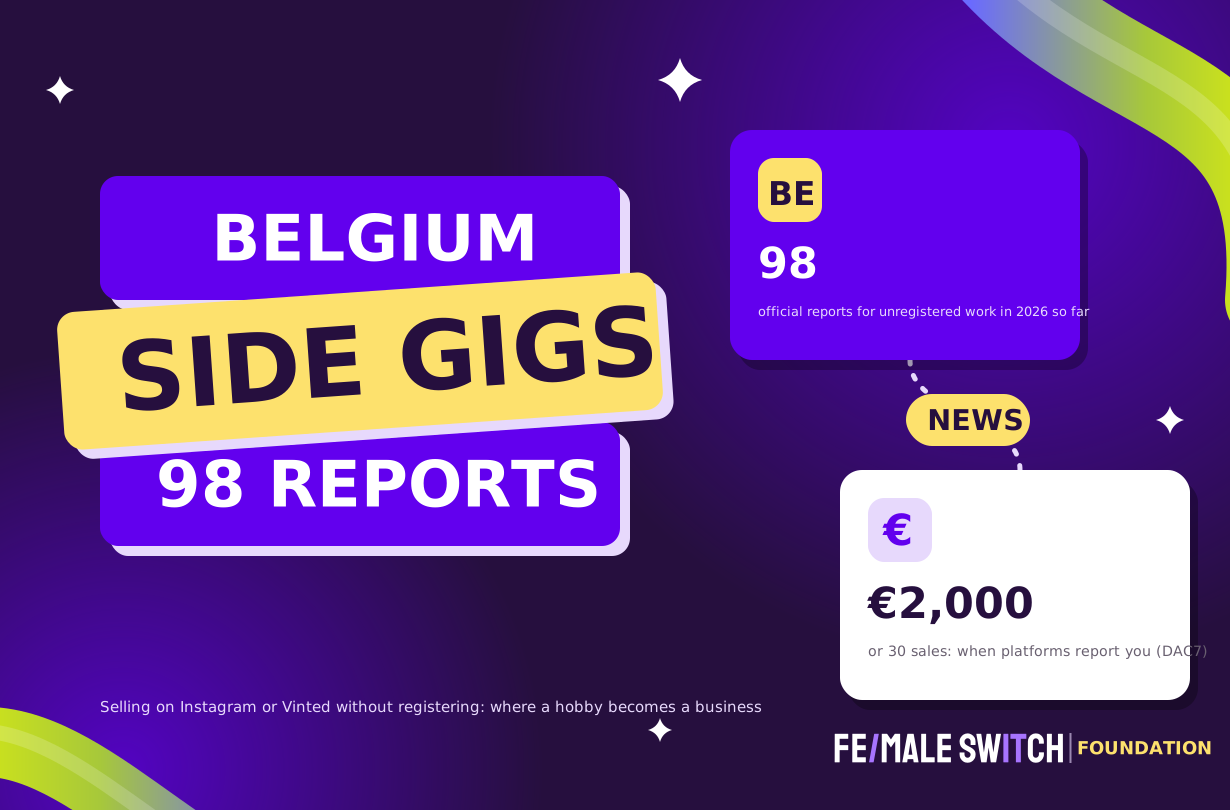
TL;DR: is Belgium fining people who sell on Instagram and Vinted?
Yes, if they work as self-employed without registering. Belgium’s Economic Inspectorate has drawn up 98 official reports (described in the press as fines) so far in 2026 for “sluikwerk”: regular self-employed activity without registration in the Crossroads Bank for Enterprises (KBO). The cases include selling cakes, clothes or catering through Instagram and Vinted, and offering services such as nails at home. This is not a new law; it is the enforcement of an existing one (Adopted). Selling your own used items now and then is still private. Making, reselling or offering paid services regularly is a business, and the cheapest fix is a side-job registration. If you are building a side income, our side hustle timeline shows when to make it official.
You bake on weekends and sell through Instagram. You do your friends’ nails and now their friends book you too. You buy vintage pieces at flea markets and resell them on Vinted. In Belgium, all three can now earn you a visit from an inspector.
On 26 October 2026, Het Nieuwsblad, Gazet van Antwerpen and the news agency Belga reported that the Economic Inspectorate has written up 98 people this year for working as self-employed without registering. Here is what happened, where the line between a hobby and a business sits, and what it means for you, in Belgium and elsewhere in Europe.
What happened
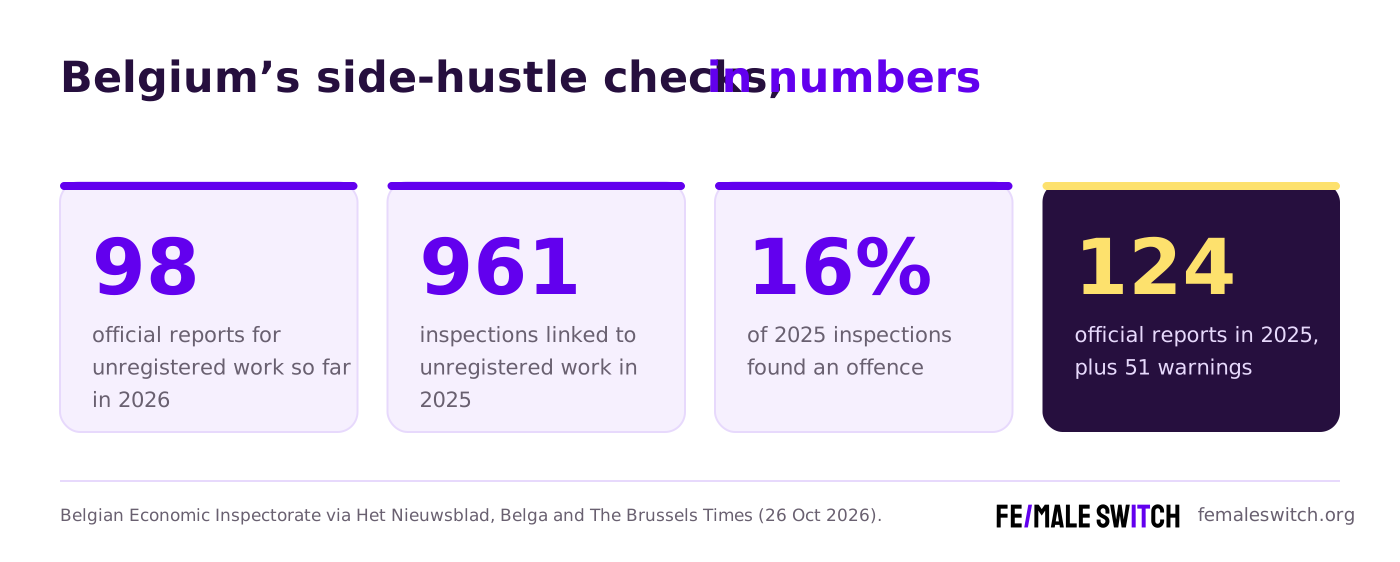
Belgium’s Economic Inspectorate, part of the federal public service for the economy (FPS Economy), has drawn up 98 official reports since the start of 2026 for sluikwerk, according to The Brussels Times, which carried the Belga story. The inspectorate stresses that the 98 are only part of the people breaking the rules.
The cases involve people who sell products or services through channels such as Instagram or Vinted without registering as self-employed, either as their main job or as a side job. Selling cakes online or offering nail treatments at home is allowed only if you are registered, the inspectorate says. Business AM lists recent targets: catering through social media, selling clothes on Vinted, and building or installation work.
Federal Consumer Protection Minister Rob Beenders (Vooruit) said, in the paraphrase carried by Belga, that an Instagram profile can quickly turn into a shop. That encourages entrepreneurship, he said, but it is no excuse for ignoring the rules. Gazet van Antwerpen summed up the official line in its headline: “Centje bijverdienen mag, maar je moet wel de regels volgen”, roughly “earning a bit on the side is fine, but you have to follow the rules”.
The 2026 count follows a busy 2025. Last year FPS Economy carried out 961 inspections linked to sluikwerk and found an offence in 16% of them, which led to 51 warnings and 124 official reports, The Brussels Times reports. No fine amounts were published.
Sluikwerk vs zwartwerk: what the inspectors are looking for
Belgium uses two words that are easy to mix up. FPS Economy’s consumer site ConsumerConnect explains that anyone who carries out a self-employed activity “op regelmatige basis” (on a regular basis) must be registered in the KBO. Doing so without registering is sluikwerk. Zwartwerk, undeclared work, is different: an employee working for an employer who does not declare them. That falls under the social inspection services, not FPS Economy.
So the question for a side hustle is not “do I earn a lot?” but “do I do this regularly, as a business?”. The inspectorate gives two reasons for acting. Unregistered sellers skip tax and social contributions, so they can charge less than registered ones, which “zorgt voor oneerlijke concurrentie” (creates unfair competition), as Gazet van Antwerpen quoted. And customers who buy from an unregistered trader lose part of their consumer protection, Business AM adds.
The approach is not to fine first. People who have just started usually get a warning, followed by a later inspection to check that they have registered. When minors are selling, their parents are questioned too, and the first focus is on information.
Where the line is in Belgium: four routes for side income
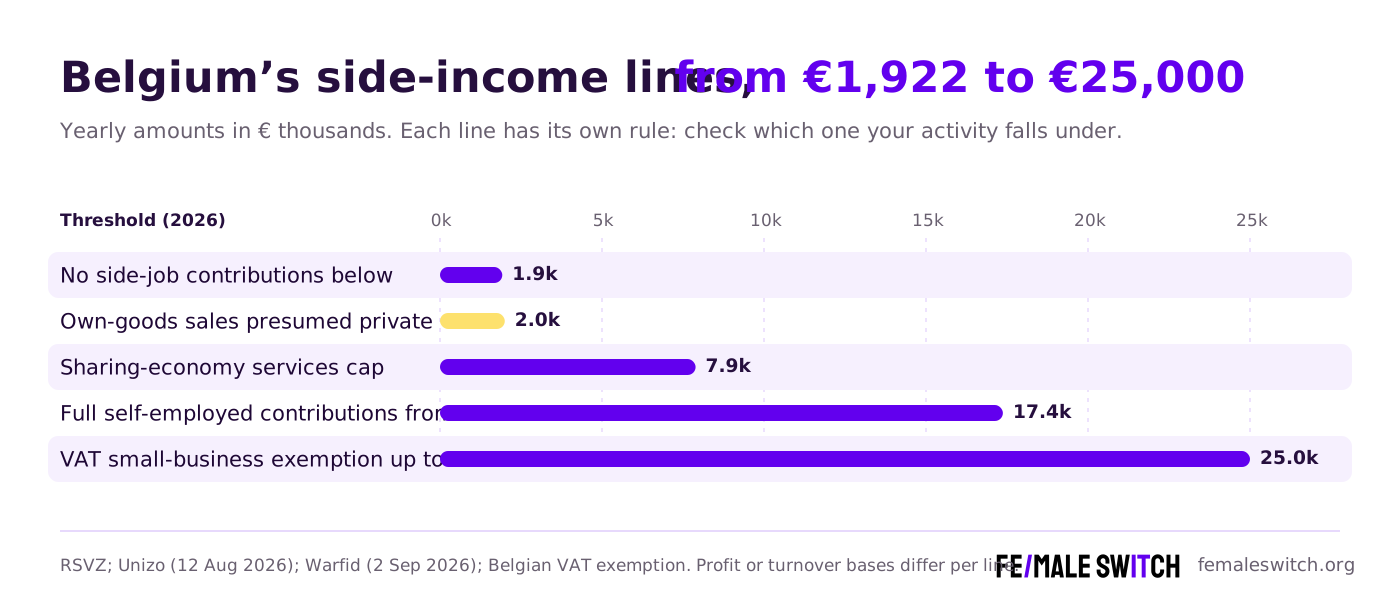
Not every euro you earn online needs a business registration. Belgium has separate rules for selling your own things, for small services through recognised platforms, and for real side businesses. All of them are Adopted law, except where marked.
Sources: RSVZ (side-job contributions); Unizo, updated 12 August 2026 (sharing economy); Accountable (registration fee); Warfid, 2 September 2026 (€2,000 line). Note: Warfid describes the €2,000 line as an irrebuttable presumption that applies to 2026 income; Unizo’s August update still called it a proposal awaiting Parliament. Check the final text with FPS Finance before you rely on it.
The side-job route is cheaper than many people think. According to the self-employed social security institute RSVZ, side-job self-employed people pay no social contributions on income below €1,922.16 a year and reduced contributions up to €17,374.08. They also have “dezelfde wettelijke verplichtingen”, the same legal obligations, as full-time self-employed people, and must report it within 15 days when they stop.
The sharing-economy regime is narrower than its name. According to employers’ organisation Unizo, it covers only services, only to private people, only through a recognised platform that also handles payment, and never your own professional activity. Go over €7,890 and you are treated as self-employed, with 20.5% social contributions on all of that income. Selling goods, such as cakes or clothes, does not qualify.
For occasional sales of your own things, tax adviser Warfid writes that gross sales under €2,000 in 2026 count as normal management of your private assets and so are not taxed. Above €2,000 you are not automatically taxed either: the tax authorities then look at the facts.
Why the platforms make side income visible everywhere in the EU
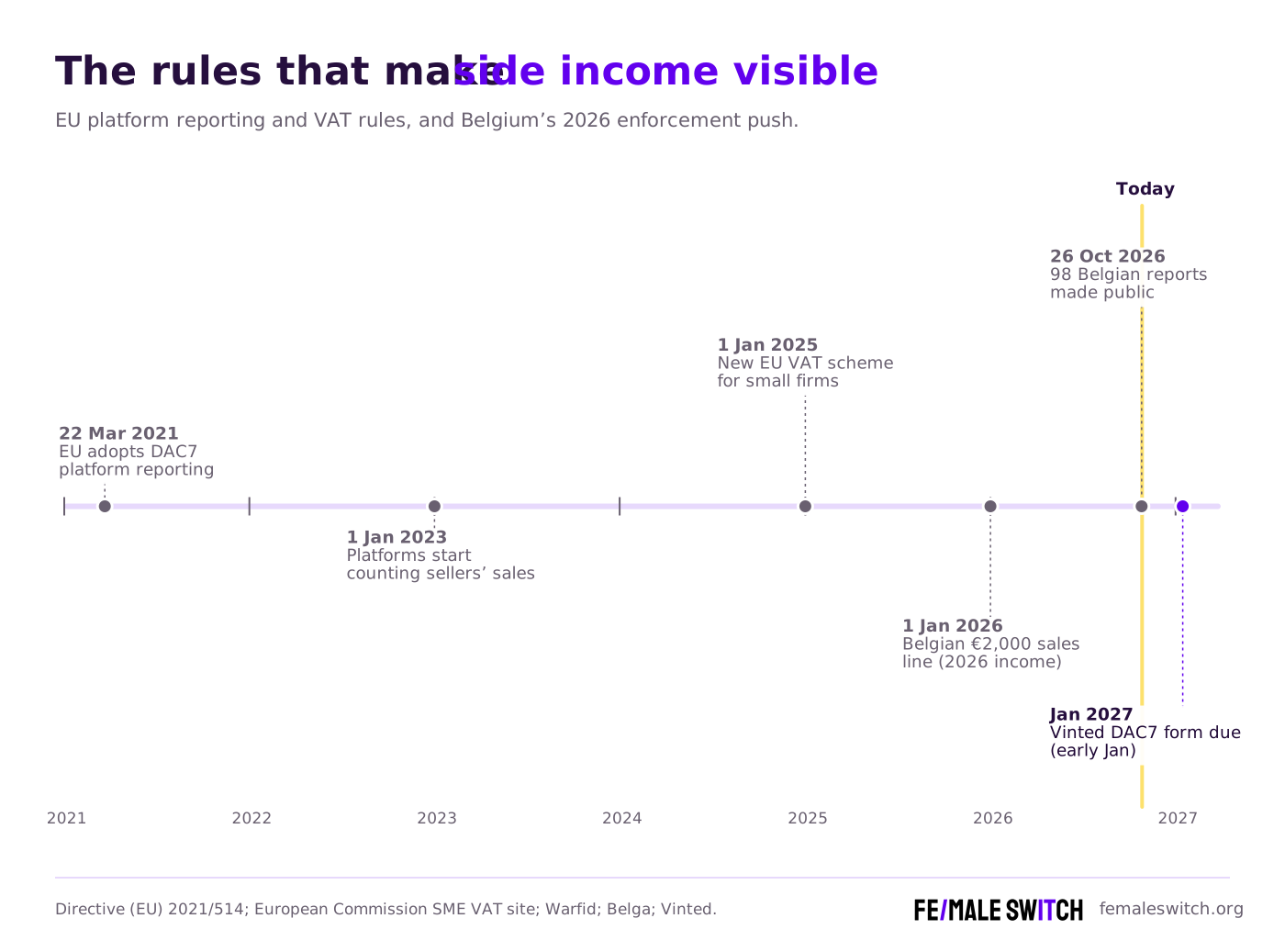
Belgium’s inspectors are not the only ones who can see what you sell online. Since 1 January 2023 the EU’s DAC7 directive (Adopted) has required platforms to report their sellers to tax authorities. Vinted’s own DAC7 page says the rule applies to anyone who makes “minstens 30 verkopen” (at least 30 sales) or earns more than €2,000 in a calendar year. Vinted also says that meeting those criteria does not mean you owe tax, but sellers who don’t fill in the form can lose the ability to sell or to reach their Vinted wallet.
A DAC7 report is not a tax bill, and the Belgian reports are not based on it. But it means the tax office has your name and turnover for each platform. If your Vinted shop is really a resale business, assume someone can see that. The same applies on Etsy, Airbnb and other platforms, and in every EU country, which matters if you sell abroad; see our guide to tax essentials for founders in Europe.
Once you register, VAT is the next line. Since 1 January 2025 the EU’s SME VAT scheme (Adopted) lets each country exempt small businesses with turnover up to €85,000 a year, and lets EU businesses with total EU turnover under €100,000 use exemptions in other member states too, where those states have put the scheme into national law. Businesses outside the EU, including the UK, can’t use it. If you are exempt, you can’t deduct VAT on your costs.
Sources: European Commission SME VAT site (EU, Italy, Ireland, Austria, Germany); Belgian and Dutch tax guidance (Belgium, Netherlands). Thresholds can change; check your country’s tax office.
Registering is a routine step in most of Europe, and many people take it. In the Netherlands, 82% of the 62,395 businesses started in the third quarter of 2026 were solo self-employed, according to the Dutch Chamber of Commerce KVK, even as the Dutch government tightens the rules on false self-employment. What changed in Belgium this year is how visible enforcement has become.
What this means for you
You don’t need to live in Belgium for this to matter. Every EU country has a line between a hobby and a business, and platforms now report the numbers. Here is what to do.
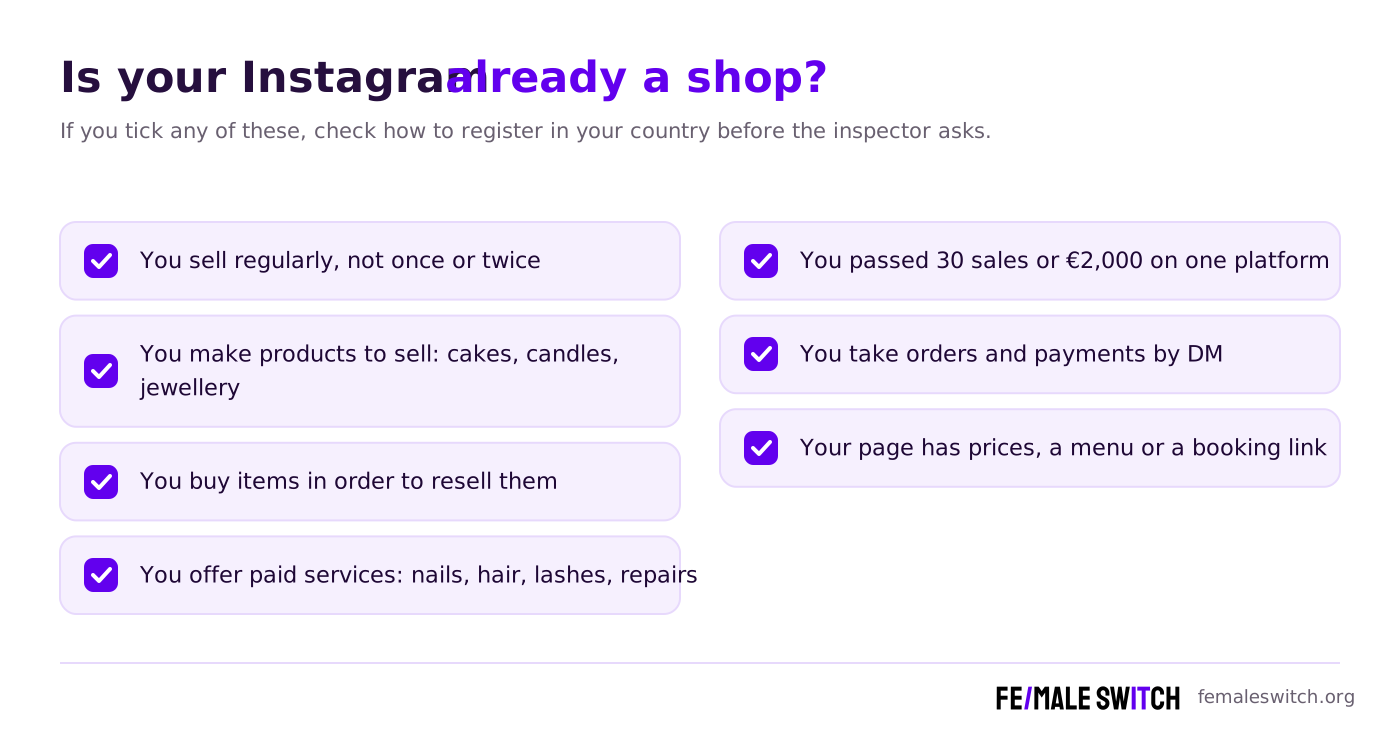
- Decide honestly what you are doing. Clearing out your wardrobe is private. Baking to order, making candles to sell, buying stock to resell or doing paid nails, hair or lashes is a business once it is regular. Our list of small business ideas from home shows how to start these properly.
- Register before the inspector comes, not after. In Belgium, a side-job registration costs €111.50 in 2026 and no social contributions below €1,922.16 a year. Elsewhere, look at your country’s light regime. Our overview of Budget 2027 changes for freelancers covers the Netherlands, Italy, Spain, France, Ireland and Germany.
- If you get a warning, act on it straight away. Belgian inspectors usually warn newcomers first and come back later. Use that window to register and fix your page.
- Put your enterprise number on your shop page. FPS Economy guidance says a business website or social media page must show your name, address, contact details and enterprise number, plus your VAT number if you charge VAT. It also makes buyers trust you more than a page that sells by DM only.
- Keep simple records. Note what you sold, whether it was your own item or stock, and what you earned per platform. If a DAC7 report reaches the tax office, you can show the difference. Our guide to financial management for non-finance founders keeps it light.
- Price like a registered business. If your low price only works because you pay no tax or contributions, your business isn’t viable yet. Rework it with our guide to pricing services versus products.
- Selling abroad? Check the VAT threshold in each country you sell to and the EU cross-border scheme. Shipping goods into the EU from outside? The new €2 parcel handling fee starts on 1 November.
Turning a hobby into a real business?
The Fe/male Switch startup game takes you from idea to first paying customers in weekly quests, with an AI co-founder, so you can test pricing, registration and your first sales before real money is at stake.
👉 Start the game
What to watch next
- The final text of Belgium’s €2,000 rule for occasional sales: advisers and Unizo describe its status differently, so watch for FPS Finance guidance before you file your 2026 return.
- More inspections: the inspectorate says the 98 reports are only part of the offenders, and warnings given this year will be followed by checks.
- DAC7 reports for 2026: platforms send them to tax authorities early next year, and Vinted asks sellers to complete its form by early January.
- National VAT schemes: not every EU country has fully put the 2025 cross-border scheme into law yet, so check before you rely on it abroad.
FAQ: selling on Instagram and Vinted without registering
Is it illegal to sell on Instagram without registering in Belgium?
If you do it regularly as a business, yes. Belgian law requires anyone with a regular self-employed activity to register in the Crossroads Bank for Enterprises (KBO). Working without registering is called sluikwerk, and the Economic Inspectorate has drawn up 98 official reports for it so far in 2026.
Do I need to register to sell my own clothes on Vinted?
Not if you are occasionally selling your own used items. That counts as managing your private assets. Buying clothes to resell, or selling regularly as a business, is different and needs a registration.
How much can I earn on the side in Belgium without paying social contributions?
As a registered side-job self-employed person, you pay no social contributions on income below €1,922.16 a year, according to RSVZ. Reduced contributions apply up to €17,374.08.
What is the €2,000 rule for Vinted sellers?
There are two. Under DAC7, platforms report sellers with at least 30 sales or more than €2,000 a year to the tax authorities; that is not a tax bill. Separately, Belgium has a €2,000 line under which occasional sales of your own goods are presumed private for 2026 income, according to tax advisers.
Will I get fined straight away?
Usually not if you are new. Belgian inspectors tend to give newcomers a warning first and check again later. If minors are selling, their parents are questioned and the first focus is on information.
Does this apply outside Belgium?
The word sluikwerk is Belgian, but every EU country requires a regular business to register, and DAC7 platform reporting and the EU SME VAT scheme apply everywhere in the EU. Check your own country’s registration rules and VAT threshold.
