
TL;DR: what is the EU’s €2 parcel handling fee?
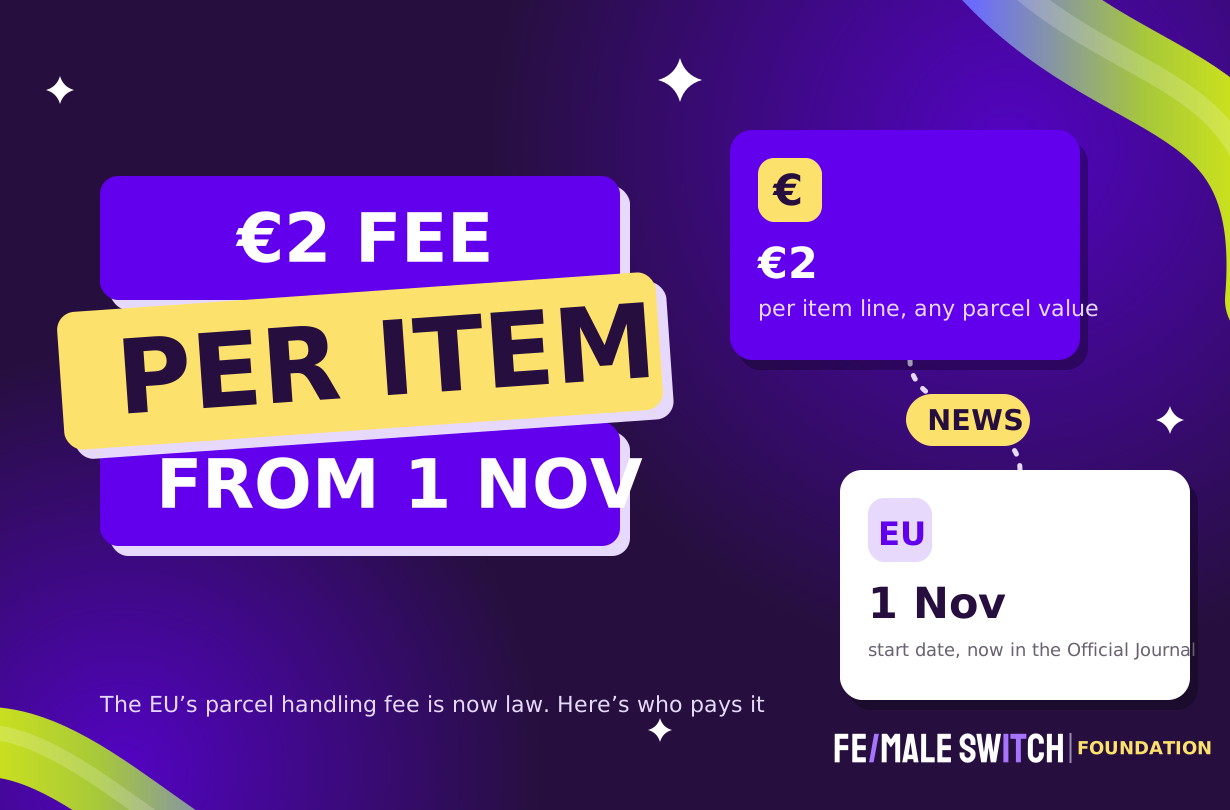
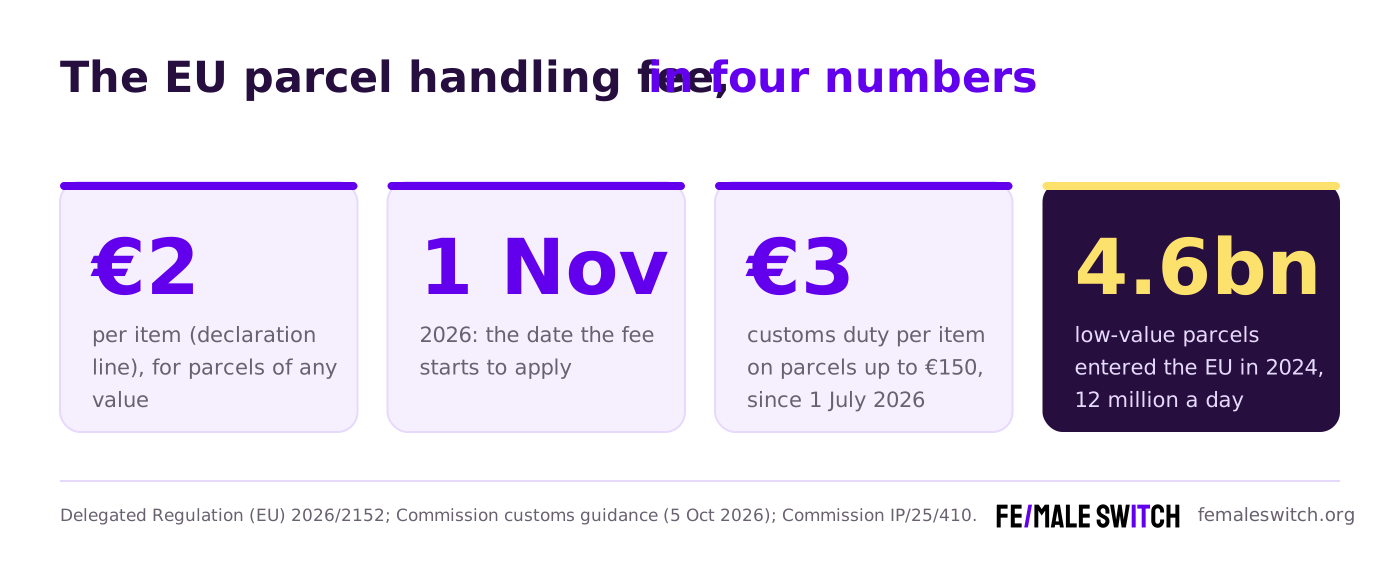
From 1 November 2026, EU customs will charge a €2 “Union handling fee” per item on goods sold online from outside the EU and shipped to consumers in the EU. It is now law (Adopted): Delegated Regulation (EU) 2026/2152 was published in the Official Journal on 22 October. The fee applies to parcels of any value, counts each distinct item line (identical units count once), comes on top of the €3 duty per item on parcels up to €150, carries VAT and is not refunded on returns. If you ship from the UK, the US, Switzerland or China to EU customers, or dropship from a non-EU supplier, your costs go up next week. If you sell EU stock to EU customers, nothing changes. Background on other new rules for small online sellers: our report on the EU packaging representative rule vote.
Since July, a €10 parcel of three small items bought online from outside the EU has carried €9 in customs duty. From Sunday 1 November, the same parcel carries €15, plus VAT. That jump comes from a new €2 fee per item that became law this week, and it lands hardest on the kind of sellers who read this blog: makers, small brands and solo founders with lots of small, different products.
Here is what changed on 22 October, how the fee is counted, who actually pays it, and what to do in the six days before it starts.
What happened on 22 October
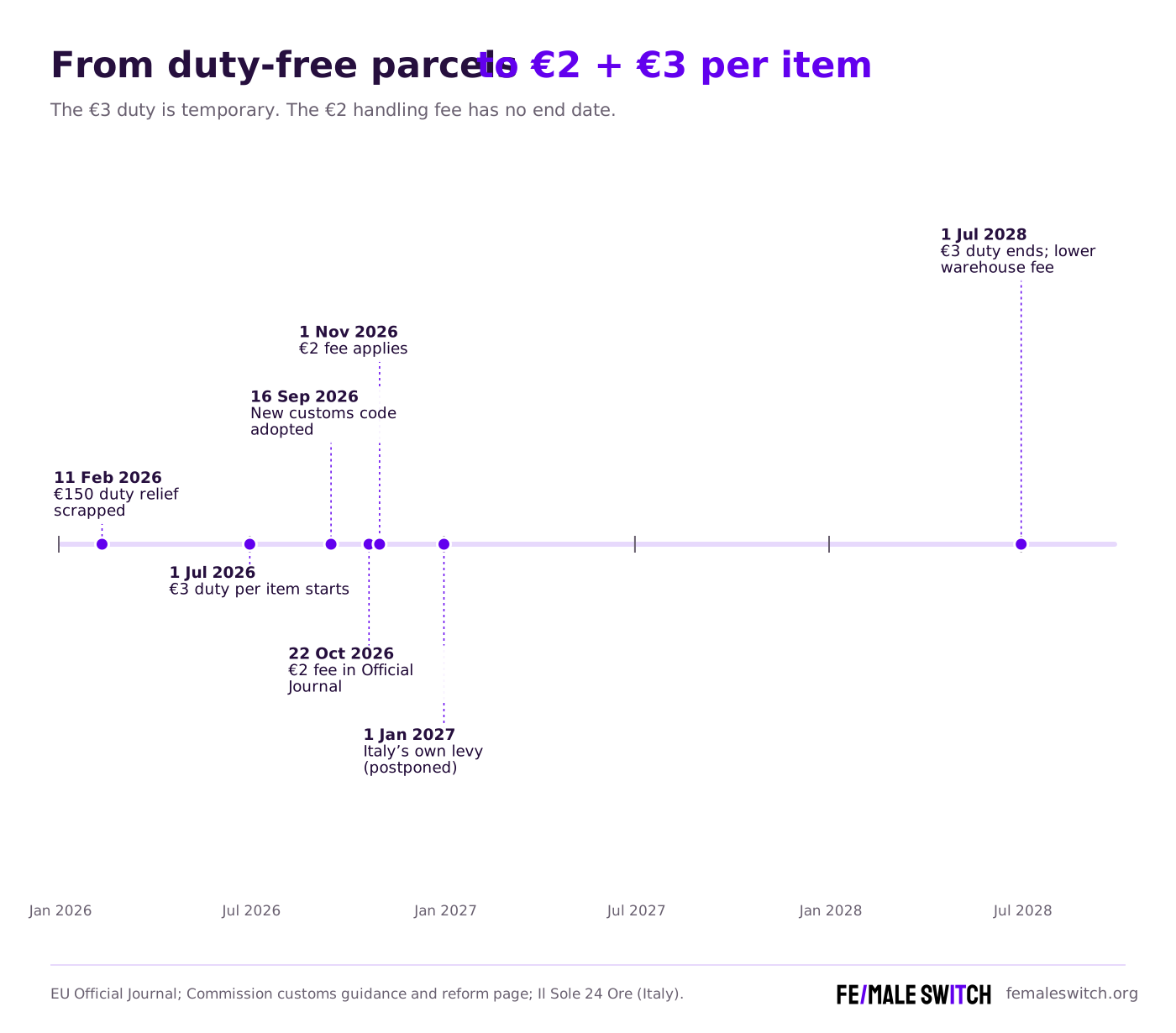
The European Commission adopted the act setting the fee on 21 September (document C(2026) 6694). Until this week it was still “under scrutiny”, and several national customs pages called the 1 November start “expected”. On 22 October it was published in the EU’s Official Journal as Commission Delegated Regulation (EU) 2026/2152. It entered into force the same day.
The text is short. Article 1 says the Union handling fee “shall be EUR 2 per item”. Article 2 says “It shall apply from 1 November 2026.” The Commission’s customs reform page confirms it: “From 1 November 2026, the EU will apply the €2 Union handling fee.” Status: Adopted.
The fee itself was created by the new Union Customs Code, Regulation (EU) 2026/2108, published on 19 September. Its Article 20 says customs “shall collect a Union handling fee of a fixed amount per item” for goods sold in distance sales, that the fee “shall be non-refundable”, and that it is paid by the person who owes the import customs debt. The delegated act only fixed the amount. The Commission says €2 matches the approximate cost of customs checks on these goods.
How the €2 is counted: per item line, not per parcel
This is the part most sellers get wrong. An “item” is not a single product unit. Under the new customs code, it is one or more goods in a consignment sharing the same tariff classification, description and origin. In practice, customs charge the fee per line on the customs declaration.
- Ten pairs of identical socks are one item: €2.
- A pen, a notebook and a key ring are three items: €6.
- Two shirts, three sweaters and a hat are three declaration lines: €6, according to Dutch Customs (page updated 22 October).
There is no value threshold. The Commission’s customs guidance of 5 October says the fee applies “irrespective of the items’ value”, so “goods in consignments valued above EUR 150 are also subject to the handling fee”. Unlike the €3 duty, the fee is “not limited in time as it is not temporary”.
Here is what that means for real parcels, using the official examples published by Irish Revenue and German Customs:
Sources: Irish Revenue examples (published 30 September) and German Customs (Zoll). VAT is charged on top: German Customs says the fee is part of the import VAT base, and the Commission guidance says “VAT will be due on the UHF”.
Who pays: you, your platform or your carrier
The consumer is not legally liable. The customs code says “the consumer should not be a debtor” of the fee. It is owed by whoever declares the goods: typically the seller or platform registered for the EU’s Import One-Stop Shop (IOSS), an indirect customs representative, or the carrier. Irish Revenue puts it simply: the fee is paid by the e-commerce seller or the delivery business, but “they may pass on the charge to the end consumer”.
Platforms are already moving. Etsy told sellers on 23 October that “eligible shipments to the EU will be subject to a new €2 Union handling fee per unique item per package. This new handling fee applies regardless of the value of the package.” Etsy says its own shipping labels account for the fee; sellers using other labels should check with their carrier. Etsy has also tightened its listing rules: it now bans AI-generated patterns and recipes and wants one real, unedited photo on most listings, as our report on Etsy’s new AI rules for sellers explains.
Two more rules matter if you sell through IOSS. If you charge the fee to your buyer at checkout, it becomes part of the price on which you declare VAT in your IOSS return. And from 1 November, product identifiers, such as your SKU or the manufacturer’s code, are mandatory on customs declarations for distance-sale goods worth up to €150. Etsy says it pulls them from your listings for Etsy labels.
Does it apply to you? Six common situations
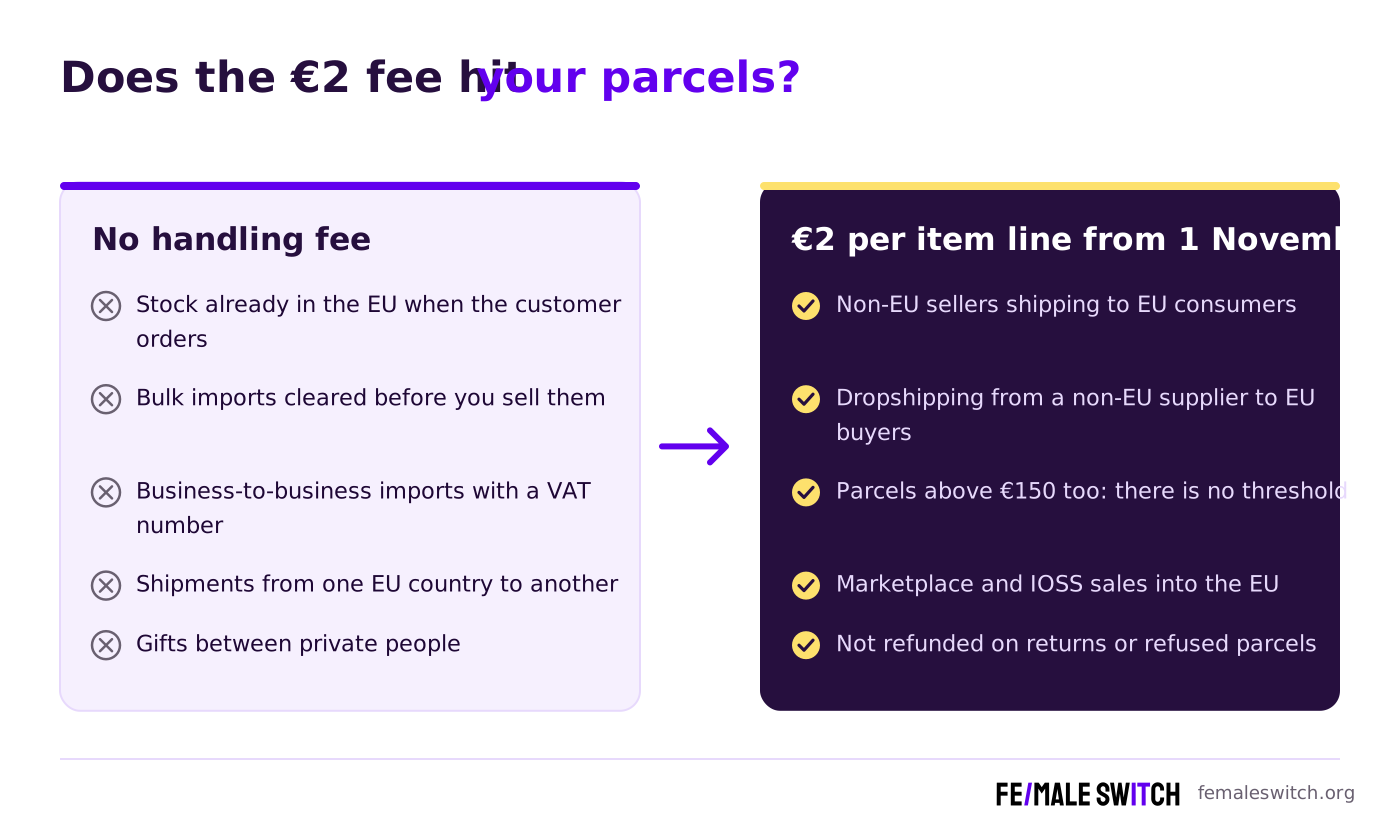
Sources: Commission customs guidance (5 October 2026); Irish Revenue; German Customs. The Commission is also changing the rules so that goods sold while they sit in a customs warehouse are caught too; a lower fee for warehouse goods comes only from 1 July 2028.
The fee is also final. It is due once customs accept the declaration, even if the parcel is later refused, undelivered or returned. Irish Revenue says it is non-refundable “even when goods are faulty or returned”. For small sellers with generous return policies, that is a cost you can’t claw back.
Why the EU is doing this
Volume. The Commission counted about 4.6 billion low-value parcels (worth €150 or less) entering the EU in 2024, or 12 million a day, twice as many as in 2023. It estimated 5.9 billion items for 2025, more than 90% of them from China. Until July, they entered duty-free.
The EU scrapped that €150 duty exemption from 1 July 2026 and replaced it, for now, with a flat €3 customs duty per item that runs until 1 July 2028. The €2 fee pays for the extra customs checks; Dutch Customs says the money funds extra staff, scanners and AI.
The early effect is visible. A spokesman for Cyprus customs told the Cyprus Mail on 21 October that parcels from outside the single market have fallen by 30 to 35 per cent since July, while the number of items per parcel rose. “This is not an additional duty. It is a fee for processing customs controls,” he said.
Italy shows how messy the national picture still is. Its own €2 levy on small non-EU parcels has been postponed for the fourth time, to 1 January 2027, Il Sole 24 Ore reported on 22 October. The Commission has said national handling fees must stop once the EU fee applies, so how Italy’s levy fits with the EU fee is not clear yet.
What this means for you
If you sell physical products across the EU border, treat 1 November like a price change from your supplier.
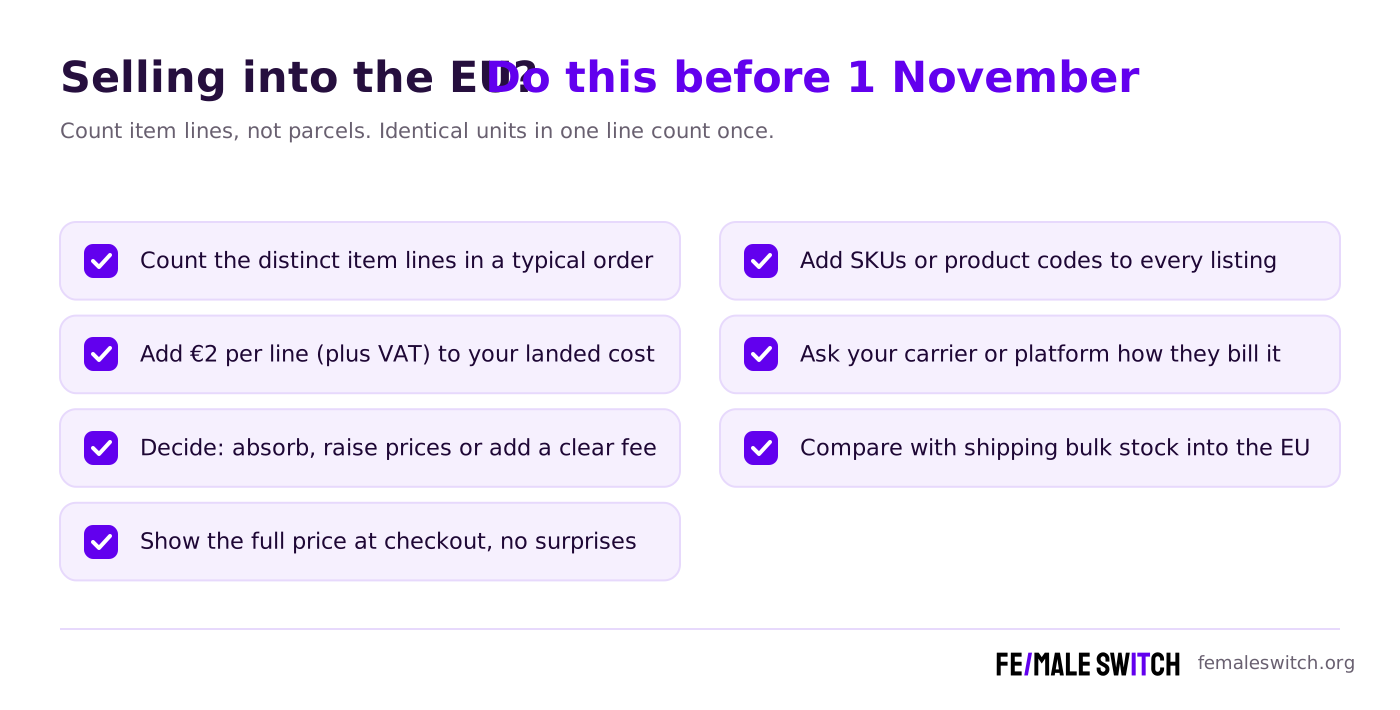
- Recalculate your landed cost per order. Count the distinct item lines in a typical order, add €2 per line plus VAT, and on parcels up to €150 the €3 duty per line as well. A three-product order now carries €15 before VAT. Our guide to pricing psychology and strategy helps you decide whether to absorb it or pass it on.
- Show the full price upfront. If you add a customs or handling charge, show it before checkout. Hidden extra charges are exactly what regulators fined companies for this month; see our report on fake countdown timers and hidden fees.
- Rethink your bundles. Five identical items cost one €2 fee; five different small items cost five. Kits made of one product type, or fewer variants per order, cut the charge.
- Consider EU stock. If you ship a lot into the EU, sending bulk stock to an EU warehouse or fulfilment partner and selling from there avoids the per-parcel fee and duty. Do the maths with customs, storage and VAT registration costs first. Our guide to expanding across Europe covers the practical steps.
- Fix your product data now. Add SKUs or manufacturer codes to every listing; they are mandatory on declarations for parcels up to €150 from 1 November. If you are setting up a shop, our no-code e-commerce guide walks through setting up a shop on the common platforms.
- Ask your carrier and platform how they bill it. Etsy builds the fee into its labels. Carriers and IOSS intermediaries may charge it to you monthly or per parcel. Check your VAT treatment too; our tax essentials for founders in Europe explain the basics.
Want to test a pricing change before your customers see it?
The Fe/male Switch startup game takes you from idea to first paying customers in weekly quests, with an AI co-founder, so you can practise pricing, costs and first sales decisions in a safe space first.
👉 Start the game
What to watch next
- 1 November: the fee and mandatory product identifiers start. Watch for delays at carriers in the first weeks.
- Customs warehouses: the Commission’s amendment so that sales made while goods are stored in a customs warehouse also pay.
- Italy: whether its national levy really starts on 1 January 2027, or is dropped.
- 1 July 2028: the €3 duty ends and a lower handling fee for customs warehouses applies; platforms become “importers” for distance sales, per the Commission’s reform plan.
FAQ: the EU €2 Union handling fee
What is the EU Union handling fee?
It is a €2 fee that EU customs charge per item on goods sold online from outside the EU and shipped to consumers in the EU. It was set by Commission Delegated Regulation (EU) 2026/2152, published on 22 October 2026, and applies from 1 November 2026.
Is the €2 fee per parcel or per item?
Per item, which in practice means per line on the customs declaration. Identical goods with the same tariff code, description and origin count as one item, so ten identical pairs of socks cost €2, while a pen, a notebook and a key ring cost €6.
Does the handling fee apply to parcels over €150?
Yes. There is no value threshold. Parcels over €150 pay normal customs duty plus €2 per item. Parcels up to €150 pay the €3 duty per item plus €2 per item.
Who pays the €2 handling fee?
The person who declares the goods to customs, usually the seller or platform registered for IOSS, an indirect customs representative or the carrier. The consumer is not legally liable, but sellers and carriers may pass the cost on.
Is the handling fee refunded if the customer returns the goods?
No. The fee is non-refundable once customs accept the declaration, even if the parcel is refused, undelivered, faulty or returned.
Do EU sellers have to pay the handling fee?
Only on goods that come from outside the EU when the customer orders, for example in dropshipping. Goods already in the EU, shipments between EU countries and business imports with a VAT number are not distance sales and do not pay it.
