
TL;DR: did the EU just scrap the packaging representative rule for small sellers?
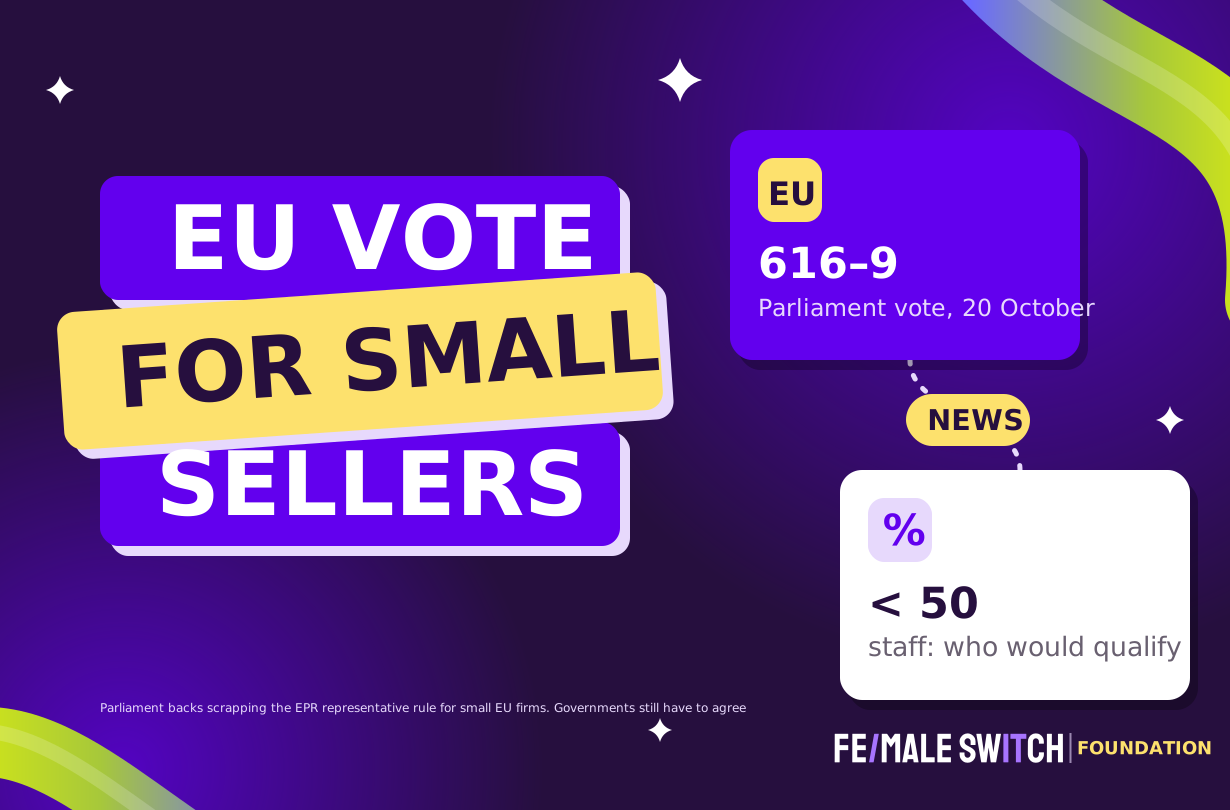
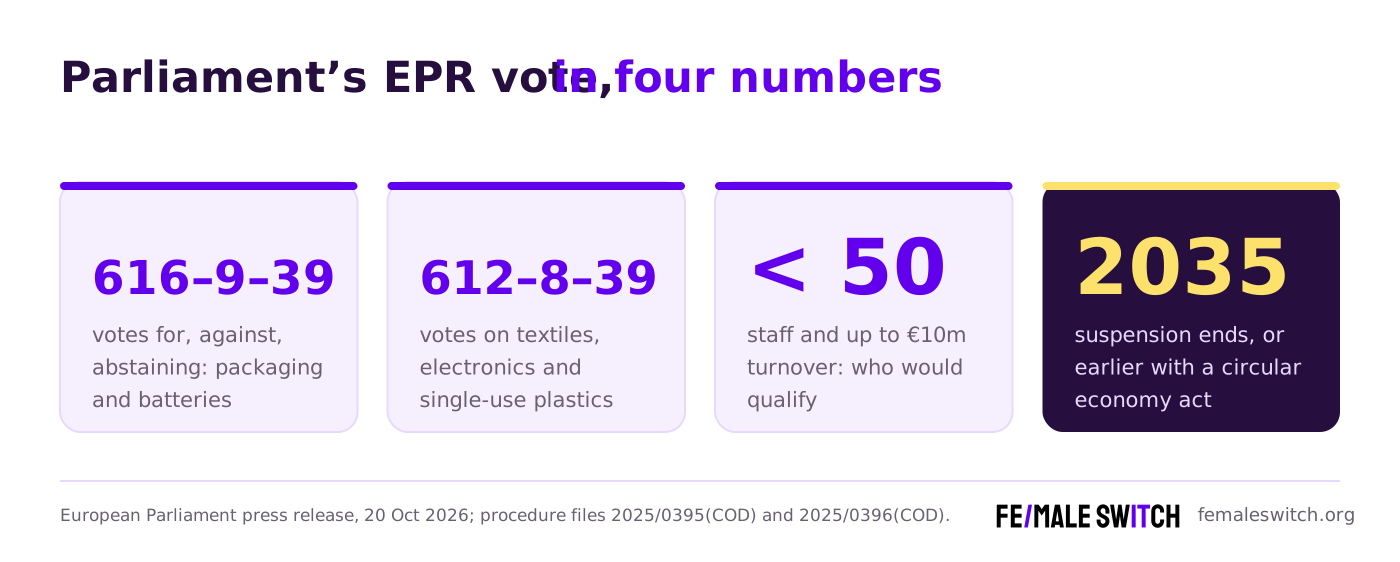
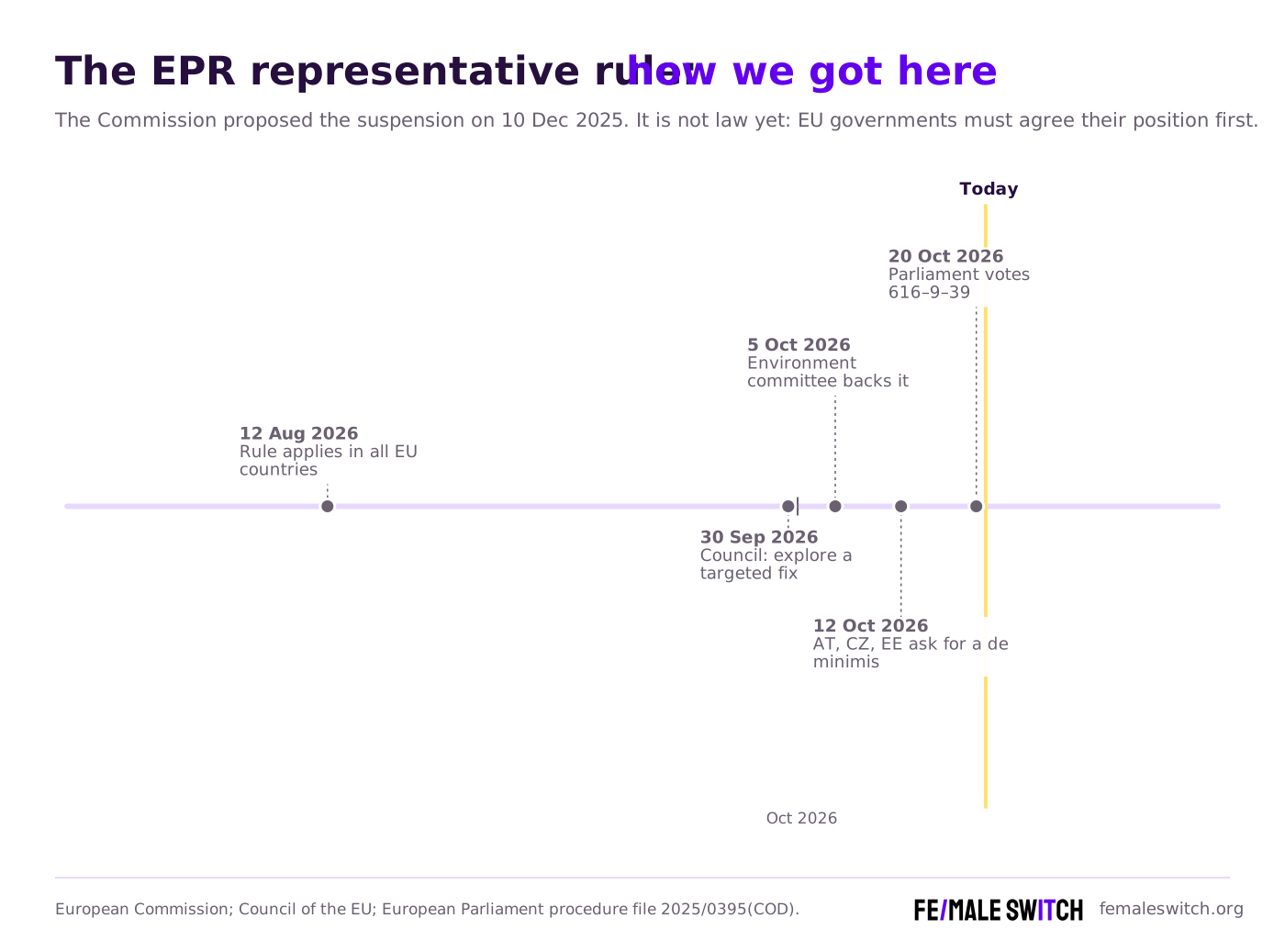
Not yet. On 20 October 2026 the European Parliament voted 616 to 9, with 39 abstentions, to suspend the duty to appoint an “authorised representative” for extended producer responsibility (EPR) in every other EU country where you sell. A second vote, 612 to 8, extends the same relief to textiles, footwear, electronics and single-use plastics. Parliament wants it only for EU-based small and micro firms, with fewer than 50 employees and a turnover or balance sheet under €10 million, until 2035. It is Proposed: EU governments have no position yet, and the rule has applied to packaging since 12 August 2026. Registration and fees stay either way. Background: our report on EU packaging rules for small online sellers.
If you sell candles, cosmetics or handmade clothes online and ship them to customers in other EU countries, this vote is about you. Since August, the EU’s packaging regulation has asked even the smallest cross-border seller to hire a representative in each country it ships to. As Packaging Europe reported in September, registering can cost over €500 per country, and a representative another €200 to €800 per country.
On Tuesday, MEPs from almost every political group voted to lift it for small companies. The vote was a big win, but it is only half the process. Here’s what Parliament decided, what still applies today, and what to do with your next invoice from a compliance provider.
What happened: two votes, one message
20 October, Strasbourg. Parliament adopted its position on two laws from the Commission’s environmental omnibus package, the Parliament announced. The first, a regulation, covers packaging and batteries. The second, a directive, covers waste rules for textiles and footwear, electrical and electronic equipment, and single-use plastics.
In both, MEPs back “a more targeted suspension” than the Commission proposed. It would apply “only to EU-based small and micro enterprises (fewer than 50 employees and an annual turnover or balance sheet under €10 million) and until 2035, or until a more comprehensive circular economy act is adopted.” MEPs also say the suspension “does not affect other obligations under the EPR system, for example waste-prevention or fees.”
They added three asks for the single market: better information exchange between member states, digital systems that work with each other, and common reporting requirements for companies.
The rapporteur, Dutch MEP Ingeborg ter Laak (EPP), said: “It is clear that companies should take responsibility for the waste they produce, and that products need to be collected and recycled properly. We should reach these goals without creating unnecessary obstacles for the businesses we want to see succeed in Europe.”
Sources: European Parliament press release of 20 October 2026; Legislative Observatory procedure files. Both files went through the environment committee (ENVI) on 5 October.
Who still needs an authorised representative
Article 45(3) of the packaging regulation is the rule in question. If you sell packaged goods directly to end users in another EU country, you must appoint, by written mandate, a representative for your EPR duties there. The European Commission’s page for small businesses says: “Since August 2026 the requirement applies to all Member States.” It has asked countries to “abstain from sanctioning operators” while lawmakers decide, but that is a request, not a legal exemption.
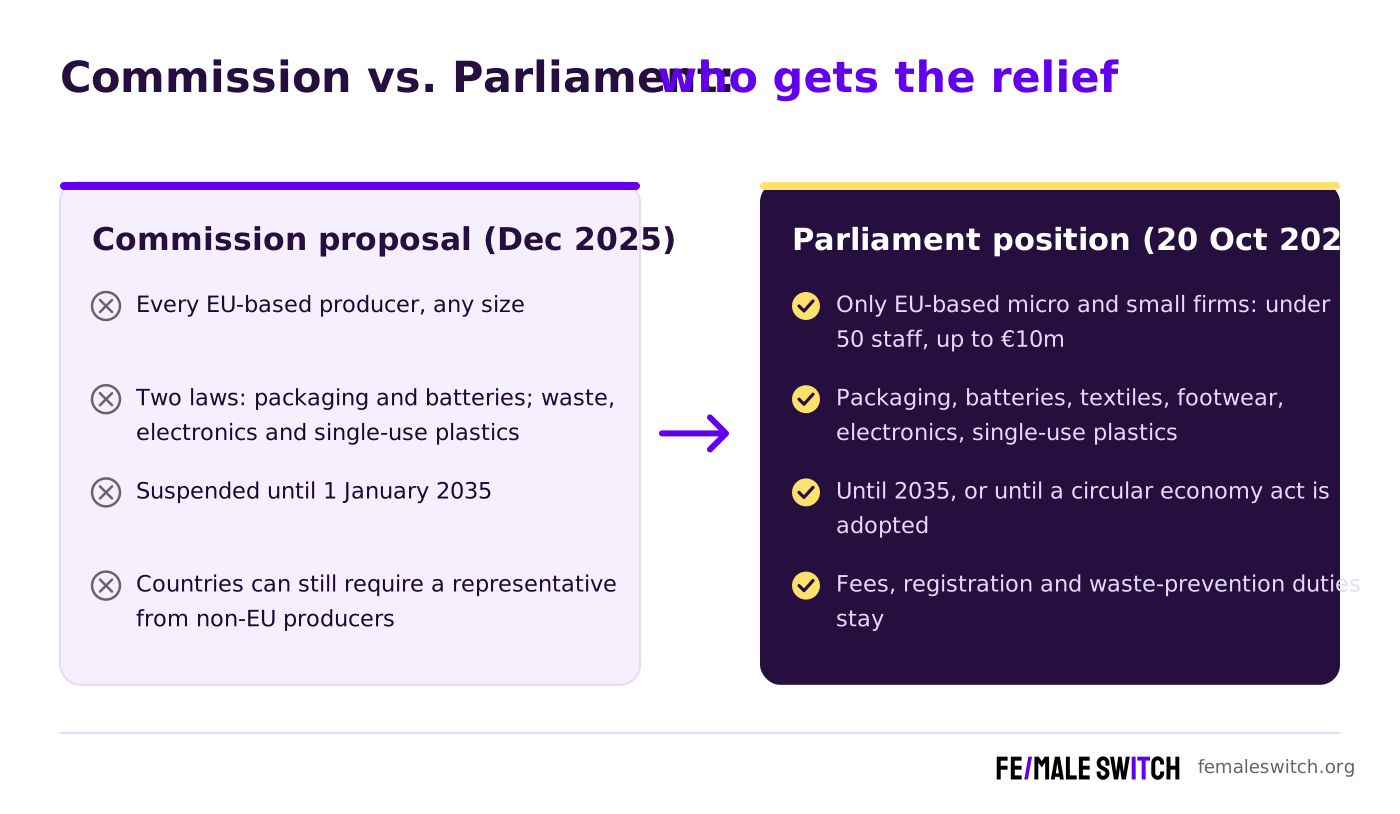
Here is how Parliament’s version would change things for packaging, if EU governments accept it:
Sources: European Parliament; European Commission; Regulation (EU) 2025/40. The European Commission’s original proposal COM(2025) 982 would have suspended the rule for every EU-based producer until 1 January 2035, whatever its size.
A rare cross-party vote
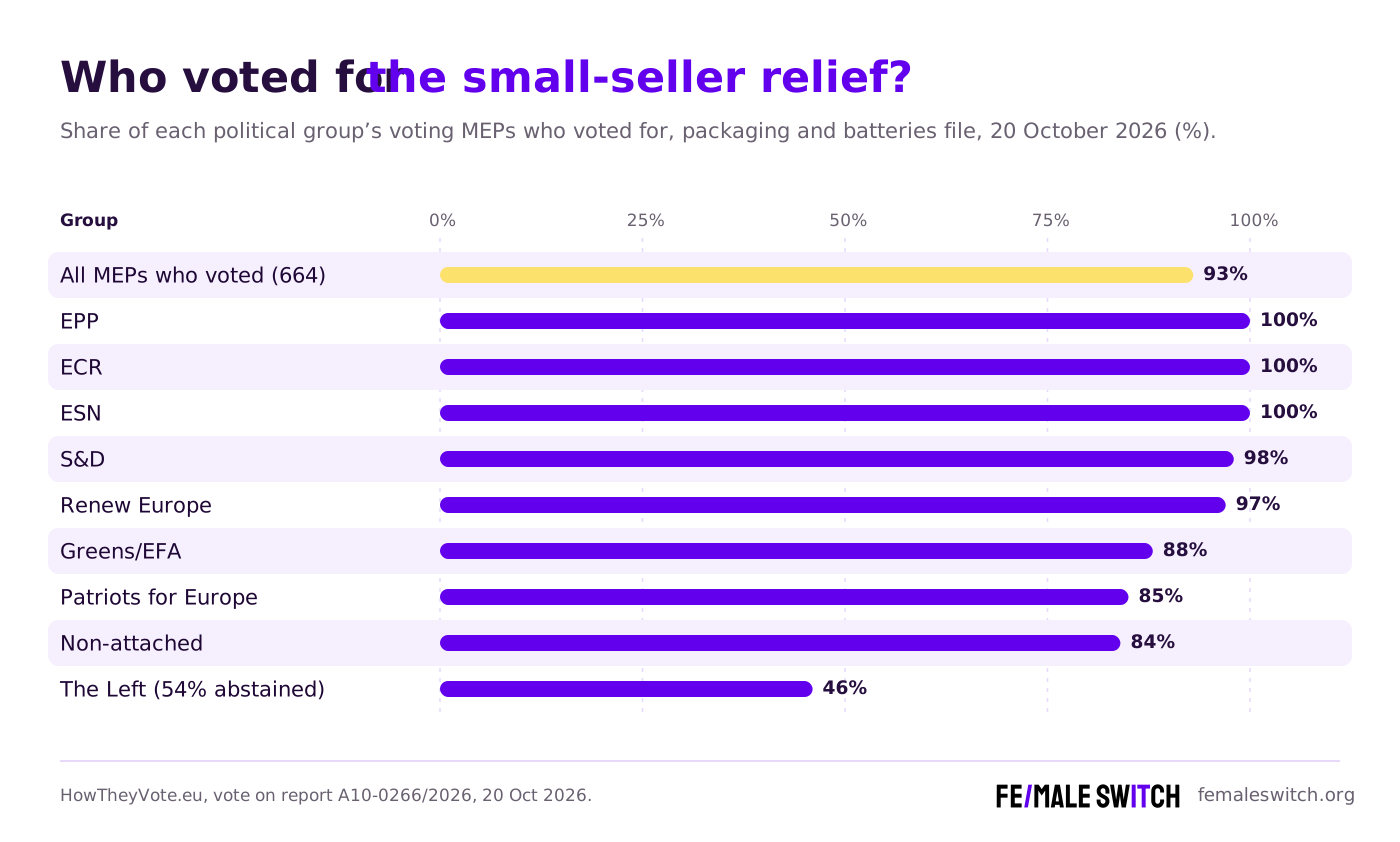
93% of the MEPs who voted backed the packaging and batteries file. According to HowTheyVote.eu, which tracks roll-call votes, every voting member of the centre-right EPP, the conservative ECR and the far-right ESN group voted for it. So did 98% of Socialists and 97% of liberal Renew MEPs. The Greens backed it with 43 votes and 6 abstentions.
The only group that hesitated was The Left: 19 of its MEPs voted for and 22 abstained. Of the 9 votes against, 5 came from the Patriots for Europe, 3 from non-attached MEPs and 1 from Renew. By country, 84 of Germany’s 87 voting MEPs and 64 of France’s 76 voted in favour; the rest of the French MEPs abstained.
The catch: EU governments haven’t agreed yet
Parliament adopted its position “ahead of trilogue negotiations”, the talks in which Parliament and EU governments agree a final text. “Once the Council has also adopted its position, negotiations on the final form of the laws can begin,” it said. That is the hard part.
Governments have been split. In September, EU ambassadors had stopped work on the two suspension proposals, as we reported on 18 October. On 30 September, ministers agreed that “a targeted solution should be explored” for packaging EPR “due to a possible disproportionate burden placed on small producers of packaging,” according to a Council press release. Status: Debated.
At the environment ministers’ meeting on 12 October, Austria, supported by Czechia and Estonia, went further. In a note to the Council, they point out that Article 45(1) applies “to any quantity of packaging placed on the market without any volume-based de minimis exemptions.” They propose:
- A real de minimis exemption. EU-based producers placing minimal amounts of packaging on the market would skip registration, EPR fees and the representative altogether.
- A simplified regime above that line. No representative, and a flat-rate EPR contribution instead of a fee per kilo.
- More responsibility for online platforms. Large marketplaces could take on EPR duties for the sellers who use them.
- A single EU entry point. One registration for packaging, batteries, electronics and textiles, instead of one per country.
None of this is law. But if governments go down that road, the final deal could be wider for the very smallest sellers than Parliament’s version, and based on how much packaging you ship rather than on how many people you employ. The Commission is also expected to propose a broader circular economy act later in 2026.
What this means for you
Nothing changes legally today. But you now know which way the law is moving, and that should shape what you sign and what you budget.
- Check if you qualify. Under 50 people and a turnover or balance sheet under €10 million covers almost every bootstrapped shop and solo brand. If you are based outside the EU, plan to keep a representative in each country.
- Keep registering and paying. The vote doesn’t touch registration or EPR fees. If you’re setting up a new shop, our guide to launching an online store without code shows where packaging fits in your launch plan, and our tax essentials for Europe help you budget fees like VAT.
- Avoid long representative contracts. Ask for monthly terms or a short notice period, so you can exit if the suspension becomes law.
- Don’t pull out of markets yet. If cross-border paperwork made you pause a country, keep the plan warm. Our guide to international expansion in Europe helps you rank which markets to reopen first.
- Weigh your packaging. The Austrian proposal is based on quantity. Know how many kilos you ship to each country each year, and cut where you can; see how to build sustainability into your product.
- Follow the other EU rules for online sellers. Brussels is also targeting fake countdown timers and pre-ticked extras and promising a new company form, see the EU Inc deadline. Our overview of EU policy changes for women founders pulls it together.
Selling across borders on a bootstrap budget?
The Fe/male Switch startup game takes you from idea to first paying customers in weekly quests, with an AI co-founder, so you can plan pricing, costs and new markets before you ship your first parcel abroad.
👉 Start the game
What to watch next
- The Council’s position: whether governments back Parliament’s size test, a tonnage threshold, or both. Talks with Parliament can only start after that.
- National enforcement: whether countries follow the Commission’s call not to sanction small sellers until the law changes.
- The circular economy act: expected later in 2026, and the place where a single EU registration point could land.
- Online platforms: whether marketplaces end up carrying EPR duties for their sellers.
Track progress on the Parliament’s procedure file for packaging and batteries and the one for textiles, electronics and plastics.
FAQ: Parliament’s vote on the EPR representative rule
Did the EU scrap the authorised-representative rule for packaging?
No. On 20 October 2026 the European Parliament voted to suspend it for EU-based small and micro firms, but EU governments still have to agree their position and negotiate a final text. Until then, the rule applies.
Who would be exempt under Parliament’s position?
EU-based small and micro enterprises with fewer than 50 employees and an annual turnover or balance sheet under €10 million, until 2035 or until a circular economy act is adopted.
Which products does the vote cover?
Packaging and batteries in one law, and textiles, footwear, electrical and electronic equipment and single-use plastics in a second law.
Do I still need to register and pay EPR fees?
Yes. Parliament says the suspension does not affect other EPR obligations, such as fees and waste prevention. Registration in each country still applies.
Does this help sellers outside the EU?
No. Parliament’s relief is only for EU-based small and micro firms. Sellers based outside the EU still need a representative.
When could the change become law?
There is no date yet. EU governments must first adopt their position; then Parliament and the Council negotiate the final text, which must be formally adopted by both.
