

TL;DR: what are Etsy’s new AI rules?
On 22 October 2026 Etsy banned AI-generated patterns, recipes and instructions, and now requires at least one real, unedited photo of the actual item on most listings. Listings made by bots without human involvement are not allowed, and AI-made art must still be disclosed. There is no deadline: if a listing breaks the photo rules and a buyer says the item is “materially different”, you may have to refund. Six days later Etsy reported Q3 results with a 26.2% take rate, driven mainly by ads that small sellers buy. If you sell handmade goods or patterns from Europe, update your photos this week. Our business ideas for women over 50 guide shows where an Etsy shop fits among other low-cost starts.
If you knit, crochet, bake or design, you have probably seen them: crochet patterns with perfect AI photos of a cardigan that nobody can actually make. Buyers pay, spend days and yarn on the project, and end up with something that looks nothing like the picture.
Etsy has now drawn a line. Its new rules protect honest makers, but they also add work for every seller, including those who never touched an AI tool. Here is what changed, what Etsy’s latest numbers say about where the platform is going, and what to fix in your shop.
What happened
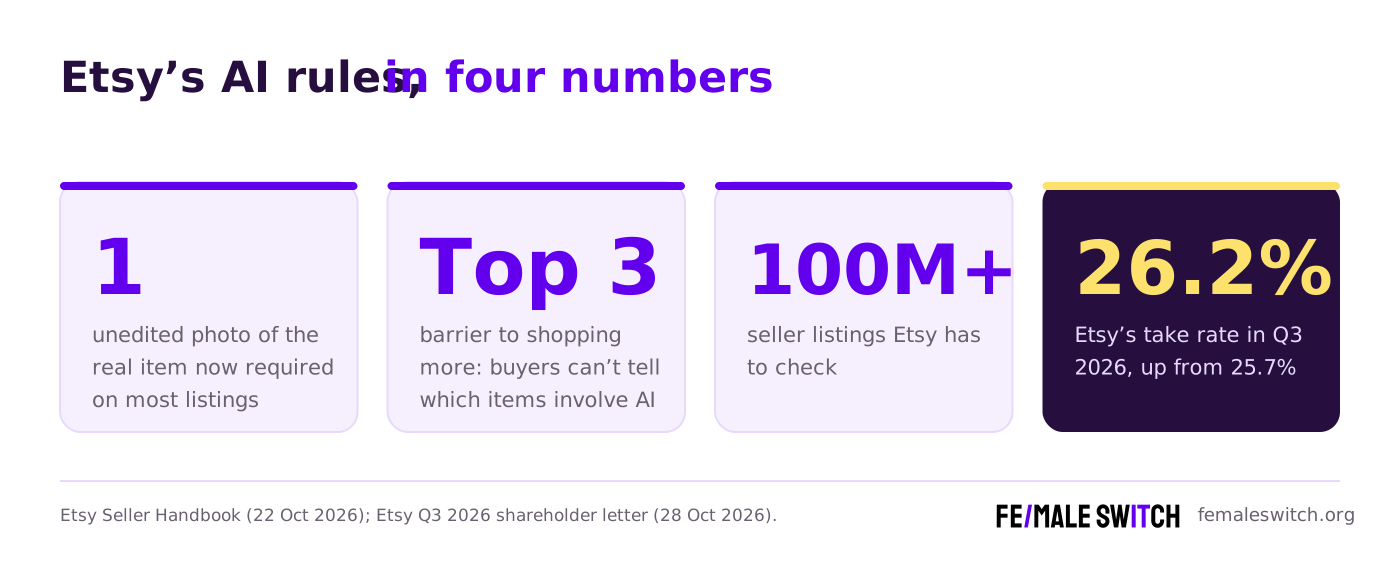
On Wednesday 22 October 2026 Etsy published “Important updates to AI use on Etsy” in its Seller Handbook. The author, James Ossman, Etsy’s vice president of customer operations, sets out the principle: “AI should support your creativity and craftsmanship, not replace them.”
Etsy also gives its reason. “Today, many active buyers say they can’t tell which items involve AI-generated content. It’s become a top-three barrier to shopping more often on Etsy,” the post says. It also admits: “We recognize we haven’t always addressed the topic of AI as directly or as quickly as you may have wanted.”
The new rules, in Etsy’s words:
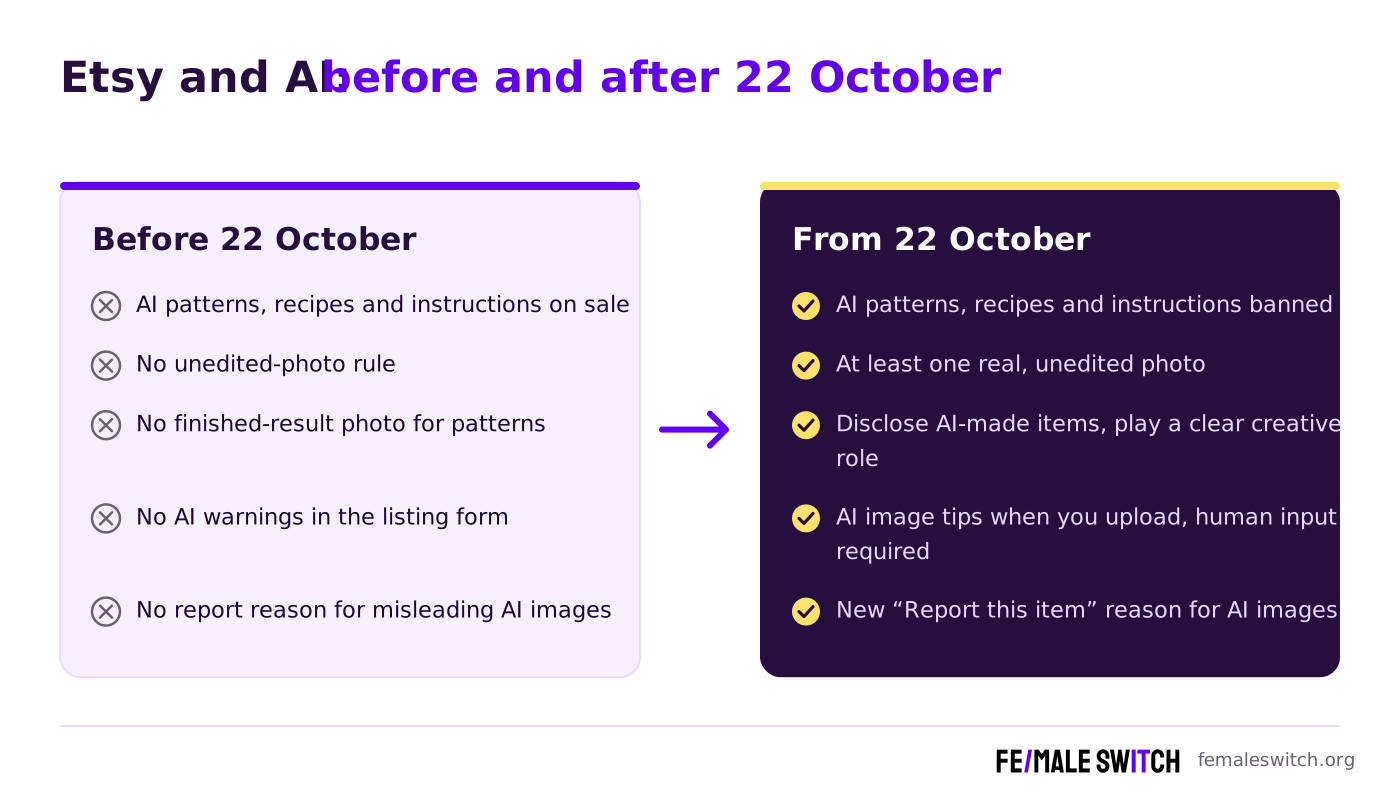
- One real photo. “Your listing must include at least one unedited photo of the actual item against a real background, meaning the photo hasn’t been edited or changed in any way.” Some exceptions apply by item type.
- No AI instructions. If you sell patterns, recipes or instructions, they “must be your own work, not generated by AI.” You must also show “an actual result made using your instructions, not an AI-generated or simulated result”.
- Refund risk. If a listing breaks the image rules and a buyer opens a case because the item is materially different, “you may be responsible for refunding the buyer.”
- No bot shops. “Bot-generated listings without any human involvement aren’t allowed. These listings will be removed and may also result in your shop being removed from Etsy.”
- AI art stays, with disclosure. AI-generated art is still allowed when the seller plays “a clear creative role”. Sellers “cannot misrepresent AI-generated work as handmade or entirely their own creation.”
You may still edit your other photos, including with AI, to fix lighting, crop or change the background, as long as the item still looks like what the buyer gets. Etsy recommends, but does not require, a note in the description when AI was used to edit photos.
Which items are hit hardest
Etsy’s updated Listing Image Requirements policy, also dated 22 October, sets different rules by item type. Etsy’s separate page on its stance on AI creations lists the banned AI instructions: knitting, crochet, sewing, embroidery, quilting and beading patterns, recipes, woodworking and other project plans, assembly manuals, and how-to e-books. Its reason is practical: buyers “often won’t discover the problem until they’ve already spent time and materials following them.”
Sellers of printables and planners should note that previews now count. If you sell planners, our sister site’s guide to selling digital planners on Etsy covers the basics of building a preview that sells.
Enforcement starts softly. When you upload a new image, the listing form will warn you if it detects AI and give tips. Buyers get a new “Report this item” reason for misleading AI images, but these reports “won’t result in immediate enforcement action” at first. Etsy says it is building better detection, and removed listings can be appealed on the Policy violations page in Shop Manager. Repeated violations can lead to removal of your shop, the policy says.
What is missing is a date. Etsy’s FAQ says that if listings don’t meet the rules, “you’ll need to update them”, but the announcement “did not include a deadline or grace period”, as Value Added Resource noted. It also points out that Etsy does not say how much human involvement is enough.
Why makers welcome it
Pattern designers have pushed for this for a long time. CNBC wrote that Etsy “has in recent years struggled to curb the proliferation of AI-made crochet patterns and other AI ‘slop.’” Crochet designer Love & Yarn Studio put the problem simply: “a convincing image does not prove that the item can actually be made, or that the instructions are correct.” The studio added: “I am pleased to see Etsy taking a firmer stance on AI-generated patterns.”
For an honest maker, the unedited photo is an advantage. It is the one thing a pattern mill or a dropshipper with AI photos can’t fake cheaply. If your work is real, the rule turns that into proof on every listing.
Etsy’s Q3 results: growth, and a bigger cut
On Tuesday 28 October Etsy published its third-quarter results in a shareholder letter. Chief executive Kruti Patel Goyal wrote: “I’m increasingly confident that our business is now firmly in growth mode.” On AI she added that “as AI makes it easier to create, replicate, and sell products at scale, the human touch that has always differentiated Etsy - in both our items and the shopping experience - matters more than ever.”
- Sales: gross merchandise sales of $2.65 billion, up 8.8% on a year earlier. Revenue rose 10.9% to $692.5 million.
- Buyers: about 88 million active buyers, up 1.0%, the first year-on-year growth in two years.
- Sellers: the active seller base “grew at its fastest rate in two years”, so competition for buyers is rising too.
- Take rate: 26.2% of sales, up from 25.7%, “primarily driven by further enhancements to Etsy Ads and, to a lesser extent, contribution from Offsite Ads.”
- Who pays for ads: “The majority of Etsy Ads revenue comes from sellers with less than $100,000 in annual GMS”.
- AI shopping: Etsy calls AI-powered shopping “an exciting and increasingly important discovery channel”, which is one more reason clear, real photos matter.
Etsy forecasts a take rate of about 25.6% for the fourth quarter. The results announced no fee changes. Still, the higher take rate shows where the money goes: more of each sale now flows back to Etsy as ads, and most of that comes from small shops.
What selling on Etsy costs from Europe
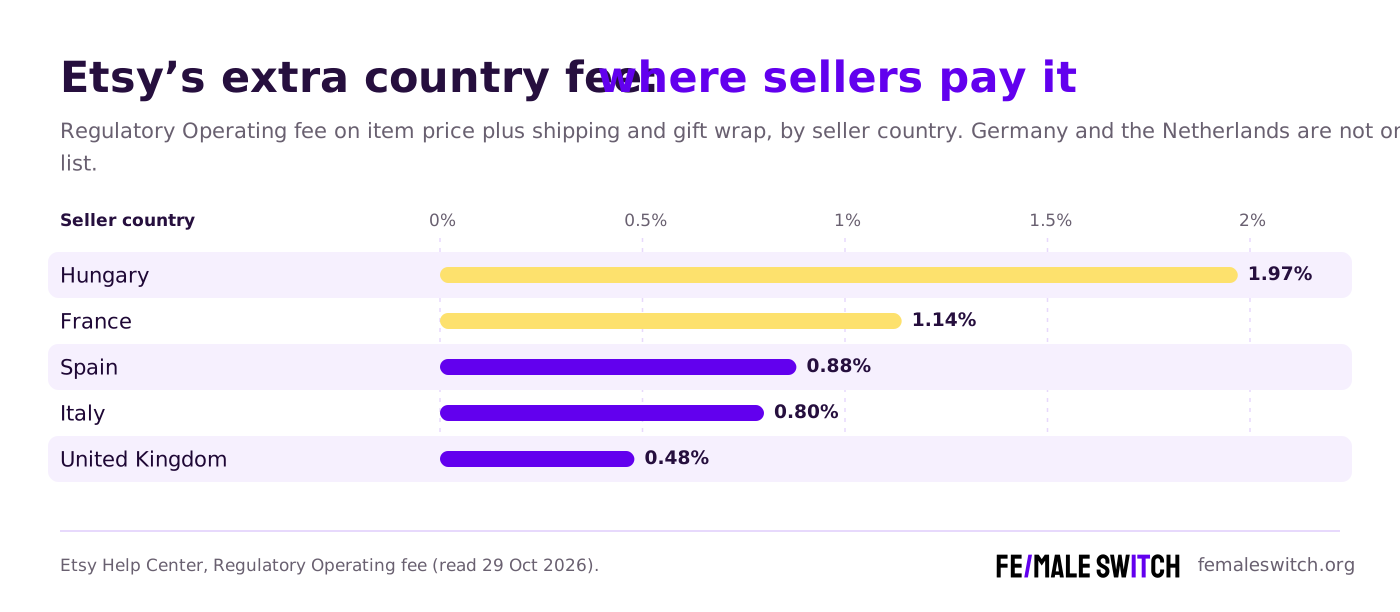
The rules change your workload; the fees decide your margin. These are Etsy’s published rates from its fees policy, updated 5 October 2026, and its payments policy. Etsy also charges a Regulatory Operating fee in some countries, on the item price plus shipping and gift wrap.
Here is our own calculation for a German seller with a €40 item and €5 shipping: the transaction fee is 6.5% of €45, or €2.93, and payment processing is 4% of €45 plus €0.30, or €2.10. That is about €5.03, or 11% of the order, before the listing fee, VAT on fees and any ads. If the sale came through an Offsite Ad, add 15% of the order, another €6.75. Our guide to pricing psychology and strategy helps you build these costs into your prices.
The European rules around it
Etsy’s rules are company policy, not law, but they sit next to EU rules that already apply to sellers:
- EU AI Act transparency (Adopted). The Commission says the AI Act’s transparency rules came into effect in August 2026. Article 50 requires people who use AI to make “deep fake” images, including ones that resemble existing objects, to “disclose that the content has been artificially generated or manipulated”. Whether a polished product photo counts has not been tested; Etsy’s disclosure rules already go further for its sellers.
- DAC7 tax reporting (Adopted). Etsy tells EU sellers it must report their sales and personal details to tax authorities once they pass 30 sales or €2,000 a year. Belgium is already using such data, as our report on the Belgian crackdown on unregistered side hustles shows.
- Parcels into the EU (Adopted). From 1 November a €2 handling fee applies per item line on parcels from outside the EU, whatever their value, which Etsy has told sellers about. See our explainer on the EU parcel handling fee.
- Packaging rules (Adopted). Etsy has also published a handbook note on EU packaging and EPR rules; our guide to EPR rules for small online sellers explains what applies to you.
UK sellers have their own news: the Budget on 28 October tripled the trading allowance for side income to £3,000 from April 2027, and marketplaces will collect VAT for VAT-registered UK sellers from October 2027. Our Autumn Budget 2026 breakdown has the details.
What this means for you
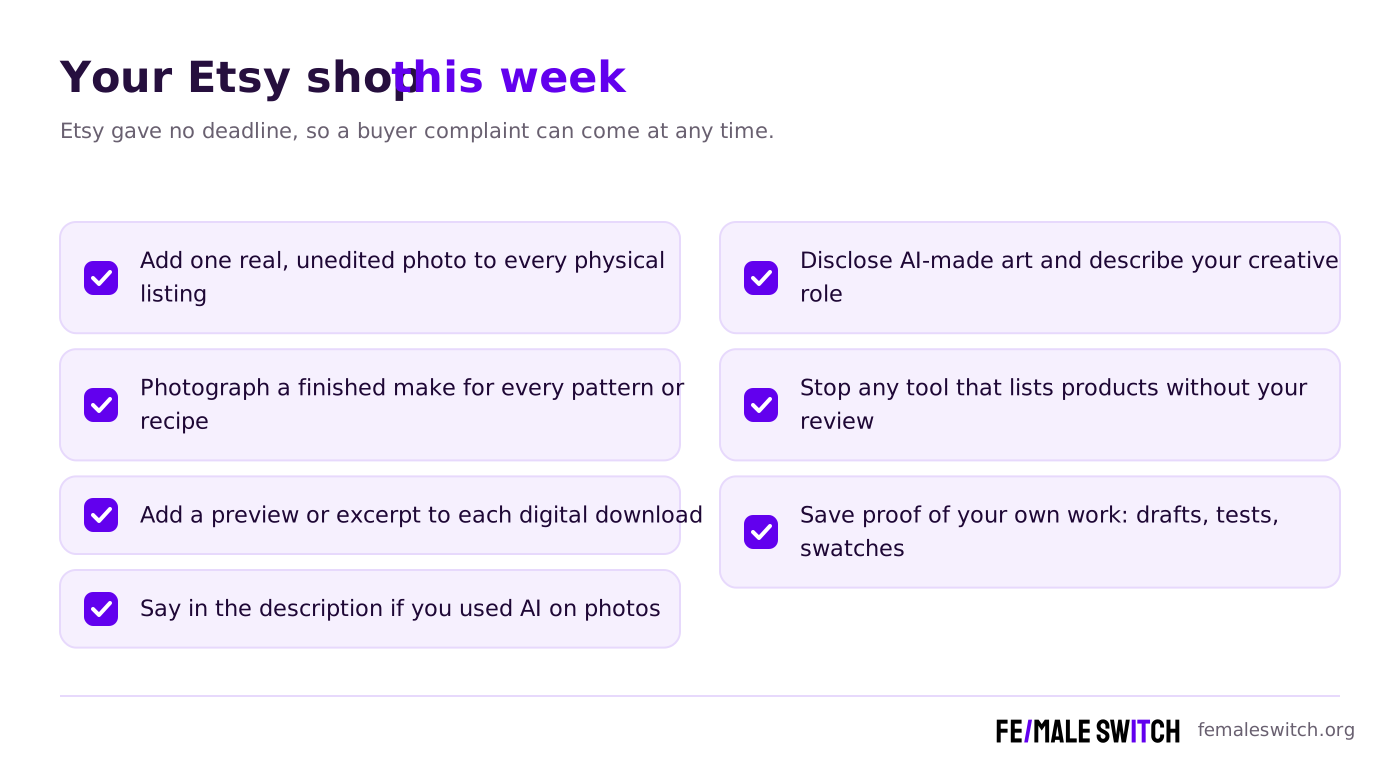
Etsy’s rules reward makers who can prove their work. Here is what to do now, before a buyer complaint does it for you.
- Add one real photo to every physical listing. Phone camera, daylight, a real table or wall, no filters, no retouching. Put it first, as Etsy recommends.
- Prove your patterns and recipes. Each needs at least one unedited photo of something made with it. If you only have a digital render, make a sample or pause the listing.
- Add previews to digital downloads. Show real pages or an excerpt of what buyers receive.
- Disclose AI where you use it. If AI helped make an item, say so in the description and explain your role. If you used AI to edit photos, say that too. Our list of free AI tools for small businesses in Europe covers tools that help without replacing your work.
- Check your automation. Listing tools are fine, but every item needs “direct, individual human prompting, curation, and creative input”. Switch off anything that creates listings without your review.
- Keep proof of authorship. Drafts, test knits, swatches and dated photos help if a listing is reported or removed and you need to appeal.
- Recheck your margins. With a higher take rate and Offsite Ads at 12–15%, price each product so it still pays you after every fee.
Platforms are rewriting their rules for small sellers all autumn. Meta has moved its new business terms to 20 November, as our report on Meta’s delayed terms explains. The lesson is the same: don’t let one platform be your only shop window.
Want to test your product, pricing and first sales before you pay platform fees?
The Fe/male Switch startup game takes you from idea to first paying customers in weekly quests, with an AI co-founder, so you can practise pricing, marketing and selling in a safe setting.
👉 Start the game
What to watch next
- A deadline. Etsy has not said when it will enforce the photo rule on existing listings. Watch the Seller Handbook and your Shop Manager messages.
- AI labels for buyers. Etsy says it will explore more ways to show buyers when AI was used “in the coming months”.
- Detection on existing listings. The AI image warnings start with new uploads and will expand to existing images over time.
- Fees. No change was announced with the Q3 results, but the take rate is rising through ads.
FAQ: Etsy’s new AI rules
Does Etsy ban AI-generated products?
No. AI-generated art is still allowed if the seller plays a clear creative role and discloses AI use in the listing description. What Etsy banned on 22 October 2026 are AI-generated patterns, recipes and instructions, bot-generated listings without human involvement and AI prompt bundles.
Do I need an unedited photo on every Etsy listing?
On most listings, yes: at least one unedited photo of the actual item against a real background. Exceptions apply to print-on-demand items (authorised stock mockups), digital downloads (a preview or excerpt, or representative images for audio) and custom items (photos of real past work).
Can I still use AI to edit my Etsy photos?
Yes, on your other photos. You can adjust lighting or colour, crop or change the background with AI, as long as the item looks like what the buyer receives. Etsy recommends saying in the description that AI was used.
Is there a deadline to update existing Etsy listings?
No deadline or grace period was announced. Etsy says listings that don’t meet the rules need to be updated, and that you may have to refund a buyer whose item is materially different from the listing.
What happens if my Etsy listing is reported for AI?
At first, reports for misleading AI images won’t lead to immediate enforcement. Etsy may still remove listings that break its rules; you can appeal on the Policy violations page in Shop Manager, and repeated violations can lead to shop removal.
How much does Etsy charge sellers in Europe?
A $0.20 listing fee, a 6.5% transaction fee and, for sellers in eurozone countries such as Germany, France and the Netherlands, payment processing of 4% plus €0.30 per order. Some countries add a Regulatory Operating fee, such as 1.14% in France, and Offsite Ads cost 12–15% of an attributed order.
