
TL;DR: did Meta delay its new business terms?
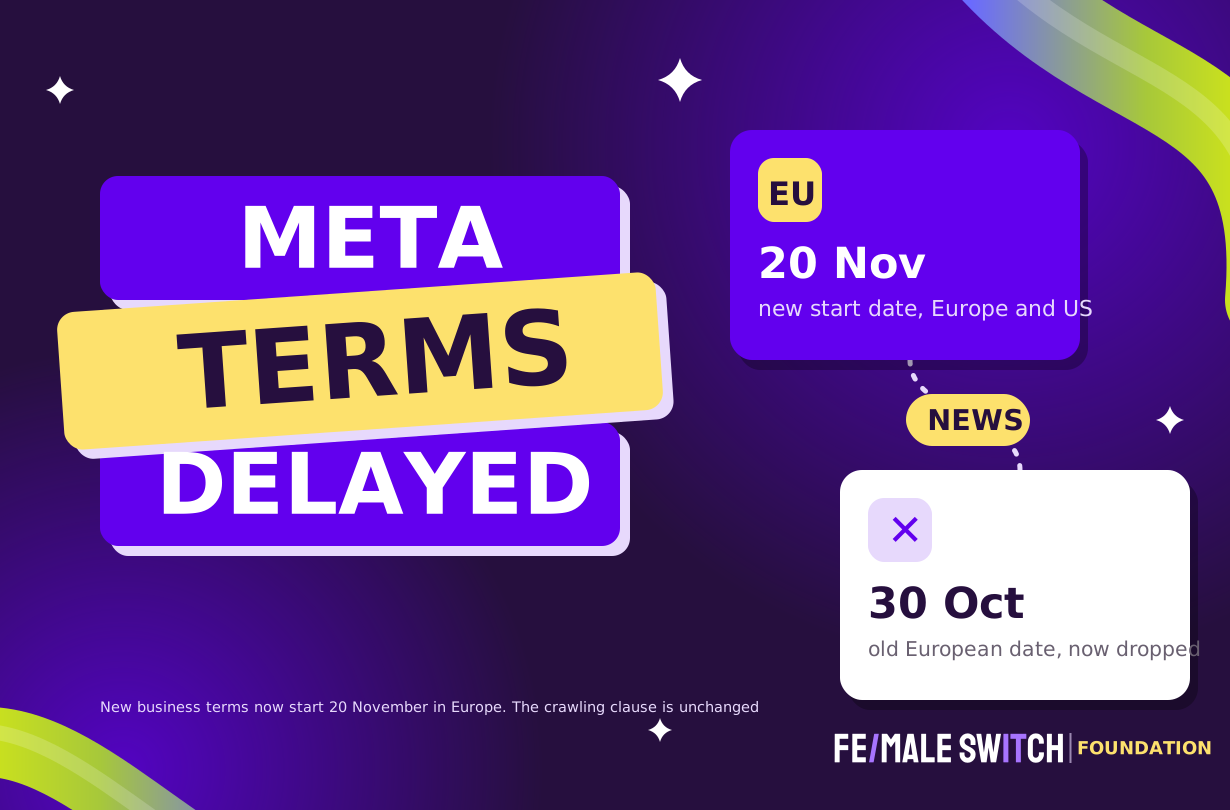
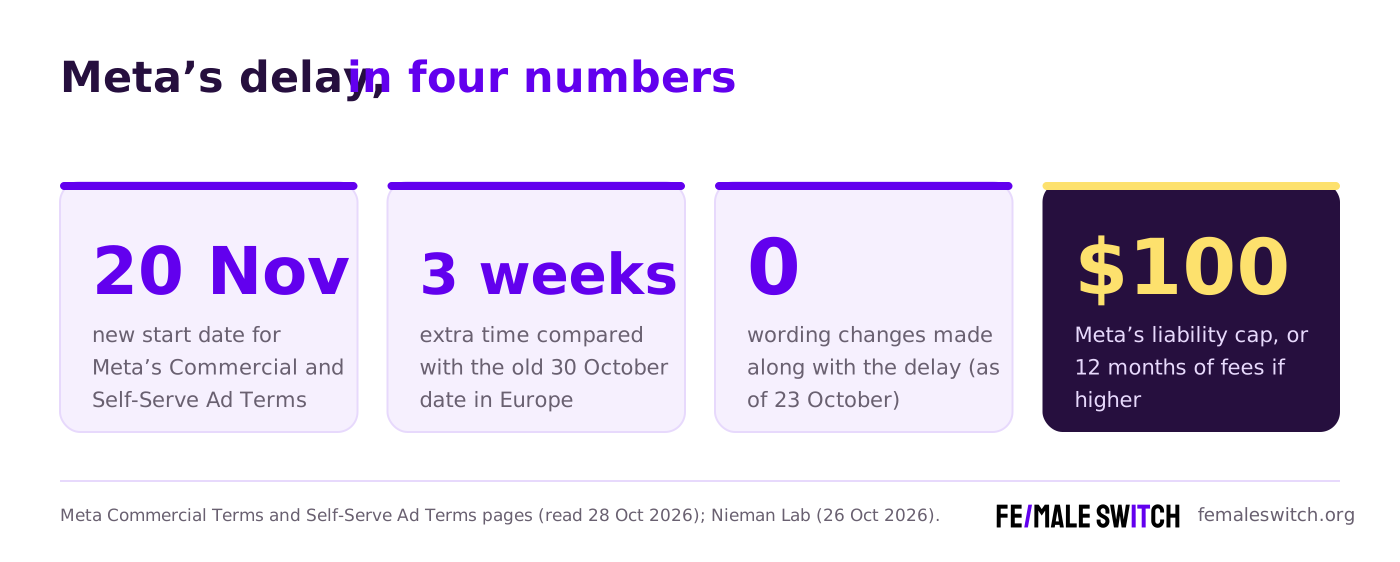
Yes. On 23 October 2026 Meta moved the start date of its updated Commercial Terms and Self-Serve Ad Terms from 30 October to 20 November 2026. Meta’s European editions now give the same date as the US edition. The wording is not softened: Meta may still crawl websites “associated with” your business, and you still carry the risk of Meta’s AI features. The European Commission welcomed the delay, the UK competition regulator says it is still looking at the terms, and publishers want the disputed clauses stopped. If you read our first report on Meta’s new terms and planned for 30 October, you now have three more weeks. Use them.
Last week we told European small businesses to plan for 30 October. That date is gone. Two days before it, Meta’s own terms pages now say 20 November in every language edition we checked.
If you run a Facebook Page, an Instagram shop, a catalogue or a few Meta ads, this is your extra time to decide what Meta may read on your website, and how much you rely on Meta AI to write and run your ads. Here is what changed, what didn’t, and what to do before 20 November.
What happened
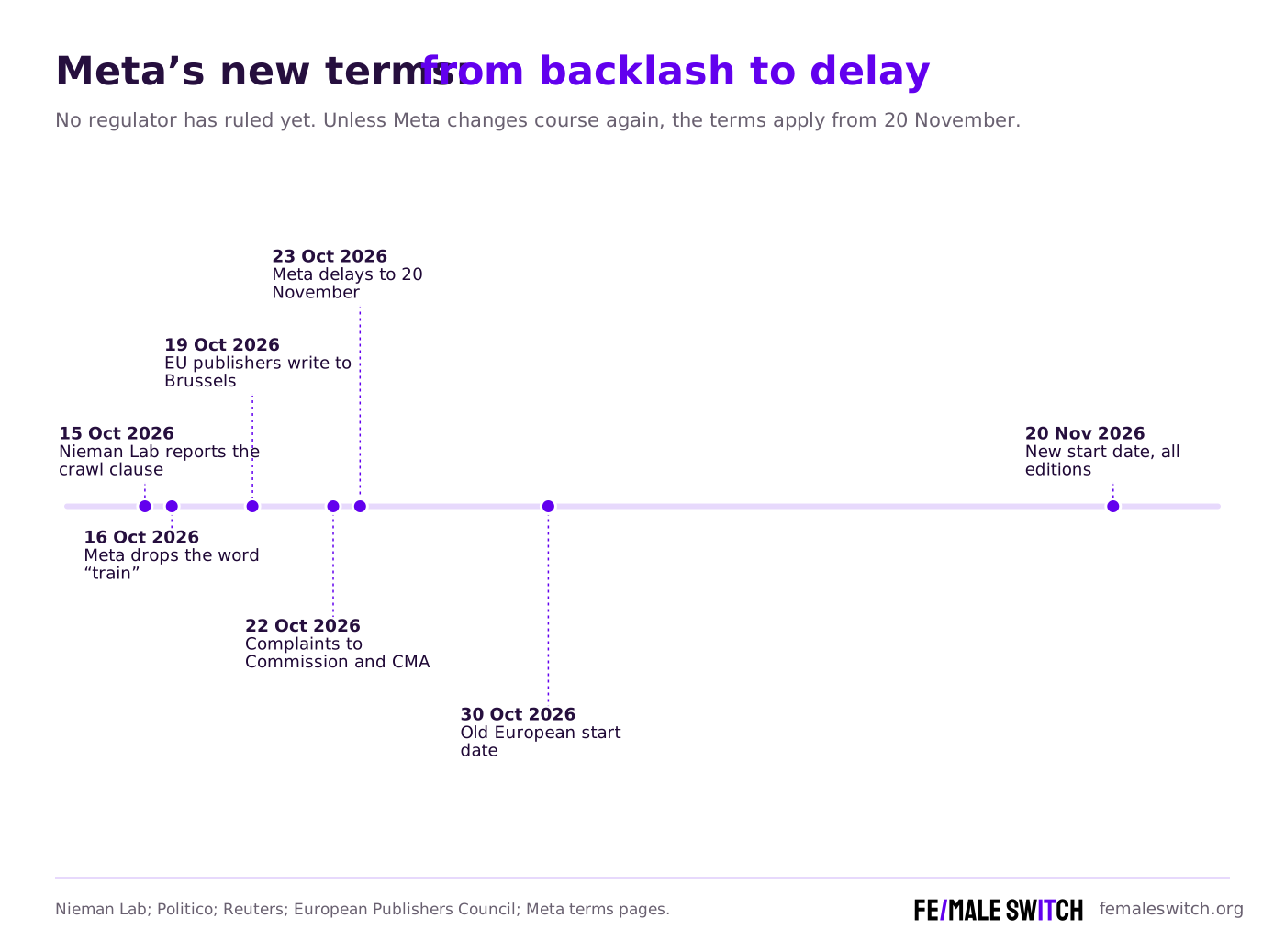
On Friday 23 October Meta told Reuters by email that it was “extending the effective date of our updated Commercial Terms and Self-Serve Ad Terms to 20 November”. In a fuller statement to Nieman Lab, a Meta spokesperson said the extra time is meant to explain “what’s changing and what’s not — including how Meta uses web crawlers and the fact that content owners will still be able to use robots.txt to signal preferences.”
Meta’s pages now match. The UK-English banner on the Commercial Terms says: “These updates will come into effect on 20 November 2026.” The German, French, Dutch and US-English editions give the same date. The footer of the new Commercial Terms reads “Effective from 20 November 2026”. One small slip: on 28 October the Dutch preview footer still showed 30 October, while the Dutch banner above it said 20 November.
The Self-Serve Ad Terms, the contract you accept when you buy ads yourself in Ads Manager, moved too. Their banner says the updates “will come into effect on 20 November 2026”. The new version contains the same website-crawling clause as the Commercial Terms and a similar AI clause, but not the USD 100 liability cap.
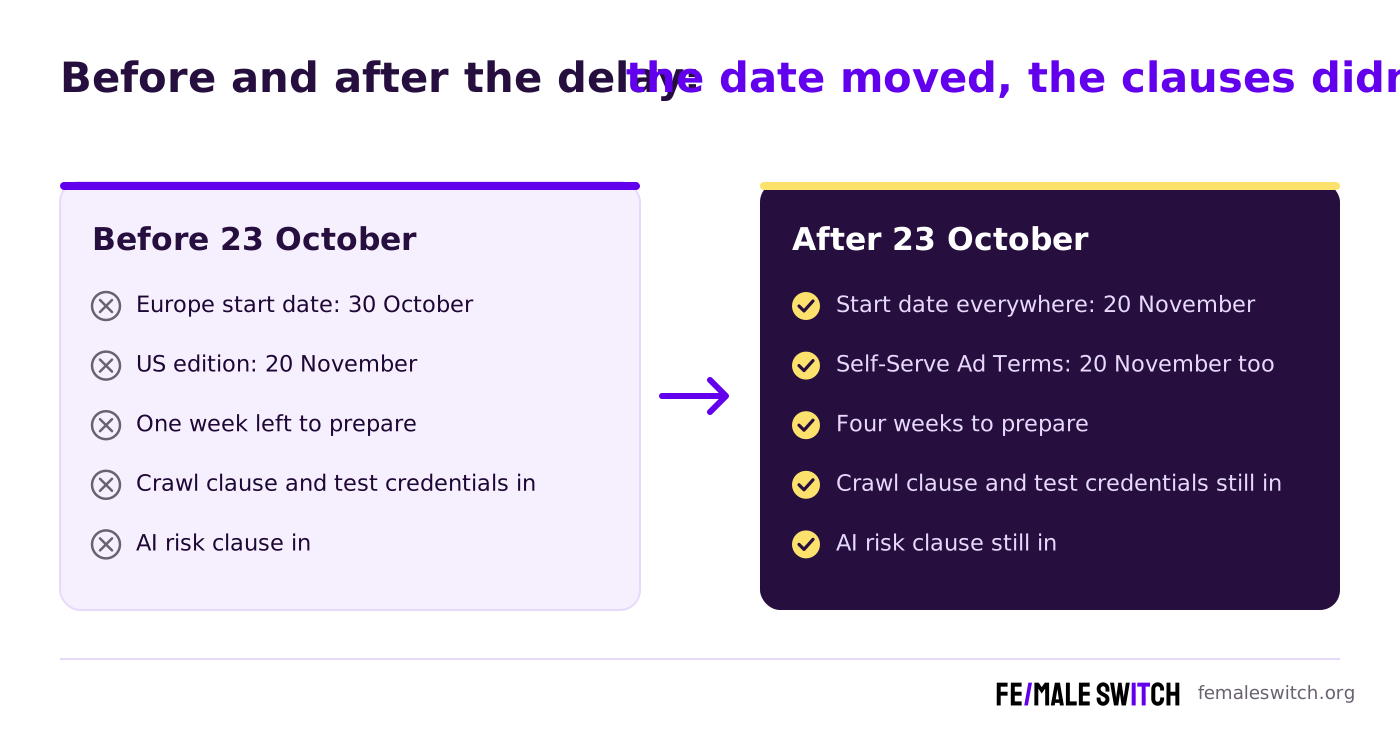
Nothing else changed. “As of October 23, Meta has made no other changes to the terms aside from the implementation date,” Nieman Lab reported, adding that no version of the terms includes language about respecting robots.txt. Trade site PPC Land also found no new wording with the delay.
What the delay does not change
The clauses that worried publishers and small businesses are still in the new Commercial Terms, as read on 28 October:
- Website crawling. You authorise Meta to use “web scrapers, bots, robots, spiders, crawlers and user agents” and to “create test credentials” to access the domains, pages or URLs “associated with your products or services”, to “provide, develop, improve, research and maintain advertising and business products”.
- AI risk. “AI features may make mistakes and may not always produce accurate, complete or suitable results”, and you are “solely responsible for and assume any and all risks” of using them.
- Watermarks. You must not remove any watermark or content-authenticating metadata that Meta’s AI adds.
- Third-party tools. You are solely responsible for any software or service you use or authorise in your account.
- Liability cap. Meta’s liability stays at the greater of USD 100 or what you paid it in the past twelve months.
- Acceptance. “By continuing any access or use of any Meta Company Products for business or commercial purposes” after the start date, you agree to the terms. There is no opt-out.
One earlier change stands. On 16 October Meta removed the word “train” from the crawling purposes. The remaining purposes, such as “develop” and “research”, are broad, which is why publishers kept pushing.
Why Meta moved: regulators and publishers
The delay followed a week of pressure in Brussels and London. On 22 October the Movement for an Open Web, a group of publishers and advertisers, asked the European Commission and the UK Competition and Markets Authority (CMA) for interim measures to suspend the terms, Reuters reported. German publisher groups BDZV and MVFP and the European Publishers Council had already written to the Commission.
After the delay, the regulators reacted differently:
- European Commission: “The Commission welcomes Meta’s announcement that it has postponed the entry into force of its new commercial terms,” it said, adding it is committed to making sure Meta complies with EU law, “including Article 102 TFEU and the Digital Markets Act.” (Debated: no investigation has been announced.)
- UK CMA: “The CMA has been in urgent discussions with Meta this week on this important issue,” a spokesperson said. “Meta has now paused implementation until 20 November. We will continue to scrutinize these terms.” (Debated)
- Publishers: Theo Bamber, chief executive of the UK’s News Media Association, called the delay “a pause not a solution.”
The European Publishers Council went further the same evening. It asked the Commission to examine the terms under the Digital Markets Act and competition law and, if interim measures can’t come before 20 November, to get an immediate undertaking from Meta to postpone the contested clauses. “Technical controls over crawler access cannot substitute for clear, enforceable contractual limits,” it wrote.
Why do regulators have a lever? Meta is a designated gatekeeper under the Digital Markets Act (Adopted) for Facebook, Instagram, WhatsApp, Messenger and Meta Ads. Competition lawyer Thomas Höppner told Nieman Lab the terms are “a prima facie infringement of European Union competition law, and a textbook case for imposing interim measures.” That is one lawyer’s view; no authority has found anything yet.
Your website and Meta’s crawlers
Meta says robots.txt still works, but the terms don’t say so. What you can control today is which of Meta’s crawlers you let in. Meta’s crawler documentation says: “In order to block these crawlers, add a disallow for the relevant crawler to robots.txt.” It lists several, with different jobs:
Be careful with the last two. If you block facebookexternalhit, links to your shop may lose their preview image on Facebook and Instagram, which costs clicks. Most small businesses will want to keep link previews and decide case by case on the AI and ads crawlers. If you are unsure what each bot does on your site, check your server logs or your website analytics for these user agents first.
Also check what EU law says about notice. Under the platform-to-business rules (Regulation (EU) 2019/1150, Adopted), a platform must give business users at least 15 days’ notice of changes to its terms, and you may end the contract before the notice period runs out, according to Article 3(2). That gives you a right to leave, not a right to negotiate. For most small businesses, leaving Meta is not realistic, so the practical levers are robots.txt, logins and how much you rely on Meta’s AI.
What this means for you
Three extra weeks don’t change the decision, but they give you time to make it calmly. Here is what to do before 20 November.
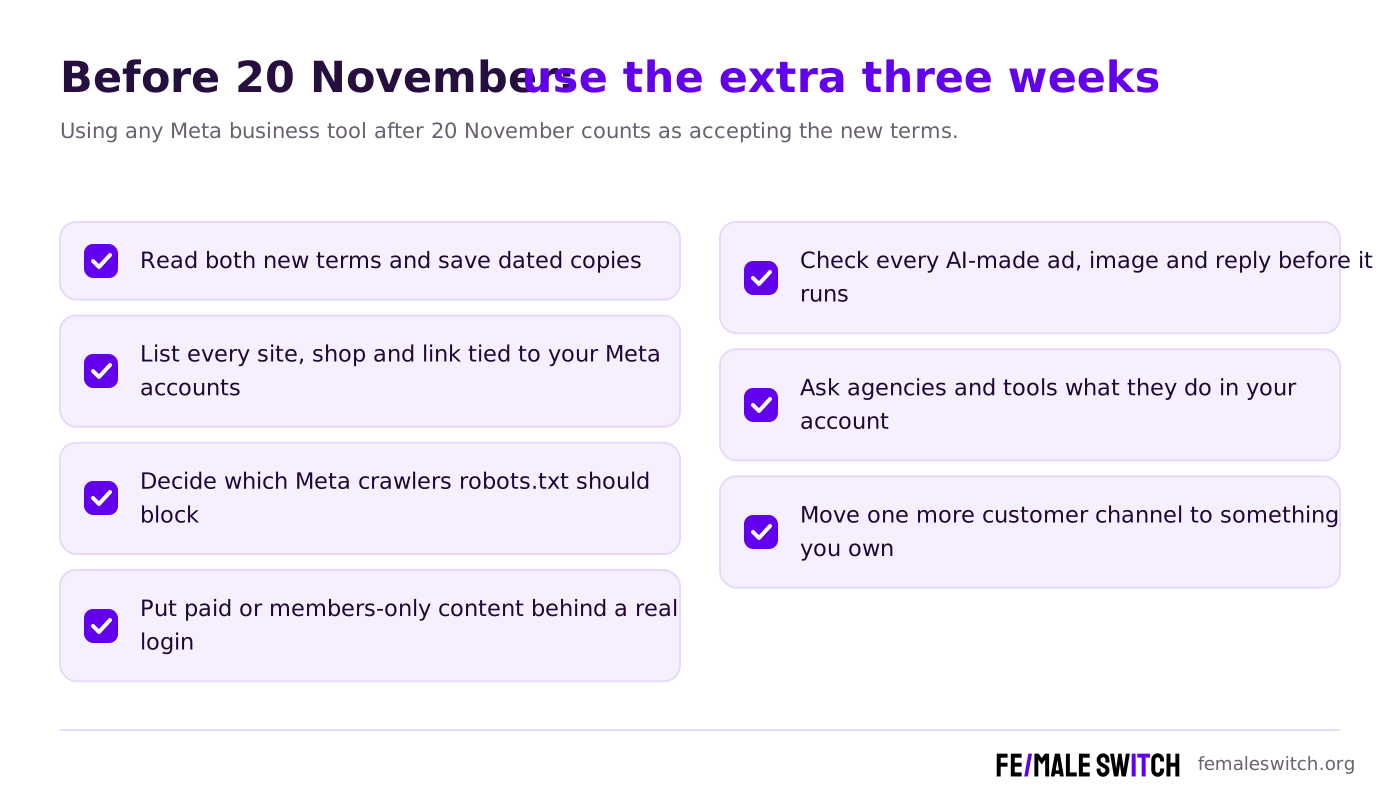
- Read both documents, not just one. If you buy ads yourself, the Self-Serve Ad Terms apply as well as the Commercial Terms. Save dated copies. Our guide to contracts and agreements explains why a dated copy matters if terms change later.
- List every website tied to your Meta accounts. Your shop, booking page, blog, link-in-bio page and any domain verified in Business Suite can count as “associated with your products or services”.
- Decide your robots.txt lines. Use the table above. Keep link previews unless you have a reason not to. For SEO side effects, see SEO basics for founders.
- Put paid content behind a real login. Courses, templates and member areas should not sit on open URLs that a crawler can reach.
- Treat Meta AI output as a draft. The terms say its AI “may make mistakes” and the risk is yours. Check every AI-written ad, auto-reply and generated image before it runs. Our list of free AI tools for small businesses in Europe covers alternatives you control better.
- Ask your agency and tools what they do in your account. The terms make you responsible for third-party software you authorise.
- Build one channel Meta doesn’t own. An email list or a community you host is your insurance if terms change again. Our social media plan for founders with little time shows how to keep Meta in its place.
Platform rules for small businesses are tightening on several fronts in Europe this autumn, from the EU’s Digital Omnibus on cookies and GDPR to the Commission’s Digital Services Act case against Booking.com. For the AI-training side of Meta’s crawling clause, see MeanCEO’s analysis of Meta’s terms and AI crawling.
Want to practise these decisions before real money is at stake?
The Fe/male Switch startup game takes you from idea to first paying customers in weekly quests, with an AI co-founder, so you can test your marketing channels, pricing and first sales in a safe setting.
👉 Start the game
What to watch next
- Whether the wording changes before 20 November. Meta says it wants to explain the terms; publishers want the crawling clause narrowed or removed.
- Interim measures. The Commission and the CMA could act on the complaints, or Meta could offer an undertaking, as the European Publishers Council asked.
- A robots.txt promise in writing. Meta says robots.txt still works; so far no version of the terms says so.
- Another date change. Check the banner on Meta’s terms pages in mid-November before you rely on 20 November.
FAQ: Meta’s delayed business terms
When do Meta’s new Commercial Terms take effect?
On 20 November 2026. Meta moved the date from 30 October on 23 October 2026, and its UK-English, German, French, Dutch and US-English pages now give 20 November.
Did Meta change the website-crawling clause?
No. As of 23 October Meta had made no changes other than the date, Nieman Lab reported. The clause still lets Meta crawl domains associated with your products or services and create test credentials. The word “train” was removed earlier, on 16 October.
Do the Self-Serve Ad Terms change too?
Yes. The Self-Serve Ad Terms, which cover ads you buy yourself in Ads Manager, also take effect on 20 November 2026 and contain the same crawling clause and a similar AI clause.
Can I opt out of Meta’s new terms?
Not while you keep using Meta’s business tools. Continuing to use Meta products for business after 20 November counts as accepting the terms. You can limit some crawlers with robots.txt and keep paid content behind a login.
Which Meta crawlers can I block with robots.txt?
Meta’s documentation lists meta-externalagent, meta-externalads and meta-webindexer, and tells site owners to add a disallow line for the crawler they want to block. meta-externalfetcher and facebookexternalhit may bypass robots.txt in some cases, and blocking facebookexternalhit can remove your link previews.
Are EU regulators stopping Meta’s terms?
Not yet. The European Commission welcomed the delay and says Meta must comply with EU competition law and the Digital Markets Act. The UK CMA says it will keep scrutinising the terms. Publishers have asked for interim measures, but no regulator has ordered any.
