
TL;DR: what do Meta’s new business terms mean for a small business?
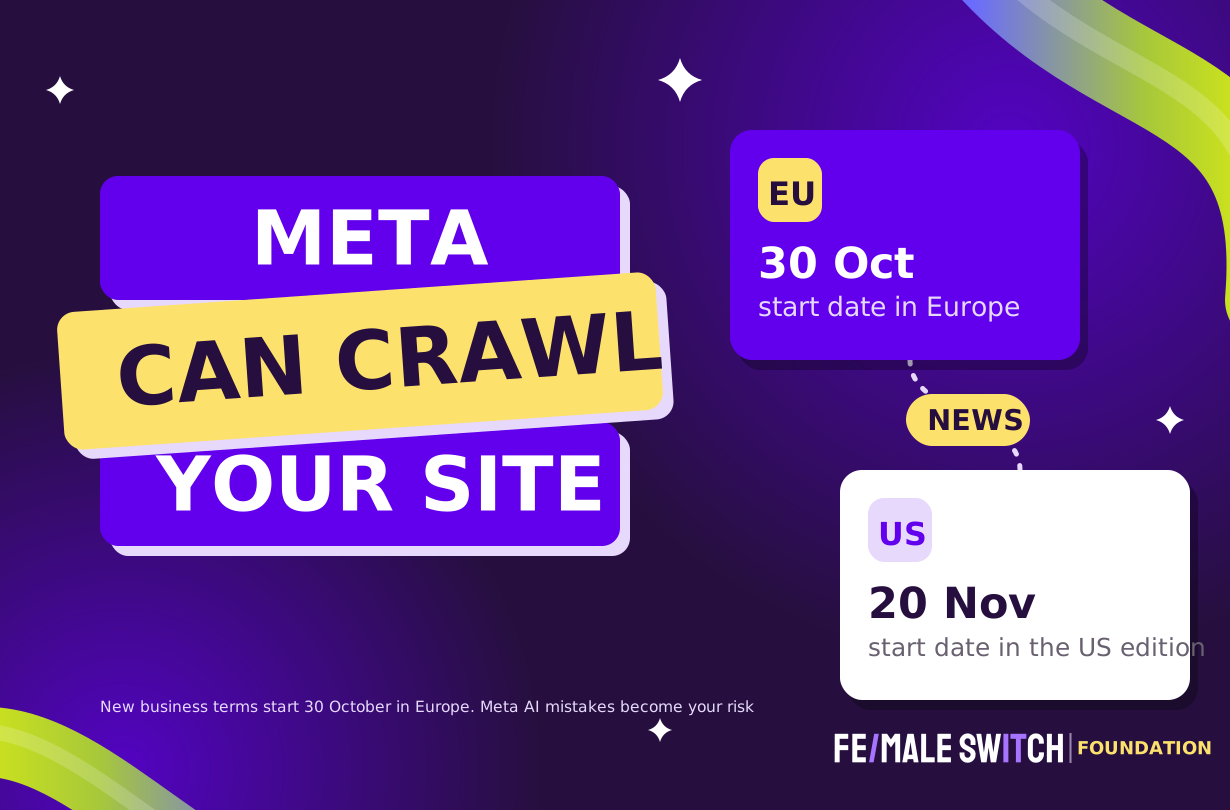
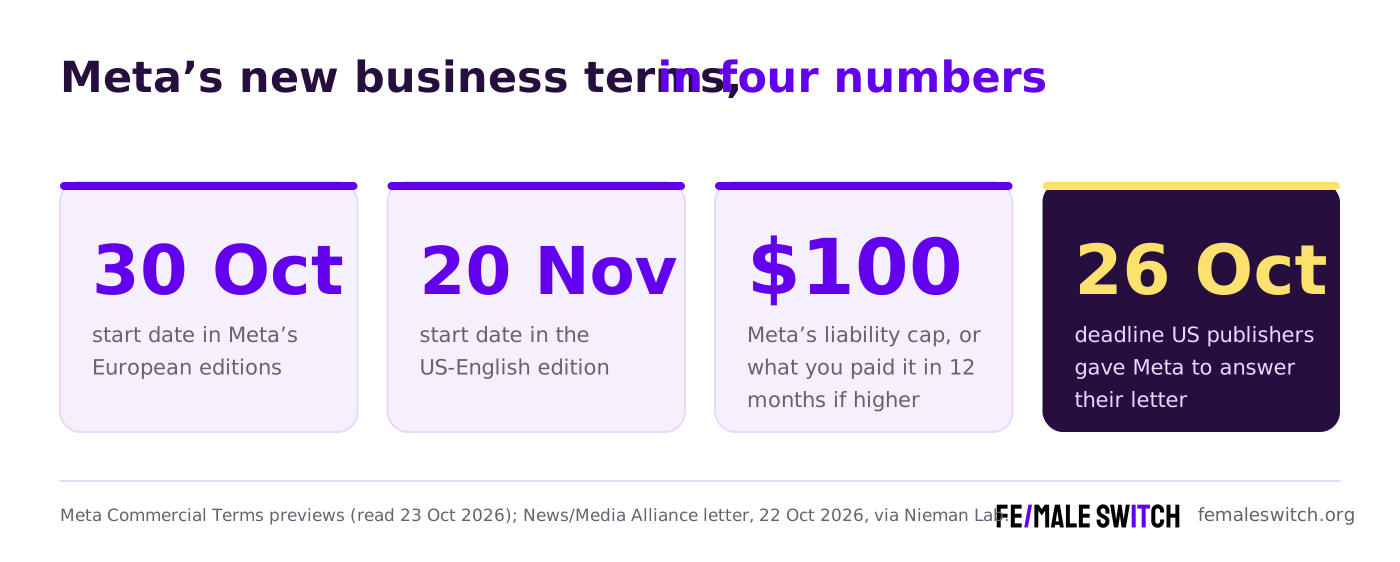
Meta’s updated Commercial Terms take effect on 30 October 2026 in the European editions (20 November in the US edition). If you run ads, a Page, a shop, a catalogue or Meta Business Suite, using them after that date means you accept the new terms. Two clauses matter most. Meta may crawl the websites “associated with your products or services”, and may even create test credentials to get in, to build its ads and business products. And Meta’s AI features “may make mistakes”, but you assume “any and all risks” from them. Publishers asked the European Commission and the UK competition regulator on 22 October to suspend the terms; nothing has been decided (Debated). Start with our social media strategy for founders with limited time, then use the checklist below.
If you sell anything online in Europe, Meta is probably part of how customers find you: an Instagram account, a Facebook Page, a few boosted posts, a WhatsApp Business number. You clicked “accept” on Meta’s business terms years ago and never thought about them again.
That changes next Friday. Meta has rewritten those terms, and the new version reaches beyond your Page, into your own website and into the ads its AI writes for you. Here’s what the text actually says, who is fighting it, and what to do in the next seven days.
What Meta changed, in its own words
The Meta Commercial Terms apply to anyone who uses Meta’s products “for business or commercial purposes”. The new version lists what that means: “using ads or marketing messages, selling or listing products, developing apps, creating or using a product catalogue, managing a Page, managing a group for business purposes, using any business product, such as Ads Manager or Meta Business Suite”. In short: almost every founder who promotes a business on Facebook or Instagram.
The UK-English edition says: “These updates will come into effect on 30 October 2026.” The German, French and Dutch editions give the same date. The US-English edition now says 20 November 2026. Meta hasn’t explained the difference publicly. If your business is in Europe, plan for 30 October. Update, 28 October: Meta has since moved the start date to 20 November 2026 in every edition, Europe included, without changing the wording.
Acceptance is automatic: “By continuing any access or use of any Meta Company Products for business or commercial purposes after any notice of an update to these Commercial Terms, you agree to be bound by them.” The only alternative the terms offer: “you may stop all access or use of our Products for business or commercial purposes.”
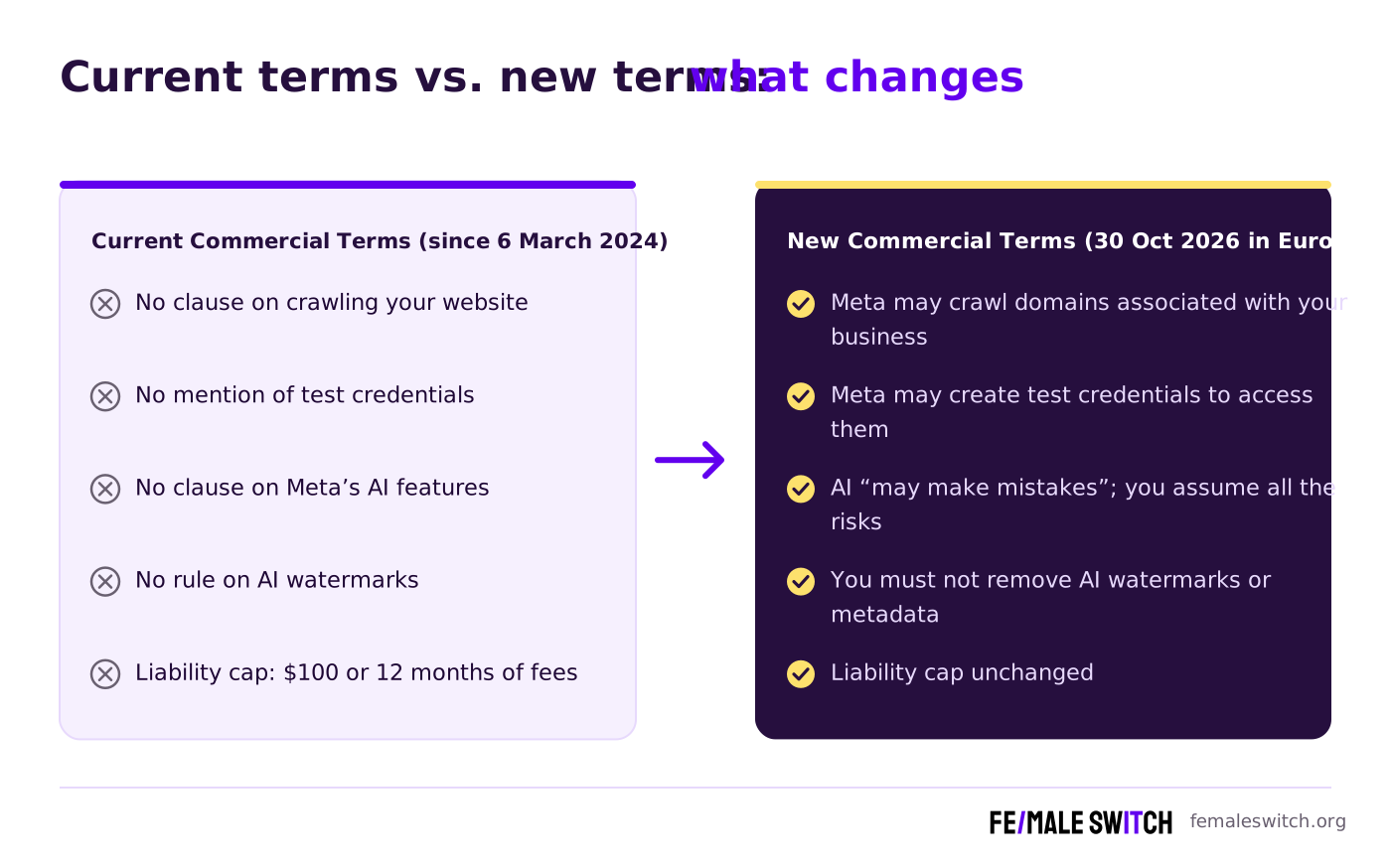
Quotes from the UK-English edition of the new terms, read on 23 October 2026. The current terms (in force since 6 March 2024) contain no crawling clause, no test credentials and no AI clause. New to reading terms like these? Our guide to contracts and agreements explains the basics.
The crawling clause: “associated with your products or services”
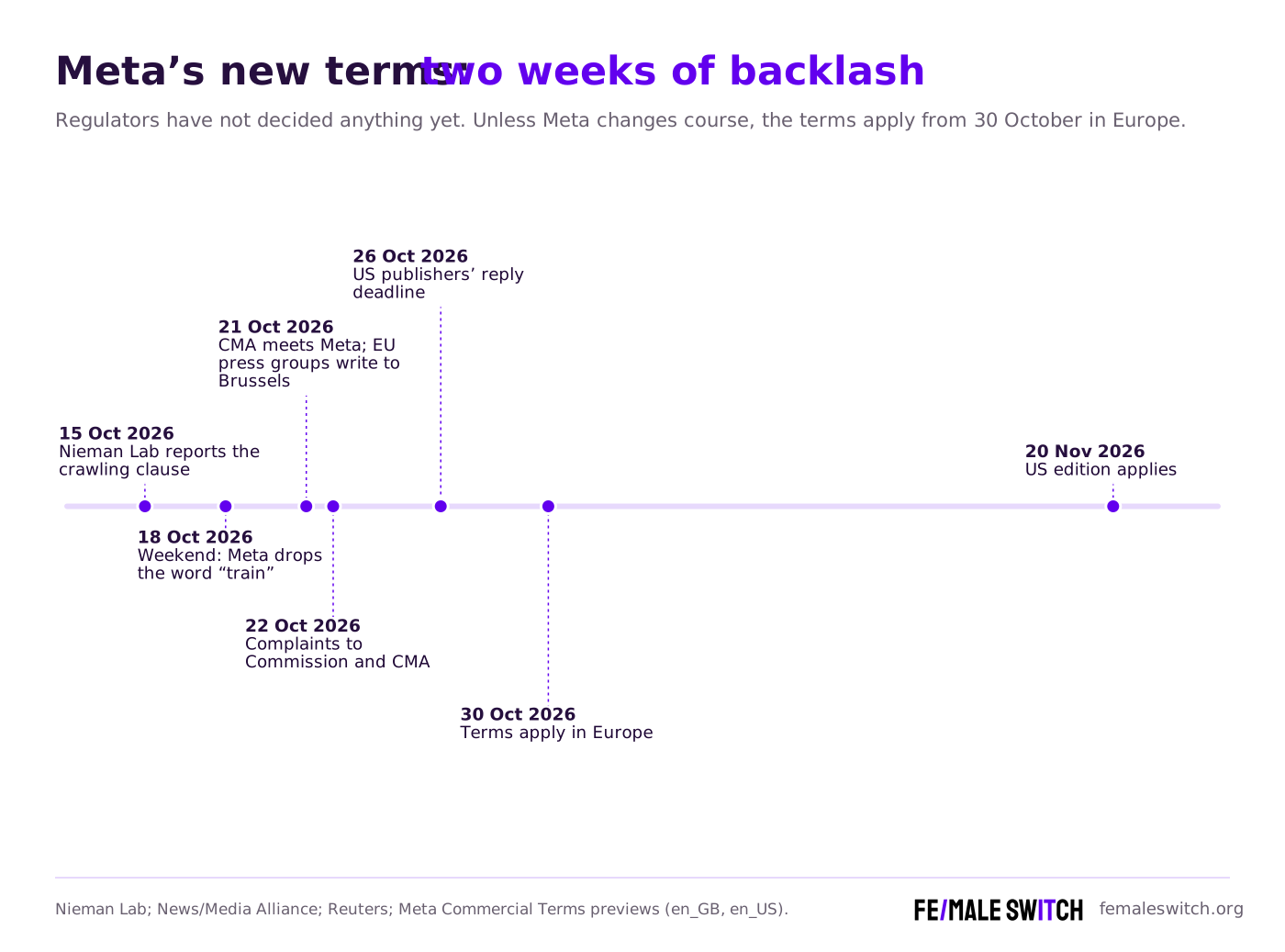
This is the clause that started the fight. On 15 October Nieman Lab reported that an earlier version let Meta crawl these sites to “research, train, and maintain” its products. Legal experts read that as permission to train AI on any website tied to a business account. After the backlash, Meta removed the word “train”. The editions we read on 23 October say Meta may crawl “in order to provide, develop, improve, research and maintain advertising and business products”.
Critics say that is no real fix. Thomas Randall, a research director at Infotech, told CIO the change was “not a substantive fix”. The terms don’t define “associated with”, and “test credentials” are still in both English editions. For the first version of the clause and what it meant for AI training, see MeanCEO’s analysis of Meta’s crawling terms.
Meta’s answer, given to Reuters: “The crawling terms we consolidated only applied to our ads and business products, and we’ve clarified that in the terms themselves. It does not change how Meta uses web crawlers. As always, content owners can use robots.txt to signal their preferences.”
Meta’s own crawler documentation names several bots. It says: “In order to block these crawlers, add a disallow for the relevant crawler to robots.txt.” But it also says two of them may ignore robots.txt in some cases.
Source: Meta for Developers, web crawlers page, read 23 October 2026.
The AI clause: Meta’s mistakes, your risk
The new terms cover the AI features Meta offers businesses to “optimise, enhance or create Content”. They say: “You acknowledge and agree that AI features may make mistakes and may not always produce accurate, complete or suitable results. You are solely responsible for and assume any and all risks associated with such AI features and any resulting Content.”
Frank Dickson of Dickson Research told CIO the clause “turns accountability upside down. Meta builds the AI features, admits they ‘may make mistakes’ and then assigns ‘any and all risks’ to the business.”
For a small shop, the risk is concrete. If an AI-generated ad promises a discount you don’t offer, or makes a product claim you can’t back up, it is still your ad. The regulators who fined retailers for fake countdown timers won’t accept “the AI wrote it” as an excuse.
Who is pushing back, and what regulators said
Europe’s publishers have led the fight, but the complaints cover every business that uses Meta’s tools. Status of every regulatory step so far: Debated. No regulator has suspended the terms.
- 20 October: Will Hayter, the UK Competition and Markets Authority’s executive director for digital markets, told a parliamentary committee he had written to Meta and set up a meeting, Nieman Lab reported.
- 21 October: the CMA met Meta. Four European press associations (EMMA, ENPA, the European Press Council and News Media Europe) wrote to the Commission that the terms breach the Digital Markets Act.
- 22 October: the Movement for an Open Web, whose members include advertisers and publishers, filed complaints with the Commission and the CMA and asked for interim measures to suspend the terms, Reuters reported. Co-founder Tim Cowen: “Many businesses effectively have no choice but to use Meta’s services and these conditions would force them to sign away the rights to their digital content with no means of opting out.”
- 22 October: the CMA said: “We are engaged in urgent discussions with Meta as we consider our next steps.” The Commission said it would assess the complaint under its usual procedure.
- 22 October: the US News/Media Alliance asked Mark Zuckerberg to withdraw the crawling provision before 30 October and requested a public reply by 26 October.
To get interim measures, complainants must show “serious and irreparable damage”, Reuters notes. The terms take effect in seven days. Meta said it disagreed with the complaint.
Is there an EU rule on changing business terms?
Yes, in general. The EU’s platform-to-business regulation, Regulation (EU) 2019/1150 (Adopted), says providers of online intermediation services, such as marketplaces and app stores, must give business users at least 15 days’ notice of changes to their terms, on a durable medium, and that business users may end the contract before the change applies. Whether and how it applies to each Meta product is a legal question we can’t answer for you.
Note the timing: EU governments agreed this week to repeal parts of that same regulation in the Digital Omnibus (Proposed). If you depend on a platform, save every notice of a terms change now.
What this means for you
Leaving Meta isn’t realistic for most bootstrapped businesses, and you don’t need to panic. You do need an hour this week.
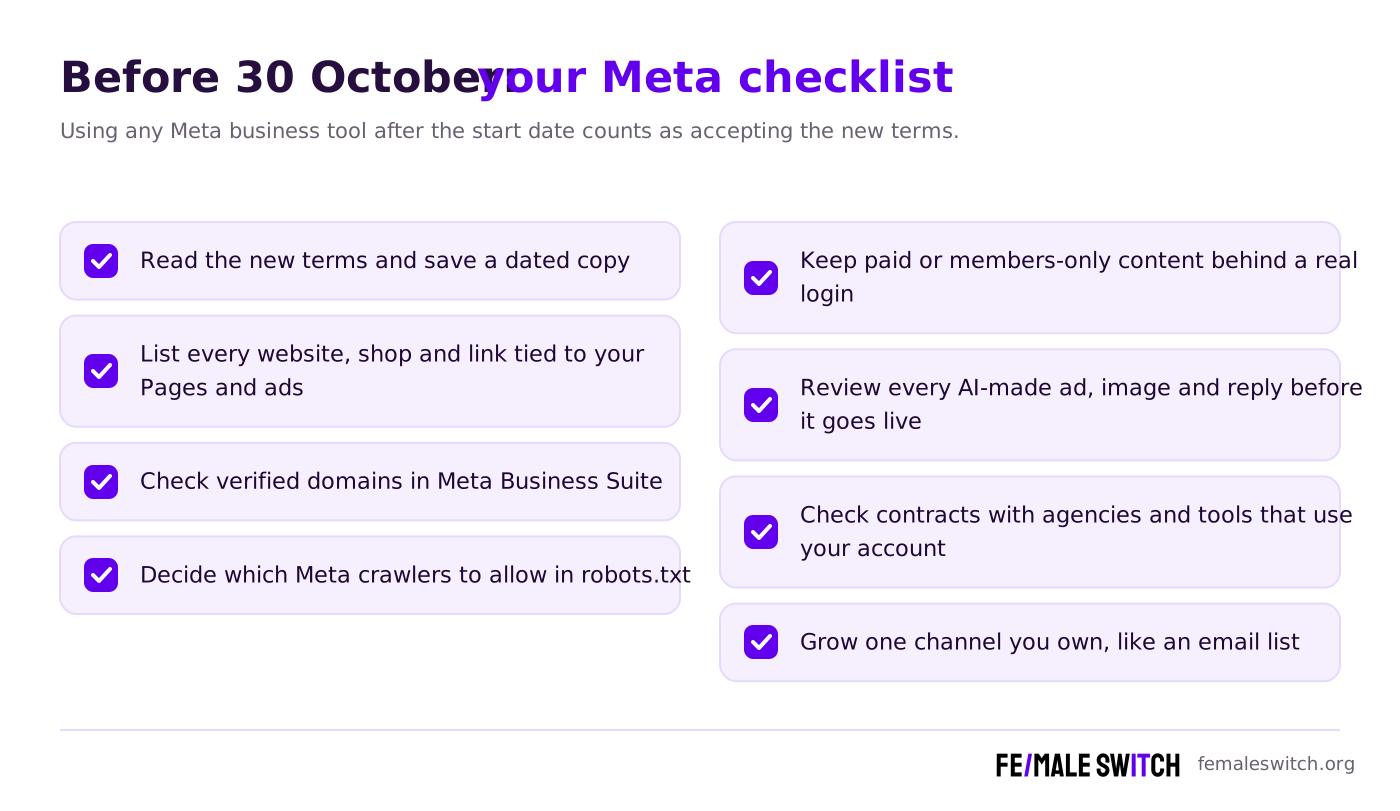
- Read and save the terms. Find the notice in Meta Business Suite, read the clauses quoted above, and save PDFs of the current and new versions with today’s date. Our legal templates and resources show how to keep a simple contracts folder.
- Map what’s “associated” with your business. List your website, shop, booking page, link-in-bio page and catalogue URLs. Then check the domains you verified in Meta Business Suite: Meta’s help page says to go to “Domains in the Brand safety section of Meta Business Suite’s Settings”. The terms may reach further than that list.
- Decide on robots.txt. You can disallow meta-externalagent (AI training) and meta-externalads (ads and business products) by name. Don’t block facebookexternalhit, or your links lose their previews. Check first whether blocking the ads crawler hurts your catalogue or ads; Meta hasn’t said.
- Protect paid content properly. If you sell courses or memberships, robots.txt is not a lock. Keep paid material behind logins you approve, not open sign-up, because the terms mention test credentials.
- Treat Meta AI output as a draft. Read every AI-generated headline, image and auto-reply before it goes live, and keep a record. Our guide to AI for non-technical entrepreneurs covers basic review habits, and our GDPR guide for European startups covers the customer data side.
- Check who else touches your account. The terms make you “solely responsible” for third-party tools you authorise. Review agency contracts and remove apps you no longer use.
- Build a channel Meta doesn’t own. An email list and search traffic don’t come with new terms every year. Start with our plan for your first ten customers.
Want a business that doesn’t live or die on one platform?
The Fe/male Switch startup game takes you from idea to first paying customers in weekly quests, with an AI co-founder, so you build your own channels and your own customer list from day one.
👉 Start the game
What to watch next
- 26 October: whether Meta answers the US publishers in public, or changes the crawling clause again.
- Before 30 October: whether the Commission or the CMA orders interim measures. Neither has said it will.
- The US date: why the US edition starts on 20 November, and whether the European date moves too.
- The Digital Markets Act: whether the Commission treats the press groups’ letter as a DMA case.
FAQ: Meta’s new Commercial Terms
When do Meta’s new Commercial Terms take effect?
On 30 October 2026 in the UK-English, German, French and Dutch editions. The US-English edition says 20 November 2026. Using Meta’s business tools after the start date counts as accepting them.
Do the new terms apply to my small business?
Yes, if you use Meta for business: ads, a Page, selling or listing products, a catalogue, a business group, Ads Manager or Meta Business Suite. The terms apply regardless of your company type.
Can Meta crawl my website under the new terms?
The terms authorise Meta to crawl domains and URLs “associated with your products or services” to build its advertising and business products, and to create test credentials to access them. Meta says robots.txt still works.
Will Meta train AI on my website?
The word “train” was removed from the crawling clause after criticism, and Meta says the clause covers only ads and business products. Meta’s separate meta-externalagent crawler does collect content for AI training; you can disallow it in robots.txt.
Who is responsible if Meta AI makes a mistake in my ad?
You. The new terms say AI features may make mistakes and that you are solely responsible for, and assume all risks from, AI features and the content they produce. Review every AI-generated ad before it runs.
Have EU regulators blocked Meta’s new terms?
No. On 22 October complaints asked the European Commission and the UK CMA to suspend them. The Commission said it would assess the complaint, and the CMA said it was in urgent discussions with Meta. No decision has been published.
