
TL;DR: Why are we leaving Bubble after five years?
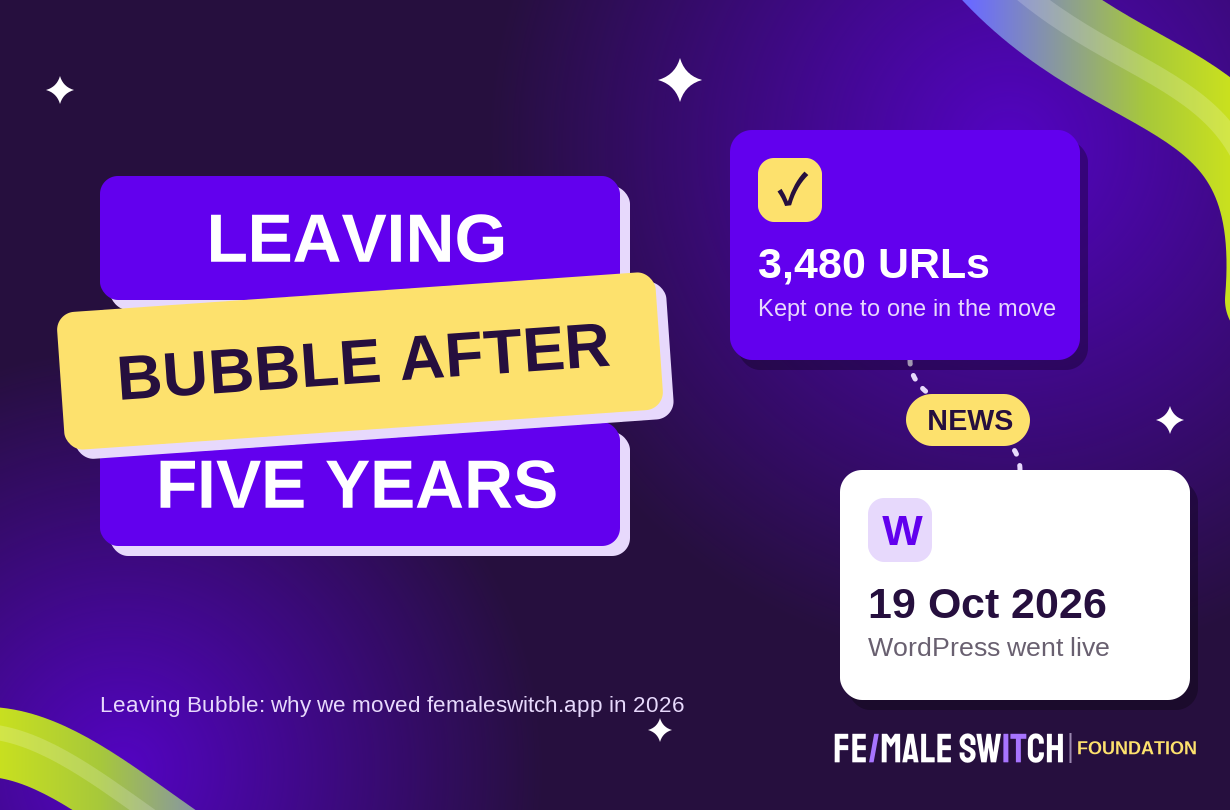
Leaving Bubble was an easy call for us in 2026, and joining it in 2021 was the right one. We ran femaleswitch.app on Bubble from at least October 2021 until October 2026. On 19 October 2026 we moved the public site to WordPress, kept all 3,480 URLs one to one and rebuilt the AI tools as our own plugin. With AI coding agents, a closed no-code platform makes far less sense for a new build. Below: our numbers and a checklist for founders leaving Bubble.
Here is what we know about the Bubble layoffs, on our sister site MeanCEO. Bubble's co-CEOs, Josh Haas and Emmanuel Straschnov, announced them on LinkedIn on 17 November 2026, without a headcount. Haas wrote about moving to "smaller teams that own a problem from start to finish" and building AI into how every team works. Here we answer what founders keep asking us: should you stay on Bubble, and how do you leave?
Why was Bubble the right choice for femaleswitch.app in 2021?
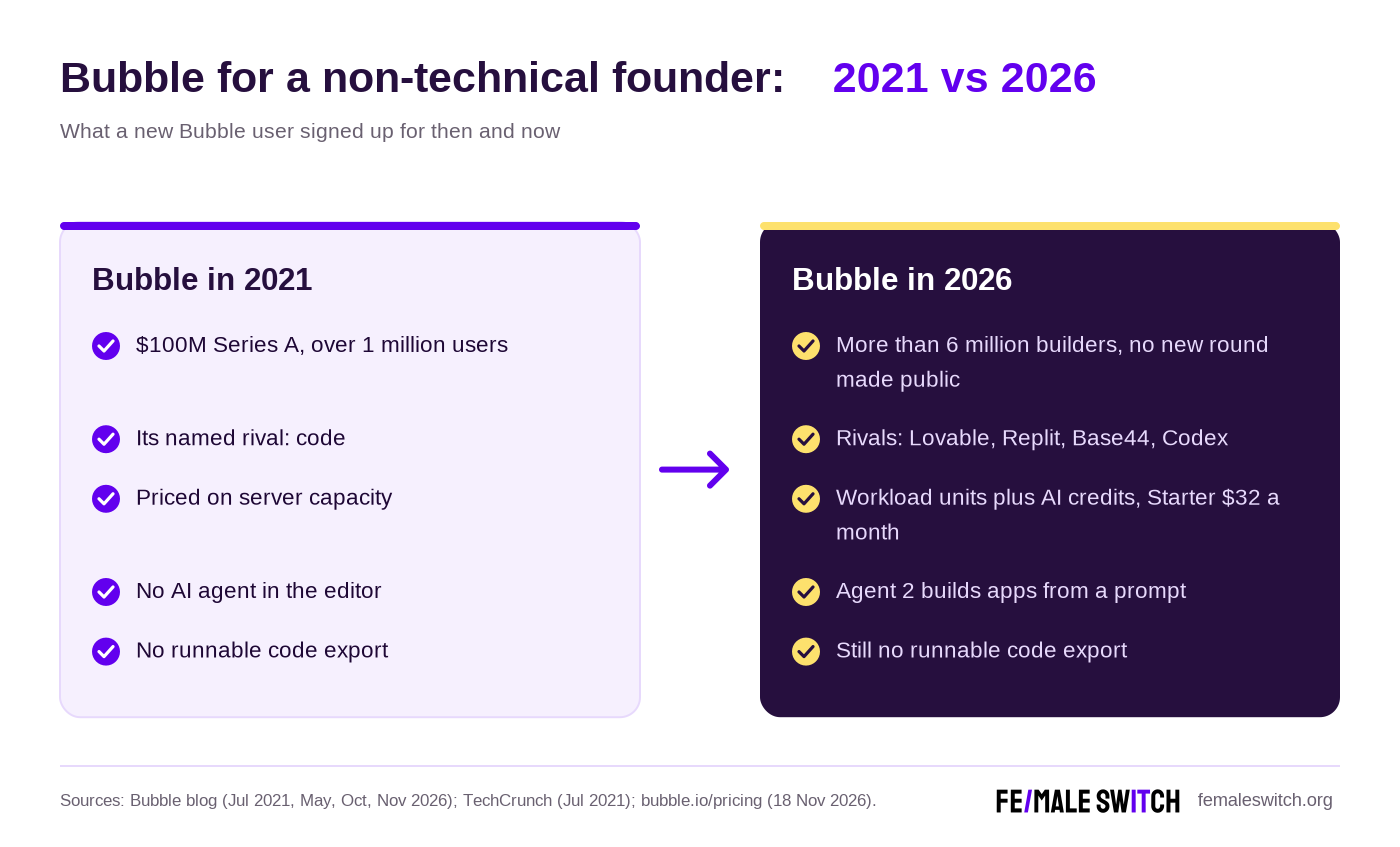
The Wayback Machine's first capture of femaleswitch.app is from 21 October 2021, and its page code already carries Bubble's loader. Three months earlier Bubble had raised a $100M Series A led by Insight Partners and counted "over a million users", says Bubble's announcement. Co-founder Emmanuel Straschnov told TechCrunch: "the true competition we have is code."
For a founder without a developer, he had a point. We built pages, data and logins without hiring anyone, and in December 2022 we used Bubble to build an AI tool with GPT-3 in a few days. That speed was worth every limit, and we have no regrets.
What changed for Bubble users between 2021 and 2026?
Four things moved: the price model, the cost of lock-in, the tools around Bubble and our own needs as the site grew past 3,000 public pages. Let's break it down. We use the same rule for email now, and wrote up what to vibe code and what to rent if you build your own Mailchimp.
The 2023 workload pricing change
On 6 April 2023 Bubble announced workload units (WU), a usage metric for the server work an app does, to replace server capacity from 1 May 2023. Straschnov's forum post listed the goals, starting with "Ensure Bubble's long-term success as a platform". He explained that the old model created "a perverse incentive for us: as our team improves Bubble and makes it faster and better, Bubble's revenue from capacity goes down."
The community pushed back hard. The FAQ thread reached 1,380 posts and 91,400 views. Some users blamed investor money: "I suspect the VCs are driving this," one wrote. That was their opinion, and Bubble gave its own reason above. Bubble's VP Marketing answered that 83% of paying apps would see a change below $50 a month, even without optimising.
Six days later, on 12 April 2023, Josh Haas walked it back: the main activities would cost 50-99% fewer WU than planned, "leading to a ~30–90% decrease in cost", and he wrote that Bubble "could have communicated this change more effectively". Credit to Bubble for listening. We still learned that our costs hung on a metric someone else could redefine.
Prices and lock-in today
Bubble's pricing page lists Starter at $32 a month billed annually, Growth at $119 and Team at $349. Starter went up from $29 on 20 October 2026, one day after our WordPress launch, when Bubble added AI credits with Agent 2 and tied the change to the AI models behind it.
The bigger cost is the exit. Bubble says it plainly in a May 2026 post: "Visual workflows built in a proprietary editor can't be exported as runnable code." Data leaves as CSV or through the API, and the logic has to be rebuilt. We accepted that trade in 2021. In 2026 it feels expensive, because AI coding agents write code we own and can move to any host.
AI coding agents arrived
Money moved to tools that write real code. Lovable passed "more than $500 million in annualized recurring revenue" in June 2026, as reported by Business Insider. IT Brief reported in June 2026 that more than 5 million people use OpenAI's Codex each week, about 20% of them non-developers. We are in that 20%: we built our new AI tools plugin with Codex. A Bubble staff member wrote in September 2026: "leads from our RFP system have slowed down in 2026."
Two incidents after our move
These came after our switch, so they decided nothing for us. From 26 October 2026, according to Bubble's preliminary report, "an attacker obtained temporary internal credentials by exploiting a security vulnerability in our platform" and read private plugin data; Bubble has "no evidence" that app databases were read. On 10 November a caching change pushed Google font requests past Google's daily cap at 2:10 PM ET, with recovery at 3:09-3:15 PM ET, staff explained.
How does Bubble in 2021 compare with Bubble in 2026 for a non-technical founder?
What does Bubble still do well in 2026?
Bubble kept shipping. The AI Agent beta arrived on 16 October 2025, Agent 2 and a Bubble MCP beta on 6 October 2026, and in November a Universal import that turns projects from Lovable, Claude Code and Replit into editable Bubble apps. Native mobile reached general availability on 12 November 2026, with "more than 99.5% of iOS and Android users experiencing no crashes at all", according to Bubble.
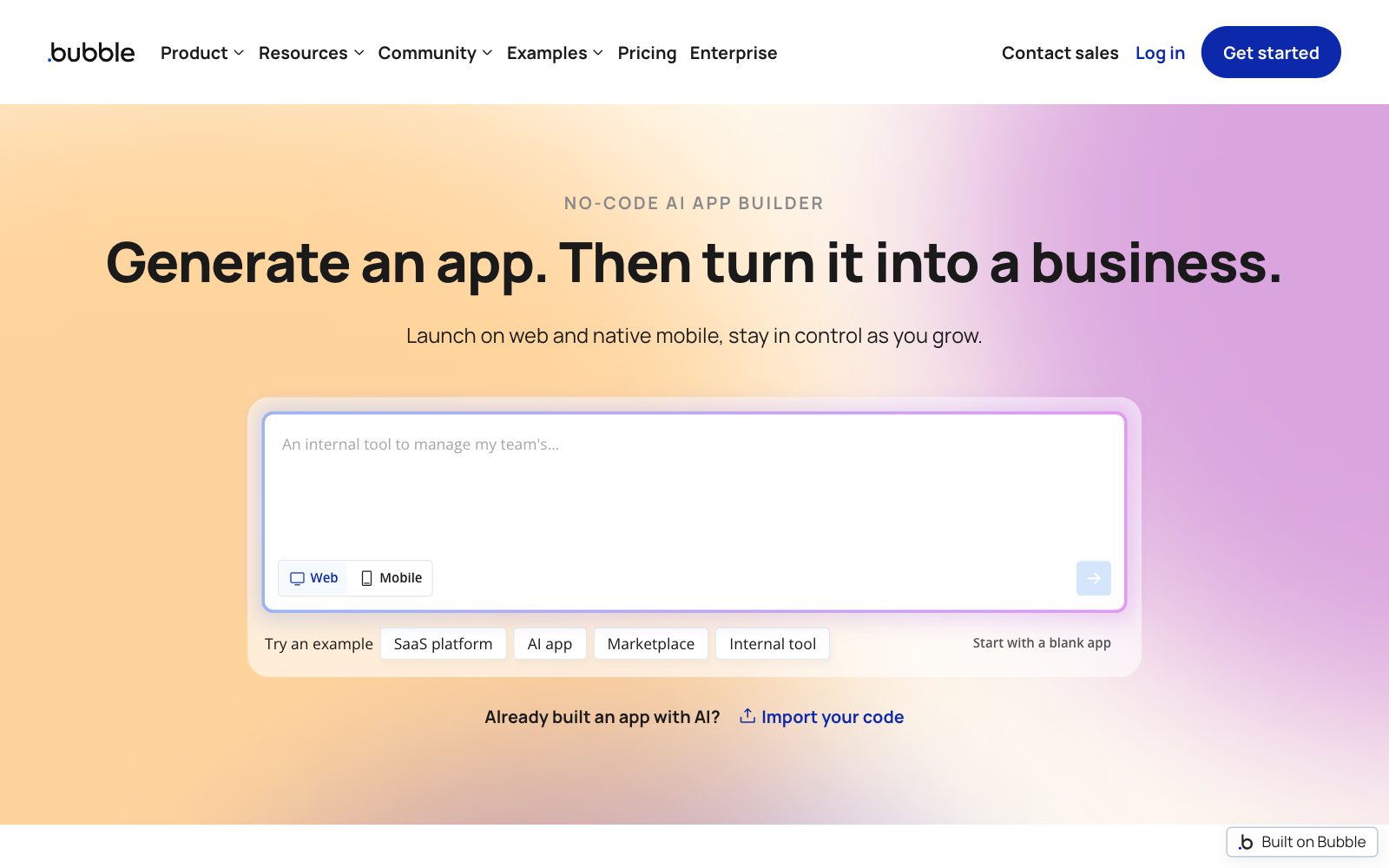
Bubble argues that code-first AI builders leave a control gap for people who can't read code, and those builders have real problems. CVE-2025-48757, a database exposure in apps built with Lovable, got a 9.3 severity score, which Lovable disputes. YipitData found only about 9.8% of US Lovable payers from late 2025 still paying in mid-2026, with billing caveats.
If your Bubble app earns money and you can't read code, staying is a reasonable decision. Our view covers new builds and content-heavy sites like ours.
How did we move femaleswitch.app off Bubble?
Before the move we listed 3,480 public sitemap URLs and kept every one of them one to one on WordPress, self-hosted on Bluehost, so we needed no redirect layer. The DNS switch went live on 19 October 2026, and we retired Bubble completely, login side included.
We were careful with Google, because an earlier migration of ours got a whole site de-indexed. This time we released in stages: 793 pages were indexable at launch (pages with Search Console history or already indexed, plus the blog, AI tools, company and main pages), and about 2,700 playbook and podcast pages waited on noindex for release in batches.
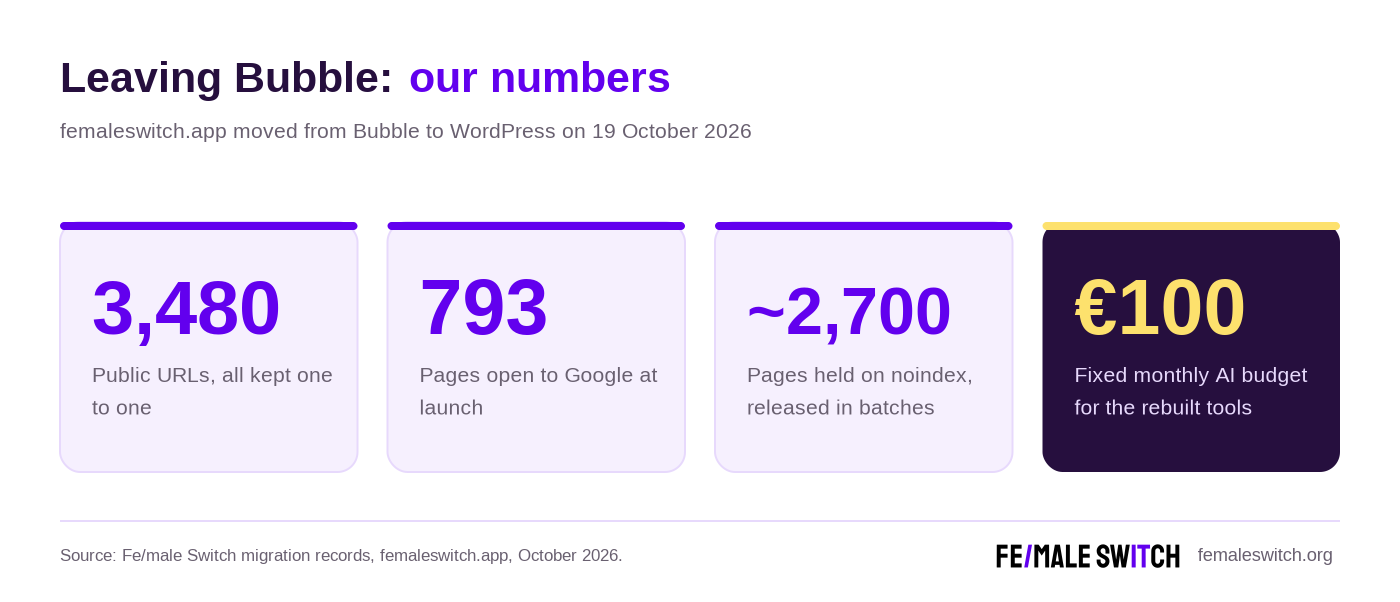
The AI tools took the most work. Bubble workflows can't be exported, so we rebuilt them as our own WordPress plugin, written with Codex, OpenAI's coding agent. Since 30 October 2026 they run on Claude Haiku 5.5 with a fixed budget of €100 a month. After the move we also built a company directory with paid tiers from $10 to $89 and a submission flow. You can see femaleswitch.app as it looks now.
One surprise: the Wayback Machine's July 2026 capture of our old site only shows "Your browser was unable to load the application". Save your own copies before you switch.
How do you leave Bubble without losing your Google traffic?
Next steps for a move like ours:
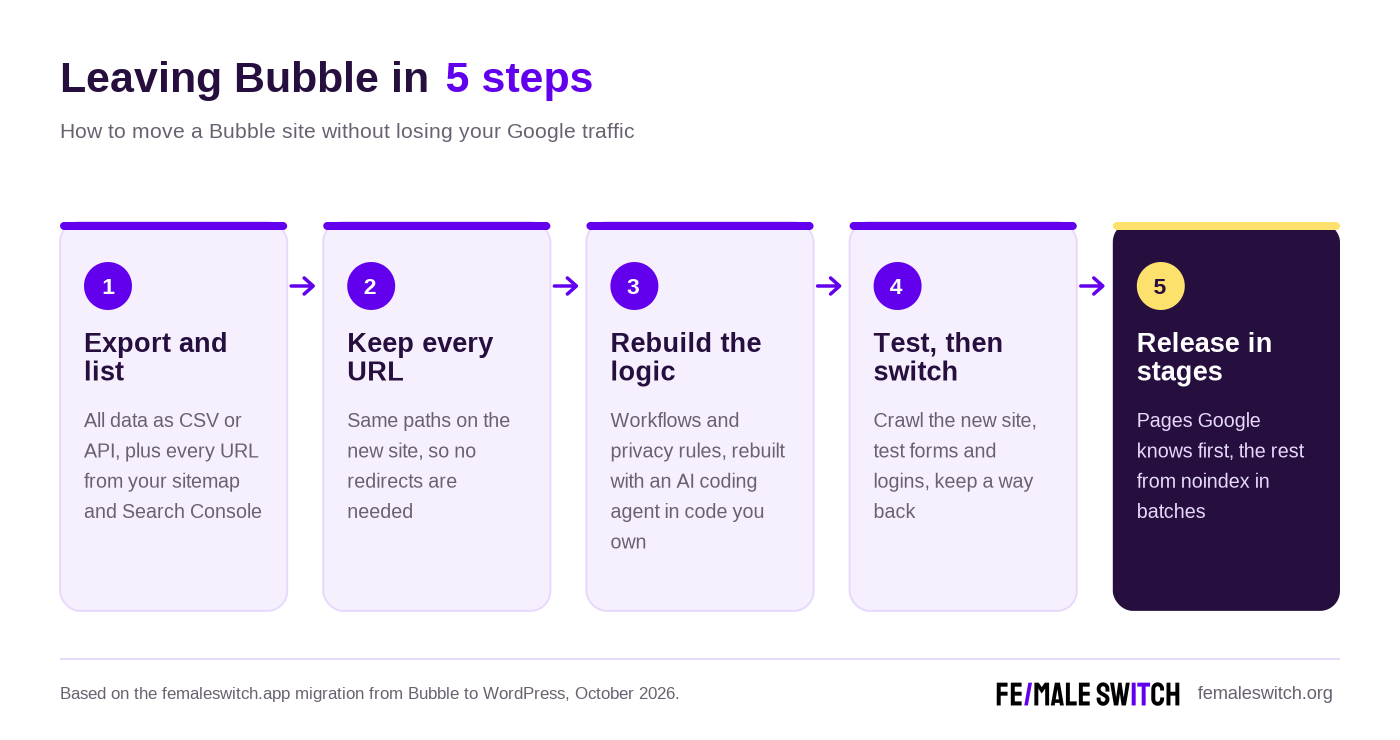
- Export your data: every data type as CSV or through the API, plus files. Compare row counts.
- Inventory every URL: your sitemap plus every page with clicks or impressions in Search Console.
- Keep your URLs: rebuild with the same paths, and you need no redirects. Where a path has to change, map it to a 301 redirect.
- Rebuild the logic with an AI coding tool: list every workflow, API call and privacy rule, then rebuild them with an agent such as Codex, Claude Code or Cursor, in a repository you own.
- Test before the DNS switch: crawl the new site, compare titles and status codes with your inventory, and test logins, forms and payments.
- Release indexing in stages: open the pages Google already knows first and release the rest from noindex in batches.
- Keep a rollback plan: lower your DNS TTL ahead of time, keep the Bubble plan for the first weeks and decide who switches back, and when.
What would we build femaleswitch.app with today?
In Violetta's words: "We had femaleswitch.app on Bubble for many years and back then it was a great choice, but with AI zero code like Bubble makes zero sense."
For a content site with tools, we would build what we have now: WordPress, our own plugin written with an AI coding agent, and a fixed AI budget. For a new SaaS product we would start in code from day one, with an agent writing it, a GitHub repository we own and a host we can change.
What does this mean for you if you're on Bubble today?
- Your app earns money and you can't code? Stay, export your data monthly and keep a URL list. Our guide to the limits of no-code and when to hire developers helps you spot the moment to move.
- Your workload bill keeps climbing? Check your WU use before renewal and compare it with the cost of no-code versus hiring developers, now that AI agents write much of the code.
- Starting something new? Pick tools that let you take your work with you. Our guide to building your first SaaS product covers the options.
- Running a content-heavy site? Move the pages to a CMS with the same URLs first and the app logic second, the way we did.
Building your first startup on a budget?
The Fe/male Switch startup game takes you from idea to first paying customers in weekly quests, with an AI co-founder and a community of founders.
👉 Start the game
- Bubble layoffs: what the co-CEOs announced and what it means for builders (MeanCEO)
- SaaS is dead? Which software survives and what bootstrappers should build (MeanCEO)
- AI app builders vs Bubble: will Lovable, Replit and Base44 share Bubble's fate? (Fe/male Switch)
- Zapier vs Make vs n8n: who survives the AI-agent era (Fe/male Switch)
- AI layoffs and the solo founder boom: what laid-off women in Europe can build in 30 days (Fe/male Switch Foundation)
FAQ: leaving Bubble
Why did femaleswitch.app leave Bubble?
Bubble served us well for about five years. In 2026 we wanted code we own and AI tools on a fixed budget, so we moved to WordPress on 19 October 2026.
Can you export a Bubble app as code?
No. Bubble says its visual workflows can't be exported as runnable code. Data leaves as CSV or through the API.
How much does Bubble cost in 2026?
Starter costs $32 a month billed annually ($39 monthly), Growth $119 and Team $349, plus a Free plan.
What happened with Bubble's 2023 pricing change?
Bubble announced workload units on 6 April 2023. After a strong community reaction, Josh Haas cut the planned costs on 12 April by about 30-90% for the main activities.
Will leaving Bubble hurt my SEO?
Keep every URL and release indexing in stages. We kept all 3,480 URLs, opened 793 pages at launch and released about 2,700 more in batches.
Is Bubble still a good choice in 2026?
For a non-technical founder with a paying Bubble app, staying is reasonable. For a new build, we would start in code with an AI coding agent.
