
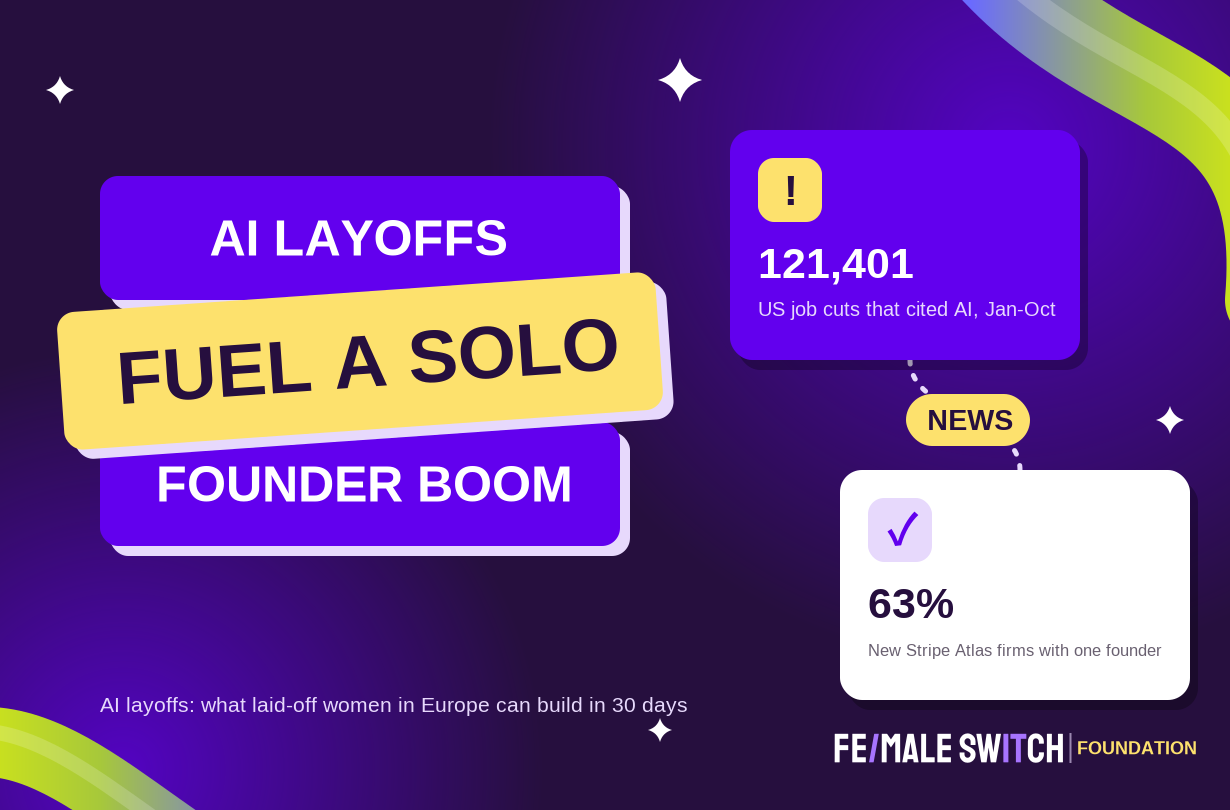
TL;DR: Are AI layoffs pushing people to start their own businesses?
AI layoffs more than doubled in 2026: US employers cited AI for 121,401 job cuts from January to October, more than double the whole of 2025. In the same year, 63% of new companies formed through Stripe Atlas in the second quarter had one founder, an all-time high. If you lost your job or fear you will, the cheapest test of a solo business takes 30 days and less than a laptop costs. The plan is below.
This week the no-code company Bubble joined the list: here is what happened at Bubble, on our sister site MeanCEO. This article looks at the wider picture for women in Europe who were laid off, or fear they will be, and for first-time founders: how real the AI layoff wave is, why so many people now start alone, and what to do in your first month.
How many layoffs did companies blame on AI in 2026?
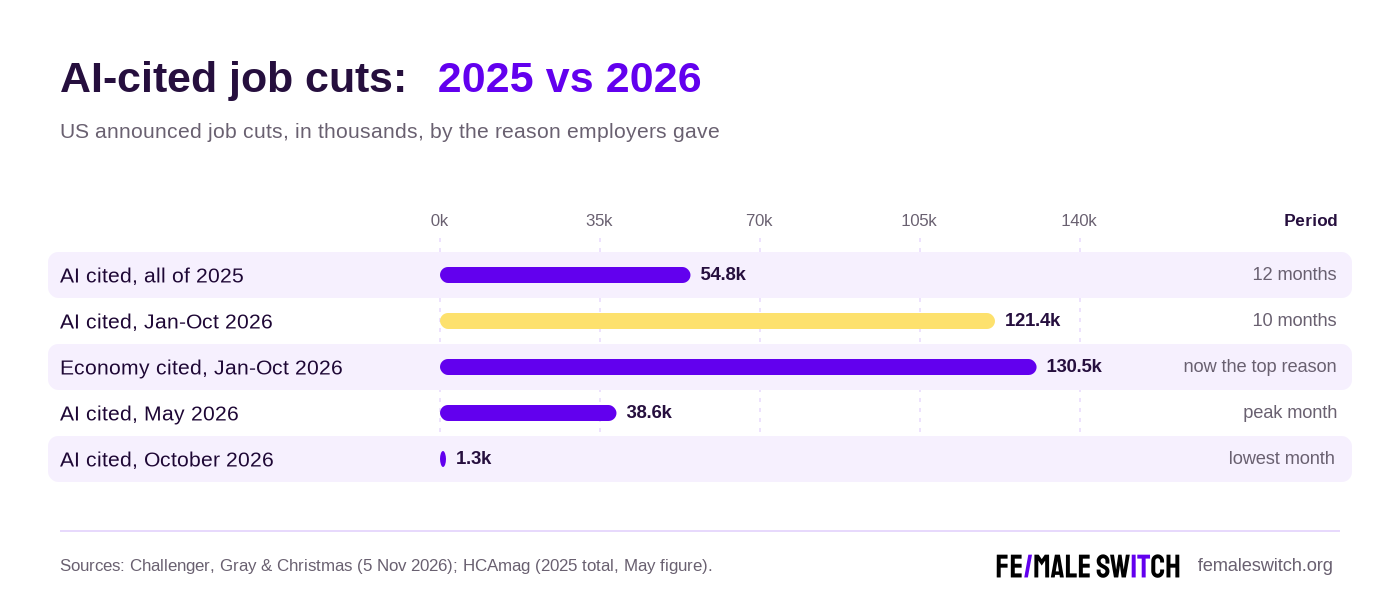
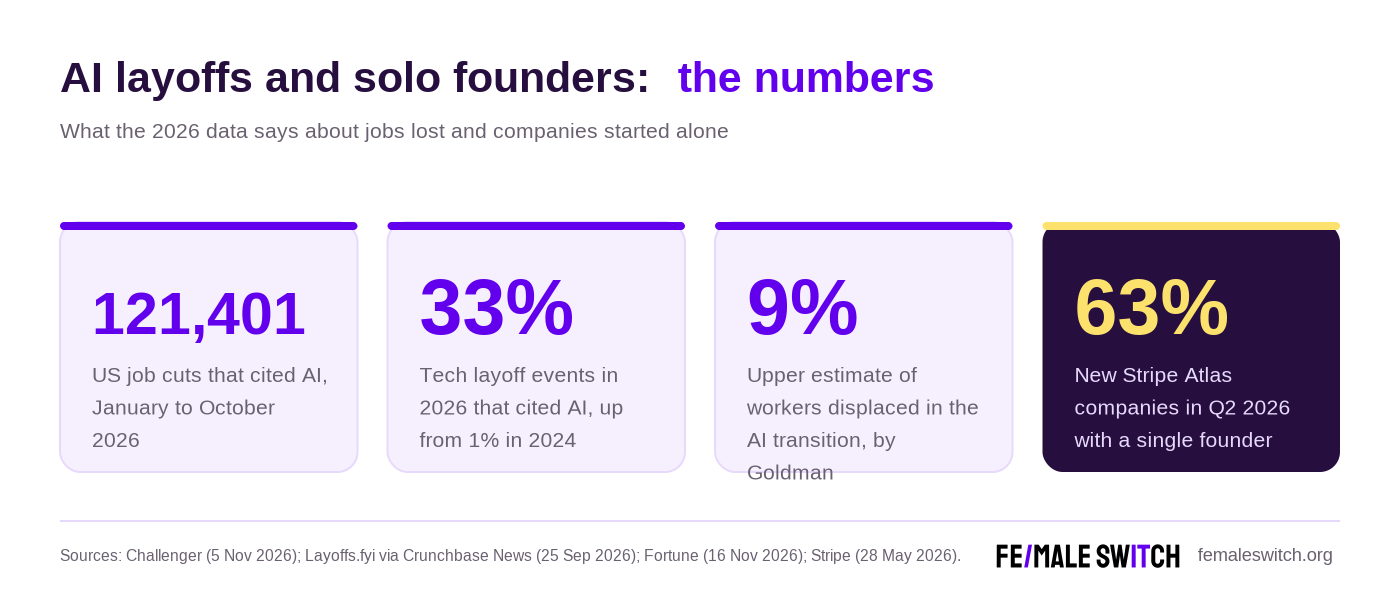
The best count comes from Challenger, Gray & Christmas, the US outplacement firm that tracks announced job cuts every month. Its October 2026 report counts 617,189 announced US job cuts from January to October. Employers named AI as the reason for 121,401 of them, about 20%.
For comparison, AI was cited for 54,836 cuts in all of 2025, according to HCAmag's summary of the same data. The peak came in May 2026, with 38,579 AI-cited cuts, about 40% of that month's total. Then the curve bent: in October AI was cited for only 1,265 cuts, the lowest month of the year, and market and economic conditions (130,531 cuts so far) overtook AI as the top reason.
Challenger put it plainly: "The reasons employers give have shifted from technology to the economy."
Tech is hit hardest. Layoffs.fyi founder Roger Lee told Crunchbase News that AI was cited in 33% of tech layoff events in 2026, up from 1% in 2024. Counted by people, Layoffs.fyi attributes 92,913 global tech layoffs to AI, 72% of this year's total.
Which software and no-code companies cut jobs in 2026?
The tools that promised to let anyone build without code were among the first to reorganise around AI. In May, Wix cut about 1,000 jobs, the largest layoff in its history, and ClickUp cut 22% of its staff. Webflow's CEO Linda Tong announced a restructuring on 27 May and said "many" teammates were leaving, without a number.
On 17 November 2026, Bubble's co-CEOs Josh Haas and Emmanuel Straschnov announced layoffs on LinkedIn, without a headcount. Haas wrote that Bubble is "building AI into how every team works", moving to smaller teams that own a problem from start to finish, and controlling costs across all operating expenses. Support and success teams are not affected, he said.
Here is our own view, from Violetta Bonenkamp, founder of Fe/male Switch: our app, femaleswitch.app, ran on Bubble for about five years, and back then Bubble was a great choice. With AI writing code, she thinks zero-code tools like Bubble make far less sense for new builds. In October 2026 we moved the site to WordPress and rebuilt its AI tools as our own plugin, written with an AI coding assistant, with a capped AI budget of €100 a month. Teams with a working Bubble app and no reason to move have a fair case for staying put.
Are companies really replacing people with AI, or using it as cover?
Both happen, and the data supports some caution before you panic. OpenAI's CEO Sam Altman said in February 2026 that there is "AI washing": "there's some AI washing where people are blaming AI for layoffs that they would otherwise do."
Oxford Economics found AI was cited for nearly 55,000 US cuts in the first 11 months of 2025, about 4.5% of reported job losses, and pointed to productivity: "If AI were already replacing labour at scale, productivity growth should be accelerating. Generally, it isn't."
The US job market is still holding. Fortune reported on 16 November that the four-week average of jobless claims, 195,000, is at its lowest level in the series' history. Goldman Sachs expects one more year of a "low-hire, low-fire" job market, and then a larger AI effect: its economist Joseph Briggs estimates up to 9% of workers, about 1 in 11, could be displaced during the AI transition, with disruption that speeds up in a downturn.
For you, the practical reading is this. Low hiring means a laid-off person waits longer for the next job. That waiting time is exactly when a small, cheap business test makes sense.
Why are so many people starting a business alone?
Because one person with AI tools can now do work that needed a small team. Stripe reports that solo founders made up 63% of the C corporations (US companies) formed through its Stripe Atlas service so far in the second quarter of 2026, an all-time high. By month 24, AI-native solo startups earned almost twice the revenue of other solo startups. Keep in mind this covers Stripe Atlas customers only.
The extreme case is Medvi, a GLP-1 telehealth company run by Matthew Gallagher. He started it in September 2024 with $20,000. The New York Times verified $401M in 2025 revenue and $65M in net profit, as reported in April 2026, and the company is "on track" for $1.8B in 2026 sales. It has one employee, his brother, plus contractors, so it is "technically not a one-person" company.
New business applications in the US stay high, though they dipped this autumn. The US Census Bureau counted 501,609 applications in October 2026, down 6.0% from September, and 144,314 high-propensity applications, the ones most likely to become employers.
For Europe, our report on solo founders in Europe covers the latest data.
What does this mean for you if you were laid off?
Medvi is an outlier, and most solo businesses start as one person selling a skill they already have. Your old job gave you three things a new founder pays for: knowledge of a problem, contacts who have that problem, and a sense of what people pay to solve it.
- Start with services. Consulting, freelancing or a productised service brings cash in weeks. Software can come later.
- Use AI for the grunt work. Drafts, research, a first website and customer emails take hours now. Our list of free and under-€20 AI tools for small businesses includes GDPR notes.
- Keep fixed costs near zero. No office, no paid tools you don't use weekly, no logo design budget in month one.
- Don't rush into code or a no-code app. Our cost comparison of no-code and hiring developers shows what each path costs once you know what to build.
Laid off? What should you do in your first 30 days?
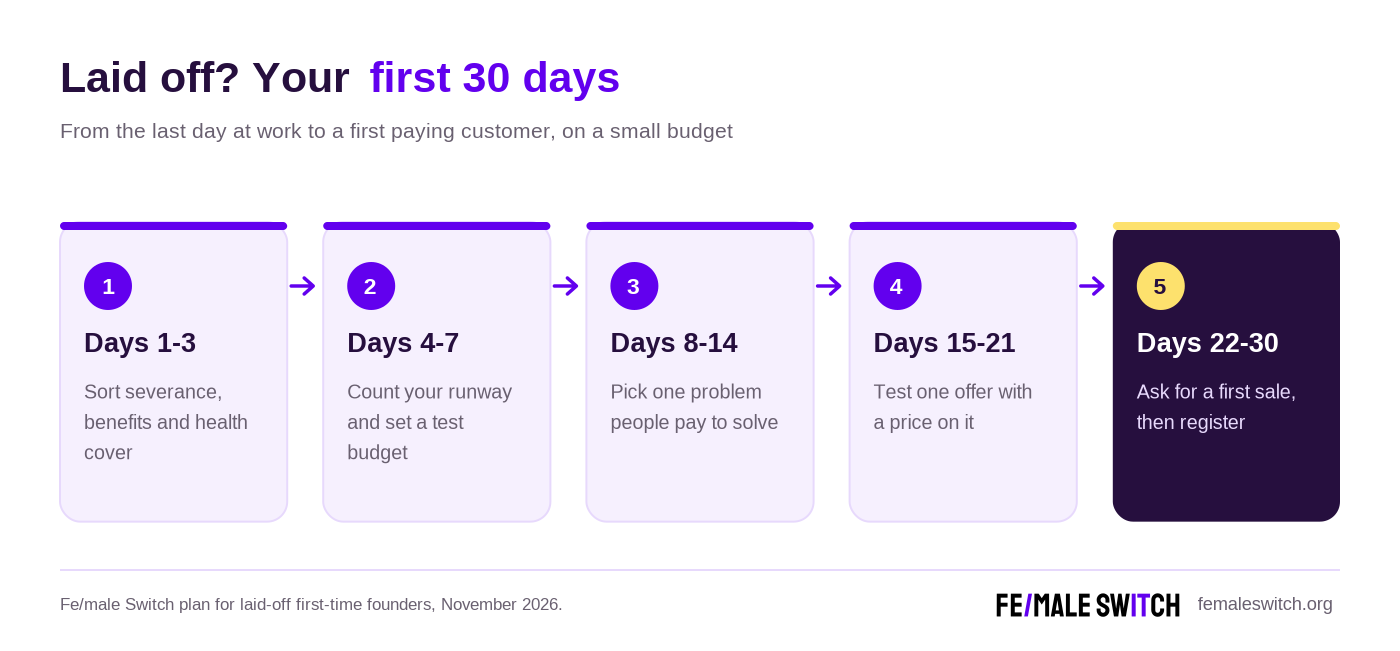
Here is a plan that keeps your money safe while you test an idea. Use the table as a checklist.
Next steps for this week:
- Protect your income first. Benefit rules differ by country, and registering a business too early can reduce what you receive. Ask before you register.
- Write down your runway in months. Our guide to start-up costs on a bootstrap budget shows how to list and cut costs before you spend a euro.
- Pick one problem you know from your old job. Ten conversations beat ten weeks of planning.
- Put a price on one offer and send it to people who know your work. A clear price gets clearer answers than a free trial.
- Ask for money. A pre-sale or a paid pilot is the only proof that counts.
- Register when someone pays. Then pick the legal form that fits your country and income.
Which legal form should a solo founder in Europe choose?
Most European countries offer a simple self-employed registration and a limited company. The right choice depends on your country's tax rules, your expected income and how much personal liability you can carry. Our solopreneur guide for women in Europe covers legal form and VAT, and our overview of Budget 2027 changes for freelancers and solo founders shows what changes next year in the Netherlands, Italy, Spain, France and Ireland. This is general information; check the details with your national tax office or a local adviser before you register.
What should you avoid in the first months?
- Spending your severance on tools and branding before anyone has paid you.
- Building an app first. AI makes building fast, and building the wrong thing fast is still building the wrong thing.
- Copying the one-person-unicorn headlines. Medvi has contractors and a brother on the payroll; your goal for month one is one paying customer.
- Reading every AI layoff headline as proof your field is finished. Part of the 2026 wave was cost-cutting with an AI label, as Altman and Oxford Economics point out.
Starting your first business after a layoff?
The Fe/male Switch startup game takes you from idea to first paying customers in weekly quests, with an AI co-founder and a community of founders.
👉 Start the game
- Bubble layoffs: what the co-CEOs announced and what it says about no-code in the AI era (MeanCEO)
- SaaS is dead? Which software survives and what bootstrappers should build (MeanCEO)
- AI app builders vs Bubble: will Lovable, Replit and Base44 share Bubble's fate? (Fe/male Switch)
- Zapier vs Make vs n8n: who survives the AI-agent era (Fe/male Switch)
- Leaving Bubble: why we moved femaleswitch.app after five years (Fe/male Switch Foundation)
FAQ: AI layoffs and going solo
How many layoffs were caused by AI in 2026?
US employers cited AI for 121,401 announced job cuts from January to October 2026, about 20% of all cuts, according to Challenger, Gray & Christmas. That is more than double the 54,836 of all of 2025.
Are AI layoffs slowing down?
Yes, for now. AI-cited cuts peaked at 38,579 in May 2026 and fell to 1,265 in October, when economic conditions became the top reason. Goldman Sachs expects a larger AI effect after about one more year.
Is "AI washing" real?
Sam Altman said some companies blame AI for layoffs they would make anyway, and Oxford Economics found AI behind only about 4.5% of US job losses in 2025.
Did Bubble lay people off because of AI?
Bubble's co-CEOs announced layoffs on 17 November 2026 without a headcount. Josh Haas named smaller teams, AI in every team and cost control as reasons. Our sister site MeanCEO has the full story.
How many new companies have a single founder?
Stripe reports that 63% of the US companies formed through Stripe Atlas so far in the second quarter of 2026 had a solo founder, an all-time high for its customers.
What should I do first after a layoff if I want to start a business?
Sort your severance, benefits and health cover, count your runway, then test one paid offer within 30 days. Register a business once someone is ready to pay, and ask your benefits office first.
