
TL;DR: Start-up costs are smaller than most first-time founders fear and bigger than their first list shows. Registering as a sole trader costs €0 in France, €20 in Estonia, €85.15 in the Netherlands and €111.50 in Belgium, so the real money goes to equipment, stock, software and the months before customers pay. Cash is where businesses die: in CB Insights' 2026 review of 431 startup shutdowns, 70% ran out of capital, and Eurostat counts only 57% of EU businesses still active three years after birth. List every cost, get three real quotes, move everything that can wait to "later" and put your numbers into the free 12-month start-up budget planner below.
Start-up costs are the first numbers I ask about when a woman in the Fe/male Switch community tells me she wants to start. The answer I hear most is "about €5,000", and it is always a guess. A guess is how founders end up with a beautiful logo and no money for the second month of rent.
As a bootstrapper, I treat the startup budget as a survival plan: what you pay before your first sale, what you pay every month after that, and how long your savings carry you while customers find you. This guide is for women and first-time founders in Europe who fund their own start. You get a method to list and price every cost, registration fees and VAT rules checked on official pages on 3 November 2026, and the free help most founders never ask for.
How does the 12-month start-up budget planner work?
Fill in your one-off costs, your monthly business costs and the living costs your job does not cover. Add the cash you can put in and the income you expect: the month it starts, the first amount and how much it grows each month. Pick your country and the planner adds the official sole trader registration fee.
The planner shows a 12-month cash table, your lowest cash point and the month it hits, and the month your money runs out, or that it lasts the full year. The verdict ends with three next steps. Copy the result as plain text for your notes or as CSV for a spreadsheet.
What counts as a start-up cost, and what is an operating cost?
- Start-up costs are what you pay once to open the doors: registration, a laptop, equipment, first stock, a website, a deposit. I call them one-off costs.
- Operating costs (also called running costs or recurring costs) come back every month or year: software, phone, insurance, an accountant, workspace, marketing.
- Burn rate is the money that leaves your account each month before income covers it: business costs plus the living costs your business must pay for.
- Runway is how many months your cash lasts at that burn rate. Cash of €3,000 and a burn rate of €500 gives you six months.
The cost of starting a business is one-off costs plus the operating costs you carry until income catches up. First-time founders forget that second part: if customers take four months to pay you, four months of running costs belong in your startup budget.
Why does cash planning decide whether a new business survives?
Here is why I push every founder to plan 12 months of cash before she spends anything:
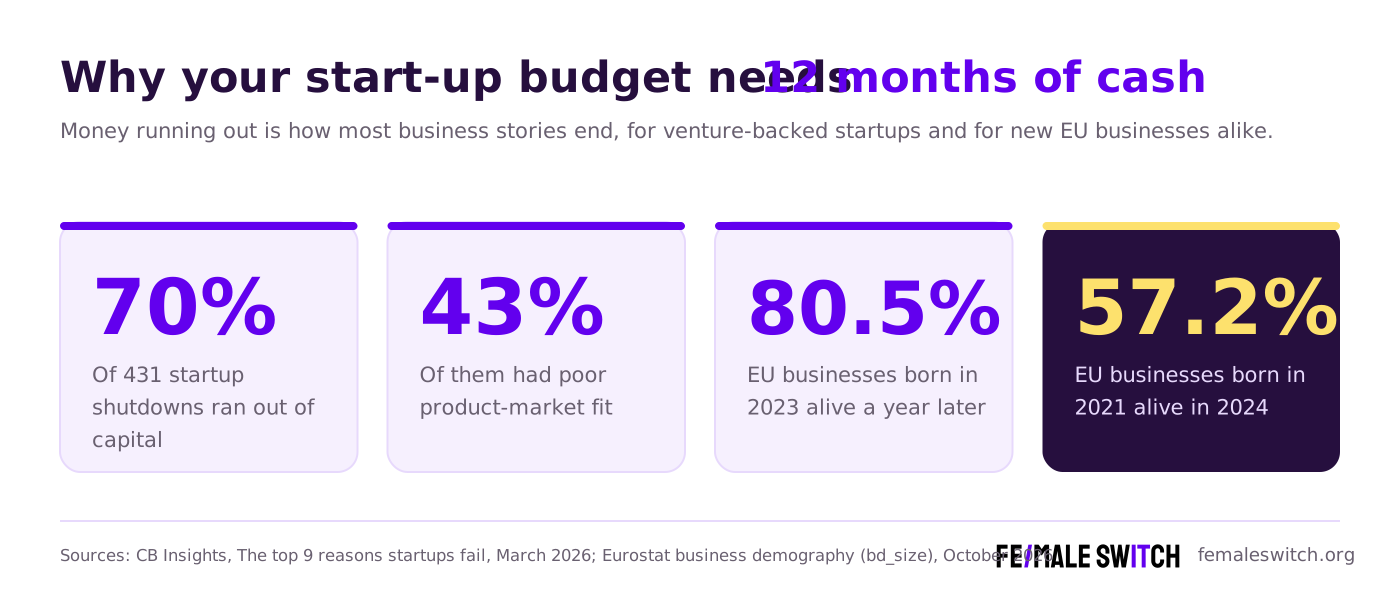
- CB Insights analysed 431 venture-backed companies that shut down since 2023 in its March 2026 report on why startups fail. 70% ran out of capital. The same report calls running out of money "almost always the final cause of death", with poor product-market fit (43%) and unsustainable unit economics (19%) underneath it.
- Eurostat's business demography data, updated in October 2026, shows that of EU businesses born in 2023, 80.5% were still active a year later. Of those born in 2021, 57.2% were still active in 2024. More than four in ten new EU businesses were gone within three years.
Those startups had investors and still ran dry. A bootstrapped founder has one source of cash: you.
My reading: money runs out at the END of a story that started earlier, with costs nobody listed and income that came late. A 12-month plan shows that ending on paper, while you can still change it.
How do you list every start-up cost?
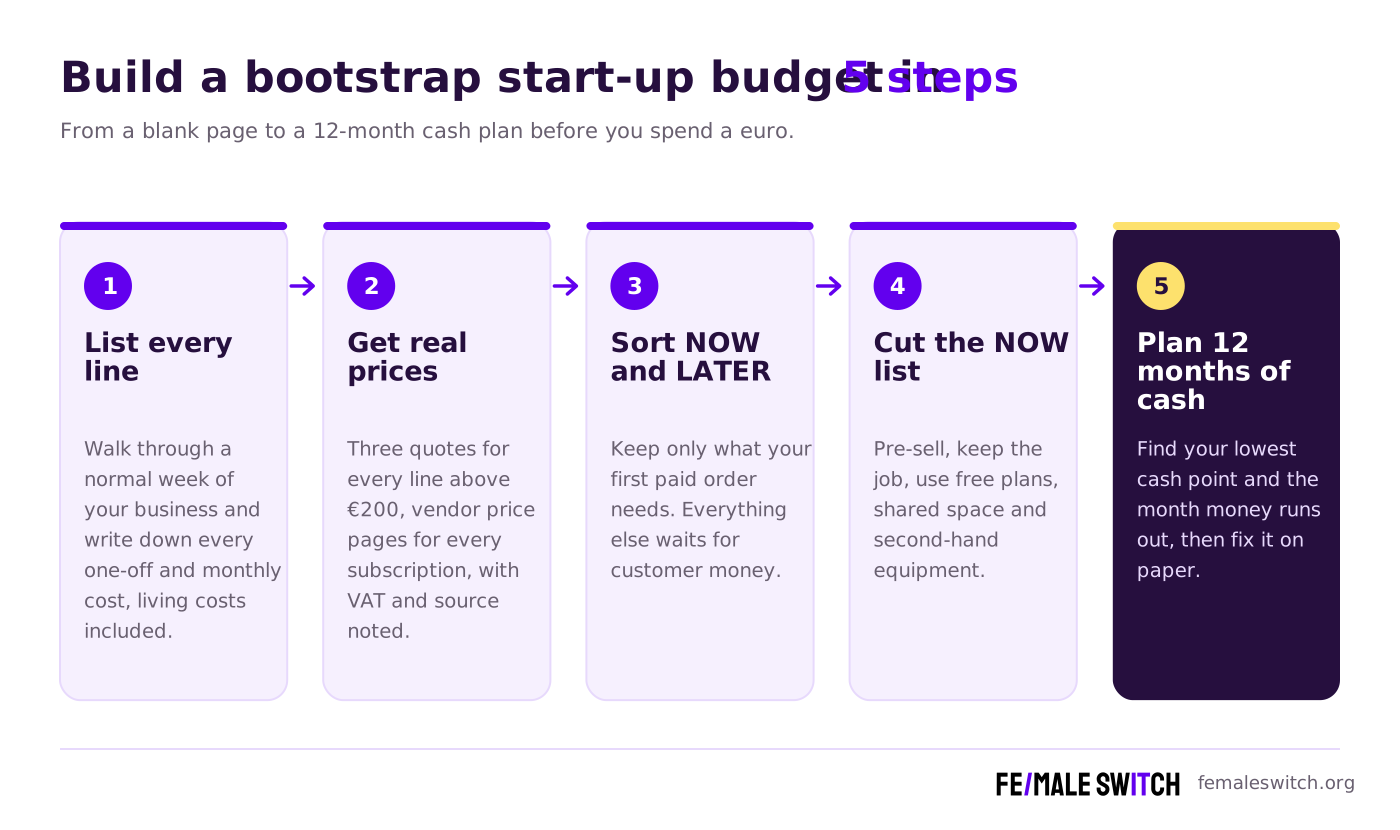
Walk through a normal week of your future business, from the first customer message to the payment landing in your account, and write down everything you touch, use or pay for. Sort each line into one-off or monthly, and mark it NOW (needed before your first paid order) or LATER (useful, not needed yet).
Two rules keep the list honest. Every line gets a number and a note of where it came from. And taxes and social contributions are costs too: as a sole trader you pay them on your profit, and if you hire later, employer social contributions (the social security an employer pays on top of a salary) join the list. Our guide to tax for startup founders in Europe covers what to set aside.
Copy this budget line list into your notes and fill in an amount and a source for each line:
- One-off: registration fee / permits / bank account / laptop or phone / tools and equipment / first stock / packaging / domain and website / photos / legal or accounting check / insurance deposit / launch costs
- Monthly: software / phone and internet share / insurance / accountant / workspace or storage / marketing / transport / payment and bank fees / tax and social contributions set aside / living costs not covered by a job
To see this for real businesses, our itemised first-year budgets for 10 low-cost businesses price every line for ten different starts. Use them as a reference, then build your list from your own week.
How do you get real prices instead of guesses?
Guesses are always too low, and quotes cost nothing but a few emails. My rule: three quotes for every line above €200 and the vendor's own price page for every subscription.
- Group your lines by supplier type: equipment sellers, printers, accountants, insurers, workspace owners, web builders.
- Write one short request and send it to three suppliers per group (the message is below).
- Ask for the full price: VAT, delivery, set-up fees, minimum contract length and what happens after a free trial ends.
- Check subscription prices on the vendor's own pricing page, and note whether the price is monthly or yearly and with or without VAT.
- Write the source and date next to every number in your list.
- Take the middle quote for your plan unless you have already chosen a supplier.
Copy this quote request:
Hello [name], I am starting [type of business] in [city] and I am preparing my start-up budget. Could you send me a price for [item or service, quantity, delivery date]? Please include VAT, delivery or set-up costs, any minimum term and your payment terms. I am comparing three offers and will decide by [date]. If you have a second-hand, refurbished or starter option, I would love to hear about that too. Thank you, [name, phone]
That last sentence earns its place: suppliers keep ex-demo machines and starter packages that never appear on their websites.
Which costs are must-have and which can wait?
Sort with one question: can I deliver my first paid order without this? If yes, it moves to LATER. A website with ten pages, a brand photo shoot, a studio lease and a paid design tool all wait until customers pay for them. Registration, the equipment the first order needs and the insurance your sector requires stay in NOW.
Then cut the NOW list again with a second question: is there a free, borrowed, shared or second-hand version? A refurbished laptop, a shared kitchen for food producers, a coworking day pass instead of a lease, a free invoicing plan. The aim is a NOW list you can pay from your own savings with money left for at least three months of running costs.
I also ask founders to sell before they buy. A validated idea changes which costs are needed at all, and our guide to validating a business idea without spending money shows how to test demand with conversations and pre-orders first.
Sole trader or company: which is the cheapest way to start?
For most bootstrappers, the cheapest legal start is registering as a sole trader (self-employed, eenmanszaak, micro-entrepreneur, Einzelunternehmen, FIE). You and the business are one legal person, so there is no share capital (the money owners put into a company when it is founded) and no notary. The price of that simplicity is personal liability: debts of the business are your debts.
Here is what the registration itself costs, checked on official or officially approved pages on 3 November 2026:
The EU's own target, published on the Your Europe portal, is that setting up a company should take no more than 3 working days and cost less than €100. For the planned EU Inc, read our update on the €100, 48-hour EU Inc agreed by EU governments before you pay a notary. Registration rules also bite early: our report on Belgium's crackdown on unregistered Instagram and Vinted sellers shows where a hobby becomes a business.
Starting in the Netherlands? Our guide on how to register a business in the Netherlands walks you through the KVK steps, and our business banking setup guide keeps business and private money apart from day one.
When do you have to charge VAT as a small business?
VAT registration means telling the tax office you will charge value added tax on your sales and pay it on to them. Every EU country has a small business exemption: below a turnover threshold you can skip charging VAT. Since 2025 the EU's VAT SME scheme sets the rules. According to the Your Europe portal, a country's threshold can be at most €85,000 annual turnover, and with the cross-border SME scheme you can use the exemption in other EU countries too if your total EU-wide turnover stays under €100,000.
The exemption has a price: you cannot deduct the VAT you pay on your own purchases, as both Your Europe and the Dutch government portal state. If your start needs €4,000 of equipment and your customers are businesses that reclaim VAT anyway, charging VAT from day one leaves you with more money. If you sell to consumers and spend little on equipment, the exemption keeps your prices lower. Run both versions through the planner. Our guide to pricing your product helps you decide whether your prices include VAT or not.
How do you cut start-up costs without cutting the business?
These eight cuts work again and again in our community, roughly in order of how much they save.
- Pre-sell before you buy. Take deposits, pre-orders or paid pilots and buy stock with the customer's money. Reward crowdfunding is a public pre-sale; our list of crowdfunding platforms for women-led and community projects shows the fees.
- Keep your job for now. A salary pays your living costs, the biggest monthly line in most budgets. Our guide on self-funding your startup while working full-time covers the practical side.
- Start part-time. Move from one evening a week to a four-day job when income proves itself. Our side hustle to full-time timeline shows the stages.
- Use free plans first. Invoicing, email, design and scheduling all have free tiers good enough for your first customers. See our list of free tools for bootstrapped startups and our AI tools for small business, free or under €20 a month. When a tool outgrows its free plan, look it up on SaaSOffers before you pay full price: its directory lists 495 startup deals and credits, and more than 95 of them are open on its free plan.
- Share space. A coworking day pass, a shared studio or a community kitchen costs a fraction of a lease, with no long contract.
- Buy second-hand or refurbished. Laptops, sewing machines, kitchen equipment and furniture lose value fast in their first year, so let someone else pay for that.
- Build it yourself before you hire. No-code tools build a booking page or a small shop in a weekend; compare the numbers in our no-code vs hiring developers cost comparison.
- Buy stock in the smallest batch the supplier allows. A higher unit price on 50 pieces beats a discount on 500 that sit in your hallway.
One cut I never recommend: skipping insurance or registration. A single claim or fine costs more than your whole first-year budget.
Where can you get free advice and small loans?
Public help for first-time founders is better than its reputation, and most of it is free.
- Chambers of Commerce and enterprise counters such as the KVK in the Netherlands publish step-by-step start guides and fee lists.
- The EU's Your Europe portal explains company types, VAT and hiring rules country by country, and points to the Points of Single Contact each EU country runs to handle start-up formalities.
- The Enterprise Europe Network "can give you free advice", according to Your Europe.
- Grants and training programmes for women founders; see our grants for women entrepreneurs in Europe and the safety nets for new founders in 8 countries, from start-up allowances to lower contributions.
When savings and pre-sales still leave a gap, a micro-loan is the bootstrapper's bank, built for founders the banks turn away.
You never apply to the EU directly: ask your Chamber of Commerce which local microlender works with the European guarantee. Our guide to alternative funding sources for women-led businesses compares loans with crowdfunding and revenue-based options.
A loan goes into the plan as money in, with its repayment as a new monthly cost. If the planner turns red when repayments start, borrow less.
What does a bootstrap start-up budget look like on paper?
Here is the worked example the planner loads under "Fill with an example": a Dutch founder starts a hand-made candle shop next to her job.
- One-off costs: KVK registration €85.15, refurbished laptop €350, website and domain €60, first wax, wicks and jars €600, equipment €400. Total €1,495.
- Monthly costs: software €30, phone share €20, insurance €25, marketing €50. Total €125, and €0 living costs because her salary covers them.
- Cash in: €2,000 of savings.
- Income: from month 3, €150 in the first month, growing by €75 a month.
Her cash dips to its lowest point of €255 in month 2, before the first sale, and the money lasts the full year, with about €3,880 in the bank by month 12. The planner still calls it amber, because €255 is less than three months of costs. Now change one thing: she quits her job and needs €1,200 a month for living costs. Her money runs out in the very first month. That single line is why I tell every founder to keep the job until the planner says otherwise.
For a deeper revenue plan once you have customers, follow our financial projections guide for beginners, and when growth starts to eat your cash, our guide on managing cash flow during growth picks up where this one stops.
Rehearse your start before you spend your savings. In the Fe/male Switch startup game you build a startup step by step: test the idea, set a price, plan your budget and your first customers, and make the expensive mistakes in the game first. Read our guide on how to bootstrap as a female founder for the mindset that goes with it.
What should you do with your start-up budget this week?
Write your full list today, including the living costs your job pays now. Send the quote request to three suppliers for every line above €200. Mark each line NOW or LATER, then cut the NOW list with free, shared and second-hand versions.
Then open the planner. Green means you can start with what you have. Amber means keep a buffer and pre-sell before you buy. Red means change the plan on paper: keep the job longer, cut a line, pre-sell or talk to a microlender, all before you spend a euro.
FAQ: start up costs
How much does it cost to start a small business in Europe?
The legal part is cheap: a sole trader registration costs €0 in France, €20 in Estonia, €85.15 in the Netherlands and €111.50 in Belgium. The real cost of starting a business is equipment, stock, software and the months before customers pay, which you add up line by line.
What are examples of start-up costs?
Registration fees, permits, a laptop or tools, first stock, packaging, a domain and website, insurance and an accountant's first session.
What is the difference between start-up costs and operating costs?
Start-up costs are one-off payments to open the business. Operating costs come back every month or year, and your startup budget carries them until income does.
Is it cheaper to start as a sole trader or a company?
As a sole trader. In the Netherlands a BV needs a notary, whose fee the government portal puts at €500 to €1,500, against €85.15 for a sole trader's KVK registration. A company limits your personal liability, so weigh that against the cost.
Do I need to charge VAT when I start a business?
Only above your country's small business threshold, if you join the exemption scheme: €20,000 in the Netherlands, €25,000 previous-year turnover in Germany, €37,500 for services in France. Under the exemption you cannot reclaim VAT on your own purchases.
How many months of costs should I save before starting?
Enough for your one-off costs, every month until income covers your running costs, and a three-month buffer on top.
Can I get a loan to start a business with no savings?
Microlenders exist for that case: Qredits in the Netherlands lends up to €50,000, Adie in France up to €15,000 and MicroBank in Spain €25,000 to €30,000 without collateral. Expect to show a business plan.
How do I reduce start-up costs?
Pre-sell before you buy stock, keep your job, use free software plans, share a workspace and buy second-hand.
