
TL;DR: A solopreneur is one person who runs a business alone: no employees, no co-founder, every decision and every invoice hers. Across the EU, more than 7 million women worked that way in 2025, according to Eurostat. Most start as a sole trader, which costs €0 in France, €85.15 in the Netherlands and €111.50 in Belgium to register, and most can skip VAT below a national threshold that runs from €15,000 in Portugal to €85,000 in Italy, while Spain has no such exemption at all. Pick your country in the free solo setup finder below to see your form, your VAT position and your simplified tax regime in one place.
A solopreneur is a person who starts and runs a business on her own, with no employees and no co-founder. The word joins "solo" and "entrepreneur", and the solopreneur meaning is exactly that: one owner, one decision-maker, one person who sells, delivers, invoices and files the taxes. A one-person business can be a design studio, a translation service, a bakery stall, a coaching practice or a small online shop.
As a bootstrapping founder, I have spent years in that seat, and in the Fe/male Switch community I meet women every week who are about to take it. Their first questions are practical: which form, do I charge VAT, what do I charge, and how do I keep going when nobody else is in the room. This guide answers those questions for women and first-time founders in Europe, with fees, thresholds and tax regimes checked on official pages on 4 November 2026.
What is a solopreneur, and how is she different from a freelancer or a startup founder?
Three words get mixed up all the time, so here are the definitions I use.
- Solopreneur: one person who owns and runs a business alone and builds it as a business, with her own products, prices, brand and systems. She can work with outside help, and she stays the only owner and only worker.
- Freelancer: a self-employed person who sells her time and skills to clients, project by project. Legally she runs a one-person business too. The difference is the plan: a freelancer sells hours, a solopreneur also builds something that sells without her hours, such as a product, a course or a fixed-price package.
- Startup founder (entrepreneur): a person who builds a company meant to grow fast, with co-founders, staff and investors. Solopreneur vs entrepreneur is a question of scale: every solopreneur is an entrepreneur, and few entrepreneurs stay solo.
A solo founder sits between the columns: she starts alone, and she may hire or take investment later. If you are weighing that choice, our guide to choosing between a solo start and a co-founder walks through it, and our news report on how many of Europe's new founders start alone shows how common the solo start has become.
How does the solo setup finder work?
Choose one of eight countries, type your expected yearly turnover, and say what you sell and to whom. The finder shows the sole-trader form, where you register and what it costs, whether your turnover stays under the VAT small-business exemption, and which simplified tax regime fits.
Every result ends with three next steps, and the copy button gives you the setup as plain text for your accountant. Change the turnover a few times to see where "you qualify" turns into "charge VAT".
How many women in Europe run a one-person business?
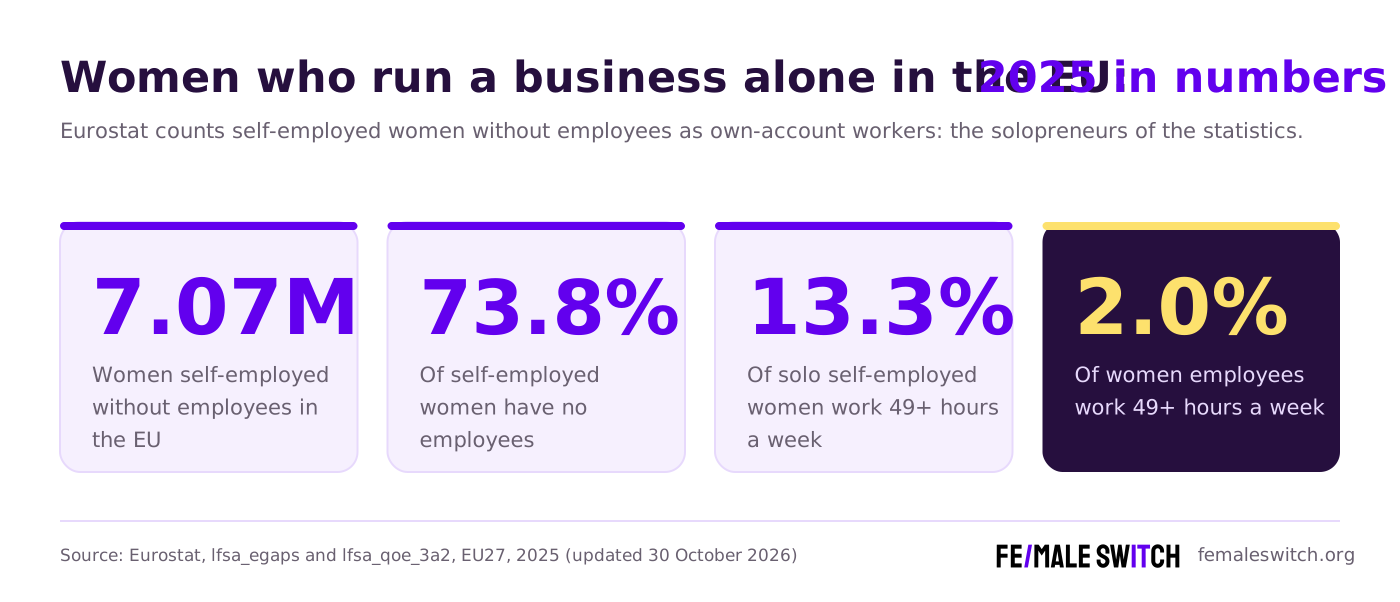
More than most people think. Eurostat's labour force data for 2025, updated on 30 October 2026, counts 7,074,200 women in the EU who are self-employed without employees. Eurostat calls them own-account workers, and they are the solopreneurs of the statistics.
- Of all 9.59 million self-employed women in the EU, 73.8% have no employees. For men the share is 64.8%.
- Women make up 36.9% of the EU's 19.15 million own-account workers.
- Own-account workers put in 39.7 usual hours a week on average in 2025, against 36.6 hours for employees, according to Eurostat's hours-of-work data.
My reading: going solo is the NORMAL way women run a business in Europe, and it deserves its own playbook instead of a startup playbook with the hiring chapter torn out.
Which legal form does a solopreneur use in each country?
Almost every solopreneur starts as a sole trader, also called a sole proprietorship: you register in your own name, there is no share capital (money owners put into a company at its founding), and you keep the profit. The price of that simplicity is personal liability: the debts of the business are your debts. Here is what the form is called and what registration costs, checked on official pages on 4 November 2026.
Two details trip up first-timers. In Germany, liberal professions such as writers, artists and doctors register no trade, according to the Berlin trade office, and still owe the tax office its questionnaire within one month. In Italy, trade and artisan businesses go through the Comunicazione Unica to the business register on top of the VAT number.
Registration is also where hobbies become businesses. Our report on Belgium's crackdown on unregistered Instagram and Vinted sellers shows where that line sits, and if you start in the Netherlands, our step-by-step guide on how to register a business in the Netherlands covers the KVK visit. Dutch freelancers who work for a few big clients also need our explainer on the new safe-harbour test for Dutch freelancers.
When does a solopreneur have to charge VAT?
VAT (value added tax) is the tax you add to your prices and pay on to the tax office. Every EU country can run a small-business exemption: below a turnover threshold you charge no VAT. The European Commission's Your Europe portal sets the frame: a national threshold of at most €85,000 a year, and a cross-border SME scheme that lets you use the exemption in other EU countries too while your total EU-wide turnover stays under €100,000 and under each country's own threshold. You register once at home, receive an EX number and file one quarterly report.
Sources: national tax pages and laws; Spain's position comes from the EU threshold table Hungary's tax authority published on 4 March 2026.
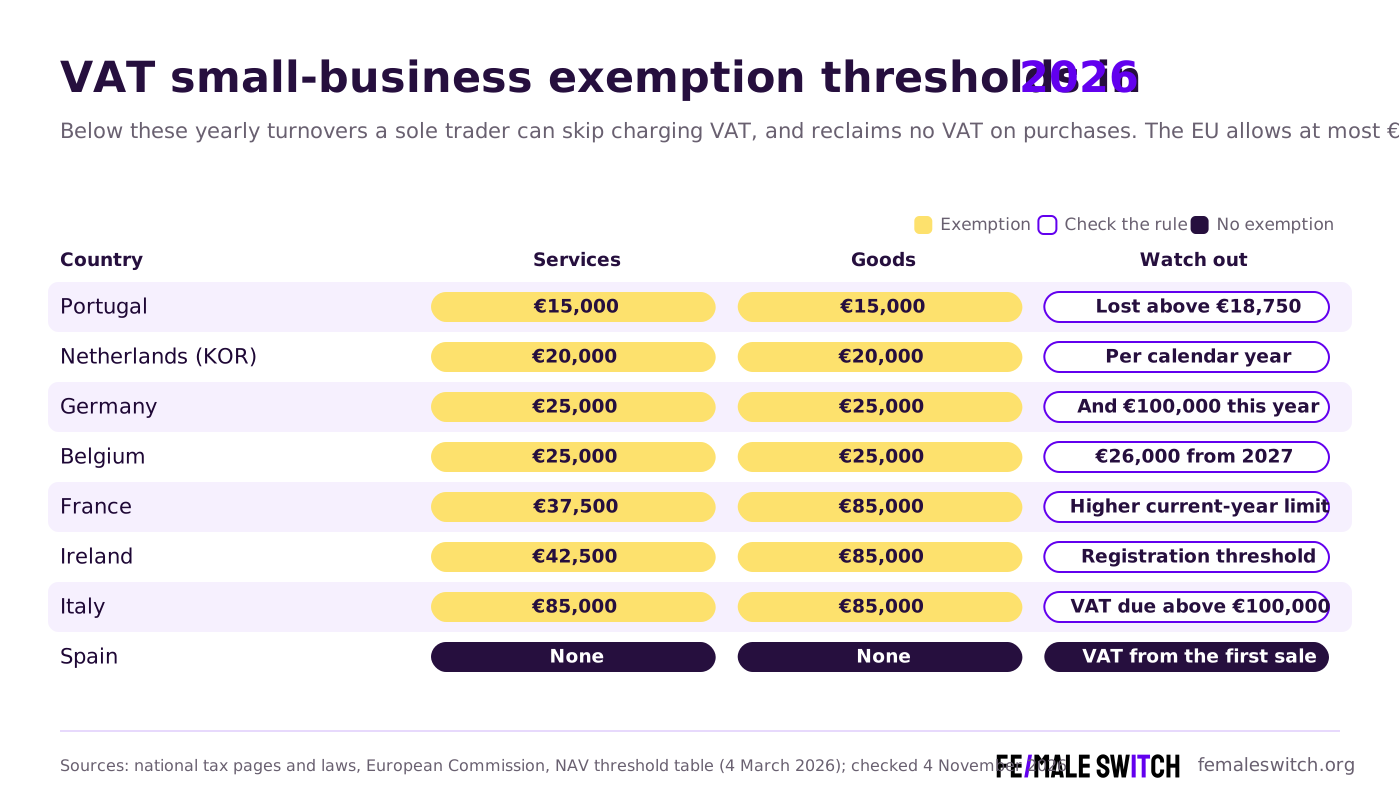
The exemption has a price, and both Your Europe and the Dutch government portal spell it out: you cannot reclaim the VAT you pay on your own purchases. So the decision depends on who your customers are.
- You sell to consumers: the exemption keeps your prices lower, because private customers cannot reclaim VAT.
- You sell to businesses: your clients reclaim VAT anyway, so the exemption gives them nothing, and you lose the VAT back on your laptop, software and equipment. Charging VAT from day one leaves you with more money if you buy a lot.
- You sell to both: count which group brings more turnover and run the numbers twice.
Our guide to tax for startup founders in Europe covers what to set aside beyond VAT.
Which simplified tax regimes can a solopreneur use?
A simplified tax regime replaces part of the normal bookkeeping or tax calculation with a fixed rule. Five of the eight countries in the finder have one that fits a solo business.
- Italy, regime forfetario: open to individuals whose revenue stayed at or under €85,000 the year before. One 15% tax replaces income tax and local surcharges, and a new activity pays 5% for its first five years if you ran no business in the previous three. You leave the regime in the same year your revenue passes €100,000. Italy's 2027 budget bill proposes a higher ceiling; our report on Italy's 2027 flat-tax plan tracks it.
- France, micro-entrepreneur: turnover ceilings of €203,100 for goods and €83,600 for services in 2026. Social contributions are a flat share of what you collect: 12.3% on goods sales, 21.2% on commercial services and 25.6% for non-regulated liberal professions.
- Netherlands, zelfstandigenaftrek: a self-employed deduction of €1,200 in 2026, falling to €900 in 2027, if you spend 1,225 hours a year on the business. Starters add a €2,123 starters' deduction in 2026, its last year according to the KVK.
- Spain, estimación directa simplificada: open while turnover stayed at or under €600,000 the year before, with 5% of net income allowed as hard-to-justify costs, up to €2,000. New autónomas also pay a reduced Social Security fee for 12 months; each state budget sets the amount, and I found no official 2026 figure.
- Portugal, regime simplificado: the common choice for starters, with organised accounts compulsory above €200,000 a year.
Germany has no flat-rate income tax, and its simplification is in the paperwork: traders may keep a simple cash-basis profit statement (EÜR) up to €800,000 turnover and €80,000 profit, under the German Fiscal Code. Belgium and Ireland tax a sole trader on real profit. In Ireland, Class S PRSI has been 4.35% of income or €650, whichever is greater, since 1 October 2026, according to Citizens Information.
Budgets change these numbers every year. Our round-up of what the 2027 budgets change for freelancers and solo founders is the page I reread every autumn.
How should a solopreneur price her work?
Most solo rates cover the hours worked and forget the hours nobody pays for. Three terms make the maths honest.
- Billable hours: the hours a client pays for.
- Utilisation: billable hours divided by all the hours you work. Sales, admin, learning and invoicing eat the rest.
- Retainer: a fixed monthly fee for an agreed amount of work, paid in advance. It smooths your income and fills your calendar before the month starts.
Here is the calculation I use with every woman who asks me what to charge.
- Set your income goal for the year before tax: what you need to live, save and rest.
- Add your business costs: software, insurance, equipment, accountant, travel, training.
- Add a set-aside for tax and social contributions, using your country's rates or your accountant's estimate.
- Count your working hours. The Dutch hour criterion of 1,225 hours a year is a useful yardstick: about 27 hours a week over 46 weeks.
- Multiply by your utilisation. At 60%, 1,225 hours gives 735 billable hours.
- Divide the total by your billable hours. That is your floor rate, the lowest price that keeps the business alive.
A worked example: an income goal of €30,000 plus €4,000 of costs is €34,000. If you set aside 25% of turnover for tax and contributions, you need about €45,300 of turnover. Divided by 735 billable hours, the floor rate is about €62 an hour. That turnover is also above the Dutch €20,000 KOR threshold, so a Dutch solopreneur adds VAT on top. Put your own numbers into the finder to see where your turnover lands in your country.
Then move to fixed-price packages and retainers as early as you can. Our framework for pricing services versus products shows how to build them, and our business banking setup guide keeps tax money in its own account from the first invoice. If you need to plan the first year's cash before you register, our start-up budget planner shows the month your money runs out.
How do you set up as a solopreneur, step by step?
- Test the idea with paying customers before you register: pre-orders, a paid pilot, a first small client.
- Run the solo setup finder for your country and expected turnover.
- Register your sole-trader form at the body the finder names, and keep the receipt: the KVK fee, for one, is tax-deductible.
- Decide on the VAT exemption before your first invoice, based on who your customers are.
- Open a separate business bank account and move your tax set-aside there every time a client pays.
- Set your floor rate with the six-step calculation above, then turn it into two or three packages.
- Write down your systems: how a client finds you, books, receives the work and pays. Our guide to building systems when you're the only employee has templates.
- Check grants and prizes that let you keep full ownership with our non-dilutive funding matcher for bootstrappers.
Where do solopreneurs find community and peer support?
Working alone does not mean deciding alone. The founders I see last longest have three kinds of people around them: peers at the same stage, one or two people a few years ahead, and specialists on call, such as an accountant and a lawyer.
- Join one community and show up every week. Our list of communities for female entrepreneurs, free and paid covers networks online and in European cities.
- Start a small peer group of three to five solopreneurs: one call every two weeks, each person brings one number and one decision.
- Hire help by the task. A freelancer for bookkeeping or design keeps you solo and gives you hours back; our guide to working with freelancers covers contracts and briefs.
- Know your own pattern. Our entrepreneurial mindset test with 12 bootstrapping situations shows where you rush and where you stall.
How does a solopreneur protect herself from burnout?
Here is the number that made me change my own calendar. Eurostat's 2025 data shows that 13.3% of women who work for themselves without employees put in 49 hours or more a week as their normal schedule, against 2.0% of women employees. Among solo men the share is 25.1%. Long weeks are built into solo work, because there is nobody to hand the next task to.
My guardrails, each one tested on myself first:
- A hard stop time in your calendar, with a short shutdown routine.
- Two admin blocks a week for invoices, VAT and email, so admin stops leaking into evenings. Our guide to time management systems for solo entrepreneurs shows how to block the week.
- Holidays priced into your rate: the 46-week year only works if the six weeks off happen.
- A sick-day and parental plan before you need it. Social protection for self-employed women differs by country; our report on maternity protection for self-employed women in Germany shows how thin it can be.
- Written boundaries for clients, sent before the work starts.
Our guide to burnout prevention for female founders goes deeper on the warning signs.
Copy this weekly solo operating checklist:
- Monday: plan the week, block two admin slots and one learning slot, set my stop time
- Every client payment: move the tax and VAT set-aside to the business savings account
- Wednesday: send invoices, chase anything 7 days overdue
- Thursday: one hour of sales or marketing, even in a full week
- Friday: update my numbers (turnover this year vs my VAT threshold, billable hours, cash), book one rest block for next week
- Monthly: check the hours log, compare my rate with my floor rate, talk to my peer group
Copy this boundaries message for new clients:
Hello [name], thank you for choosing to work with me. To give your project my full attention, here is how I work: I answer messages on weekdays between [time] and [time], within one working day. Urgent changes outside those hours are billed at [rate or surcharge]. Each package includes [number] rounds of changes; extra rounds are [price]. Invoices are due within [number] days. I take [weeks] of holiday a year and will tell you at least [number] weeks ahead. If anything here does not work for you, tell me now and we will find a fix. Best, [your name]
Practise the solo path before you register
Rehearse your business in the Fe/male Switch startup game. In the game you build a startup step by step: test the idea, set a price, plan a budget and find first customers, and you make the expensive mistakes in a game before you make them with your savings. Read our explainer on what gamepreneurship is and how it works to see how learning through play fits a solo start.
What should you do with your solo plan this week?
Pick your country in the finder and write down the four answers: your form, your registration body, your VAT position and your simplified regime. Book the registration. Run the six-step pricing calculation with real numbers, and set your floor rate before a client sets it for you.
Then protect the business that is you: copy the weekly checklist into your calendar, send the boundaries message to your next client and find two other solopreneurs to compare notes with every fortnight. A one-person business lasts as long as its one person does.
FAQ: solopreneur
What is a solopreneur?
A solopreneur is a person who owns and runs a business alone, with no employees and no co-founder. She handles sales, delivery, money and admin herself, with outside help by the task.
What is the difference between a solopreneur and an entrepreneur?
Scale and team. An entrepreneur builds a company and hires to grow it; a solopreneur builds a one-person business on purpose and keeps it solo.
What is the difference between a solopreneur and a freelancer?
A freelancer sells her time to clients project by project. A solopreneur also builds products, packages or a brand that can earn without her hours. In law, both are sole traders unless they set up a company.
Is a solopreneur the same as a sole trader?
Sole trader (sole proprietorship) is the legal form; solopreneur describes how you work. Most solopreneurs register as sole traders, and some later move to a limited company for liability reasons.
How much does it cost to register as a sole trader in Europe?
On official pages checked on 4 November 2026: €0 for a French micro-entrepreneur's commercial register entry, €15 online in Berlin, €85.15 at the Dutch KVK and €111.50 at a Belgian enterprise counter.
Do solopreneurs have to charge VAT?
Only above their country's small-business threshold, if they use the exemption: €20,000 in the Netherlands, €25,000 in Germany and Belgium, €85,000 in Italy. Spain has no exemption. Under the exemption you cannot reclaim VAT on purchases.
How do solopreneurs avoid burnout?
With fixed stop times, admin blocks, holidays priced into the rate, written client boundaries and a peer group. In the EU, 13.3% of solo self-employed women work 49 hours a week or more, so the guardrails need to be set on purpose.
