
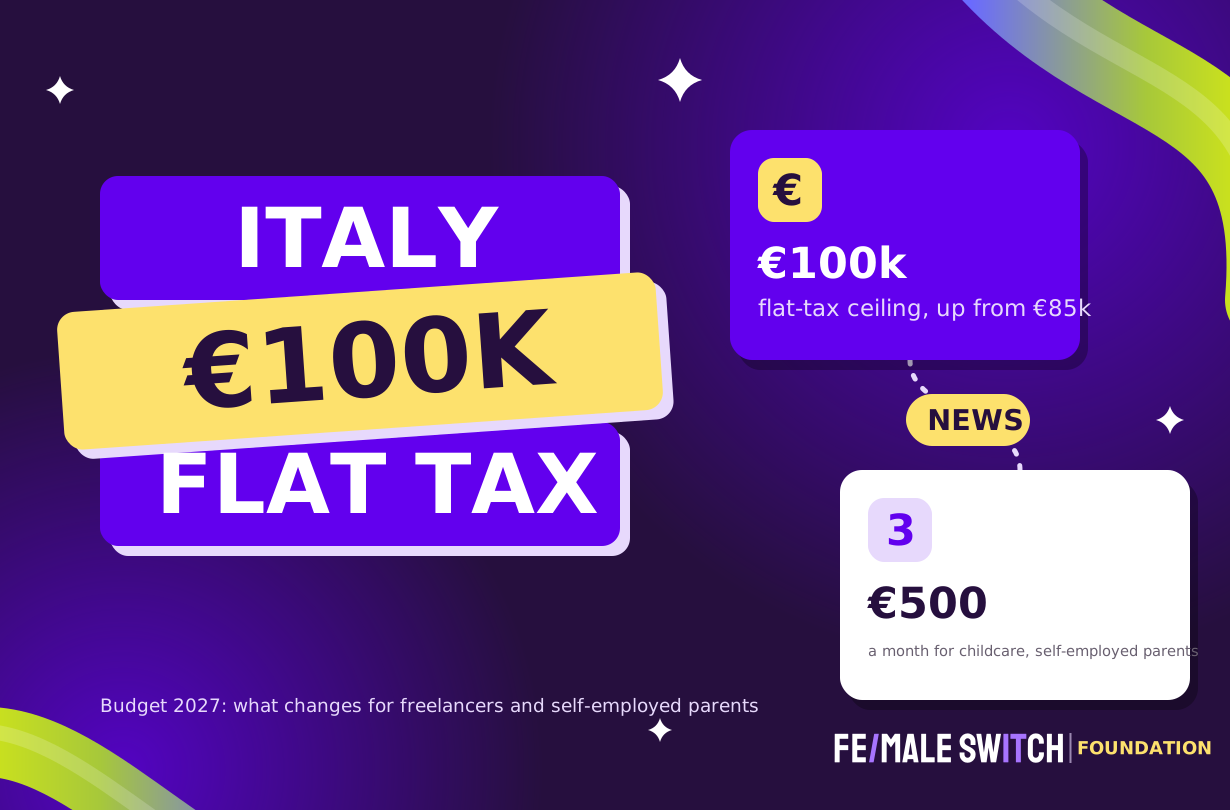
TL;DR: what does Italy’s 2027 budget change for freelancers?
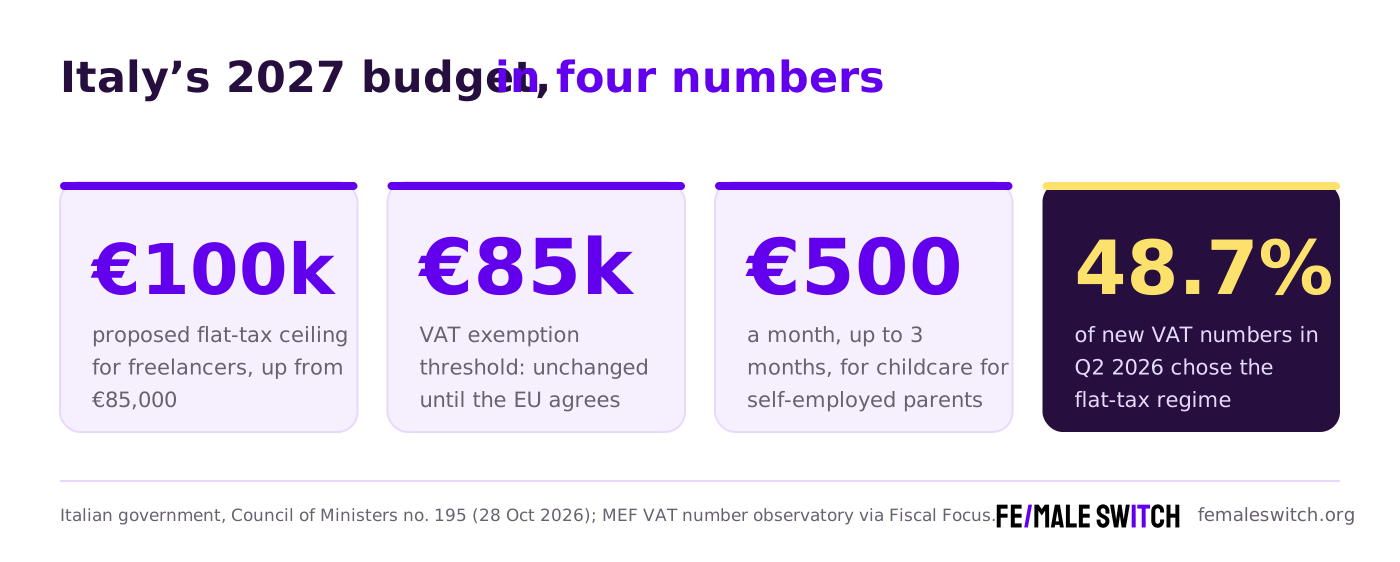
On 28 October 2026 Italy’s government approved its 2027 budget bill. It raises the ceiling of the forfettario, the 15% flat-tax regime chosen by about half of new VAT-number holders, from €85,000 to €100,000 a year. The VAT exemption stays at €85,000 until the EU agrees, so freelancers between €85,000 and €100,000 may keep the flat tax but have to charge VAT. Self-employed parents get a new childcare voucher of up to €500 a month for three months, and the bonus for working mothers becomes permanent. All of this is Proposed: Parliament must pass the bill by 31 December. Our roundup of 2027 budgets for the self-employed in Europe shows how Italy compares.
If you freelance in Italy, the €85,000 line has shaped your year. Earn a euro more and you leave the flat-tax regime the following year, with more tax, more paperwork and VAT on every invoice.
Italy’s government now wants to move that line to €100,000. But Brussels controls one half of it, and the bill also brings new money for self-employed parents. Here is what was approved, what is still missing, and what to plan for.
What happened
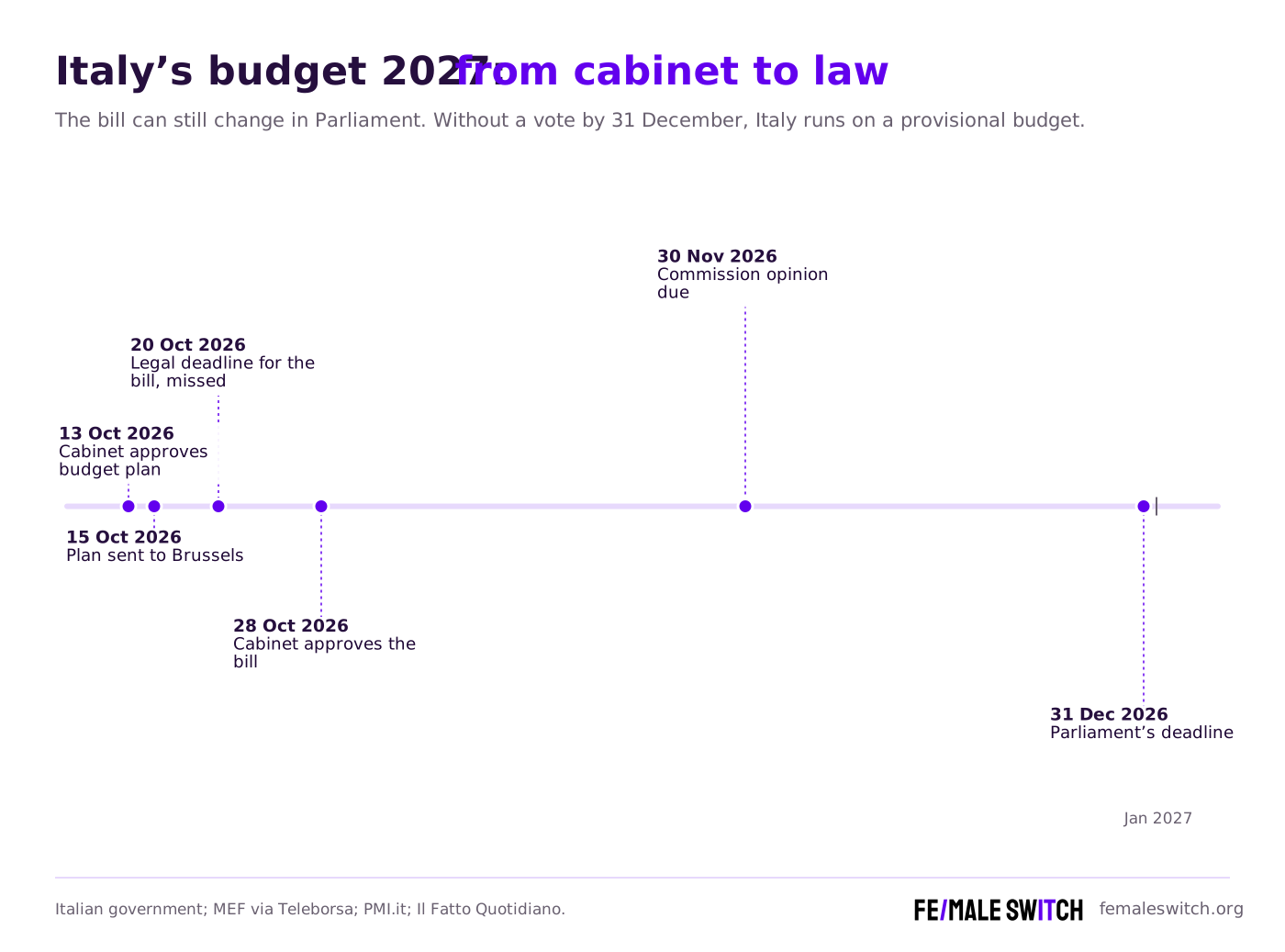
On Wednesday 28 October 2026 the Council of Ministers, meeting number 195, approved the draft budget law for 2027, the government’s fifth. According to the official press release, the package is worth about €26 billion in 2027 and €27 billion in 2028.
For the self-employed, the key sentence is short. The ceiling to access the forfettario for income tax “passa da 85.000 a 100.000 euro” (goes from €85,000 to €100,000). For the VAT exemption, “la soglia resta a 85.000 euro, in attesa dell’autorizzazione dell’Unione europea”: the threshold stays at €85,000, waiting for EU authorisation.
At the press conference Prime Minister Giorgia Meloni called the regime “one of our first measures” and explained the gap: “Per quello che riguarda il regime di esenzione IVA abbiamo un anno per negoziare con la Commissione europea, perché lì serve un’autorizzazione dalla Commissione europea.” In English: on the VAT exemption, we have a year to negotiate with the European Commission, because that needs its authorisation. Il Fatto Quotidiano reports that the flat-tax change “costa 250-260 milioni”: it costs €250–260 million.
The bill was approved eight days after the usual date for sending it to Parliament, Il Fatto noted. The law sets 20 October for that step. Parliament now has until 31 December to pass it.
The forfettario today, and what would change
The forfettario is Italy’s simplified regime for sole traders and freelancers. The Agenzia delle Entrate sets out today’s rules (Adopted):
- One tax at 15% replaces income tax and the regional and municipal surcharges. New activities pay 5% for the first five years if they meet the conditions.
- No real cost accounting. Taxable income is your revenue times a fixed profitability coefficient for your type of activity.
- Limits: revenue of up to €85,000 in the previous year, and no more than €20,000 spent on staff and collaborators.
- Hard stop at €100,000. Go above €85,000 and you leave the regime the following year. Go above €100,000 and you leave in the same year, with VAT due from the invoice that crossed the line.
- Employee income: you can’t use the regime if you earned more than €30,000 as an employee the year before. The limit is €35,000 only “per gli anni 2025 e 2026”, for 2025 and 2026.
The regime is popular. In the second quarter of 2026, 60,493 people who opened a new VAT number chose the forfettario, 48.7% of all new openings, according to Ministry of Economy data reported by Fiscal Focus.
Here is what the bill changes and what it leaves open:
The VAT gap between €85,000 and €100,000
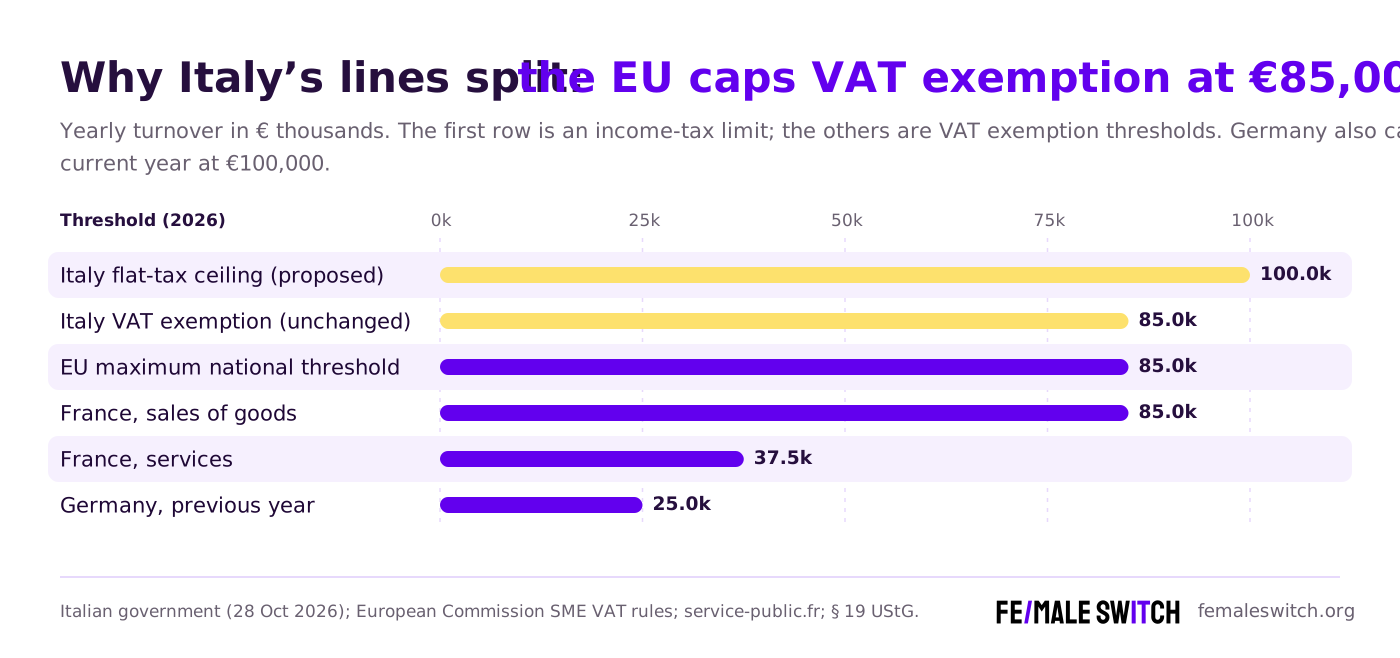
Why can’t Italy simply move both lines? Because VAT is EU law. Under the EU’s small-business VAT rules, in force since January 2025, “the maximum national annual threshold” for the exemption is €85,000, as the European Commission’s SME VAT page states. Italy can set its income tax as it likes, but it needs the EU’s approval to exempt more turnover from VAT.
Our reading of the bill: if it passes as announced, a freelancer with €85,000 to €100,000 of revenue could keep the 15% flat tax but would have to register for VAT, charge it on invoices and file VAT returns. That matters most if your clients are consumers or small firms that can’t reclaim VAT: either your prices go up by 22%, or your margin goes down. Business clients that reclaim VAT will barely notice.
How VAT would work inside the forfettario in that band, from which invoice and with which filings, is not in the press release. Wait for the bill text before changing anything.
Italy is not alone in drawing these lines. France and Germany keep income tax and VAT thresholds apart too, as this comparison of official figures shows:
France’s figures come from service-public.fr; Germany’s from § 19 of the VAT Act. If you run a cross-border business, our guide to tax essentials for founders in Europe explains how VAT registration and invoicing work across countries.
What’s in it for self-employed parents and working mothers
The family chapter is the second big change for this audience. According to the press release (all Proposed):
- A childcare voucher for the self-employed. “Per i genitori lavoratori autonomi, un voucher fino a 500 euro mensili, per un massimo di tre mesi”: up to €500 a month, for up to three months, for babysitting and early-childhood services. Meloni said it is meant for self-employed workers who don’t get paid parental leave. Income limits and how to apply are not published yet.
- The bonus for working mothers becomes permanent. Mothers of at least two children with work income of up to €40,000 keep the bonus, now “potenziato e reso strutturale” (increased and made permanent). Self-employed mothers stay eligible. In 2026 it pays €60 a month, up to €720, in one payment in December, under INPS circular no. 106 of 16 October, as reported by Informazione Fiscale. The 2027 amount is not in the press release; press figures of €80 or €100 are unconfirmed.
- Longer parental leave at 80% pay. The congedo parentale paid at 80% goes from three to four months, five for a second child and six from the third.
- A savings account for every baby. Children born from 2027 get a savings account with a €100 state contribution each year until they turn 18.
Three months of help is modest, but it targets a group Meloni described as self-employed workers who don’t take parental leave. For the bigger picture, see how Germany’s parliament is debating maternity protection for self-employed women, and our guide to maternity leave while founding a startup.
If you hire or run a small company
- A bigger deduction for new hires (Proposed). For the 2027 tax year, the extra deductible cost for new hires “sale all’80 per cento per le lavoratrici madri e al 40% per i giovani di età inferiore a 36 anni”: 80% on top of the cost for working mothers, 40% for under-36s. This helps companies and freelancers under ordinary tax rules; forfettari don’t deduct costs, so it doesn’t help them.
- Lower income tax for the middle bracket (Proposed). The 33% income tax rate is extended to income up to €55,000. Meloni put the maximum gain at about €500 a year. This matters once you leave the forfettario.
- Cheaper energy for SMEs (Proposed). Meloni announced a new “Energy Release” for small and medium-sized companies, funded with €1 billion.
- Plastic and sugar taxes stay suspended until 1 July 2027 (Proposed).
- New rules for craft businesses (Proposed). A separate draft decree, approved the same day, says a company’s artisan status will depend on who holds the capital, not on the number of partners, and allows up to three local units.
Craft and small business association Confartigianato welcomed the hiring measure. Its president, Marco Granelli, said: “riteniamo fondamentale anche la maxi deduzione del costo del lavoro, uno strumento da valorizzare per incentivare le assunzioni e accompagnare la crescita delle imprese”. In English: we also consider the maxi-deduction on labour costs essential, a tool to encourage hiring and help businesses grow.
What this means for you
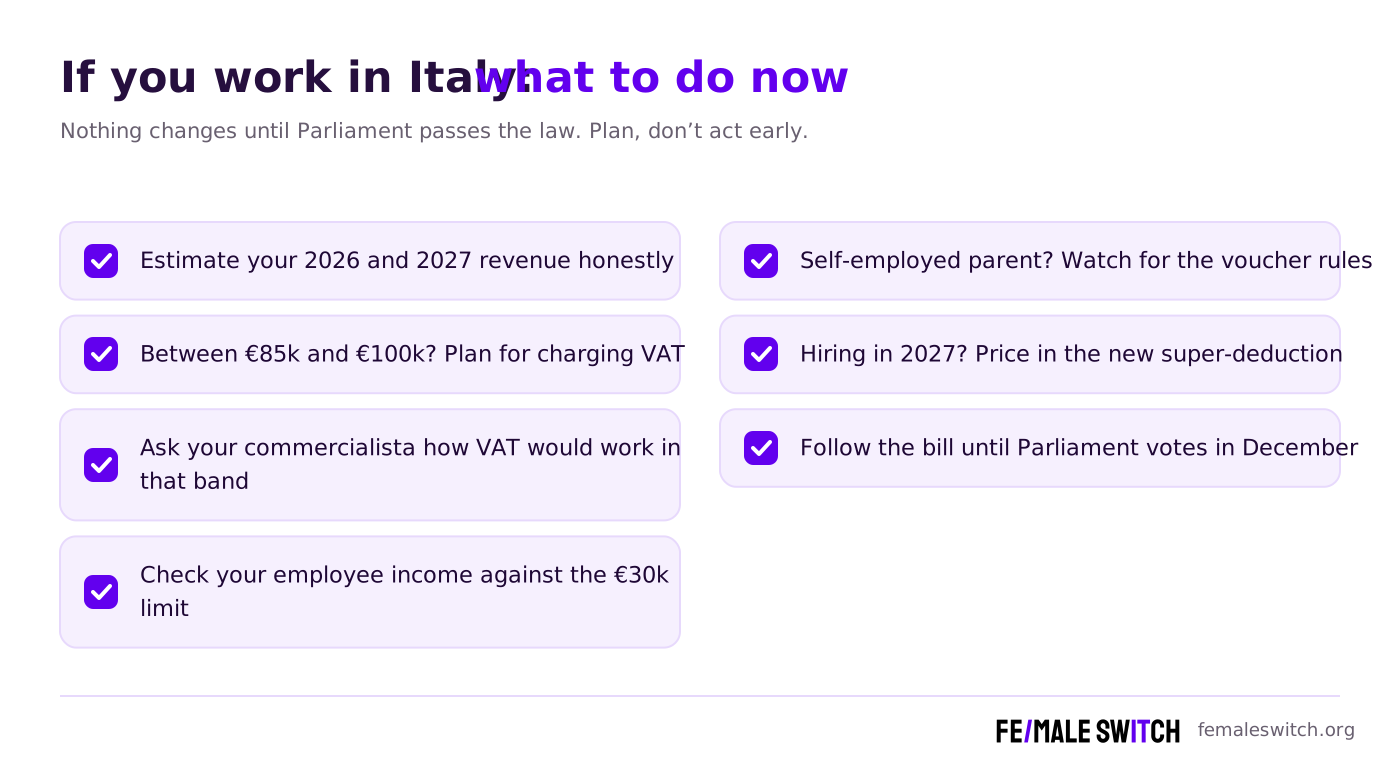
Nothing changes until Parliament passes the law, and budget bills often change on the way. Use the next two months to plan.
- Know your numbers. Estimate your 2026 revenue and your 2027 pipeline now. Our guide to financial projections for beginners shows how to build a simple forecast.
- Between €85,000 and €100,000? Plan for VAT. Work out what charging 22% VAT would mean for your clients and prices. Business clients can reclaim it; consumers can’t.
- Don’t plan 2026 around the new ceiling. Until the law is published and in force, today’s €85,000 and €100,000 rules apply.
- Check your employee income. If you also have a job, the €35,000 limit applies only to 2025 and 2026 unless the final law extends it.
- Self-employed parent? Watch for the voucher rules and INPS instructions once the law passes. Our list of government support for women entrepreneurs covers other help you may be missing.
- Not in Italy? Self-employed rules are moving all over Europe. The Netherlands is rewriting its rules for freelancers, and Belgium is cracking down on unregistered side hustles.
Want to test whether your freelance business can grow past the flat-tax line?
The Fe/male Switch startup game takes you from idea to first paying customers in weekly quests, with an AI co-founder, so you can practise pricing, sales and planning in a safe setting.
👉 Start the game
What to watch next
- The bill text. It will show how VAT works between €85,000 and €100,000, the 2027 amount of the mothers’ bonus and the voucher’s rules.
- Parliament. MPs can amend the bill until the final vote, due by 31 December.
- Brussels. The Commission gives its opinion on Italy’s budget plan by 30 November. A higher VAT exemption needs separate EU authorisation, which Meloni expects to take up to a year.
- The employee-income limit. Whether the €35,000 limit is extended beyond 2026 or falls back to €30,000.
FAQ: Italy’s 2027 budget and the forfettario
Is the forfettario ceiling €100,000 from 2027?
Not yet. The government approved a bill on 28 October 2026 that raises the ceiling from €85,000 to €100,000. It becomes law only when Parliament passes the budget, which must happen by 31 December 2026, and the text can still change.
Will forfettari between €85,000 and €100,000 have to charge VAT?
Probably, if the bill passes as announced. The government says the VAT exemption threshold stays at €85,000 until the EU authorises a higher one, because EU rules cap national VAT exemptions at €85,000. The exact mechanism will be in the bill text.
Does the flat-tax rate change?
The press release doesn’t mention any change. Today the forfettario applies one 15% tax, or 5% for the first five years of a new activity if the conditions are met.
What is the new voucher for self-employed parents?
The bill introduces a voucher of up to €500 a month, for up to three months, for babysitting and early-childhood services for self-employed parents. Income limits and how to apply have not been published.
Can self-employed mothers get the bonus mamme?
Yes. The bill makes the bonus for working mothers of at least two children with work income up to €40,000 permanent and increases it, and confirms that self-employed mothers remain eligible. In 2026 it is €60 a month, paid in December; the 2027 amount is not yet published. The bill text published on 30 October sets it at €100 a month from 2027.
Does this affect freelancers outside Italy?
Only if you are tax resident in Italy or plan to move there. But the VAT limit applies to every EU country: no member state can set its national small-business VAT exemption threshold above €85,000.
