
TL;DR: Minimum viable product means the smallest real offer you can put in front of paying customers to learn whether they want what you plan to build. For a bootstrapping founder, the first one should cost under €500 and take two to four weeks: a concierge test, a landing page smoke test, a pre-sale with a payment link, a Wizard of Oz test, a single-feature no-code build or a paid pilot. Every tool price below was checked on the provider's own page on 8 November 2026. Plan your test with the free €500 test budget builder below and write your pass rule before the first visitor arrives.
A minimum viable product is the cheapest version of your idea that real customers can see, use or pay for, built to answer one question: will they want it? Eric Ries defined it on his blog Startup Lessons Learned in August 2009 as "that version of a new product which allows a team to collect the maximum amount of validated learning about customers with the least effort." Wikipedia credits Frank Robinson of the consulting firm SyncDev with coining and defining the term in 2001, and Steve Blank and Eric Ries with making it popular.
As a bootstrapping co-founder of the Fe/male Switch Foundation, I watch first-time founders search for "minimum viable product", land on agency guides and conclude they need a developer and five figures. One agency guide from August 2026 puts most first builds at $3,000 to $80,000. A bootstrapper has a better plan: spend under €500 on a test that brings real money or real sign-ups, and build only what that test proves people want.
What is a minimum viable product, in plain words?
A minimum viable product is an experiment dressed as a product. It has one job: to test your riskiest assumption, the belief that would sink the business if it turned out false. For most first-time founders that belief is "people will pay me for this", so the best first version asks for money or a firm commitment.
Steve Blank wrote on his blog in March 2010 that the "minimum feature set (sometimes called the 'minimum viable product') causes lots of confusion." His fix is a single question: "What is the smallest or least complicated problem that the customer will pay us to solve?" I put that question at the top of every test plan I review.
Three words get mixed up, so here is how I separate them:
So, minimum viable product vs prototype: a prototype tests the design, a minimum viable product tests demand. The people you test with first are your early adopters: customers who feel the problem strongly enough to try an unfinished solution and forgive its rough edges.
Before you pick a test, make sure the problem is real. Our guide to problem-solution fit with a real example covers that stage, and how to interview potential customers without feeling awkward gives you the scripts.
How does the €500 test budget builder work?
Pick a test type and the builder fills in a cost list with prices from the official pricing pages, converted from dollars at the European Central Bank rate of 6 November 2026. Every line stays editable, and free plans show at €0 with their limit. Add your ad budget, weeks and expected visitors or conversations, then set your pass rule.
You get your total against €500, the cost per sign-up or pre-order at your pass mark, a week-by-week plan and a copyable test card. Default pass rules are our suggestions. Write your own pass number down BEFORE the test starts.
Why should your first minimum viable product cost less than €500?
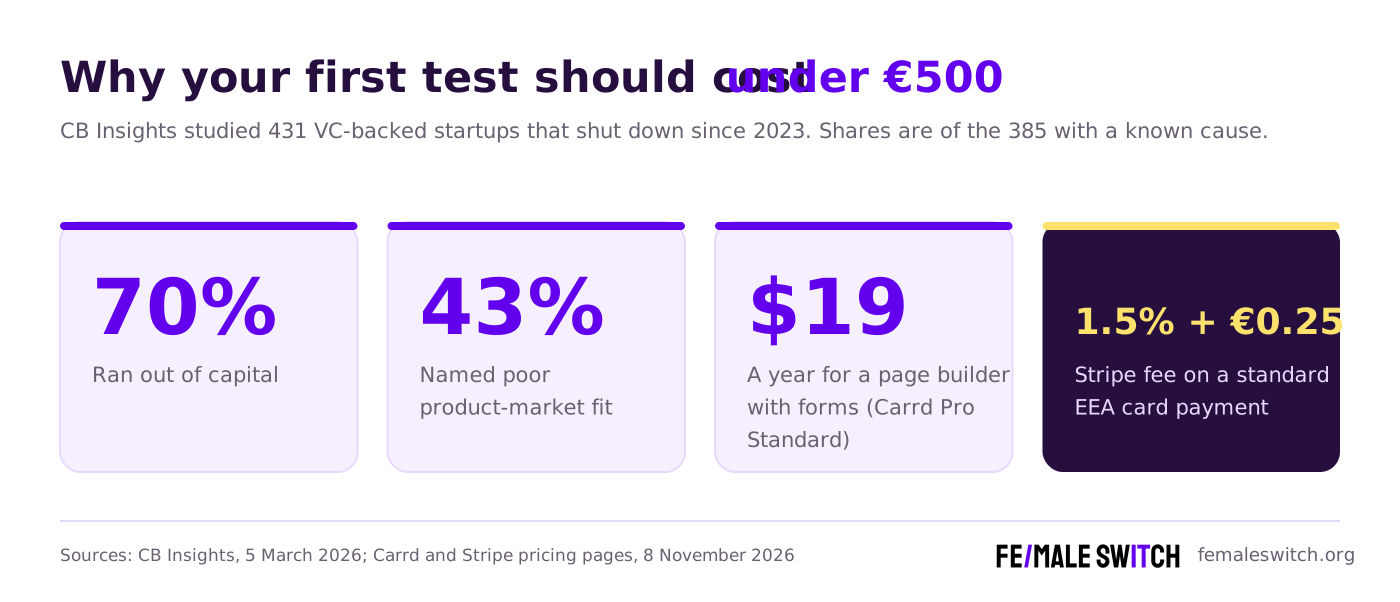
CB Insights studied 431 VC-backed startups that shut down since 2023 and published the results on 5 March 2026. Among the 385 with a known cause, 70% ran out of capital and 43% named poor product-market fit. Those founders had investors. A bootstrapper spending her savings has a thinner cushion.
My reasons for a €500 ceiling:
- One question per test. A cheap test forces you to pick the riskiest assumption and test only that. A €20,000 build tests twenty things at once and tells you nothing clear when it flops.
- Speed. Most tests below go live in a weekend. Joel Gascoigne of Buffer needed 7 weeks of evenings and weekends for a first coded version he had estimated at one week.
- Money in, early. A pre-sale or a paid pilot can pay for itself before you build anything.
Our guide to start-up costs on a bootstrap budget shows how to list and cut the rest of your first-year spend.
Which six minimum viable product tests fit a €500 budget?
Prices come from the bill of materials further down. Pass signals are our suggestions.
1. Concierge test
A concierge test means you deliver the result by hand, openly, to a few paying customers. A meal-planning app becomes you writing meal plans in a shared document. The customer knows a person does the work.
- What it tests: whether people pay for the result, and what the job involves step by step.
- Cost: €0 to €20 in cash, plus your hours. A free booking page and a payment link cover it.
- Pass signal: 3 paying customers out of 20 conversations.
2. Landing page smoke test
A smoke test checks interest in something before it exists. In a landing page test, one page describes the offer, shows a price and asks for an email or a click on "Buy". Eric Ries wrote that "a simple AdWords smoke test" would have exposed a feature nobody wanted.
- What it tests: whether your message attracts the right people and whether they click at your price.
- Cost: about €28 a year for a domain and a page builder with forms, plus ads.
- Pass signal: 10% of at least 300 visitors leave an email. Layout tips: designing your first product landing page.
3. Pre-sale with a payment link
A pre-sale sells the product before it exists, with a delivery date and a full-refund promise. Stripe's Payment Links come at no extra charge on its standard pricing, and a standard EEA card payment costs 1.5% + €0.25, so a €49 pre-order costs about €0.99 in fees (our calculation).
- What it tests: whether strangers pay before the product exists, the most honest test on this list.
- Cost: €0 for the link, card fees per sale, plus a page and ads for cold traffic.
- Pass signal: 5 pre-orders from 300 visitors.
4. Wizard of Oz test
In a Wizard of Oz test, the customer sees a finished-looking product while you do the work behind the curtain, such as a "smart" skincare quiz whose recommendations you write yourself. Unlike a concierge test, the customer believes it runs on its own.
- What it tests: whether people use the product the way you expect and come back.
- Cost: Tally is free with unlimited forms and submissions within fair use, and Zapier's free plan gives 100 tasks a month.
- Pass signal: 10 people complete the service from 200 visitors.
5. Single-feature no-code build
Build ONE feature with no-code tools, the one your interviews say people want most: a booking form with an automatic confirmation, a calculator or a directory. Our list of no-code tools for female founders and the guide on building a first version without coding skills show what fits.
- What it tests: whether people use the feature more than once.
- Cost: €0 to €50 on free plans. Check limits first: Glide's free plan cannot publish an app.
- Pass signal: 15 repeat users from 200 visitors.
6. Paid pilot for a service business
A paid pilot is a short paid trial for a business customer, with dates, a price and a success measure agreed in writing. A company that pays a few hundred euros has passed its own approval process.
- What it tests: whether a business pays and uses it in real work.
- Cost: close to €0 in cash. Card fees on a €300 pilot paid by standard EEA card come to €4.75 (our calculation).
- Pass signal: 2 paid pilots from 15 conversations.
Which test should you pick? A comparison
My rule: if you can ask for money, ask for money. Start with a pre-sale or concierge test, and use a smoke test to find the message first. More tactics: testing demand before building.
What does a €500 minimum viable product cost, line by line?
Prices were read on each provider's official page on 8 November 2026. Dollar prices are converted at the ECB reference rate of 1 EUR = 1.1165 USD (6 November 2026) and rounded to the euro. None of the pages state VAT on these amounts, and MailerLite says prices "may be subject to applicable taxes".
Sample budgets (our calculation):
- Landing page smoke test: domain €11 + Carrd €17 + Tally and MailerLite €0 + ads €150 = about €178, leaving €322 for a second round.
- Pre-sale for a €49 product: the same page plus 5 pre-orders at €0.99 in fees each = about €183, and €245 comes in before you build.
- Concierge test: free booking, form and payment link, plus 3 payments at €49 = €2.97 in fees.
The list of free tools for bootstrapped startups adds more, and the cost comparison of no-code versus hiring developers shows when paying for code starts to make sense.
Which minimum viable product examples started for almost nothing?
Buffer: a landing page with a pricing step. Joel Gascoigne wrote on Buffer's blog in February 2011 that he built two pages to check "whether people would even consider using the app" and tweeted the link. When "a few people used it to give me their email", he added a pricing page between the two, so visitors had "one extra click before they gave me their email." People kept signing up, and a small number clicked paid plans. He then built the product in 7 weeks, got his first paying customer within 4 days of launch, and about 2.5 months later had over 500 users with around 4% on paid plans.
Rent the Runway: a pop-up as a concierge test. In November 2008, Jenn Hyman's younger sister Becky showed off a $2,000 designer dress bought for a wedding, a splurge the company's own timeline says was "sending her into credit card debt." In April 2009, Jenn Hyman, Jenny Fleiss and Becky "set up a pop-up shop on Harvard's campus where students could try on and rent dresses on the spot." The website launched on 10 November 2009. Two women founders tested their riskiest assumption, "will women rent instead of buy?", with a campus pop-up.
Pip & Nut: a market stall in London. Pip Murray started making nut butter at home in 2013 while training for a marathon. She told Sage Advice UK in September 2023 that she "started selling it at Maltby Street down in south London" "for a few months just to test the waters." Her proof was behaviour: "people would come back time and time again." Inbound interest from Selfridges gave her "the initial validation I needed to take a bigger leap." A market stall is a paid test with instant repeat-purchase data.
Each founder signed up or sold to real people before the product was finished, and watched behaviour instead of opinions.
How do you run a minimum viable product test in 2 to 4 weeks?
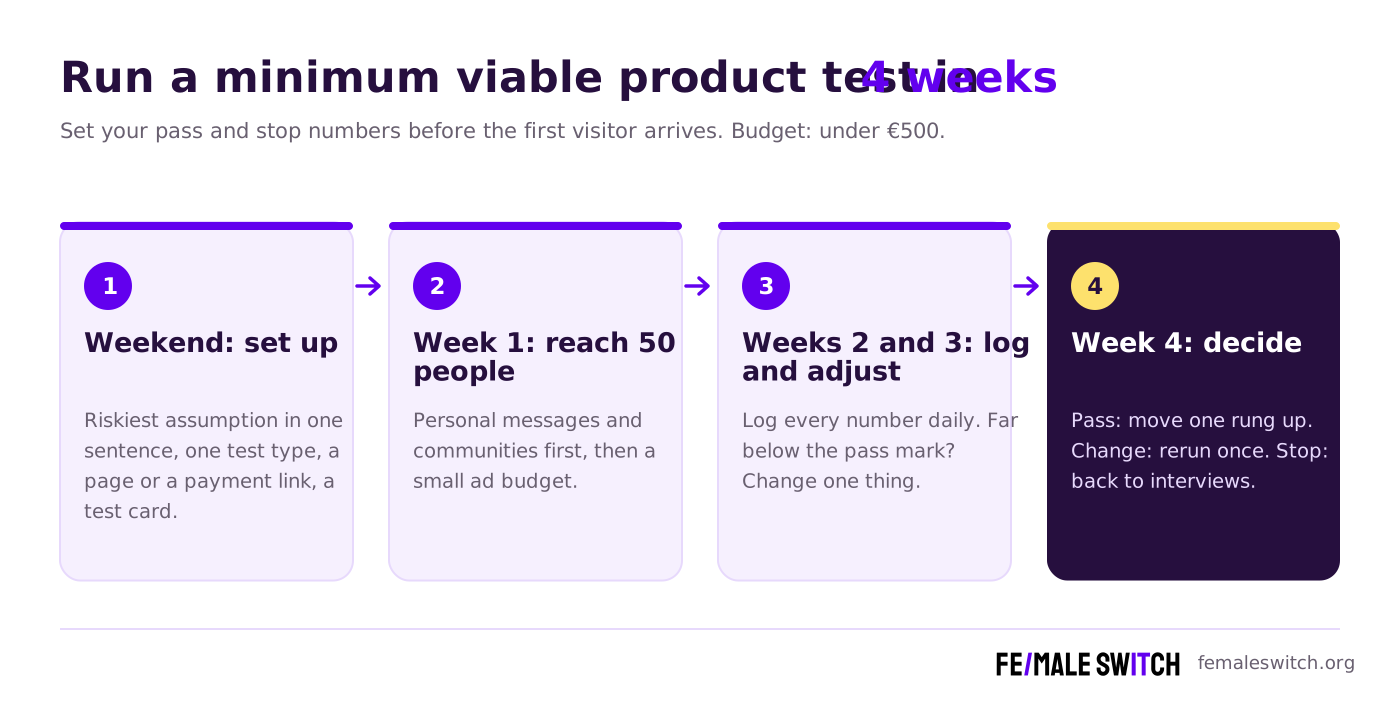
The plan I use with first-time founders. Steps 1 to 3 fit in a weekend.
- Write your riskiest assumption in one sentence. "Freelance translators in Germany will pay €49 for a done-for-you invoice reminder setup."
- Pick ONE test from the six above and set your pass and stop numbers in the budget builder. Write them on the test card below.
- Build the smallest version. A page, a form and a payment link, or a booking page and a message.
- Week 1: reach your first 50 people. Personal messages and communities where your customer talks about the problem, then a small ad budget. Our guide to getting your first 10 customers without paid ads has outreach ideas.
- Week 2: log every number daily. Visitors, replies, sign-ups, pre-orders. Ask everyone who signs up what made them act.
- Week 3: change one thing if the numbers sit far below the pass mark. The headline, the price or the channel, never all three.
- Week 4: decide with the rule you wrote in step 2. Pass, change or stop. Deliver or refund every pre-order on the date you promised.
- Write three lines: who acted, what they said, what you test next.
Copy this test card:
- Riskiest assumption: [customer] will [pay / sign up / use it twice] for [offer] at [price].
- Test type: [concierge / landing page smoke test / pre-sale / Wizard of Oz / single-feature no-code build / paid pilot]
- Reach: [number] visitors or conversations from [channels]
- Budget: €[amount], spent on [items]
- Time: [2 to 4] weeks, from [date] to [date]
- PASS: at least [number] [sign-ups / pre-orders / paid pilots]
- CHANGE: between half and all of the pass number. I change one thing and rerun once.
- STOP: under half the pass number. I go back to customer interviews.
- Promise to buyers: delivery by [date] or a full refund.
Copy this pre-sale or concierge message:
- "Hi [name], you mentioned [problem] when we spoke / in [group]. I am opening [offer] for the first 10 people: [what they get] by [date], for €[price]."
- "Because it is a first round, I deliver it personally and I refund the full amount if it does not arrive by [date] or does not help."
- "If you want a place, here is the payment link: [link]. If not, tell me what would make it worth paying for."
Our guide on how to validate a business idea without spending money has more scripts, and the customer discovery guide for non-technical founders shows how to log what you hear.
When should you stop, change or keep going?
A stop rule protects your savings as much as a pass rule protects your ambition. This is the rule on every test card I write:
- PASS: you hit the number. Move one rung up: smoke test to pre-sale, pre-sale to concierge delivery, concierge to a single-feature no-code build or a paid pilot.
- CHANGE: you reached half the pass number or more. Change ONE thing (the customer group, the problem you lead with, or the offer and price) and rerun once.
- STOP: under half the pass number, or two failed rounds on the same idea. Go back to interviews with a new group or a new problem.
Watch for false signals: likes, friends who pay to support you, and one large customer asking for custom work nobody else wants.
Changing course is a pivot, and our guide on how to pivot when your first idea doesn't work shows how to keep your learning. Price is the cheapest variable to test; read our article on pricing psychology and strategy before you lower anything.
What comes after a passed test?
A pass buys you the right to build a little more. Deliver to your first buyers by hand, note every step that repeats, and automate the one that eats the most hours. Our comparison of what to build first versus a full product, the guide on getting first customers without a budget and measuring product market fit on a bootstrap budget cover the next stage.
Practise running tests before you spend your savings
Rehearse the whole test cycle in the Fe/male Switch startup game. In the Fe/male Switch startup game you take a startup from idea to first customers: you interview, test demand, set a price and decide when to change course, so the expensive mistakes happen in the game instead of in your bank account. You practise alongside a community of women founders. Read what gamepreneurship is and how it works to see how learning by playing fits a bootstrapped start.
What should you test this month?
Write your riskiest assumption in one sentence today. Open the budget builder, pick a test that asks for money if you can, and keep the total under €500.
Then run it for two to four weeks, log every number and decide with the rule you wrote before you started. A minimum viable product is a question you ask the market with your own small budget, and the answer arrives as emails, payments and people who come back.
FAQ: minimum viable product
What is a minimum viable product in simple terms?
The smallest real offer you can put in front of customers to learn whether they want it, before you build the full product.
Who coined the term minimum viable product?
Wikipedia credits Frank Robinson of the consulting firm SyncDev with coining and defining the term in 2001. Steve Blank and Eric Ries made it popular from 2009 onward.
What is the difference between a minimum viable product and a prototype?
A prototype shows how something will look or work and is tested with a few people. A minimum viable product is a real offer that strangers can buy, join or use, and it tests demand.
How much does a minimum viable product cost?
One agency guide from August 2026 puts most builds at $3,000 to $80,000. A first test for a bootstrapper costs €0 to €500: a domain at about €11 a year, a page builder with forms at about €17 a year, free form and email tools, card fees and a small ad budget.
What are examples of a minimum viable product?
Buffer tested a two-page site with a pricing step before writing the product, Rent the Runway ran a dress-rental pop-up at Harvard in April 2009, and Pip & Nut sold nut butter at a London market for a few months before reaching shops.
What is a Wizard of Oz test?
The customer sees a finished-looking product while you do the work manually behind it. It tests whether people use the product as expected before you pay for automation.
How long should a minimum viable product test run?
Two to four weeks: a weekend to set up, one to three weeks to reach people and log numbers, then a decision based on the pass rule you wrote first.
