
TL;DR: what happened on Equal Pay Day 2026?
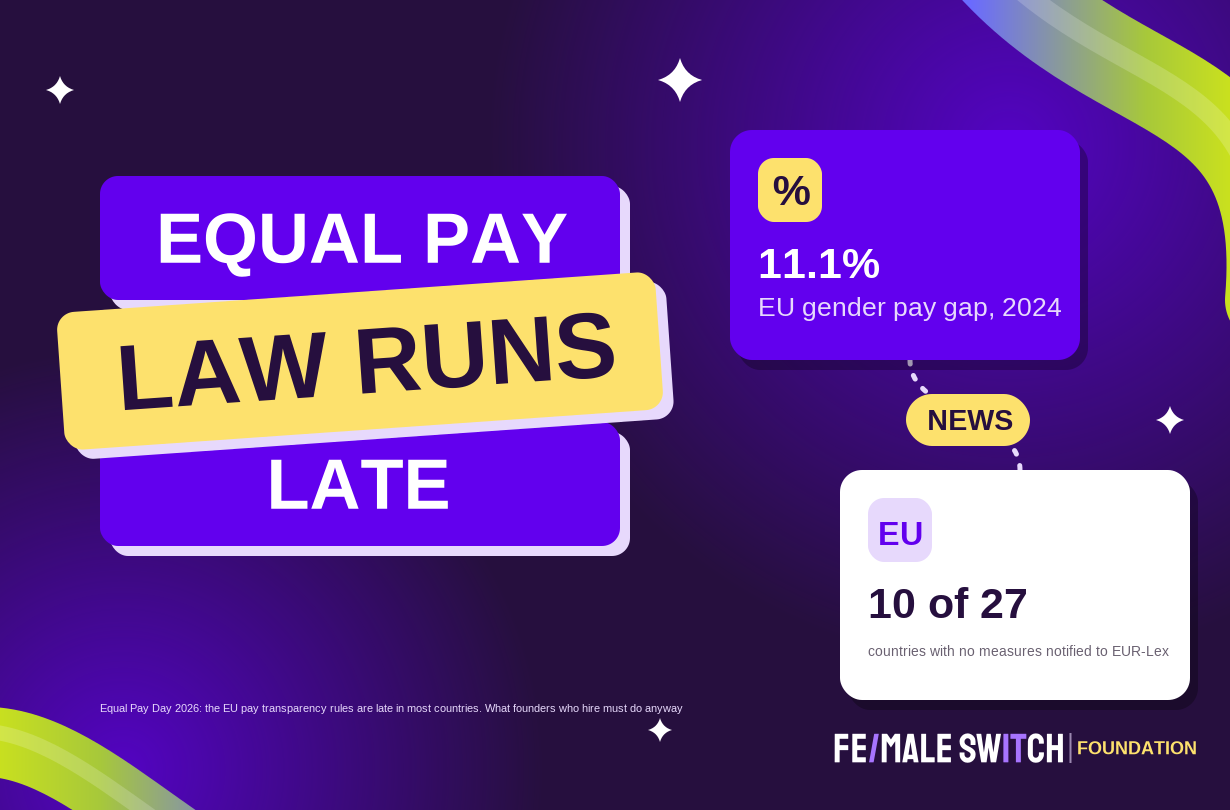
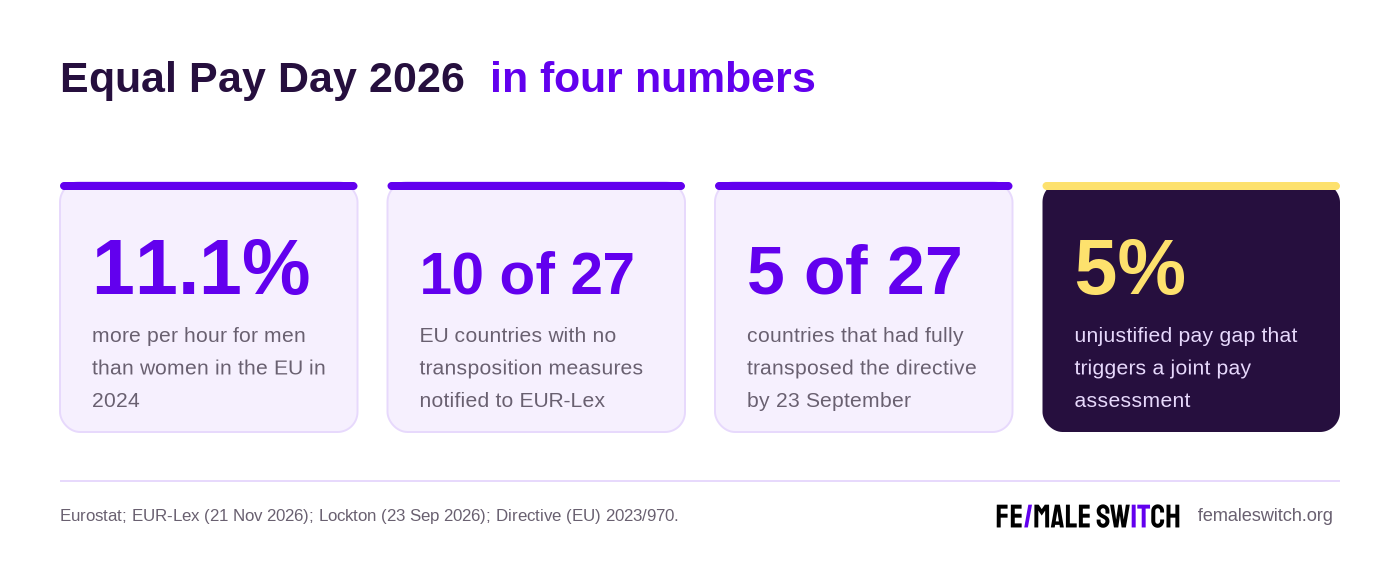
Equal Pay Day fell on 20 November 2026: from that day, women in the EU work for free until the end of the year, because men earned 11.1% more per hour in 2024. The day before, the European Commission said that “delays in implementing” the Pay Transparency Directive hinder gender equality and competitiveness. The deadline for national laws was 7 June 2026. On 21 November, EUR-Lex listed no transposition measures at all for 10 of the 27 EU countries, including Germany, France and the Netherlands. If you hire, the core rules apply to employers of every size: pay range before the interview, no questions about past salary, and answers to staff pay questions within two months. Get ready now, before your country’s law lands.
If you are about to hire your first employee, you probably wonder what to put in the job ad. Salary range or “competitive pay”? Ask what the candidate earns now, or not?
The EU answered those questions in 2023. Most governments have still not turned the answer into national law, and this week Brussels said so in public. Here is what happened on Equal Pay Day, where your country stands, and what the rules mean for a small team.
What happened
On Thursday 19 November 2026, Executive Vice-President Roxana Mînzatu and Commissioner Hadja Lahbib published a statement ahead of European Equal Pay Day. It opens with a plain line: “Equal pay is a fundamental right.” It then points at the law that was meant to close the gap:
“The Pay Transparency Directive, adopted in 2023 and expected to be transposed into national law by June this year, marked a major step forward. [...] But legislation only delivers when it is fully implemented. Delays in implementing the new rules hinder both our fight for gender equality and our competitiveness.” Roxana Mînzatu and Hadja Lahbib, European Commission
The Commissioners also made the business case: pay transparency helps companies “attract and retain talent, reduces recruitment costs, and improves staff motivation and performance”, according to the statement. The Commission says it is working with governments, businesses and workers’ representatives to speed things up.
The date of Equal Pay Day is set by the gap itself. According to the Commission’s Equal Pay Day page, average gross hourly earnings of men were 11.1% higher than those of women in the EU in 2024. Spread over a year, that means women stop being paid on 20 November. Twelve EU countries, among them Germany, France, the Netherlands and Spain, also hold their own national Equal Pay Day, on a date that matches their national gap. Our gender pay gap in Europe by country page breaks the 11.1% down by country, age, sector and company size.
How late are EU countries?
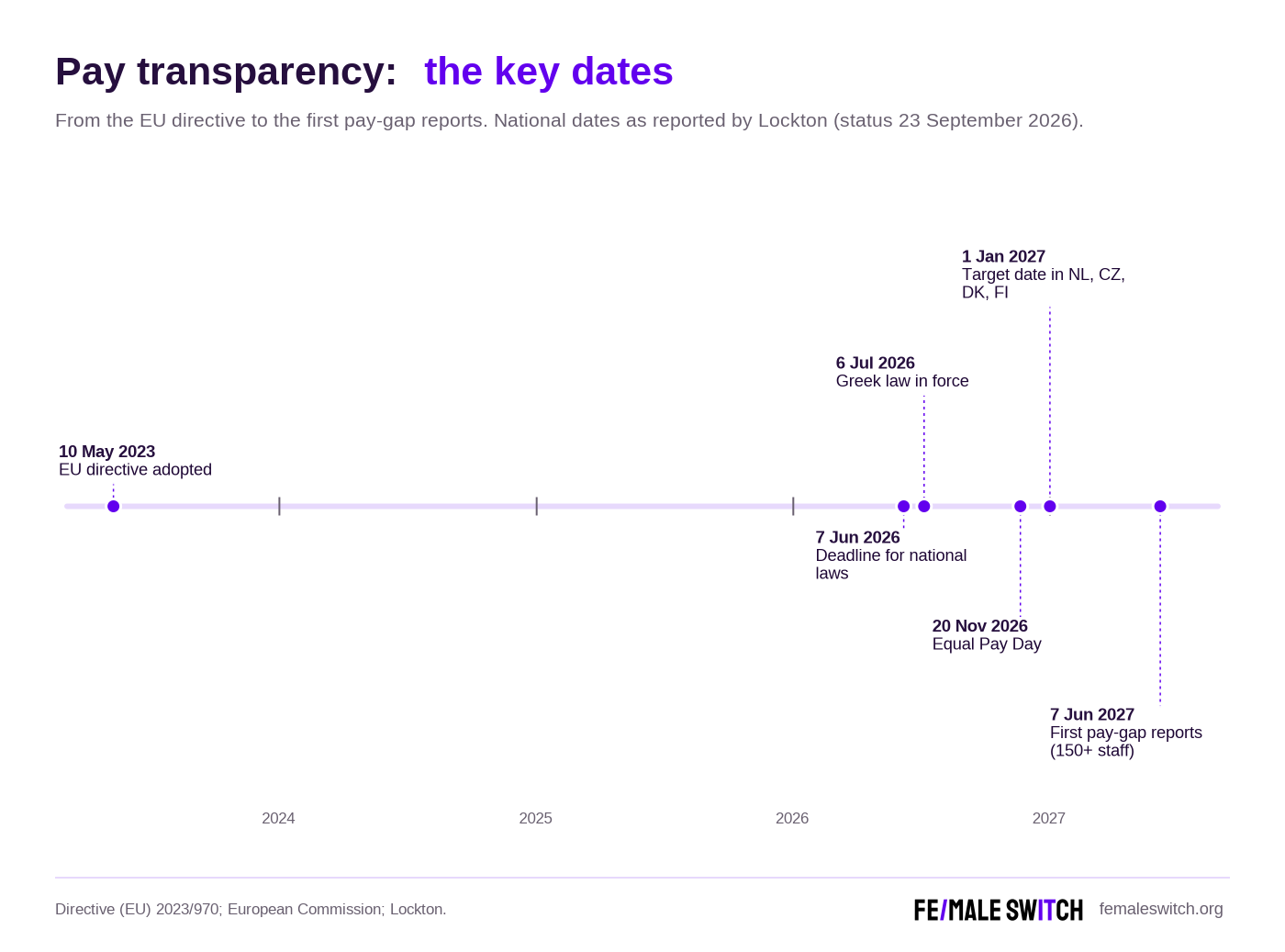
Status of the EU law: Adopted. Directive (EU) 2023/970 was adopted on 10 May 2023, and Article 34 gave governments until 7 June 2026 to put it into national law. Five months later, the picture is patchy.
The official record is the EUR-Lex list of national transposition measures. On 21 November 2026 it showed no measures at all for 10 countries: Denmark, Germany, Ireland, France, Croatia, Cyprus, Luxembourg, Hungary, the Netherlands and Portugal. Countries report these measures themselves, some lists include older equality laws, and EUR-Lex warns that the collection is being updated, so a long list does not prove a country is done.
A more precise picture comes from the employee-benefits adviser Lockton, which tracks the directive country by country. Its latest status, from 23 September 2026, looks like this:
Ireland had published a draft for the rules before hiring in January 2025. Lockton’s statuses are two months old, so check your own country’s labour ministry before you rely on them.
Will Brussels act? Not yet. The Commission’s November infringement package, also published on 19 November, contains no action on the Pay Transparency Directive. Formal infringement steps are the usual way the Commission pushes late countries, so watch the next packages.
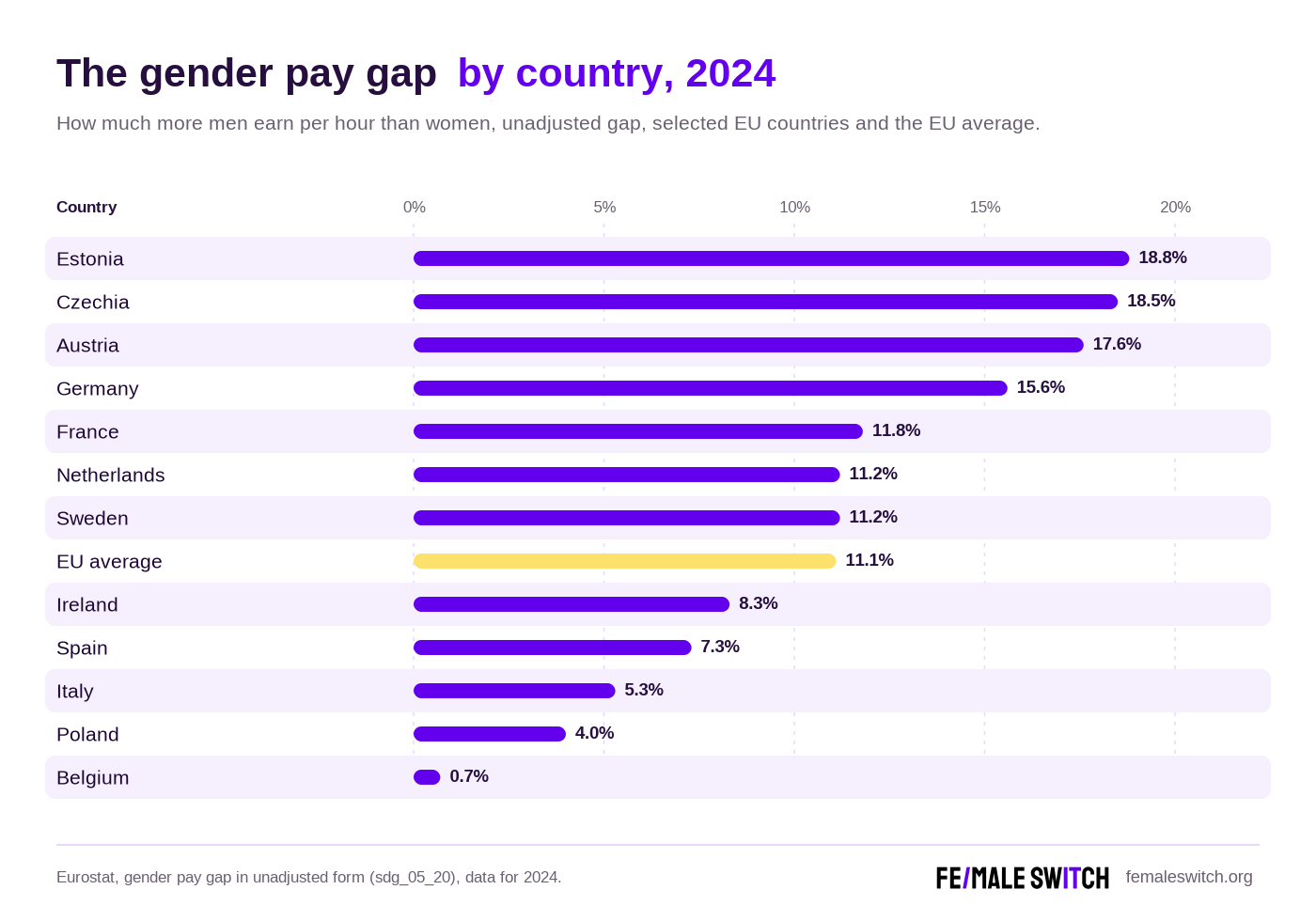
The EU gap has been falling slowly: 12.2% in 2022, 11.7% in 2023 and 11.1% in 2024, according to Eurostat’s gender pay gap data. Some of the countries with the biggest gaps, such as Germany and Austria, are also among those without a published law. For a wider view, our news piece on the EU’s Gender Equality Index 2026 shows how pay, care and parental leave fit together, and our explainer on the pay gap in the tech industry looks at the sector many founders hire from.
What the law asks of employers, by size
The most important point for founders: the core rules have no minimum company size. Article 2 covers “employers in public and private sectors”. The reporting duties start at 100 workers, but the rules on hiring and pay questions apply to a team of two.
Source: Directive (EU) 2023/970, Articles 2 and 5 to 10. National laws can go further, for example by requiring smaller companies to report.
Two more articles matter if something goes wrong. Workers who suffered pay discrimination can claim compensation, and an employer that ignored its transparency duties has to prove there was no discrimination, as the Commission’s explainer of the new rules puts it. Under Article 21, workers get at least three years to bring a claim. And Article 7 says workers cannot be prevented from disclosing their pay to enforce equal pay, so a pay-secrecy clause in your contracts won’t protect you.
Does this apply to me before my country passes its law?
As a rule, an EU directive binds private employers through national law, so the exact duties in your country start when its law is in force. In Greece, Italy, Lithuania, Malta and Slovakia that has happened; in Estonia and Poland the rules before hiring already apply.
Everywhere else, waiting is a weak plan. National laws in the pipeline follow the same directive, several target 1 January 2027, and the principle of equal pay for equal work has been in the EU treaties since 1957. A job ad you post today may still be online when the new law starts. And candidates already ask for ranges: a clear range in the ad saves you interviews with people you can’t afford.
What this means for you
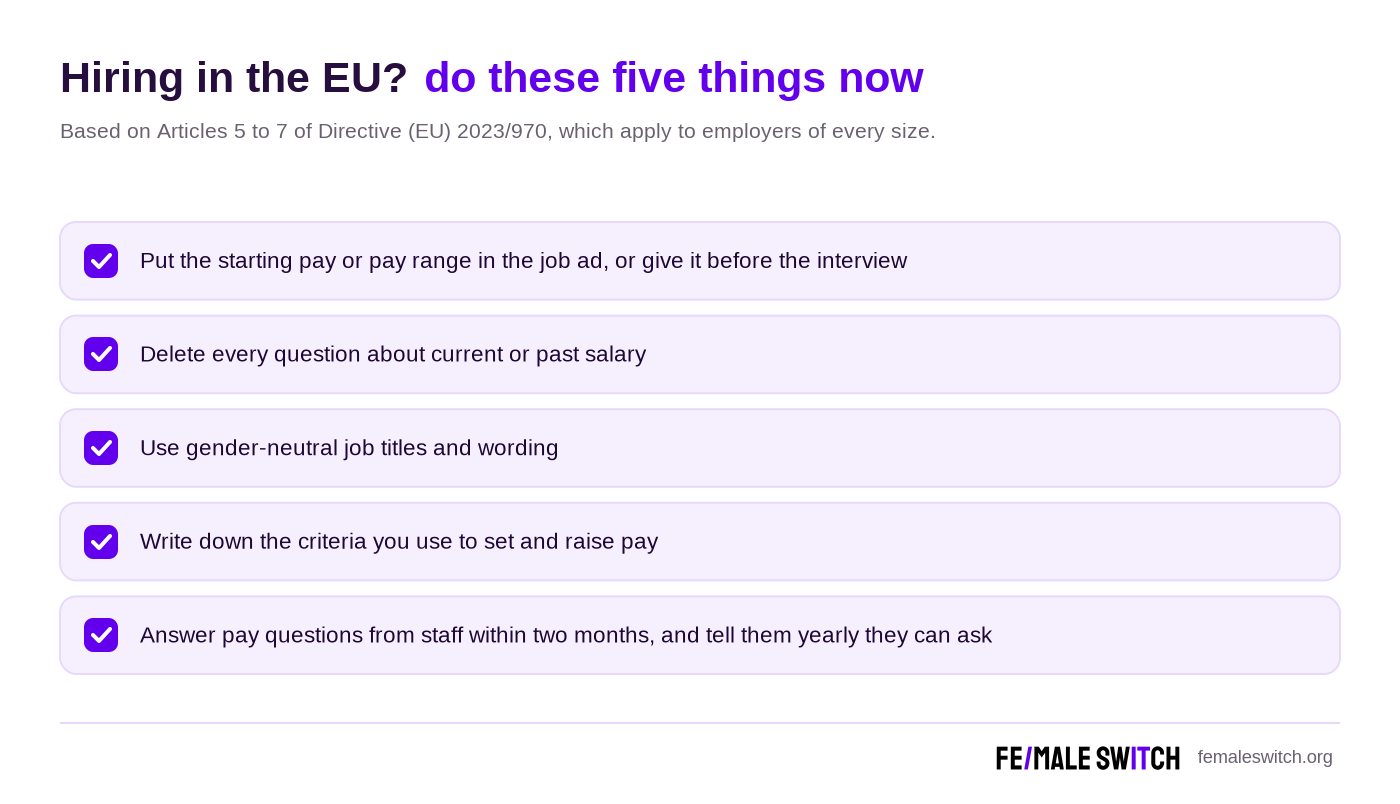
- Rewrite your job ad template. Add a real pay range, use gender-neutral titles, and remove “competitive salary”. If this is your first hire, our guide to hiring your first employee walks through the rest of the process, from contract to payroll.
- Strip pay-history questions from forms and interview scripts. Ask what the candidate expects instead, and set the offer by the role, not by their last salary. That one change is where much of the inherited gap comes from.
- Write a one-page pay policy. List the criteria you use to set and raise pay, such as skills, responsibility and results, and keep them gender-neutral. Our piece on compensation structures that attract and retain talent gives you a starting framework, and our notes on hiring during growth show how to keep pay fair as the team grows.
- Check your contracts. Remove clauses that forbid staff from talking about pay, and make sure the salary and raise rules in the contract match your policy. Our basics of contracts and agreements help if you write contracts yourself.
- Budget for the floor as well as the gap. Minimum wages also rise in 2027, for example in the Netherlands, where the minimum wage goes to €15.29 an hour. Set your ranges with both in mind.
- Use the law when you are the one negotiating. If you take a job or a contract while you build your company, ask for the range up front. In the countries with a law in force, employers must give it.
- Watch your country. If you employ people in Greece, Italy, Lithuania, Malta or Slovakia, read the national law now. Elsewhere, put 1 January 2027 in your calendar as the first likely start date, and follow our news section for updates. Women already own only a minority of businesses, as the ILO’s 2026 report on women in business showed, so fair pay from the first hire is also a way to stand out as an employer.
Want to practise pay, pricing and hiring decisions before they cost real money?
The Fe/male Switch startup game takes you from idea to first paying customers in weekly quests, with an AI co-founder, so you can test your plan, your prices and your first hire before you spend your savings. The free trial lasts 2 weeks.
👉 Start the game
FAQ: Equal Pay Day and the Pay Transparency Directive
When was Equal Pay Day 2026?
European Equal Pay Day 2026 was on 20 November. The date reflects the EU gender pay gap: men earned on average 11.1% more per hour than women in 2024, so women in effect work unpaid from 20 November until the end of the year.
What is the EU Pay Transparency Directive?
Directive (EU) 2023/970, adopted in May 2023, makes employers give the pay or pay range before the interview, bans questions about pay history, gives workers the right to ask about pay levels, and requires companies with 100 or more workers to report their gender pay gap.
Was the deadline for national laws missed?
Yes, in most countries. Governments had to transpose the directive by 7 June 2026. By 23 September 2026 only five countries had fully done so, according to Lockton, and on 21 November 2026 EUR-Lex listed no measures at all for 10 countries, including Germany, France and the Netherlands.
Does pay transparency apply to small companies?
Yes. The rules on job ads, pay-history questions, pay criteria and answering staff pay questions apply to employers of every size, although countries may exempt employers with fewer than 50 workers from the pay progression part. Pay-gap reporting starts at 100 workers.
Do I have to put a salary range in my job ad?
Under the directive, candidates must get the starting pay or its range in the job ad, before the interview or otherwise beforehand. Once your country’s law is in force this is a legal duty; in Greece, Italy, Lithuania, Malta, Slovakia, Estonia and Poland it already applies.
Has the Commission started infringement procedures over the delays?
Not in its November package. The infringement package published on 19 November 2026 contains no action on the Pay Transparency Directive, although the Commissioners said the same day that delays hinder gender equality and competitiveness.
