
TL;DR: what does the Gender Equality Index 2026 say?
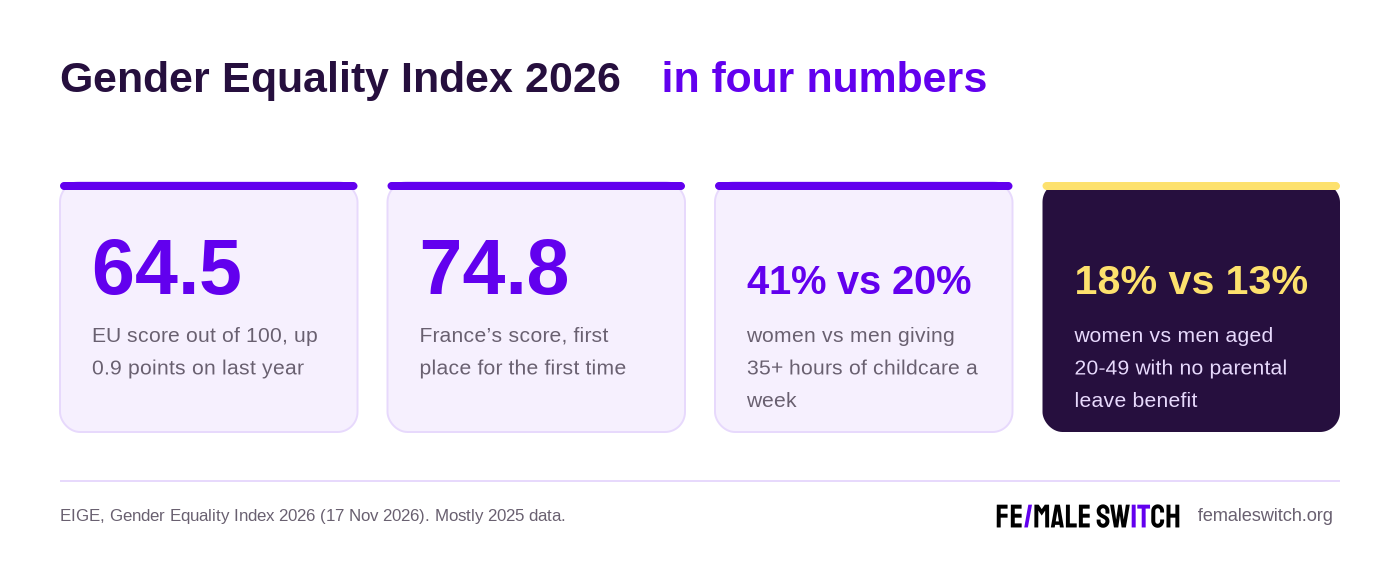
The European Institute for Gender Equality (EIGE) published its Gender Equality Index 2026 on 17 November 2026. The EU scores 64.5 out of 100, up 0.9 points in a year, and France takes first place for the first time, ending Sweden’s run at the top since 2013. This year’s report looks at parental leave, and one finding matters most if you work for yourself: among working parents who can’t get statutory parental leave, self-employment is the main reason in most EU countries. 18% of women and 13% of men aged 20 to 49 would get no parental leave benefit at all. If you are a freelancer or solo founder planning a family, check your country’s rules and contribution months now, not when the baby is due.
Most news about the new EU equality ranking will be about France beating Sweden. The more useful part for founders is buried in chapter 9 of the report: the parental leave system in most of Europe is built for employees, and people who work for themselves are the ones it misses most often.
Here is what the Index found, which countries look after self-employed parents and which don’t, and what to check if you run your own business and want children.
What happened
On Tuesday 17 November 2026, EIGE, the EU agency for gender equality, published the Gender Equality Index 2026 at its Gender Equality Forum. The Index scores every EU country from 1 to 100 across six areas of life: work, money, knowledge, time, power and health. This year’s edition, “Making parental leave work”, has a special chapter on who can and can’t take parental leave.
The EU as a whole scores 64.5 out of 100, up 0.9 points on last year and 5.6 points since 2020. France (74.8) moved ahead of Sweden (73.6), with Denmark and Spain close behind. Cyprus, Hungary and Czechia have the lowest scores. You can look up every country’s score on EIGE’s site. For the hourly pay behind the money domain, see our data on the gender pay gap in Europe by country.
“France shows what happens when a country decides that gender equality in positions of power is the norm, not the exception.” Carlien Scheele, Director of EIGE
France’s jump came mostly from the power domain, which measures women in politics, boardrooms and other decision-making roles. Power is still the weakest area for the EU at 42.9 points, but it is also the one that moves fastest: up 2.4 points this year and 13.1 points since 2020. Time, which tracks care and housework, has not moved at all since 2020.
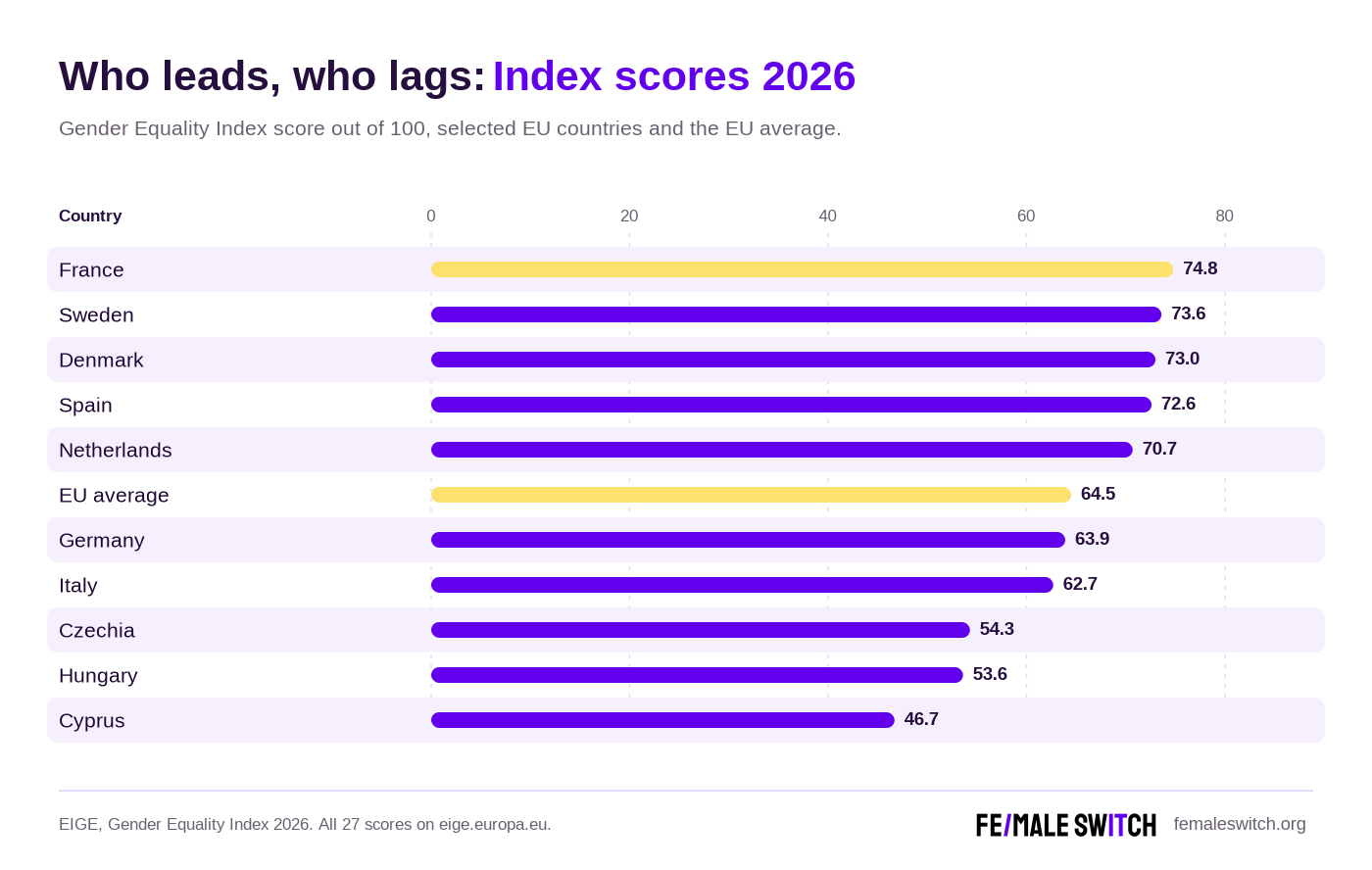
Source: EIGE, Gender Equality Index 2026, scores out of 100.
The money and care gap behind the score
The report’s numbers on work and money explain why so many women end up building something of their own, and why so many of them do it on their own money. Across the EU, women earn 80% of what men earn over a year, and the gender pension gap is 24%. In couples with children, fathers work the equivalent of 92% of a full-time job, mothers 68%.
Care is the main reason. 41% of women and 20% of men give more than 35 hours of childcare a week. Commissioner Hadja Lahbib put it plainly in her speech at the forum: “In the EU, more than twice as many women as men spend over 35 hours a week on childcare. That is a second full-time job.”
She also gave a date: this year’s EU Equal Pay Day is Friday 20 November, the day from which women in the EU in effect work for free until the end of the year. At the current pace, she said, “the gap closes around 2054”. If you are wondering how this looks in your own sector, our piece on the pay gap in the tech industry has the numbers. Two days later, the Commission admitted that the law meant to narrow that gap is late in most EU countries: our Equal Pay Day news piece on the Pay Transparency Directive shows where each country stands.
Self-employed parents: the gap in the system
The special chapter checks who is actually covered by parental leave in each EU country. For employees, coverage is near-universal in six countries: Denmark, Spain, Croatia, Italy, Slovenia and Sweden. For people who work for themselves, the picture is very different.
“Among employed parents who are not eligible for statutory parental leave, self-employment is the main reason in most Member States.” EIGE, Gender Equality Index 2026
The report separates two things that are easy to mix up. Parental leave is a legal right to step away from your job and come back to it. A parental benefit is the money paid while you do. Because there is no employer to step away from, the report says, “self-employed parents depend on benefit access, not job-protected leave.” In practice, that means your contribution record decides what you get.
- Leave law for employees only: in Belgium, Greece, Malta and the Netherlands, statutory parental leave is legally restricted to employees.
- No statutory leave for the self-employed: Greece, France and Malta exclude them from statutory parental leave, although France pays the self-employed a parental allowance (see below).
- Benefit only if you paid in: in Bulgaria, Czechia, Estonia, Ireland, France, Italy, Latvia, Lithuania, Austria, Poland, Portugal, Slovakia and Finland, the self-employed can get benefits if they meet social contribution rules.
- Where self-employment blocks the money: in Bulgaria, the Netherlands, Germany, Greece, Belgium and Malta, self-employment is the main reason working parents can’t get a parental leave benefit.
Some countries do it better. In Spain, self-employed parents have a legal right to pause their business after a birth or adoption, with a partial break on social security contributions. Since 2019, France has paid self-employed parents the parental allowance for as long as employees, if they reduce or stop their activity and have enough pension contribution quarters. In Cyprus and Luxembourg the self-employed are part of the statutory scheme.
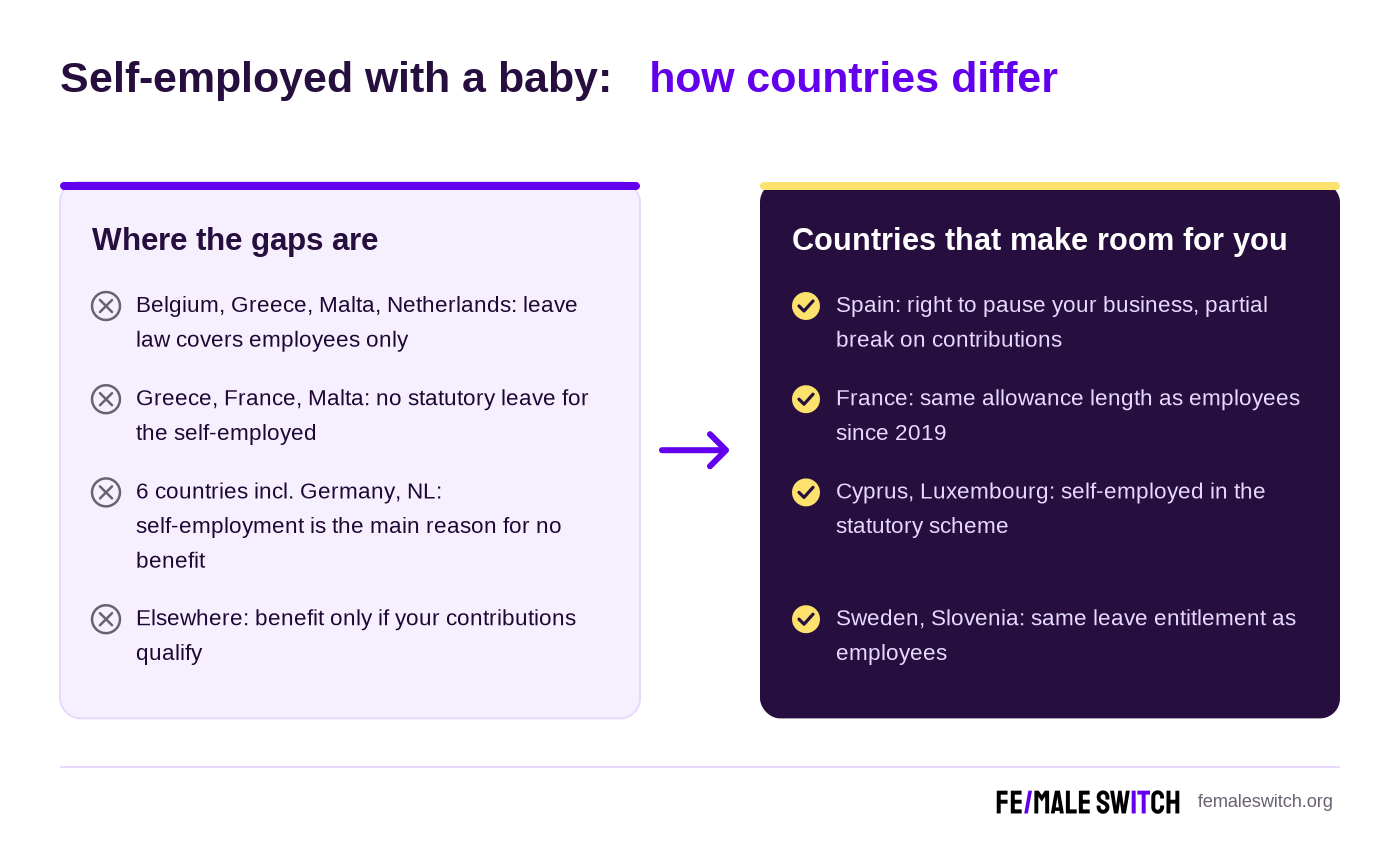
Source: EIGE, Gender Equality Index 2026, chapter 9 and annex tables 39 and 40 (rules as of March 2026). Rules change often, so check your national social security office before you plan around them.
One more thing to know: the Index looks at parental leave, not maternity leave. Maternity pay for self-employed women runs through separate national schemes, and those have gaps too. In Germany, for example, self-employed women still have no statutory maternity protection, which we explained in our piece on the Bundestag debate on maternity protection for the self-employed.
What Brussels says comes next
In her speech, Lahbib listed what the Commission is doing about pay and care. These are the items to watch, with their status:
- Pay Transparency Directive (Adopted): employees can ask what colleagues doing the same work earn on average, and when an unjustified gap reaches 5% or more, the employer must act. This matters once you hire.
- Work-Life Balance Directive (Adopted): the Commission says it is helping EU countries apply it fully.
- Childcare target (Adopted as an EU target): 45% of children under three in early education and care by 2030.
- European Care Deal (Debated): announced for next year, with no text yet.
- Quality Jobs Act (Debated): upcoming; Lahbib said it will look at how employers prevent harassment at work.
“Gender equality is good for Europe’s competitiveness, and quality care is what makes it possible.” Roxana Mînzatu, Executive Vice-President of the European Commission
None of this changes parental leave for the self-employed directly. That is still national law, which is why the rules in the table above vary so much.
What this means for you
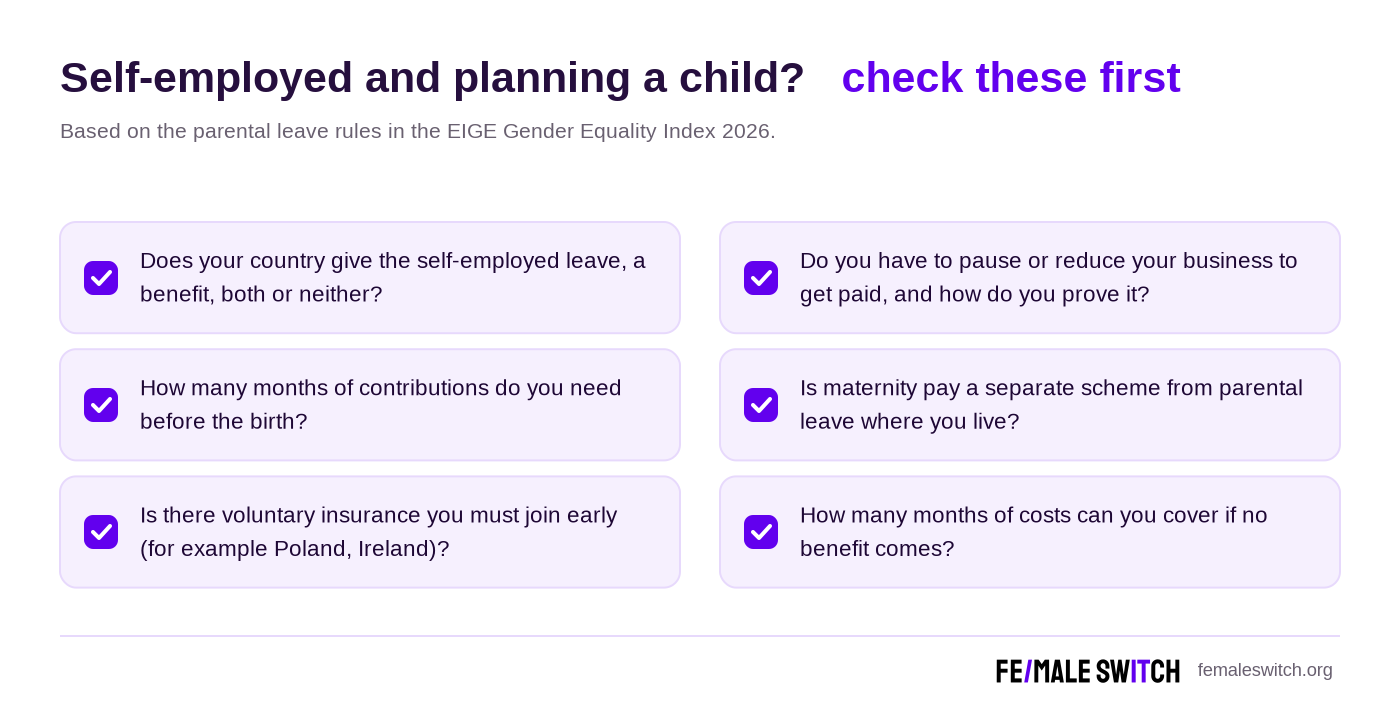
- Find out what you are entitled to before you need it. Most countries pay the self-employed only if they have paid in for a set number of months before the birth, often 6 to 12 months within the last one or two years. Ask your social security office for the exact rule and keep proof of your payments.
- Join voluntary schemes early. Where insurance is optional, such as sickness insurance in Poland, joining a few months too late can mean the flat-rate benefit instead of one based on your income. If you are weighing the legal form for your business, ask how each one affects your contributions.
- Plan how you will pause the business. Spain, France and others pay only if you reduce or stop your activity. Decide what can run without you, who covers clients, and how you will show the pause on paper. Our look at what research says about maternity leave and starting a company has more on timing.
- Build your own buffer where the system won’t. In Belgium, Greece, Malta and the Netherlands the gaps are biggest. Our overview of budget 2027 changes for freelancers in six EU countries and our explainer on the Dutch self-employed act show where national rules are moving.
- Use the deadlines that are open now. The European Prize for Women Innovators 2027 closes on 1 December 2026 at 17:00 CET, with €100,000 for the winner. And if you need the bigger picture on who funds women in Europe, read our reports on the State of European Tech 2026 and the ILO’s data on women business owners.
Building a business that has to fit around your life?
The Fe/male Switch startup game takes you from idea to first paying customers in weekly quests, with an AI co-founder, so you can test your offer and your numbers before you spend your savings. The free trial lasts 2 weeks.
👉 Start the game
FAQ: Gender Equality Index 2026
What is the Gender Equality Index?
It is a yearly score from 1 to 100 that the European Institute for Gender Equality (EIGE) gives the EU and each member state, across work, money, knowledge, time, power and health. The 2026 edition came out on 17 November 2026 and is mostly based on 2025 data.
Which country is most gender-equal in the EU in 2026?
France, with 74.8 points, ahead of Sweden at 73.6. It is the first time France has led the Index and the first time since 2013 that Sweden is not first. Denmark and Spain follow, while Cyprus, Hungary and Czechia score lowest.
What is the EU’s Gender Equality Index score for 2026?
64.5 out of 100, up 0.9 points on last year and 5.6 points since 2020. Power is the weakest area at 42.9 points but has improved the most, while the score for time spent on care and housework has not moved since 2020.
Can self-employed people get parental leave in the EU?
It depends on the country. In most member states, self-employment is the main reason working parents can’t get statutory parental leave. Belgium, Greece, Malta and the Netherlands limit statutory leave to employees, while Spain, France, Cyprus and Luxembourg give the self-employed a route in.
What is the difference between parental leave and a parental benefit for freelancers?
Leave is the legal right to step away from a job; a benefit is the money paid during that time. Because freelancers have no employer, the report says they depend on access to the benefit, which usually requires a minimum number of months of social contributions before the birth.
When is EU Equal Pay Day in 2026?
Friday 20 November 2026, according to Commissioner Hadja Lahbib. From that day women in the EU in effect work for free until the end of the year, because they earn less than men. At the current pace, she said, the gap closes around 2054.
