
TL;DR: The gender pay gap in Europe stands at 11.1% across the EU in 2024: women earned on average 11.1% less per hour than men (Eurostat, provisional, the latest year published). It runs from 18.8% in Estonia and 18.5% in Czechia down to 0.7% in Belgium and -0.8% in Luxembourg, the only EU country where women out-earn men per hour. The gap grows with age, is wider in the private sector than in the public sector in every reporting country except Slovenia, and peaks in finance (up to 40.3% in Hungary). Only 1.9 of the 12.2 points measured in 2022 are explained by differences such as job, sector or hours.
If you are a founder setting your own rates, read this next to our pay gap in the tech industry data.
The gender pay gap in Europe is the difference between what men and women earn per hour, shown as a share of men's pay. Eurostat measures it for employees in companies with 10 or more staff, so the official figure says nothing about freelancers or founders who pay themselves. I run a bootstrapped company and set my own prices, and these numbers still matter to me: they shape what clients expect to pay women, and what women expect to charge.
Across the EU, women earned 88.90 euro for every 100 euro a man earned per hour in 2024 (our calculation from the 11.1% gap). Ten years earlier the gap was 15.7%. It has closed by 4.6 points in a decade, and it has narrowed in 24 of the 27 member states.
What are the gender pay gap numbers at a glance?
- 11.1%: unadjusted gender pay gap in the EU in 2024, provisional (Eurostat, updated 27 Nov 2026).
- 15.7%: the same gap in 2014, so 4.6 points have closed in ten years (our calculation).
- 18.8%: the highest gap, in Estonia; -0.8% the lowest, in Luxembourg (Eurostat, 2024).
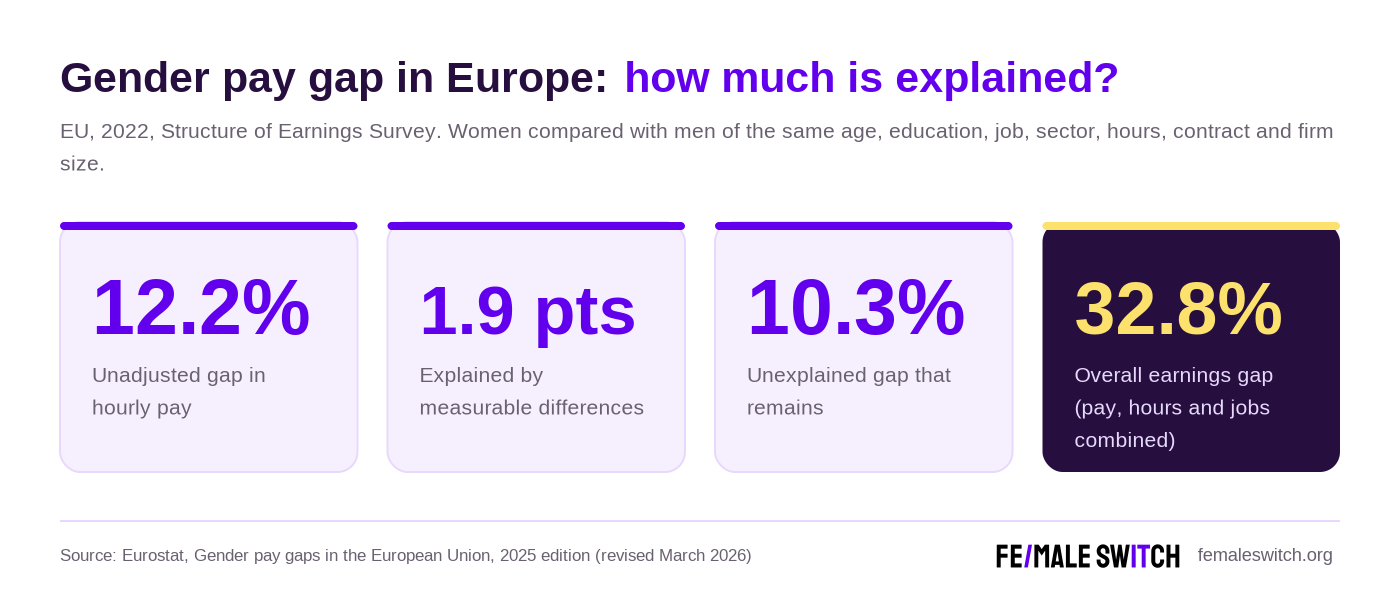
- 10.3%: the part of the 2022 EU gap that stays unexplained after Eurostat corrects for age, education, job, sector, hours, contract and firm size (Eurostat working paper, 2026).
- 32.8%: the gender overall earnings gap in 2022, which adds up lower hourly pay, fewer paid hours and lower employment (Eurostat).
- 40.3%: the gap in financial and insurance activities in Hungary, the highest sector figure in the EU in 2024 (Eurostat).
- 20 November 2026: European Equal Pay Day, the date from which women in the EU symbolically work for free until year end (European Commission).
- 34.3%: women's share of the EU's self-employed in 2025 (our calculation from the Eurostat Labour Force Survey).
What is the gender pay gap in Europe by country?
Here is every EU member state plus Iceland, Norway and Switzerland, ranked by the 2024 gap. The 2014 column shows how far each country has moved.
Sources: Eurostat, gender pay gap in unadjusted form (sdg_05_20), updated 27 Nov 2026. 2024 values are provisional; Romania's are estimates; Czechia and Norway use a different definition. Change in percentage points is our calculation.
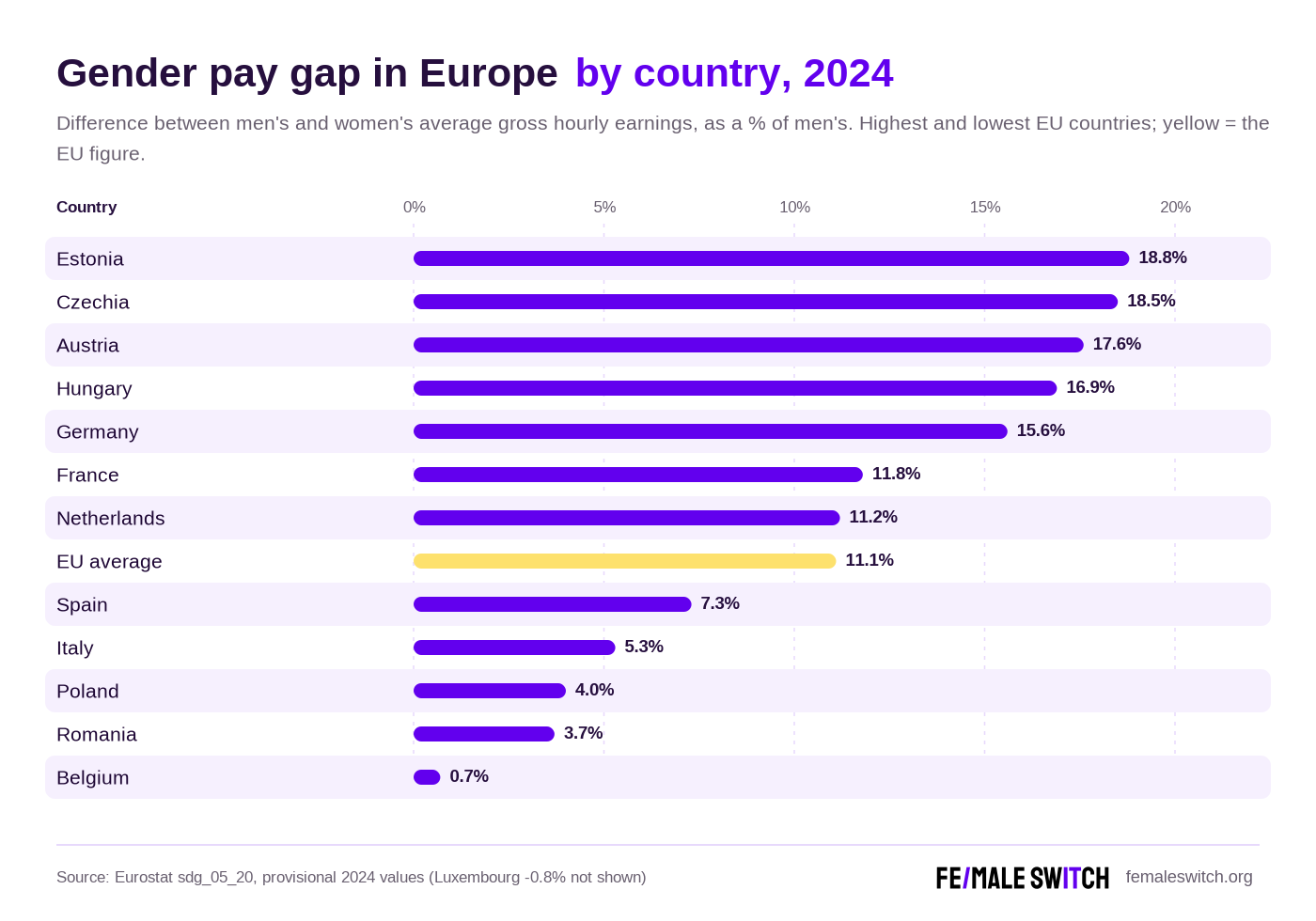
Three countries moved the wrong way since 2014: Hungary (+1.8 points), Slovenia (+1.0) and Greece (+0.9). Estonia still tops the list, yet it also closed the most ground, 9.3 points in ten years. Latvia had the fastest recent fall, from 21.6% in 2019 to 13.9% in 2024.
A low gap does not always mean equal pay. Eurostat's own decomposition (below) shows that in Italy, Poland and Romania women's measured profiles, such as education and job type, would predict pay equal to or above men's, so the small headline gap hides a larger unexplained one.
How does the gender pay gap change with age?
The gap is small when people start work and widens through the years when children arrive and promotions are handed out. Eurostat publishes the age split per country only, so here are the largest economies plus three contrasting ones.
Sources: Eurostat, gender pay gap by age (earn_gr_gpgr2ag), provisional 2024 values.
For the EU as a whole, the Structure of Earnings Survey 2022 shows the same shape. Using its average hourly earnings, women under 30 earned 1.2% less than men, women aged 30 to 49 earned 12.3% less, and women aged 50 and over earned 19.0% less (our calculation; this simple method gives 13.2% for all ages against the official 12.2%, so read it as the shape, not the official figure).
Estonia is the outlier: its gap is largest for younger women and falls after 45. For a founder in her thirties, the German and French pattern is the one to know: the gap doubles between the late twenties and the forties, the same years in which many women weigh leaving a job to start a company.
Is the gap wider in the private sector or in the public sector?
Private companies pay women less than the public sector does in every EU country with data except Slovenia (Eurostat, 2024). Public pay follows published salary grids that apply to everyone, and Eurostat points to those grids as the likely reason.
Sources: Eurostat, gender pay gap by economic control (earn_gr_gpgr2ct), provisional 2024 values.
The private-sector gap ranges from 6.1% in Belgium to 21.8% in Portugal. In Cyprus the spread between the two sectors is 24.3 points (our calculation). Startups are private employers, and most have no salary grid at all, which is the exact setting where this gap grows.
Which sectors have the biggest gender pay gap?
Finance is the clear leader. In 2024 the gap in financial and insurance activities ran from 12.2% in Spain to 40.3% in Hungary, and it was higher than the country's overall gap in all 26 EU countries that publish sector data (our check of the Eurostat sector table). Across the EU in 2022, average hourly pay gives these sector gaps (our calculation from the Structure of Earnings Survey):
Sources: Eurostat, mean hourly earnings by sex, age and economic activity (earn_ses22_13), enterprises with 10 or more employees.
Professional and technical services, at 22.4%, covers consultancies, agencies, law and accounting firms: the sectors where many women go freelance and keep the pricing habits they learned as employees. Our report on the gender gap in tech covers the information and communication sector in more depth.
Does company size change the gender pay gap?
Eurostat publishes no official gap by company size, so we calculated it from the 2022 Structure of Earnings Survey. The gap grows from small firms to large ones, then dips in the very largest.
Sources: Eurostat, mean hourly earnings by sex, occupation and enterprise size (earn_ses22_18); our calculation.
The manager column is the one that stays with me. In companies of 10 to 49 people, women managers earned €22.74 per hour against €31.84 for men, a 28.6% gap. That is startup size, and it matches what we found on women in tech leadership roles. Small teams set pay one person at a time, with no grid and no reporting duty, which is why our hiring plan template puts the salary bands in writing before the first hire.
How much of the gap is discrimination, and how much is explained?
Eurostat splits the 2022 gap into an explained part and an unexplained part. It compares women and men with the same age, education, occupation, experience, contract type, working time, sector, firm size and region.
- 12.2%: unadjusted EU gap in 2022.
- 1.9 points: explained by different characteristics, mostly sector (3.7 points) and working time (1.5 points), partly cancelled by women's higher education.
- 10.3%: unexplained. Eurostat calls this a "residual gap" and does not label it discrimination, though it is the part no measured difference accounts for.
So 84% of the EU gap has no measurable explanation (our calculation: 10.3 divided by 12.2). In 14 of the 27 member states, including Italy, Poland and Romania, the explained part is negative: on paper women there should earn the same or more than men.
There is a wider measure too. The gender overall earnings gap combines hourly pay, paid hours and employment rates, and it reached 32.8% in 2022 (Eurostat). Women in the EU were paid for 11% fewer hours per month than men, and in the Netherlands for 24% fewer. EIGE's Gender Equality Index 2026 shows the same gap from another angle: women's median annual earnings were 25,525 against 32,079 in purchasing power standards, 20.4% less (our calculation). Our summary of the Gender Equality Index 2026 covers the rest of that report.
What does the Pay Transparency Directive change?
Directive (EU) 2023/970 had to be written into national law by 7 June 2026. Our article on Equal Pay Day 2026 and the late pay transparency law tracks which countries are behind. What the directive asks of every employer, public or private:
- Pay before the interview: job applicants have the right to the starting pay or pay range, in the job ad or before the interview (Article 5).
- No pay history questions: employers may not ask what a candidate earned before (Article 5).
- Gender-neutral ads and job titles (Article 5).
- Clear pay criteria: staff can see how pay, pay levels and pay progression are set; countries may exempt firms under 50 people from the progression part (Article 6).
- Right to information: any worker can ask, in writing, for their own pay level and the average pay of women and men doing the same work, with an answer due within two months, and contract clauses that ban talking about pay are prohibited (Article 7).
- Reporting by size: employers with 250 or more workers report the gap by 7 June 2027 and every year after; 150 to 249 workers by 7 June 2027 and every three years; 100 to 149 workers by 7 June 2031 (Article 9).
- The 5% trigger: a gap of 5% or more in any category of workers that the employer cannot justify or fix within six months leads to a joint pay assessment with worker representatives (Article 10).
- No cap on compensation: victims recover back pay and bonuses in full, and claims can be brought for at least three years (Articles 16 and 21).
Employers under 250 workers are entitled to technical help and training from their government (Article 11). If you hire your first employee, articles 5 to 7 apply to you from day one, whatever your size.
What does the gender pay gap mean for women founders?
The official gap covers employees, and no EU source measures a pay gap between self-employed women and men. What the data does show is where women founders come from and what they carry with them.
- Women make up 34.3% of the EU's self-employed and 28.0% of self-employed people with staff (2025, our calculation from Eurostat's Labour Force Survey). The pool of women employers is smaller still. Our guide for women going solo in Europe covers legal form, VAT and pricing for that first step.
- Women who leave a job at 35 to 44 leave at the age where the gap widens fastest (14.5% in Germany and 12.5% in France for that age group), so a day rate built from their last salary starts with the same discount.
- Professional and technical services (22.4%), wholesale and retail (20.9%) and health (15.9%) carry wide gaps among employees, and a freelancer who comes from these sectors starts from that pay level.
Here is how I use these numbers when pricing:
- Price from the market, never from your last salary. Look up what the work costs from agencies and male competitors, then set your rate.
- Publish your price. A published rate leaves no room for the discount that happens in private negotiations, the same logic behind the directive's pay range rule. Our guide to pricing services versus products shows how to build a rate card, and product pricing psychology explains how buyers read a price.
- Count your hours honestly. The overall earnings gap shows that hours matter as much as hourly rates. Bill for the preparation, travel and admin time, too.
- Write your own pay grid from the first hire. The public sector has the smallest gaps because its pay grids are written down.
If you want to practise pricing and negotiation before real money is on the line, the Fe/male Switch startup game lets you run a business in a safe setting first. For more data on women in business, see our female founder statistics for Europe, the ILO report on women in business and the gender gap in startup funding.
How were these numbers collected?
- Unadjusted gender pay gap: the difference between men's and women's average gross hourly earnings as a share of men's earnings, for employees in companies with 10 or more staff, all sectors except public administration and defence (Eurostat definition). Czechia and Iceland cover a wider set of firms, and Czechia and Norway use a different definition.
- Data years: 2022 is a Structure of Earnings Survey year and final. 2023 and 2024 are provisional national estimates benchmarked on that survey. No 2025 values were published when we checked on 28 November 2026.
- Our calculations: the change since 2014, the EU-level gaps by age, sector and company size (from average hourly earnings in the 2022 survey), the 84% unexplained share, the annual earnings gap from EIGE and the self-employment shares. Our EU-level calculation gives 13.2% for all ages against the official 12.2%, so treat those three tables as the pattern, not the official value.
- What does not compare: the hourly gap, the annual earnings gap (EIGE, 20.4%) and the overall earnings gap (32.8%) measure different things. EIGE's 2026 Index uses a method revised in 2025, so its scores do not compare with editions before 2025.
FAQ
What is the gender pay gap in Europe in 2026?
The latest published figure is 11.1% for the EU, for 2024, released by Eurostat. The 2025 figure was not out when we checked in November 2026. Equal Pay Day 2026 fell on 20 November, based on the 11.1% gap.
Which European country has the highest gender pay gap?
Estonia, at 18.8% in 2024, followed by Czechia (18.5%) and Austria (17.6%). Outside the EU, Switzerland's gap is 16.0%.
Which European country has the lowest gender pay gap?
Luxembourg, at -0.8% in 2024, the only EU country where women earn more than men per hour on average. Belgium (0.7%) and Romania (3.7%) follow.
What is the difference between the adjusted and unadjusted gender pay gap?
The unadjusted gap compares the average hourly pay of all women and all men. The adjusted gap compares women and men with the same job, sector, hours, education and experience. In the EU in 2022 the unadjusted gap was 12.2% and the adjusted (unexplained) gap 10.3%.
Is the gender pay gap the same as unequal pay for the same job?
The unadjusted gap also counts women working in lower-paid sectors and jobs. Eurostat describes it as a concept broader than discrimination in the sense of equal pay for work of equal value, which the Pay Transparency Directive targets.
Does the gender pay gap apply to the self-employed?
The official figure covers employees only. No EU statistic measures a pay gap among the self-employed, though women are 34.3% of the EU's self-employed and 28.0% of those who employ staff.
When do companies have to report their gender pay gap in the EU?
Under the Pay Transparency Directive, employers with 150 or more workers file their first report by 7 June 2027, and employers with 100 to 149 workers by 7 June 2031. Countries may ask smaller employers to report as well.
Can an employer in the EU ask about my previous salary?
Under Article 5 of Directive (EU) 2023/970, employers may not ask applicants about their pay history, and applicants have the right to know the starting pay or range before the interview. This applies once your country has written the directive into national law.
Cite this page
Fe/male Switch Foundation, "Gender Pay Gap in Europe by Country (2027)", https://femaleswitch.org/startup-blog/tpost/gender-pay-gap-europe, data checked 28 November 2026.
Sources
- Eurostat, Gender pay gap in unadjusted form (sdg_05_20), 2014 to 2024, updated 27 Nov 2026, checked 28 Nov 2026.
- Eurostat, Gender pay gap in unadjusted form by NACE Rev. 2 activity (earn_gr_gpgr2), by age (earn_gr_gpgr2ag) and by economic control (earn_gr_gpgr2ct), 2024, checked 28 Nov 2026.
- Eurostat, Statistics Explained: "Gender pay gap statistics", data extracted February 2026, checked 28 Nov 2026.
- Eurostat, statistical working paper "Gender pay gaps in the European Union, 2025 edition, revision", 16 Mar 2026, checked 28 Nov 2026.
- Eurostat, Structure of Earnings Survey 2022: mean hourly earnings by sex, age and economic activity (earn_ses22_13) and by occupation and enterprise size (earn_ses22_18), checked 28 Nov 2026.
- Eurostat, Labour Force Survey: employed persons by professional status (lfsa_egaps), 2025, checked 28 Nov 2026.
- Directive (EU) 2023/970 of the European Parliament and of the Council of 10 May 2023 (Pay Transparency Directive), Official Journal L 132, checked 28 Nov 2026.
- European Commission, "Equal Pay Day", checked 28 Nov 2026.
- European Institute for Gender Equality (EIGE), "Gender Equality Index 2026: Making parental leave work", 17 Nov 2026, checked 28 Nov 2026.
