
TL;DR: What do AI hacking tools mean for a small business?
AI hacking tools such as ARTEX let an attacker type a goal in plain language and leave software agents to probe, break in and copy data. The FBI warned on 13 November 2026 that some ARTEX intrusions reached privileged access in under three hours. The tools walk through ordinary doors: an old vendor login nobody removed, apps your IT provider connected to Microsoft 365, accounts without multi-factor authentication, forgotten websites and default passwords. You can close most of them in one afternoon with the checklist, the access ledger and the six questions for your IT provider below.
Here is what ARTEX is and what the FBI, Amazon and Cloudflare found, on our sister site MeanCEO. This article is for the shop owner, consultant or solo founder in Europe with no IT department who wants one answer: which of my doors would these tools find first? Amazon's researchers give the good news: "None of the techniques in these campaigns were new." The doors are old, so the locks are cheap.
What are AI hacking tools like ARTEX?
ARTEX is an open-source penetration testing framework, software that security teams use to attack their own systems with permission. The FBI's FLASH advisory of 13 November 2026 describes an LLM-driven platform: you set an objective in natural language, and AI agents turn it into commands with little human help. It connects to outside AI models such as Anthropic's Claude, OpenAI's GPT and DeepSeek.
Its developer took the GitHub repository down on 8 October after reports of abuse, and copies kept spreading. By 12 November, Cloudflare says, ARTEX and its forks made up over 60% of the AI penetration testing orchestrators it knows about. The FBI says ARTEX has been used since at least August 2026 against sectors from healthcare and manufacturing to legal firms. It "lowers technical barriers", so attackers with little skill can run complex intrusions, and it goes after peripheral systems that get less security attention than a company's main app. A different door opened on 16 November: the Optimizely hack put card-skimming code into a trusted script on the websites of 178 organisations.
Our piece on bug bounty rules for small startups shows how to let good-faith researchers test you safely.
Which doors do AI hacking tools walk through at small firms?
Each big case started with something a ten-person company also has:
Old access is the cheapest door. Barracuda's own report admits it gave a cloud access credential to an AI vendor for an earlier project and never retired it: "That is on us." Your version is the web agency or freelancer who still holds logins after the invoice is paid.
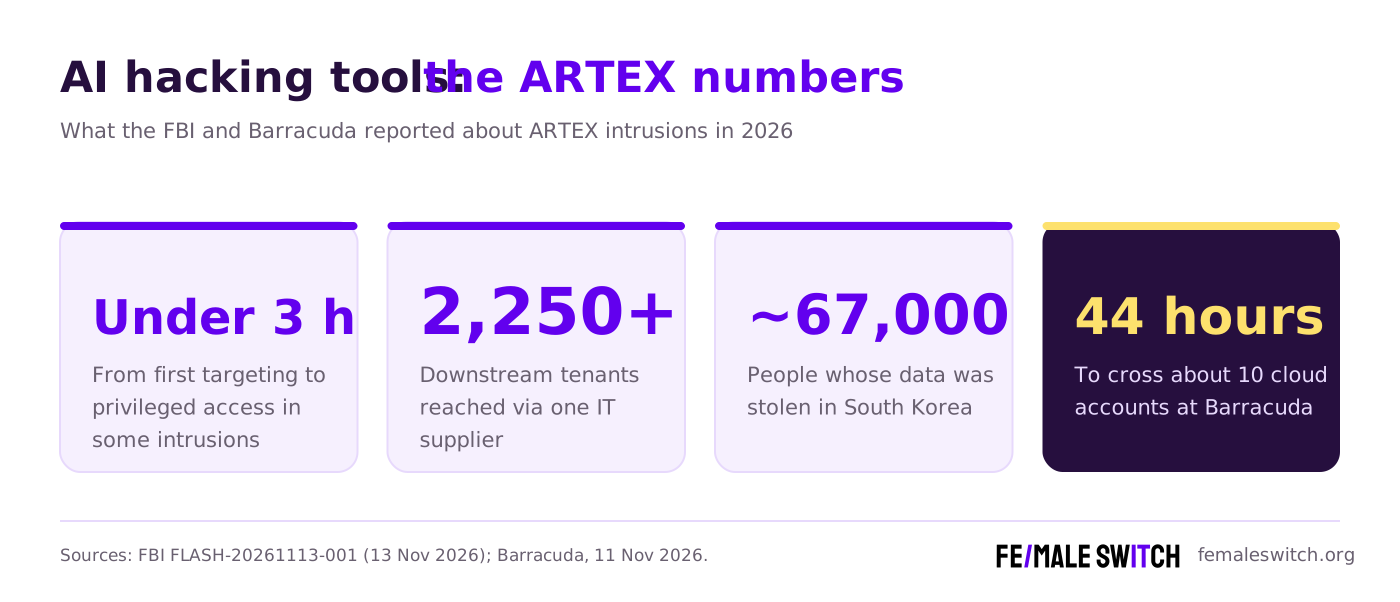
Your IT provider's apps are doors too. The FBI says attackers used ARTEX against ConnectWise Cloud Backup and reached more than 2,250 downstream tenants, meaning customers' Microsoft 365 environments. The FBI tells companies to review every Microsoft 365 tenant where those apps are or were installed. If someone else set up yours, read our case on an IT provider that created the account while the client carried the blame.
Passwords alone don't hold. TechCrunch writes that the South Korean attacks were blamed in large part on weak defences and missing protections such as multi-factor authentication (MFA), the second step after your password, like a code from an authenticator app or a hardware security token.
Forgotten systems and secrets in code finish the job. For a small business, the FBI's peripheral systems are the old version of your website, a test webshop or a booking plug-in; our PHP vulnerability plan shows how to check one without being a developer. Amazon's threat intelligence team watched ARTEX agents hunt for default admin passwords and access keys left in code and public files, and Cloudflare found attackers abusing static, non-expiring tokens inside build pipelines.
How fast do AI hacking tools move?
Faster than a small team reacts. The FBI says some ARTEX intrusions went from first targeting to privileged access in under three hours.
At Barracuda, the attacker's last activity came on 2 November and the company found the intrusion on 4 November: "By the time the activity was reported, it had already stopped." Its chief information security officer, Arve Kjoelen, wrote that defenders who wait to spot an attack and then respond "arrive after the attacker has finished". You won't out-watch a machine at 3 a.m., so close the doors before anyone knocks.
What can you check in one afternoon?
Block three hours and keep your admin logins at hand. If the vocabulary is new, start with our cybersecurity guide for non-technical entrepreneurs.
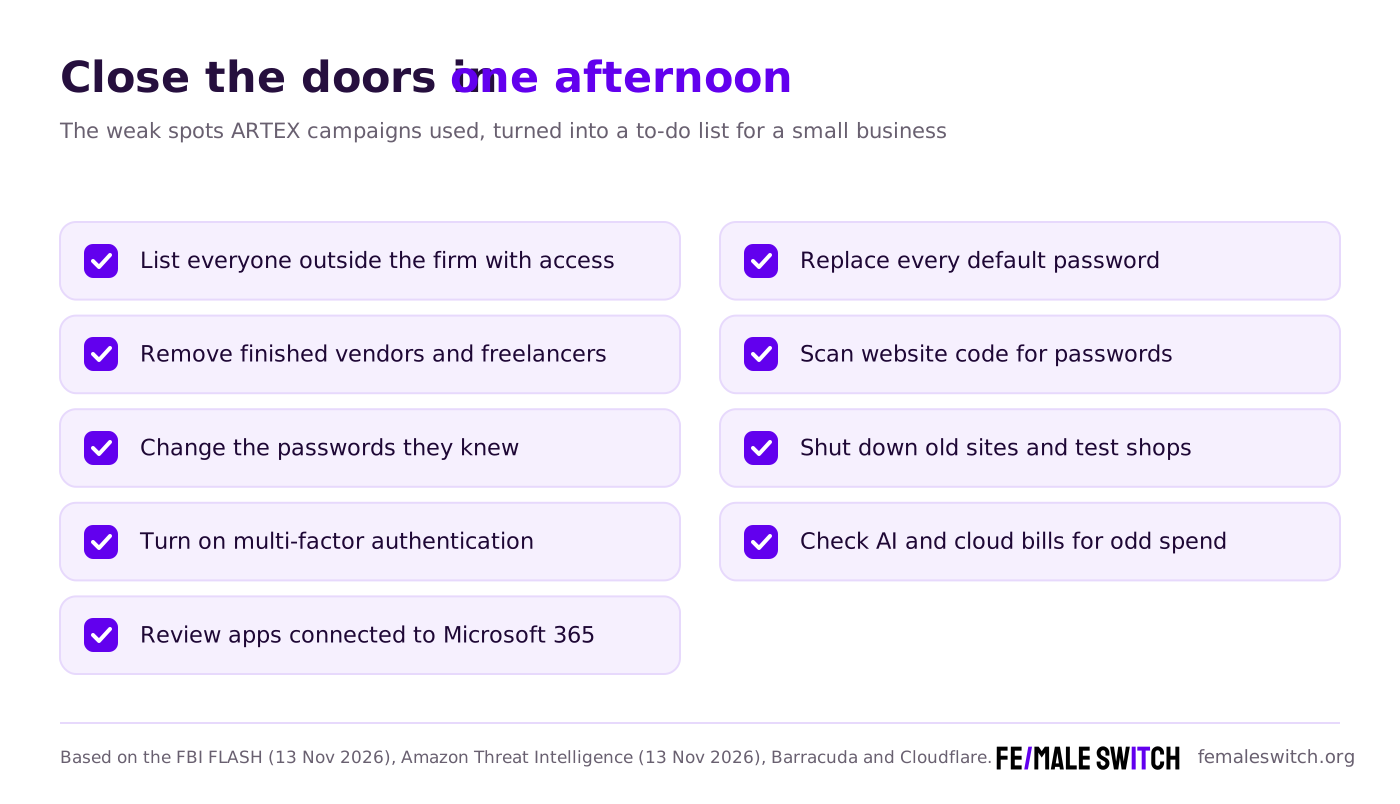
- List everyone outside your company with access: IT provider, web agency, freelancers, bookkeeper, past staff.
- Remove access when the work has ended and change any password the person knew.
- Turn on multi-factor authentication for email, banking, your domain registrar, website and webshop admin, and cloud storage.
- Open the connected apps list in your Microsoft 365 or Google Workspace admin console and ask your IT provider what each app does. Don't delete them in a hurry: the FBI advises against that as a first response.
- Replace every default password: router, network storage, webshop and any self-hosted AI tool.
- Ask your developer to scan your website code for passwords and access keys and to change any it finds.
- Shut down what you no longer use: old sites, test shops, forgotten subdomains.
- Check your AI and cloud bills for spending you can't explain, a sign of misuse Amazon tells companies to watch for. If you or a freelancer pasted an AI API key into a tool, run the 30-minute check for stolen AI API keys.
How do you keep an access ledger?
An access ledger is a one-page table of who can get into what. Keep it in a spreadsheet and review it every quarter and whenever a project ends:
A row nobody can explain is your first task. Barracuda had a whole security team and still missed one finished project.
What should you ask your IT provider or freelancer?
Send these by email this week, and put the answers in your ledger:
- Which accounts and apps do you, or tools you installed, have in our Microsoft 365 or Google Workspace, and with which rights?
- Do you use ConnectWise or another remote management or backup tool on our systems, and have you checked the FBI's advisory of 13 November 2026?
- Does every admin account, yours included, use multi-factor authentication?
- Are there default or shared passwords or access keys in our website, servers or code?
- Which of our systems can anyone reach from the internet, including old sites and test versions?
- Which logs do you keep, for how long, and how fast would you tell us about a suspected breach?
What do you do if you suspect a breach?
Move quickly and keep the evidence. Our guide to the first 72 hours after a supplier data breach covers customers and contracts.
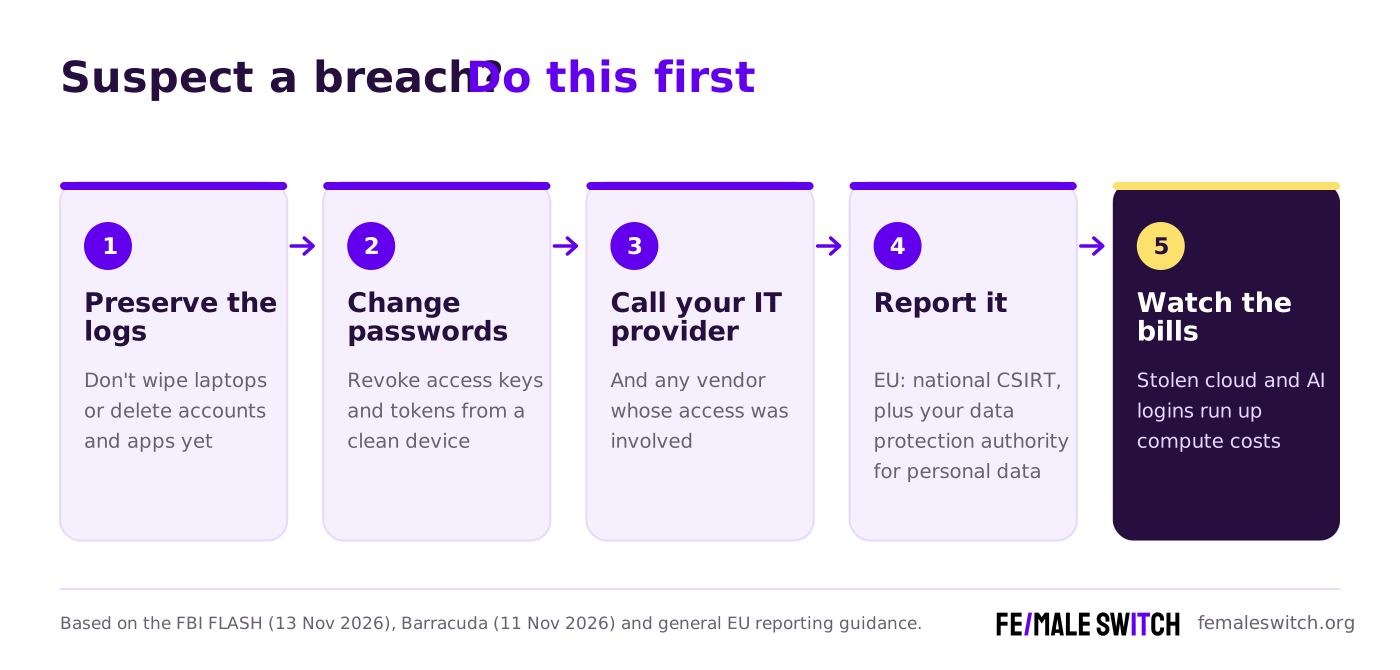
- Preserve the logs. The FBI asks victims to keep them, so don't wipe laptops or delete accounts before your IT provider has copied what happened.
- Change passwords and revoke access keys and tokens from a clean device. Barracuda chose to "assume the worst" and changed all its customer credentials, TechCrunch reports.
- Call your IT provider and any vendor involved.
- Report it. In the EU, contact your national CSIRT (computer security incident response team) or cyber security centre, and your data protection authority if personal data was involved. US victims can report to the FBI at ic3.gov.
- Watch your bills. Barracuda points to the October breach at Railway, where stolen AI service credentials ran up an estimated $740,000 in compute.
Building your first startup on a budget?
The Fe/male Switch startup game takes you from idea to first paying customers in weekly quests, with an AI co-founder and a community of founders.
👉 Start the game
FAQ: AI hacking tools and small businesses
What are AI hacking tools?
Software that uses AI agents to scan, break into and move through networks with little human input. ARTEX, the most widespread, turns a goal written in plain language into commands, according to the FBI.
Is ARTEX still available after it was taken down?
Yes. The developer removed the GitHub repository on 8 October 2026, and the FBI says forks, mirrors and archived copies keep it spreading.
How fast can an AI hacking tool break in?
The FBI says some ARTEX intrusions went from first targeting to privileged access in under three hours.
Are small businesses targets of AI hacking tools?
Small suppliers are a way in. The FBI warns that attackers compromise weaker third-party vendors to reach bigger enterprise networks.
What should I do first?
Remove access for vendors and freelancers whose work has ended, and turn on multi-factor authentication for email and admin accounts.
Where do I report an AI-driven cyberattack in Europe?
Your national CSIRT or cyber security centre, plus your data protection authority if personal data was affected.
