
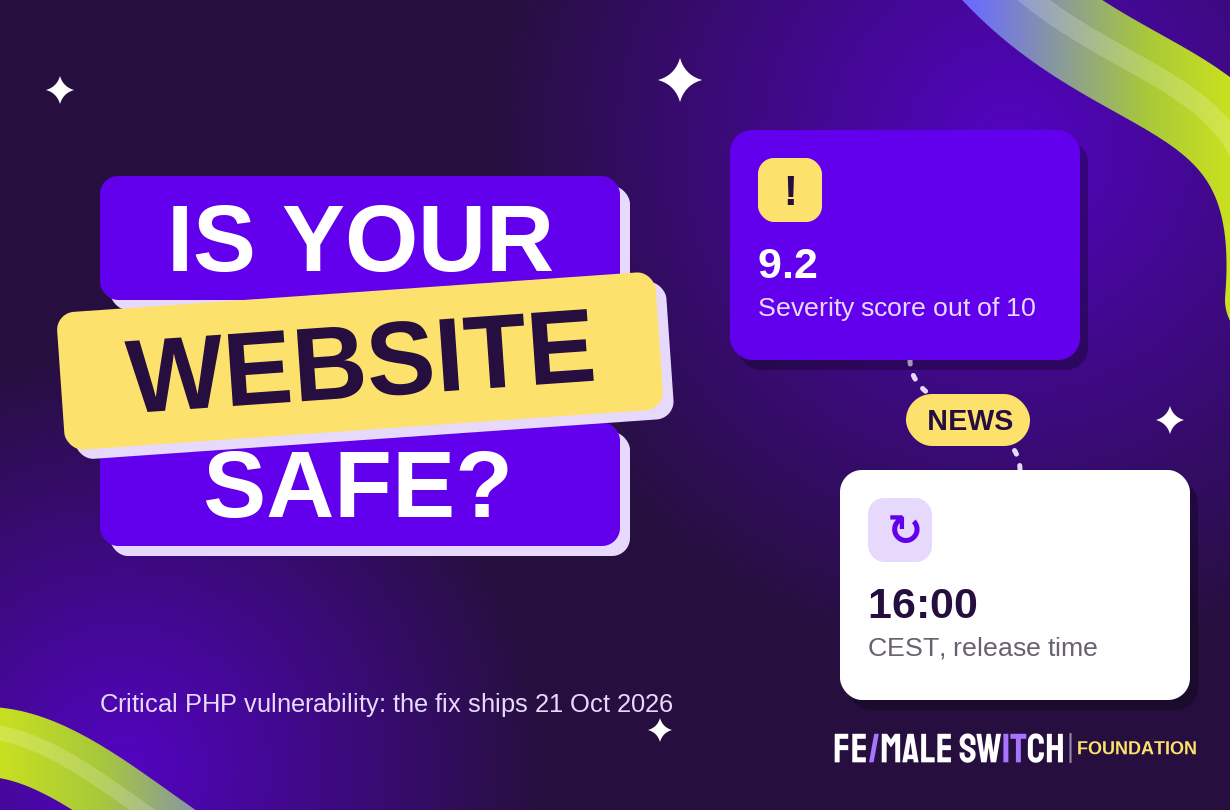
TL;DR: Does the PHP vulnerability affect my small business website?
If your website runs on WordPress, WooCommerce or another PHP system, yes, it depends on this fix. On 20 October 2026, the PHP team announced an emergency release for two critical vulnerabilities, each rated 9.2 out of 10. The fix came out on 21 October 2026: PHP 8.5.12, 8.4.27, 8.3.36 and 8.2.35. You don't need a developer to act: find out who hosts your site, check its PHP version, ask your host when they install the fix, and take a backup today.
Last updated 4 Nov 2026, 14:30 CET. A successful break-in on an unpatched server is confirmed, and the US cyber agency CISA lists both flaws as exploited. Nothing new has come out since 29 October: on 4 November PHP still had not released the fix for the third issue (CVE-2026-115560), so make sure your host keeps session.upload_progress.enabled=0 until it does. This was our last scheduled update.
Update 29 Oct, 07:40 CET: attackers have now broken in for real, so if your host still hasn't confirmed the update, chase them today. On 26 October BleepingComputer reported that Adel Karimi, detection and response lead at Perplexity, recorded a confirmed takeover of a decoy server (a honeypot) running PHP 8.4.26, an unpatched version. He adds that the decoy used a deliberately easy setup, so it doesn't show how often the attack works elsewhere. The same day the US cyber agency CISA added CVE-2026-109618 and CVE-2026-109619 to its Known Exploited Vulnerabilities catalog, its list of flaws attackers really use, and gave US federal agencies until 29 October to fix them. PHP also published rebuilt Windows packages on 26 October for a separate, narrower flaw (CVE-2026-111497); the PHP version numbers stay the same, so this only matters if your site runs on a Windows server. CVE-2026-115560 still has no fix: by 29 October PHP had not shipped its next regular release, so keep session.upload_progress.enabled=0 switched off as described below.
Update 24 Oct, 22:15 CEST: PHP has flagged a third, narrower issue. In an informational advisory on 23 October at 10:12 UTC, PHP asks everyone to set session.upload_progress.enabled=0 until its next regular bugfix release, to close "an unlikely RCE vector" now tracked as CVE-2026-115560. It only reaches sites whose code switches a session setting at runtime, an unusual setup, and the 21 October releases don't fix it. You don't need to know what that means: add one line to your email to your host (it's already in the message below) and ask them to switch it off. If you already asked for this on 21 October, keep it. The attacks so far keep failing. Sophos saw attackers try and fail to install a Mirai botnet variant called Potassium, Cloudflare counted millions of attempts by early 22 October, and Censys still counted 34.4 million vulnerable PHP services on 23 October, as The Hacker News reported. The Dutch NCSC wrote at 15:45 on 23 October that it has one report of possible abuse abroad, not confirmed as successful, that large-scale abuse looks less likely than first thought because exploiting the flaws is complicated, and that the new PHP releases appear to work well. CISA's list of exploited flaws of 23 October still doesn't include them. So nothing changes in your plan: get the fixed PHP version installed, then ask for the extra setting.
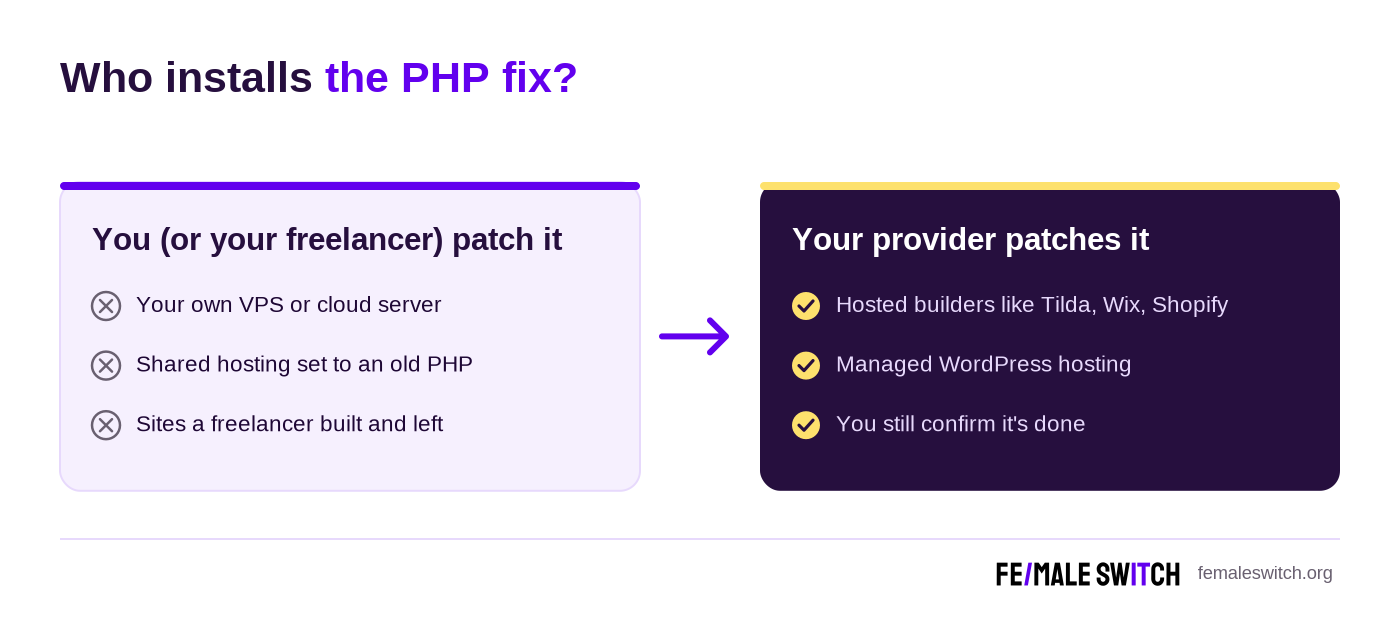
Update 22 Oct, 14:25 CEST: here's the short version for website owners. Attackers are trying the flaws, and nobody has confirmed a successful break-in yet. Amazon says its decoy servers caught a first attempt on 17 October, before the news broke, and the Dutch National Cyber Security Centre (NCSC) said on 22 October that it has seen no successful attacks and that none of the public exploits it tested worked so far. The US agency CISA advises taking a site offline if it can't be updated. Many hosts have already installed the fix: Hostinger on all its hosting servers except VPS, GoDaddy on Managed WordPress and Windows hosting, and hosts that use cPanel or CloudLinux got patched PHP builds on 21 and 22 October. So the email to your host below takes two minutes and gets you a written answer. If your site runs on your own VPS, nobody patches it for you.
Update 21 Oct, 15:50 CEST: the fix is out. PHP released 8.5.12, 8.4.27, 8.3.36 and 8.2.35, and its security advisory confirms that both flaws let an attacker run code on a server without logging in. Every PHP website is affected until its server gets one of these versions. PHP puts it plainly: "There are no complete mitigations, updating is the only safe choice." If your site runs PHP 8.1 or older, there is no official release for it: ask your host for a patched package and plan a move to PHP 8.3 or newer.
The PHP vulnerability announced this week is the kind of tech news most bootstrapping founders scroll past, and this time that would be a mistake. "PHP" jumped more than 300% on Google Trends in the US overnight, because the language behind most small business websites needs an emergency fix today.
I run several websites on a tiny budget, so here is the plain-language version: what happened, how to tell if your site is affected, and a 30-minute plan you can follow without writing a single line of code. Server software is one risk; the outside scripts your site loads are another, as the Optimizely hack showed in November.
What happened with PHP on 20 and 21 October 2026?
PHP is the programming language that runs on the server behind a huge share of the web, including every WordPress site. On 20 October 2026, the PHP project posted an advance notice on php.net: a critical security release was coming on Wednesday 21 October at 14:00 UTC, to fix two vulnerabilities rated 9.2 on the CVSS scale (the standard 0 to 10 score for how dangerous a security flaw is).
Then the details started leaking. BleepingComputer reported that a Hacker News post broke the news early, and the security firm watchTowr confirmed it. PHP has since confirmed that both bugs allow remote code execution without logging in. In plain words: an attacker sends a request to your website and can end up running their own code on your server.
Here's the European angle. According to Sansec, several Dutch sites went offline on 21 October to wait for the fix, including the tech news site Tweakers, the Dutch House of Representatives and the national cyber security centre NCSC. Since then, Amazon, watchTowr and Cloudflare have reported attack attempts, while the Dutch NCSC said on 22 October that it had seen no successful attack. When security companies disagree, the safe move is to act early. By that evening Pokémon HOME, Wikimedia's tools and government sites in several European countries had switched off too, and MeanCEO explains why so many websites went offline over the PHP issue and how to decide for your own site.
How do I know if my website runs on PHP?
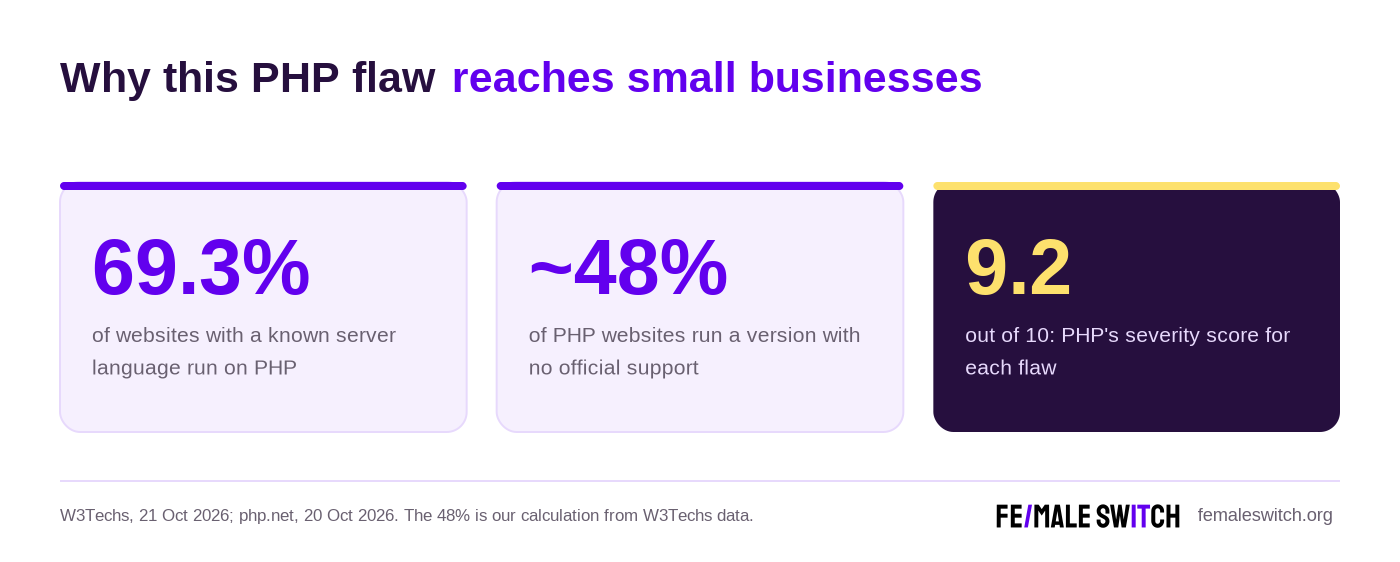
Ask yourself how your site was built. If the answer is WordPress, WooCommerce, Joomla, Drupal, Magento or PrestaShop, your site runs on PHP. W3Techs data from 21 October 2026 shows PHP behind 69.3% of the websites whose server language it can detect, so you're in big company.
If you built your site on a hosted website builder, you don't manage any server at all, and the platform takes care of its own updates. We compared those platforms in our guide to zero-code website builders. Your shop plugins, booking forms and old landing pages on other hosts still count, though, so check them too.
Which PHP versions get the fix?
PHP's advisory says every version before the fixed releases is affected. Ask your host for the version in the right-hand column:
And here is how long each version keeps getting security fixes, from PHP's supported versions page:
PHP confirmed that versions 8.1 and older get no official release; its security team only published code fixes that hosting companies and Linux distributions can build in. And here's the uncomfortable number: by our calculation from W3Techs data, nearly half of all PHP websites (about 48%) run one of those unsupported versions. Small business sites are often the ones nobody has touched since launch day, which puts many of them in that group.
What should a bootstrapping founder do today?
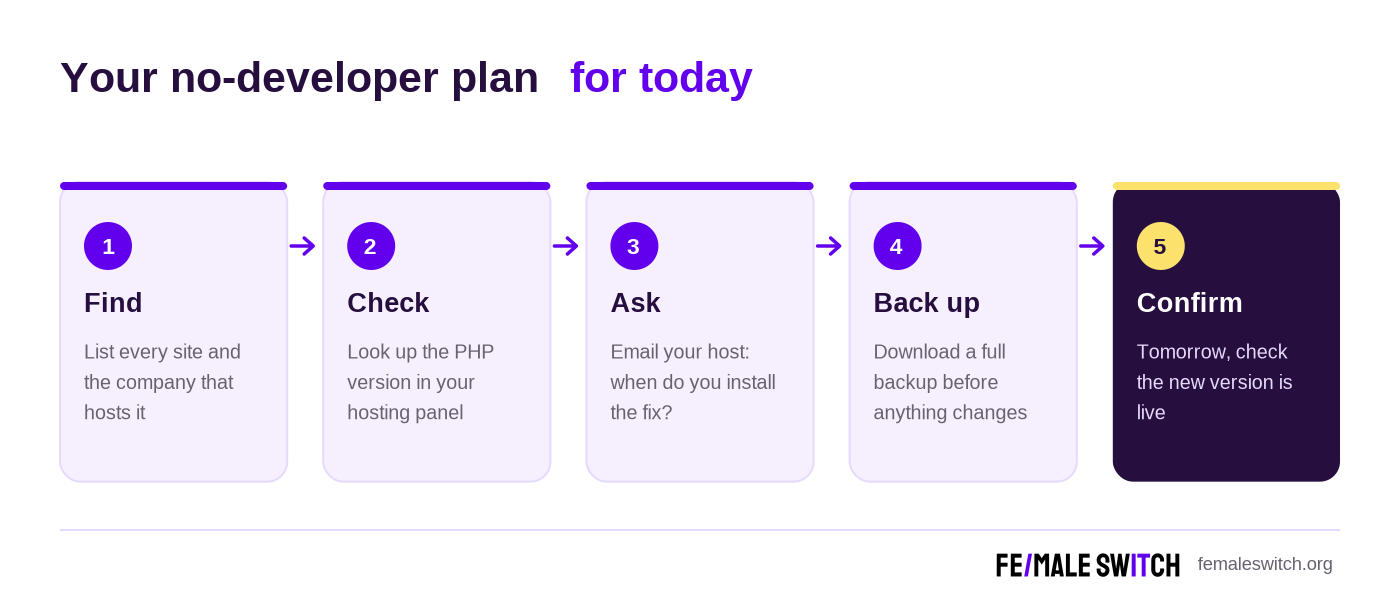
You don't need a security team for this. You need 30 minutes and access to your hosting account. Here's my plan:
- Make a list of every website you own. Your main site, your shop, the event page from 2023, the old blog. Write down who hosts each one. Forgotten sites are the easiest targets, and a hacked one still carries your name.
- Check the PHP version. Log in to your hosting panel and look for "PHP version" or "PHP settings". In WordPress, go to Tools, then Site Health, then Info, then Server. Note the number.
- Email your host. Use the short message below. Good hosts answer the same day, and their answer tells you whether you're in safe hands.
- Take a full backup. Download your files and database, or use your host's backup button. Do this before any update, so you can roll back if something breaks.
- Move off old PHP this month. If your site runs PHP 8.1 or older, ask your host or freelancer to switch it to 8.3 or newer, and test your contact forms and checkout afterwards.
- Check again tomorrow. Confirm the new PHP version is live and your site still works. Then add "check PHP version" to your quarterly admin list.
Copy this message to your host, and change the details:
Hi, PHP released a critical security update on 21 October 2026 (PHP 8.5.12, 8.4.27, 8.3.36 and 8.2.35). My website [your domain] runs on your hosting. Can you tell me when you will install the fixed PHP version on my server, and which PHP version my site uses now? If my site is on PHP 8.1 or older, please tell me how to move it to a supported version. PHP also advised on 23 October to set session.upload_progress.enabled=0 until its next release (CVE-2026-115560): can you set that for my site too? Thank you!
If you'd like the bigger picture on keeping a small company safe, start with our cybersecurity essentials for non-technical entrepreneurs and our list of data security practices for startups. A hacked site can also expose customer data, which brings GDPR duties, so keep our guide to GDPR compliance for European startups close.
Do I need to pay for a developer or a security tool?
For most small websites, no. Good hosting does the heavy lifting, and most of the steps above are free. Pay for help in two cases: when your site runs on PHP 8.1 or older and nobody knows how to update it, or when you run your own server. A freelancer will charge far less for a planned update than for cleaning up a hacked shop.
For tech founders who run their own servers, our sister site MeanCEO has a deeper breakdown of what tech founders should patch first. And if you're picking tools on a budget, our list of essential free startup tools has a few free website and backup options. If you build websites for clients, femaleswitch.com has a 24-hour plan for freelancers who look after client sites. Engineering teams whose portals and download pages hold CAD files can follow CADChain's PHP checklist for engineering teams.
Building your first startup on a budget?
The Fe/male Switch startup game takes you from idea to first paying customers in weekly quests, with an AI co-founder and a community of founders.
👉 Start the game
- PHP vulnerability: the news and the emergency fix (MeanCEO)
- A 24-hour plan for freelancers who look after client sites (Fe/male Switch)
- What engineering teams must patch to protect portals and CAD files (CADChain)
- PHP issue: why Pokémon, Wikimedia and government sites went offline, and when to go dark (MeanCEO)
FAQ: the PHP vulnerability and small business websites
Is my WordPress site affected by the PHP vulnerability?
WordPress runs on PHP, so your site depends on the PHP version on your server. Updating WordPress or its plugins won't fix it. Your host, or whoever manages your server, needs to install the fixed PHP release.
Has anyone been hacked through the PHP vulnerability?
A break-in is now confirmed, on an unpatched decoy server set up by a researcher. For the first days attackers tried millions of times and failed, as Sophos, Cloudflare and other security firms reported. On 26 October a security researcher at Perplexity confirmed a successful takeover of a decoy server running the unpatched PHP 8.4.26, and the US cyber agency CISA added both flaws to its list of vulnerabilities attackers really use. A site on one of the fixed versions is safe from these two flaws, so ask your host to confirm the update today.
Which PHP version fixes the vulnerability?
PHP 8.5.12, 8.4.27, 8.3.36 and 8.2.35, released on 21 October 2026. Ask your host which one your site runs after the update.
Are Wix, Shopify or Tilda websites affected?
On hosted website builders you don't manage a server, so there is no PHP version for you to update. The platform handles its own servers. Check any other sites, plugins or landing pages you run elsewhere.
How do I check my PHP version without a developer?
Look for PHP settings in your hosting control panel, or in WordPress go to Tools, Site Health, Info and then Server. You can also ask your host by email.
What does a CVSS score of 9.2 mean?
CVSS is the standard 0 to 10 scale for how dangerous a security flaw is. Scores from 9.0 to 10 count as critical, the highest level.
What if my site runs PHP 7 or PHP 8.1?
Those versions no longer get official security fixes from PHP. Ask your host or freelancer to move your site to PHP 8.3 or newer, take a backup first and test your forms and checkout afterwards.
What is CVE-2026-115560?
A third PHP issue that PHP flagged on 23 October 2026. PHP calls it an unlikely way for attackers to run code, and it only affects sites whose code changes a session setting at runtime. The 21 October releases don't fix it, so ask your host to set session.upload_progress.enabled=0 until PHP's next regular bugfix release. By 4 November that release had not shipped.
