
TL;DR: Is your small business affected by the Java vulnerability Java4Shell?
The Java vulnerability called Java4Shell (CVE-2026-114938), made public on 17 November 2026, lets an attacker crash Java or take over its server with a short, malformed piece of Base64 text. It needs Java 17.0.6 or later on newer Intel or AMD chips; ARM chips are not affected. Cloud tools are your vendors' job. A server, Jira, Confluence, Keycloak login or Jenkins that you or your agency run needs Oracle's 17 November builds or the vendor's update, and a restart.
Developing story. Last updated 18 Nov 2026, 10:40 CET. We'll update this article as Oracle, OpenJDK and software vendors publish more.
Here is what happened with Java4Shell, on our sister site MeanCEO. This article covers the next question: do the tools I pay for run Java, and who patches them?
Which Java setups does Java4Shell hit?
Base64 is a text format for login headers, tokens and similar data. On certain Intel and AMD processors, Java's fast Base64 decoder writes past its memory buffer when fed a short malformed string. The result ranges from leaked memory to remote code execution without a password, says Calif's write-up.
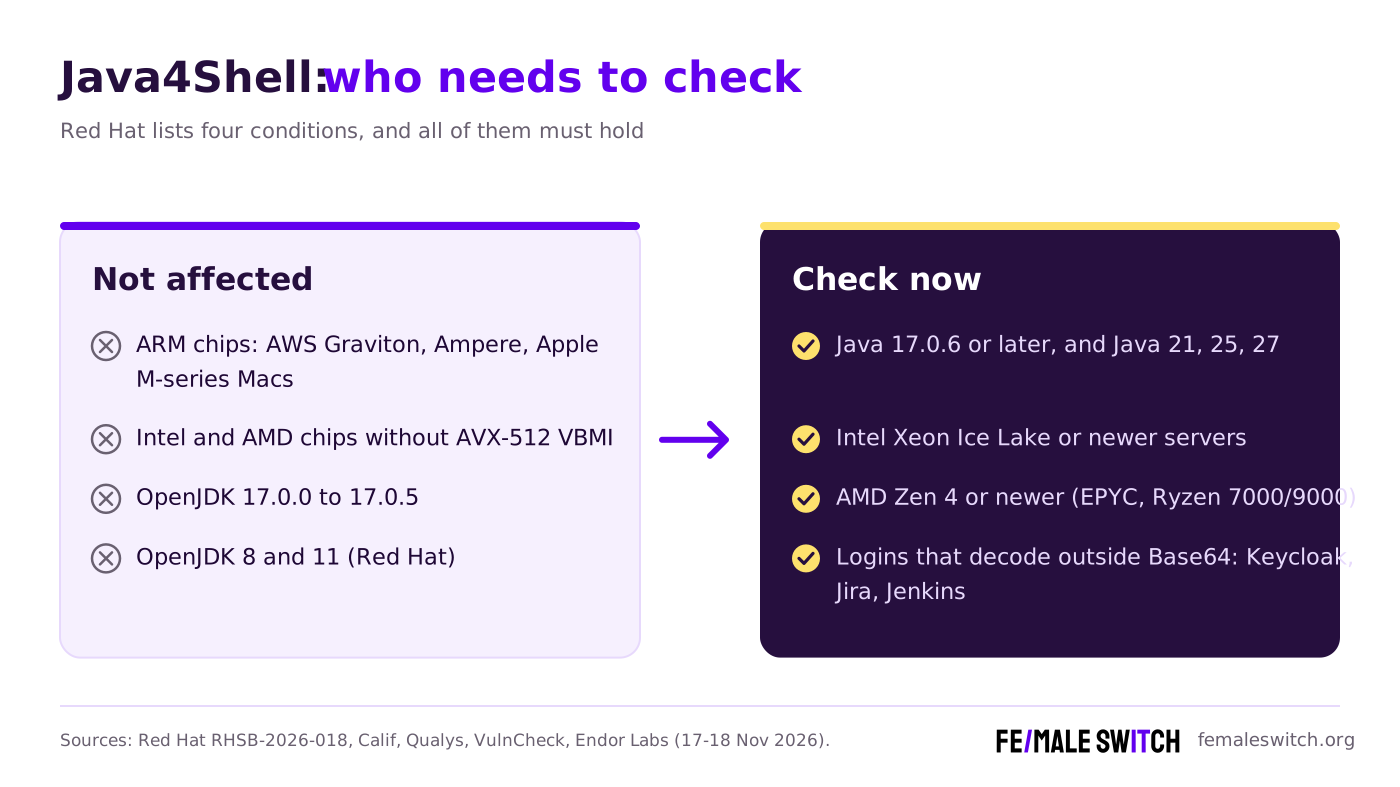
Red Hat's bulletin lists four conditions, and all four must hold:
- OpenJDK 17.0.6 or later, Java 21, 25 and 27 included, until patched.
- A processor with AVX-512 VBMI: Intel Xeon Ice Lake, Sapphire Rapids, Emerald Rapids or Granite Rapids, or AMD Zen 4 or newer.
- Java was not started with the setting -XX:UseAVX=2 or lower.
- The application decodes Base64 sent by an outsider: login credentials, SAML sign-in messages, security tokens.
Not affected: ARM chips, Apple Silicon Macs among them per Endor Labs, and OpenJDK 17.0.0 to 17.0.5. Red Hat adds OpenJDK 8 and 11.
Do the tools you pay for run Java, and are you at risk?
On default setups, Calif's first tests showed takeover before login on Keycloak, Jira, Confluence, JFrog Artifactory, Jenkins and PingFederate, and after login on Kafka, Solr, Elasticsearch, Gerrit and Spinnaker. For a small business, that splits four ways:
- Cloud and SaaS tools you log into: the vendor patches. By 18 November we found no statement from Atlassian, JFrog, Keycloak, Ping Identity or the big cloud providers, so ask.
- Your own server or VPS with a Java app: you or your host patch. Qualys warns that a move to newer hardware can put a workload on an affected chip.
- Tools an agency runs for you, such as a self-hosted Jira, a Keycloak login on your client portal or a Jenkins build server: the agency patches, and these go first.
- Your laptop: Calif showed that a Java program connecting to a malicious server over TLS can be taken over. VulnCheck lists Intel laptop chips from 2019 to 2021 and AMD Ryzen 7000 and 9000 as affected.
Bundled Java stays open until its vendor updates it and doesn't always appear in software lists, CISA warns. Like the Optimizely hack of 16 November, it sits in code your suppliers run.
Am I affected? A plain-language check
Who has to patch what?
Oracle's fixed builds from 17 November are 17.0.21.1, 21.0.13.1, 25.0.5.1 and 27.0.1.1, plus 8u513-perf for the Java 8 Performance Pack, per Tenable, Qualys and CERT-EU. Builds ending in .0.3, such as 17.0.21.0.3, are listed as affected in Oracle's CVE record. Amazon shipped Corretto 17.0.21.1.2 and 27.0.1.1.4 the same day.
Update 19 Nov: Red Hat, Ubuntu, Microsoft, Azul, Amazon Corretto and Eclipse Temurin (Linux first) have now shipped fixed builds, so for most servers the fix is the normal update. Still waiting on 19 November: Debian stable, Temurin for Windows and macOS, the official Temurin Docker images and Oracle GraalVM. If you pay for Atlassian Cloud (Jira, Confluence), Atlassian says you need to do nothing; self-hosted Data Center needs your IT person. After any update, Java must restart and containers need rebuilding.
One trap for agency clients: Atlassian's 17 November security bulletin fixes other flaws and doesn't mention Java4Shell, so a Jira or Confluence update from it says nothing about the Java fix.
What should you send your IT person, host or agency?
Subject: Java4Shell (CVE-2026-114938): is our setup patched?
Hi [name],
Java4Shell, the Java vulnerability disclosed on 17 November, hits Java 17.0.6 and later on newer Intel and AMD chips. Please answer these by [day]:
1. Do any of our servers or tools run Java 17.0.6 or later on Intel Xeon Ice Lake or newer, or AMD Zen 4 or newer, chips?
2. Have you installed Oracle's 17 November builds (17.0.21.1, 21.0.13.1, 25.0.5.1, 27.0.1.1) or each product vendor's update?
3. Did you restart Java, and rebuild containers, afterwards?
4. Were internet-facing logins (Keycloak, Jira, Confluence, Jenkins) patched first?
5. Until a fix is in, have you set the temporary flag -XX:-UseBASE64Intrinsics, and will you remove it after patching?
Thanks,
[your name]
About that flag: Red Hat calls it the preferred stopgap. Oracle's and OpenJDK's advisories don't list it, CERT-EU writes it with -XX:+UnlockDiagnosticVMOptions in front, and it works after a restart only. Patching is the only fix.
What should you do this week?
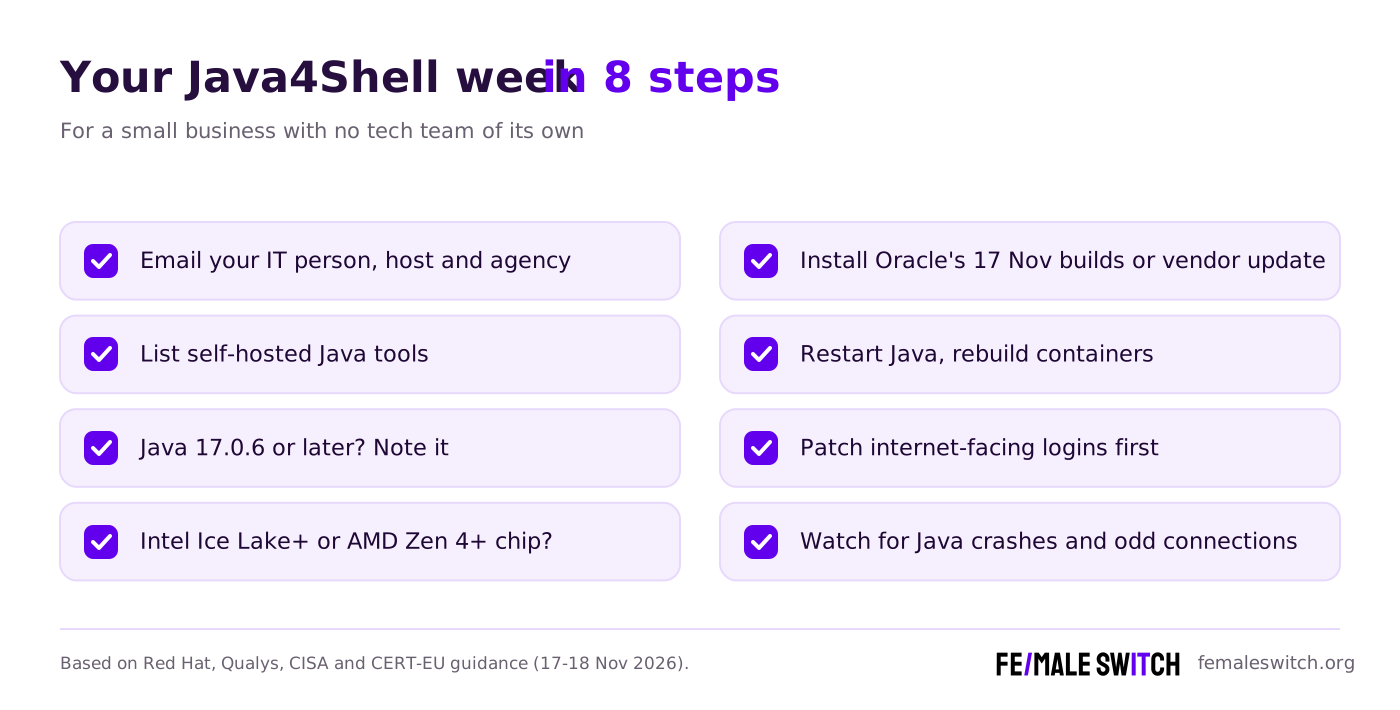
- Send the email above to whoever runs your servers, hosting and agency tools.
- List your Java tools, desktop apps that ship Java included.
- Patch in Qualys's order: internet-facing login systems, then Jira, Confluence, Jenkins and Artifactory.
- Shrink the exposure: CISA suggests limiting access for users who aren't logged in.
- Watch for attacks: unexplained Java crashes, Java processes starting shells, new outbound connections. The Swiss NCSC warns: "A security update does not remove an existing compromise."
New to this? Read our cybersecurity guide for non-technical entrepreneurs, and if your website runs on PHP, add our PHP vulnerability plan.
What we know so far
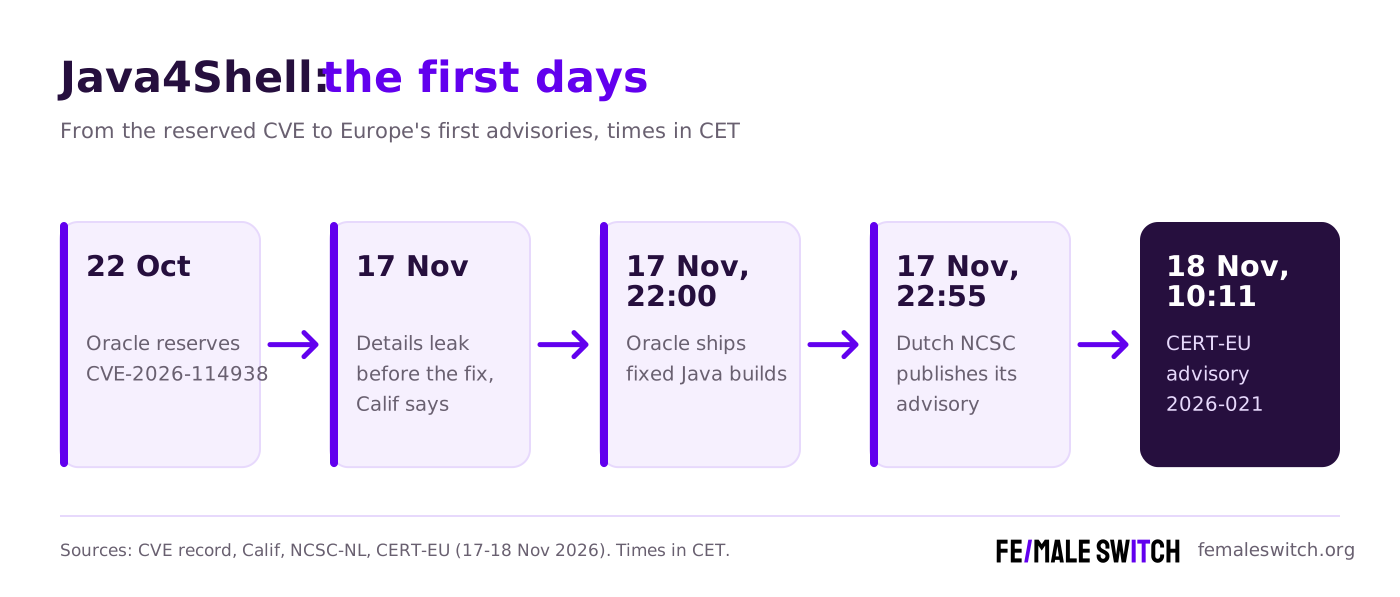
- 17 Nov, 22:00 CET: Oracle released its November 2026 security update with the fixed builds. The same day, CISA and the Canadian Centre for Cyber Security urged immediate patching.
- 17 Nov, 22:55 CET: the Dutch NCSC rated the damage high and called the flaw not easy to exploit because of its preconditions.
- 18 Nov, 10:11 CET: CERT-EU advisory 2026-021 rated it high and named login headers, JWT tokens, SAML messages, cookies and TLS data as ways in.
- 18 Nov: the Swiss NCSC told operators to "clarify their exposure with their software suppliers."
- Scores differ: Oracle 8.1 (High), Calif 9.2, Red Hat a preliminary 9.8.
- No attacks in the wild were reported as of 18 November. Calif released only a bounded test program; VulnCheck built a full exploit for paying customers.
- AI found it: Calif says Quang Luong used Codex and found the bug in an hour, for under $200 in tokens (Calif's own figures). See the doors AI hacking tools find at small businesses.
What we don't know yet
- The last fixed builds and products: Debian stable, Temurin for Windows, macOS and Docker, GraalVM, and patched Atlassian Data Center versions.
- Whether attacks succeed. Probing started by 19 November (GreyNoise counted 187 requests from 5 IP addresses), with no successful intrusion reported.
- Which AI model: Calif names Codex; reports relaying The New York Times name OpenAI's GPT-6 Cyber.
Timeline
What does this mean for you?
On cloud tools and Apple Silicon Macs, Java4Shell is a question for your suppliers. The exposure sits with Java servers you depend on. File their written answers with your contracts; our case on an IT provider that created the account while the client carried the blame shows why, and our guide to the first 72 hours after a supplier data breach covers the worst case.
Running the servers yourself? Read the Java4Shell patch plan for freelancers and small agencies, or CADChain's guide for engineering teams.
Building your first startup on a budget?
The Fe/male Switch startup game takes you from idea to first paying customers in weekly quests, with an AI co-founder and a community of founders.
👉 Start the game
FAQ: the Java vulnerability and small businesses
What is Java4Shell?
A Java vulnerability (CVE-2026-114938) in OpenJDK's fast Base64 decoder, made public on 17 November 2026. On certain Intel and AMD chips, a short malformed string lets an attacker read memory, crash Java or run code.
Is my laptop affected?
Only Java programs on it matter, on chips with AVX-512 VBMI. ARM chips are not affected, and Endor Labs names Apple Silicon Macs among them.
Do I need to act if I only use cloud tools?
Your vendors patch their own servers; ask each for a written answer.
Which Java versions fix Java4Shell?
Oracle's 17 November builds 17.0.21.1, 21.0.13.1, 25.0.5.1 and 27.0.1.1, and Amazon Corretto 17.0.21.1.2 and 27.0.1.1.4, followed by a restart.
Are hackers already using it?
Attackers began probing by 19 November: GreyNoise counted 187 requests from 5 IP addresses and no successful intrusion. It is not on CISA's exploited list yet.
Are Java 8 and Java 11 affected?
No. Red Hat, Eclipse Temurin, Ubuntu and Azul all say OpenJDK 8 and 11 are not affected. Oracle names one Java 8 build, the Enterprise Performance Pack, fixed in 8u513-perf. Install their November updates anyway, since they fix other bugs.
