
TL;DR: What does the Optimizely hack mean for a small business website?
In the Optimizely hack of 16 November 2026, an attacker put malicious JavaScript into a trusted A/B testing script, and 178 organisations, the BBC, ABN AMRO and KLM among them, served it to their visitors. It copied card numbers typed into sites' own forms and swapped crypto addresses. Your site probably loads the same kind of outside code: chat widgets, A/B tests, analytics, tag managers, review widgets.
Developing story. Last updated 17 Nov 2026, 11:30 CET. We'll update this article as Optimizely publishes more.
Here is what happened in the Optimizely vulnerability case, on our sister site MeanCEO. This article answers the next question for a founder with no tech team: which outside code runs on my site, and who can change it?
How did a trusted script turn against the sites that loaded it?
Optimizely Web, an A/B testing tool, works through a JavaScript snippet each customer loads from cdn.optimizely.com. It carries an optional field called Project JavaScript: custom code that runs on every page.
The snippet updates automatically, so, as iTWire explains, a site can receive changed code without its own developers releasing anything. The attacker wrote code into that field, and the file still came from Optimizely's servers with Optimizely's certificate.
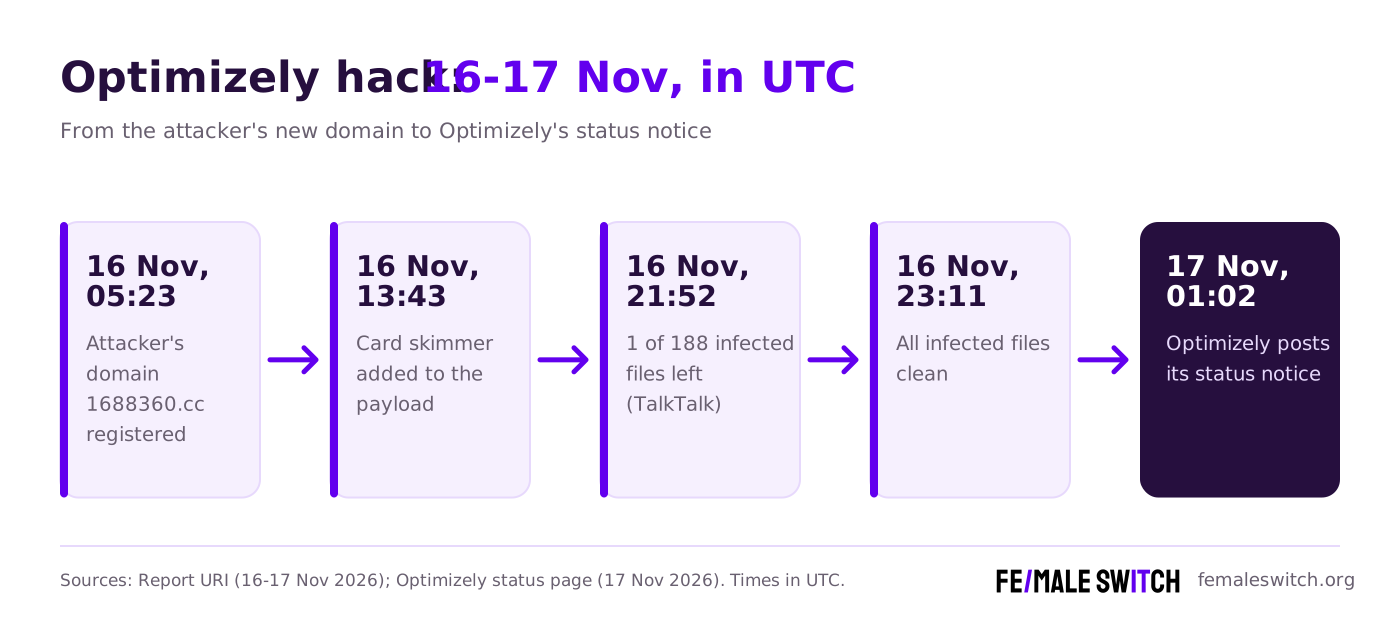
Optimizely's status notice of 01:02 UTC on 17 November says the company has "fixed the vulnerability and removed the injected code from affected projects."
An earlier wave pushed code from the webshell.lol domain through Kissmetrics, StorifyMe and Minute Media scripts on sites such as vidaxl and faz.net, from 13 November. Same operator or not, every vendor whose script you load is part of your website's security.
What could the malicious code take from visitors?
Report URI found four jobs in the payload, rebuilt 26 times that day:
- Card skimming from 13:43 UTC: card number, expiry and CVV typed into a site's own form fields. Hosted payment iframes from Stripe, Adyen and similar stayed out of reach.
- Crypto address swapping in page text, forms, links and the clipboard.
- Cookie theft for cookies without the HttpOnly flag, the setting that hides a cookie from page scripts, plus screenshots.
- iPhone and iPad exploit kits. Pages on iOS 18.6 or earlier reloaded every 60 seconds.
The attacker's wallets took about $7,040 by 19:25 UTC. On cards, Report URI says: "We have no way to see how many credit cards were skimmed."
Why were banks and airlines with security teams hit?
They trusted the script. Report URI found 188 infected snippets out of 1,611, at Zoom, IKEA, HSBC and, in Europe, ABN AMRO, KLM, Transavia, Vaillant Germany, the BBC, Virgin Media O2 and TalkTalk. Banks and financial firms were the largest group, 32 organisations, says Help Net Security.
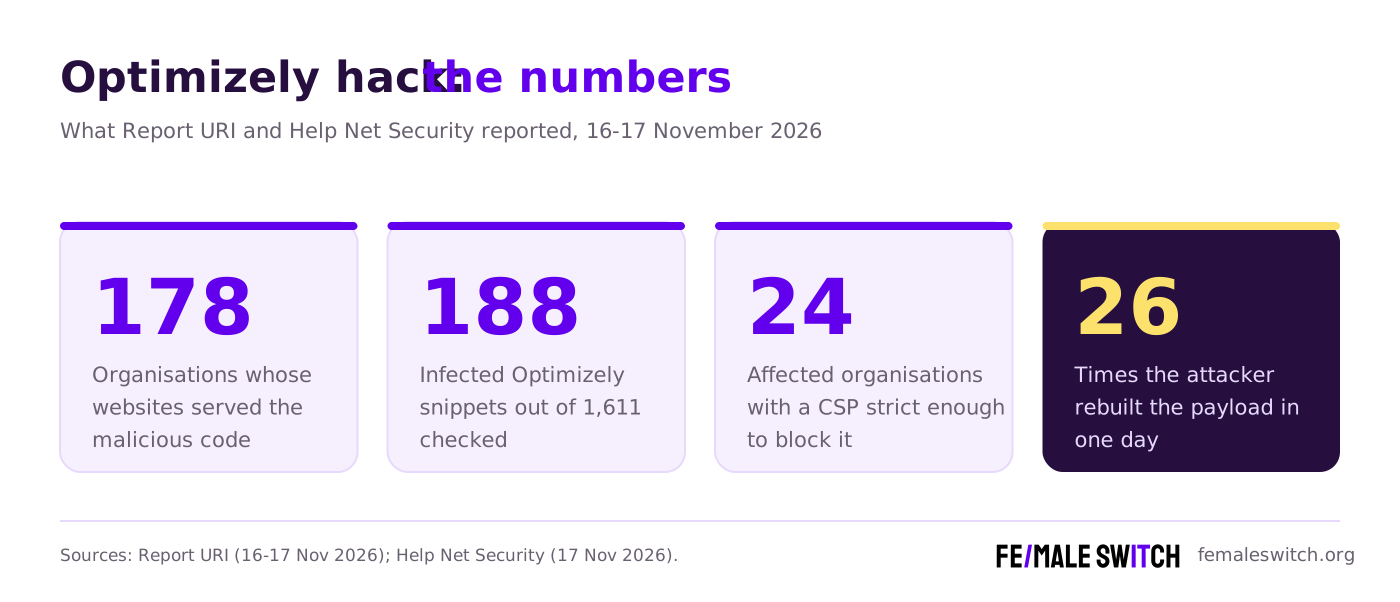
The defence for this is a Content Security Policy (CSP), a header telling browsers where a page may load code from and send data to. Only 24 (15%) of the affected organisations had one strict enough to block the attack, and 68 had none. At HSBC the policy stopped the outside file, yet an inline copy still ran because it allowed 'unsafe-eval', a setting Optimizely's own documentation tells customers to allow.
Scott Helme of Report URI: "The important lesson here is that trusted JavaScript doesn't always remain trustworthy." If your site has no CSP, it sits with the 68. Our guide to the doors AI hacking tools find at small businesses covers the login side of the same problem.
Which third-party scripts does a small business website load?
Open your website builder's custom code settings and your tag manager, and fill in this script inventory:
What can you check in one hour?
Keep your admin logins at hand. New to this? Start with our cybersecurity guide for non-technical entrepreneurs, and on a PHP site add our PHP vulnerability plan.
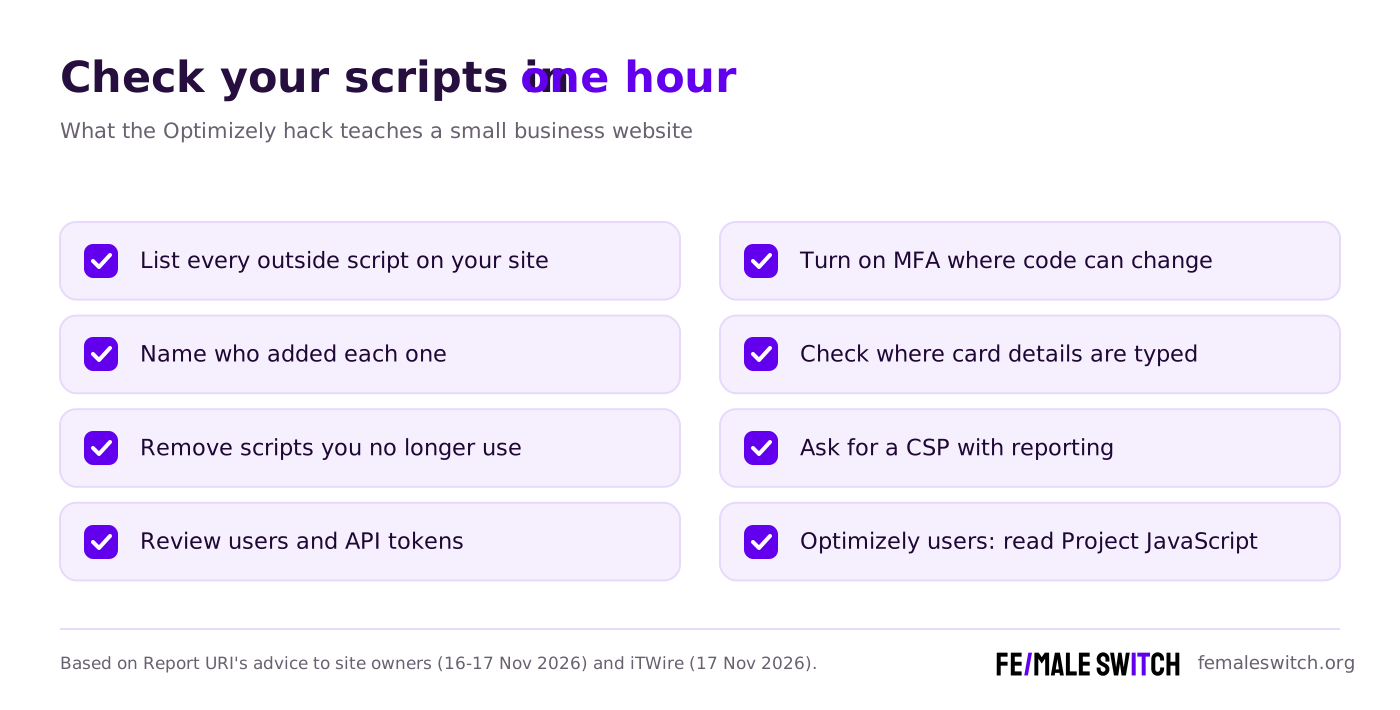
- List every outside script: View Page Source on your home page and checkout, search for script src, then add your builder's custom code and tag manager tags.
- Name an owner for each: who added it and which account controls it.
- Remove what you no longer use: finished tests, old campaign pixels, a replaced chat tool.
- Review users and API tokens on each vendor account and change shared passwords.
- Turn on multi-factor authentication wherever someone can change code on your site.
- Run the payment check below.
- Ask your developer for a CSP that limits where pages send data, avoids 'unsafe-eval' and sends reports.
- Optimizely users: read every Project JavaScript and experiment code field for 1688360.cc, atob( or code you didn't write.
Does your payment setup keep card numbers away from scripts?
This decided who lost cards. Report URI found hosted payment iframes out of the code's reach, while card fields in a site's own forms were exposed.
How to tell: start a test purchase. If the address bar switches to your payment provider's domain, it's a hosted page. If it stays on your domain, ask your developer where the card field lives.
What should you do if your site was affected or runs code nobody can explain?
Keep the evidence first: a clean script fetched today can't show what visitors received, so StepSecurity advises checking historical browser and security-policy reports.
- Save screenshots, tag manager version history, CSP reports and logs.
- Remove the code and lock the account: new passwords, revoked API tokens.
- Rotate cookie secrets. Report URI says to treat session tokens in non-HttpOnly cookies as exposed.
- Call your payment provider if card fields sit in your own forms.
- Check the GDPR clock. Under GDPR Article 33, you notify your data protection authority of a personal data breach without undue delay and, where feasible, within 72 hours of becoming aware, unless it is unlikely to result in a risk to people. Article 34 adds telling affected people when the risk is high. Skimmed card data counts as personal data. This is general information, so check with your national data protection authority.
- Tell customers what to watch: card statements, crypto transfers, iOS updates (18.7.3 or 26.3 and later).
Our guide to the first 72 hours after a supplier data breach covers customer messages and contracts.
What should you ask your web agency or freelancer?
- Which outside scripts load on our site, and who controls each one?
- Do card details go into our own form fields or the payment provider's hosted page?
- Do we have a Content Security Policy, and does anyone read its reports?
- Does every login on those vendor accounts use multi-factor authentication?
Get the answers in writing. Our case on an IT provider that created the account while the client carried the blame shows why.
What we don't know yet
- How the attacker got write access to unrelated customer projects, beyond Optimizely's mention of the account signup flow.
- How many visitors and cards were exposed, and how long the attack window ran.
- Who the attacker is, and whether a post-incident report will follow.
Building your first startup on a budget?
The Fe/male Switch startup game takes you from idea to first paying customers in weekly quests, with an AI co-founder and a community of founders.
👉 Start the game
FAQ: the Optimizely hack and small business websites
What was the Optimizely hack?
On 16 November 2026 an attacker added malicious JavaScript to customer projects in Optimizely Web Experimentation. Visitors of 178 organisations' websites received it, Report URI found. Optimizely says the flaw is fixed.
Was my small business website affected?
The Optimizely attack reached sites that load an Optimizely Web snippet. An earlier wave used Kissmetrics, StorifyMe and Minute Media scripts, so check every outside script on your site.
Is my webshop safe if I use Stripe or Adyen?
Cards typed into their hosted payment iframes were out of the malware's reach, Report URI found.
What is a Content Security Policy?
A header telling browsers where a page may load code from and send data to. Only 24 affected organisations had one strict enough.
What should I do if I visited an affected site on 16 November?
Update iPhones and iPads to iOS 18.7.3 or 26.3 and later, check crypto transfers and watch card statements.
Do I have to report it under GDPR?
If personal data was likely exposed, Article 33 asks you to notify your data protection authority within 72 hours where feasible. This is general information; check with your authority.
