
TL;DR: what does the leaked EU Digital Fairness Act mean for small online businesses?
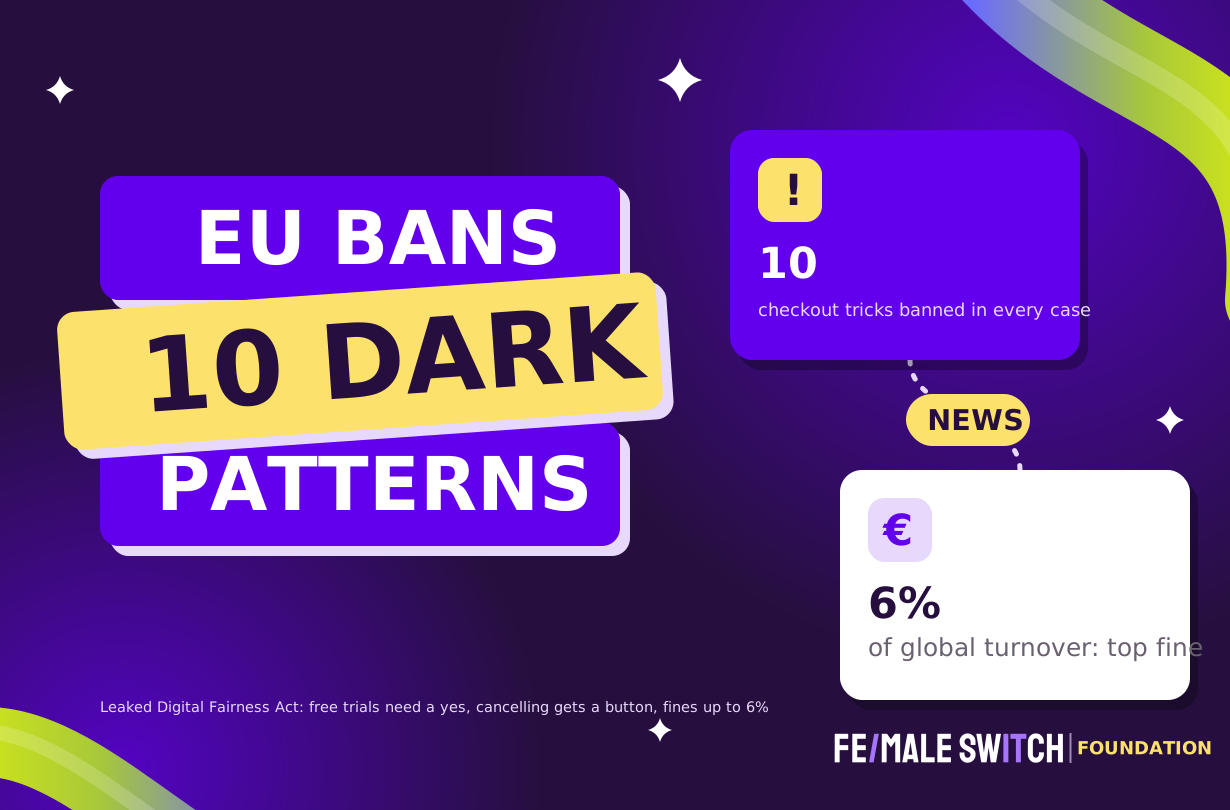
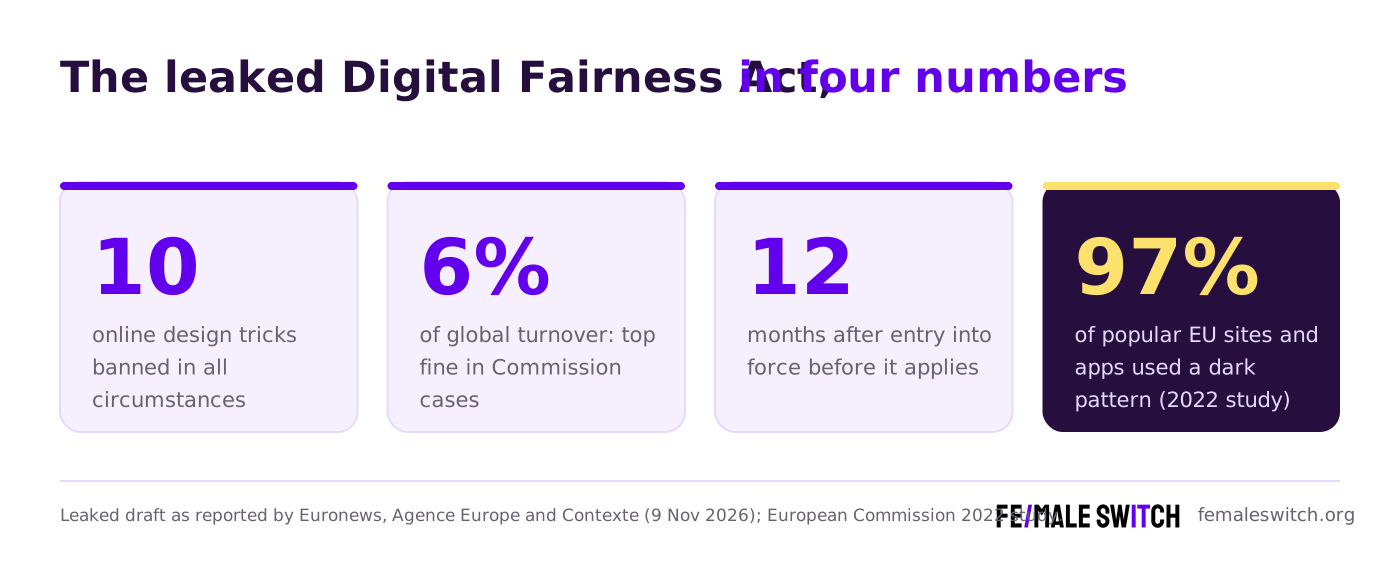
A leaked draft of the EU’s Digital Fairness Act, which the European Commission is due to present on Wednesday 11 November 2026, bans ten online design tricks outright, from fake low-stock warnings to pre-ticked add-ons and cancel flows that are harder than sign-up. Free trials could only turn into paid plans if the customer actively agrees, subscriptions would need a “terminate the contract here” button and renewal reminders, and brands would share responsibility for the influencers they pay. None of the reports mention an exemption for small businesses. Status: Debated (a leaked draft). It becomes a proposal on Wednesday and would apply 12 months after it becomes law.
If you run a Shopify store, sell a course with a free trial, charge for a newsletter or pay creators to post about your product, this is the EU law to watch. It is aimed at the tricks big platforms made famous, but the leaked text applies to every trader that sells to consumers, including a one-woman shop.
Here is what leaked, what it would change, how it compares with the rules you already have to follow, and what to fix in your funnel now. If you run a SaaS or subscription app, see also what the Commission's official proposal of 11 November 2026 means for free trials, renewals and cancel buttons.
What happened
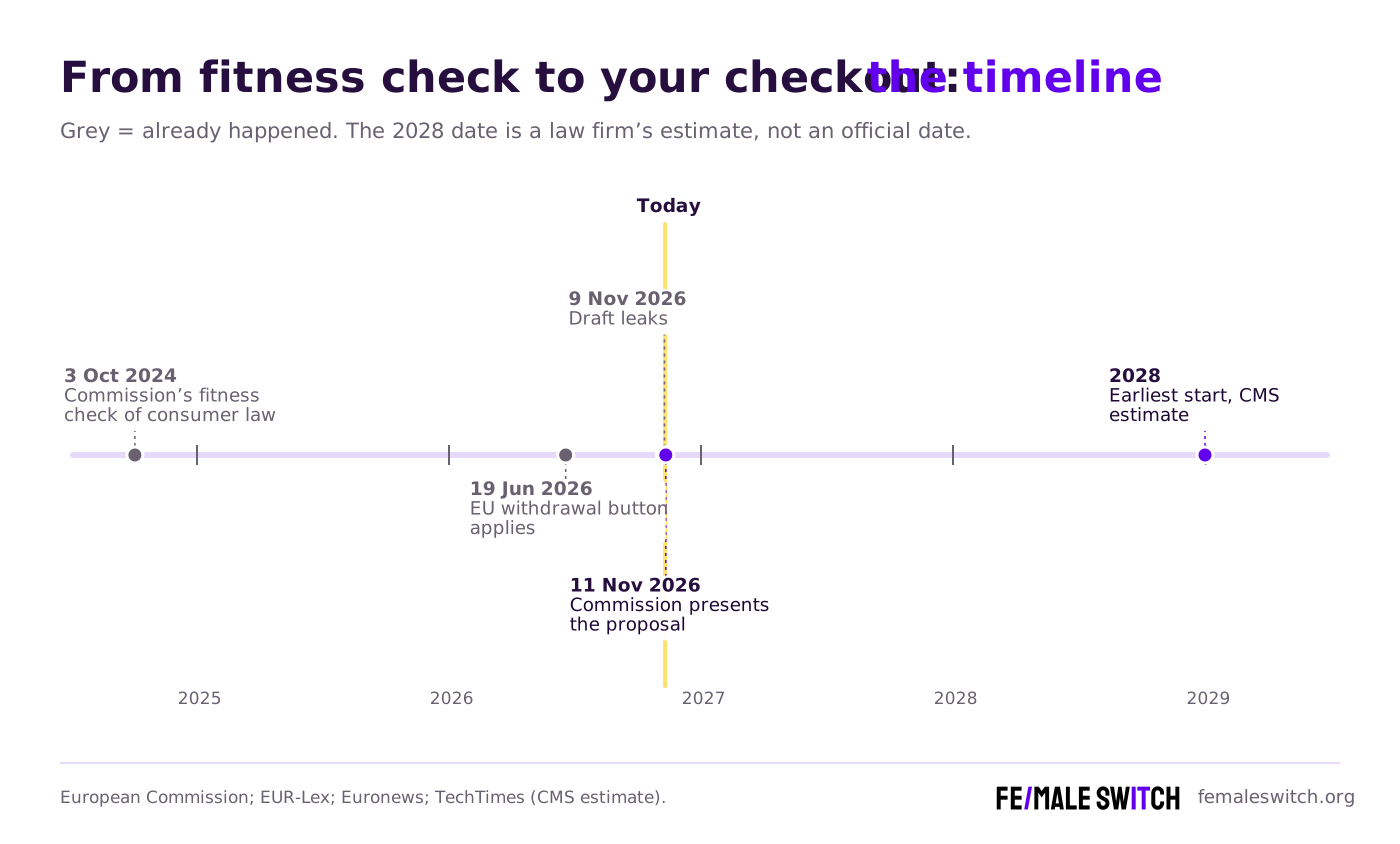
On Monday 9 November, the French EU policy outlet Contexte published a 71-page draft of the Digital Fairness Act, according to the Digital Fairness Act newsletter. Bloomberg, Agence Europe and Euronews reported on the text the same day. A Commission spokesperson told Euronews the Commission “does not comment on leaks”.
The Commission’s planning lists the consumer package for Wednesday 11 November, but TechTimes notes the planning document is only indicative. Consumer Commissioner Michael McGrath leads the file. Once presented, the proposal goes to the European Parliament and the member states, which must agree on a final text. Update: on 11 November 2026 the Commission presented the official proposal, so its status is now Proposed. It keeps the core of the leak, including the ban on fake “almost sold out” claims, the end of free trials that turn paid without the customer’s yes and fines of up to 6% of worldwide turnover, which the Commission itself can only impose on companies that are not SMEs.
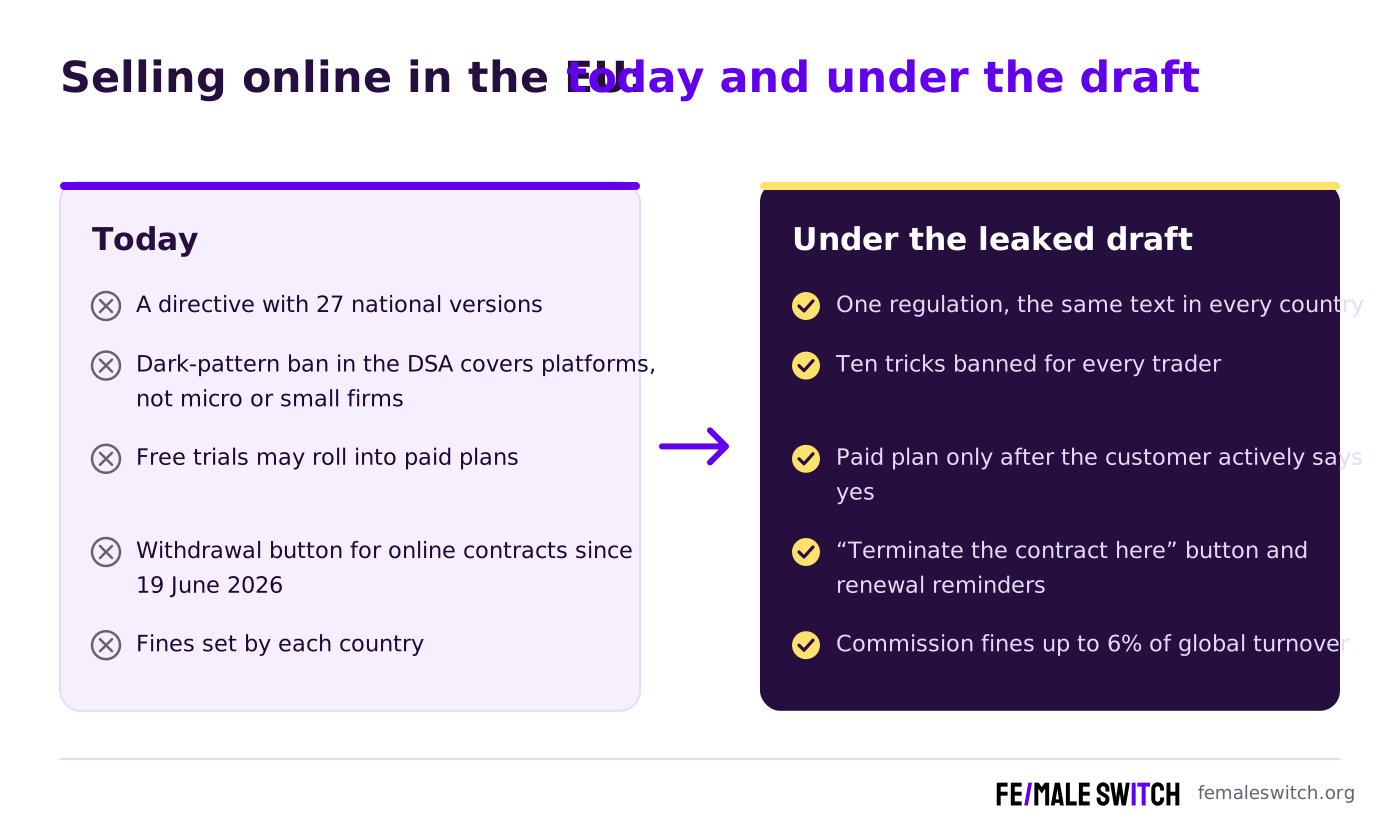
The big change is legal form. The Digital Fairness Act would be a regulation that repeals the 2005 Unfair Commercial Practices Directive and keeps its core rules, as the law firm Hogan Lovells explains. A regulation applies word for word in all 27 countries, so there would be no national versions to compare. Germany is not convinced: in a non-paper dated 14 October, it said the case for a regulation “has not yet been sufficiently demonstrated”, Euronews reports.
The ten tricks on the blacklist
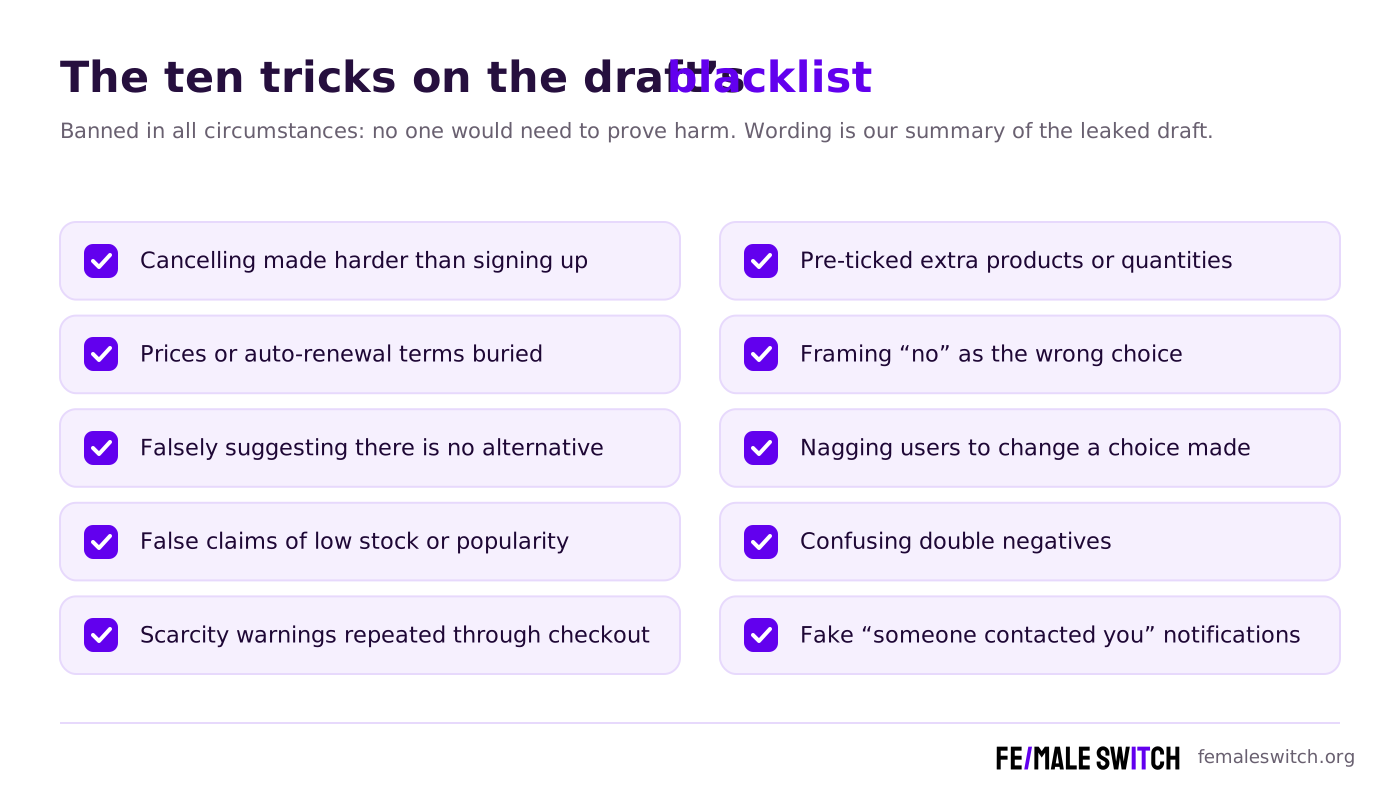
The draft lists ten design practices in an annex that would be banned in all circumstances. Authorities would not have to prove that a trick harmed anyone, and the Commission could add new practices later without going back to lawmakers.
Some of these are already risky under today’s law, as the UK’s fines for fake countdown timers and pre-ticked extras showed. What changes is certainty: on the blacklist, there is no argument about whether a “only 2 left!” badge misled anyone. If the claim isn’t true, it’s banned.
Beyond the ten, the draft bans drip pricing, where unavoidable fees appear only at checkout, and “was/now” discounts measured against a manufacturer’s recommended price instead of a real competitor price. It also blacklists misleading claims by dropshippers. If you sell to UK customers too, compare it with the UK watchdog’s demand to show delivery fees in the first price.
Free trials, renewals and the cancel button
Subscriptions get their own chapter, Articles 20 to 27 of the leaked text. For anyone selling software, memberships, courses or paid newsletters, these are the rules that would change your billing flow:
- Free trial to paid only with a yes. Before a free trial turns into a paid contract, you would have to remind the customer and get their active agreement. Silent roll-over would end.
- Renewal reminders. For contracts of six months or more, Agence Europe reports, you would have to remind customers of an automatic renewal between one month and 14 days before it happens.
- A cancel button. Subscriptions sold online would need an easy online termination function: a “terminate the contract here” button, in Euronews’ description.
- A human in customer service. Customers would get the right to reach a person, not just a chatbot.
- Cancel any time for certain automatically extended contracts, with a short notice period.
Part of this already exists. Since 19 June 2026, EU law requires a withdrawal button labelled “withdraw from contract here” for all distance contracts concluded through an online interface, and Germany has required a “Verträge hier kündigen” button for paid subscriptions sold on websites. The draft goes further: it covers the trial-to-paid moment and the renewal, which is where most small SaaS and membership businesses make their money.
Sources: EUR-Lex, German Civil Code, TechTimes (citing Pinsent Masons) and reports on the leaked draft.
Influencers, personal pricing and AI shopping agents
Three more parts matter if you market online:
- Influencer marketing (Article 11). Paid posts must be clearly disclosed, and responsibility no longer stops with the creator. Brands and agencies that pay influencers would share it, Hogan Lovells notes, so your creator contracts need a disclosure clause. Our guide to influencer marketing for startups covers how to set up those deals.
- Personalised ads and prices (Articles 12 and 13). Advertising based on profiling minors would be banned for all traders, not only big platforms, and personalised prices based on profiling would be banned where they could harm minors or vulnerable consumers.
- AI shopping agents. In a first for EU consumer law, the draft sets rules for AI agents that buy for consumers: users choose which purchases they must approve, and agents must disclose sponsored suggestions.
Games and apps get extra rules: paid loot boxes and pay-to-win would be banned for minors, in-game currencies would show their real-money value, and adults could switch off autoplay, streaks and similar features.
Fines, costs and when it would start
In cases it investigates itself, the Commission could fine a trader up to 6% of worldwide annual turnover. National authorities would get fine ceilings of at least 4% of annual turnover in the countries concerned, Agence Europe reports. Those are the maximums; a small shop’s real risk is more likely a national warning, a consumer complaint or a competitor’s claim.
The Commission’s own impact assessment, quoted by Euronews, puts the price for business at €678 million a year in recurring costs, against a benefit of €13.7 billion a year for consumers and €88.4 billion in losses avoided between 2025 and 2035.
Nothing changes yet. The regulation would apply 12 months after it enters into force, and the law firm CMS doesn’t expect it to take effect before the end of 2028 at the earliest. That is enough time to rebuild a checkout calmly, and not enough to ignore it.
Is there an exemption for small businesses?
Not in anything reported so far. Hogan Lovells, Agence Europe, Euronews and the Contexte summary don’t mention one, and Agence Europe stresses that the draft covers all sectors, not only the largest platforms. That is the point: TechTimes, citing Pinsent Masons, notes that the Digital Services Act’s dark-pattern ban leaves out micro and small enterprises, and the new law is meant to close such gaps.
So a solo founder would play by the same blacklist as a marketplace. The good news is that most of the rules cost little to follow: an honest stock counter, an unticked box and a working cancel link are cheaper than the support tickets and chargebacks their tricky versions create. Many of the same consent questions came up in the EU’s Digital Omnibus plans for cookie banners and GDPR.
What this means for you
- Audit your checkout against the ten. Look for stock or “people viewing” badges that aren’t live data, repeated urgency pop-ups, pre-ticked extras and “No thanks, I don’t like saving money” buttons. Many come from theme or app defaults. Our report on limited-time offers on social media shows how to use urgency honestly.
- Fix your free trial now. Send a reminder before a trial ends and ask for a clear yes before the first charge. It is likely to become law, and it already cuts refund requests.
- Make cancelling as easy as signing up. One clear cancel link in the account area. Customers in Germany and, since June, the whole EU already have button rights.
- Show the full price early. No fees that appear only at checkout, and no “was” prices taken from a recommended retail price. Our guide to product pricing psychology covers ways to price that persuade without misleading.
- Update your creator contracts. Require clear ad labels and keep proof. If the draft passes, a missing label is your problem too.
- Watch Wednesday’s official text. The leak can change. Check the final scope, any small-business relief and the start date before you spend money on a rebuild.
Want to practise building an honest funnel before you launch?
The Fe/male Switch startup game takes you from idea to first paying customers in weekly quests, with an AI co-founder, so you can test pricing, sign-up flows and sales without risking real customers. The free trial lasts 2 weeks.
👉 Start the game
FAQ: the EU Digital Fairness Act leak
Is the Digital Fairness Act law yet?
No. On 10 November 2026 it is a leaked draft. The European Commission is due to present the proposal on 11 November 2026, and then the European Parliament and the member states must agree on it. It would apply 12 months after it enters into force.
Which dark patterns would the Digital Fairness Act ban?
The leaked draft blacklists ten: cancelling made harder than signing up, buried prices or renewal terms, false claims there is no alternative, false low-stock or popularity claims, repeated scarcity warnings, pre-ticked extras, framing refusal as wrong, nagging, double negatives and fake contact notifications.
Does the Digital Fairness Act apply to small businesses?
None of the reports on the leaked draft mention an exemption for small businesses, and Agence Europe says it covers all sectors. Unlike the Digital Services Act’s dark-pattern ban, it is meant to reach traders of every size.
What changes for free trials and subscriptions?
A free trial could only become a paid contract after a reminder and the customer’s active agreement. Contracts of six months or more would need a renewal reminder, and online subscriptions an easy termination button and access to a human in customer service.
How big are the fines under the Digital Fairness Act?
The leaked draft allows Commission fines of up to 6% of worldwide annual turnover in cases it investigates, and national fine ceilings of at least 4% of annual turnover in the countries concerned.
When would the Digital Fairness Act start?
Twelve months after it enters into force. The law firm CMS does not expect it to take effect before the end of 2028 at the earliest, so small businesses have time to adapt their checkout and subscription flows.
