
TL;DR: do UK online shops have to include delivery in the price?
Yes, if delivery is mandatory. On 2 November 2026 the UK Competition and Markets Authority (CMA) sent an open letter to online retailers, marketplaces, comparison sites and search engines ahead of Christmas. Its message: “The first price consumers see should be the price they pay.” Under the DMCC Act, the total price, including the cheapest mandatory delivery charge, must appear in ads, on product pages, in the basket and at checkout. The CMA lists four delivery-fee practices it is watching for and can fine up to 10% of global turnover or £300,000, whichever is greater. If you sell to UK shoppers, check your shop before Black Friday on 27 November.
If you run a small online shop, delivery is probably the fee you add last. You list the candle at £18, and the £3.95 postage appears at checkout. In the UK, that habit is now on a regulator’s list, three weeks before the busiest shopping weekend of the year.
The CMA had warned that this was coming. Here is what the letter says, what counts as compliant, how the EU rules compare, and a checklist you can work through this week. If you also sell on Amazon, a second change lands before Black Friday: Amazon’s returnless refunds and longer Christmas returns in Europe.
What happened
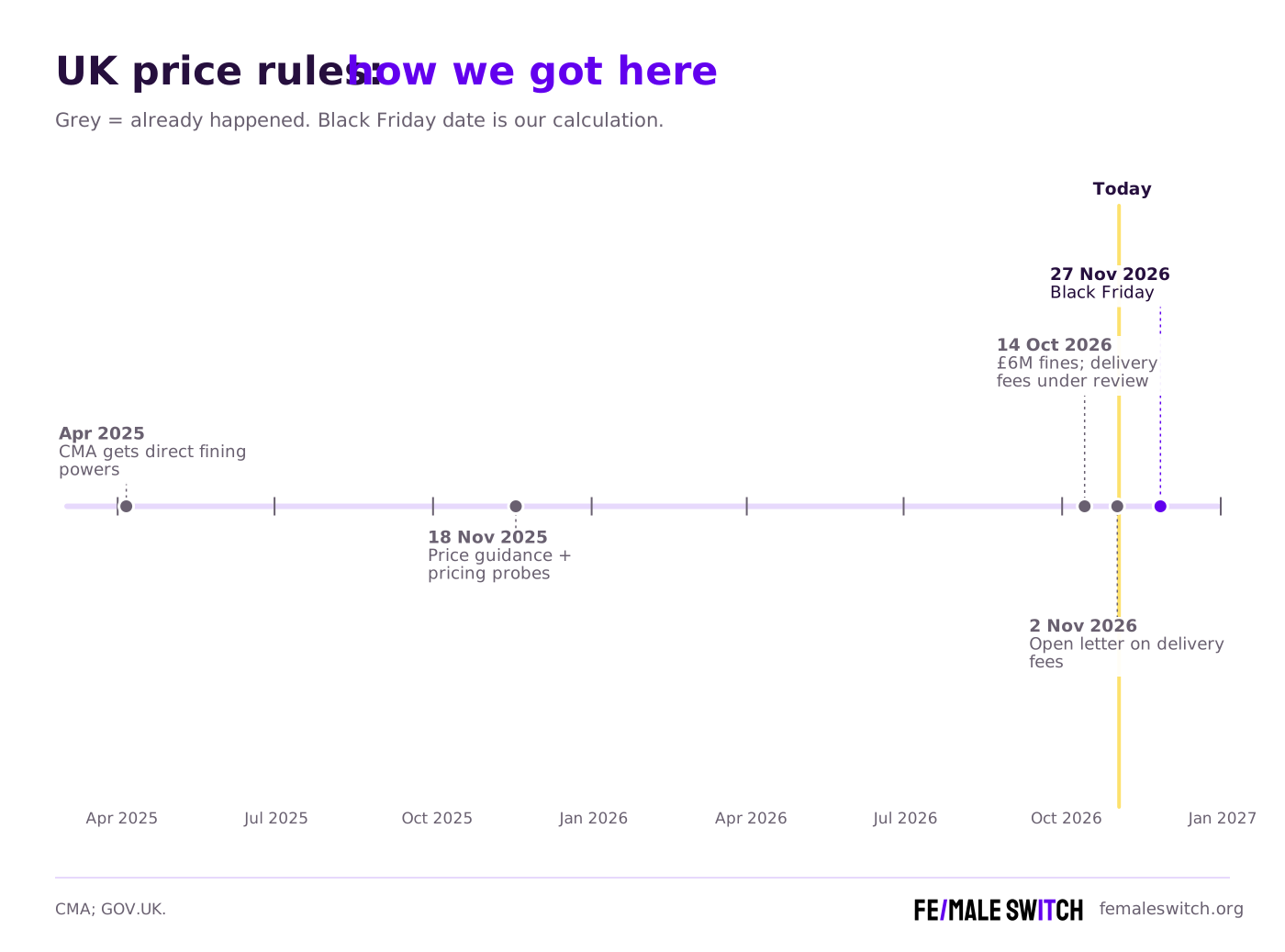
On Monday 2 November 2026 the CMA published an open letter to online retailers titled “including mandatory delivery fees in the total price”. It is addressed to online shops, marketplaces, comparison sites and search engines, and it is timed for the Christmas shopping period.
The CMA says many businesses have changed their pricing since the Digital Markets, Competition and Consumers Act 2024 (DMCC Act) gave it direct fining powers, but that “some businesses remain non-compliant in how they present delivery charges to consumers”. It asks every business that hasn’t done so to review its website, app and online advertising now.
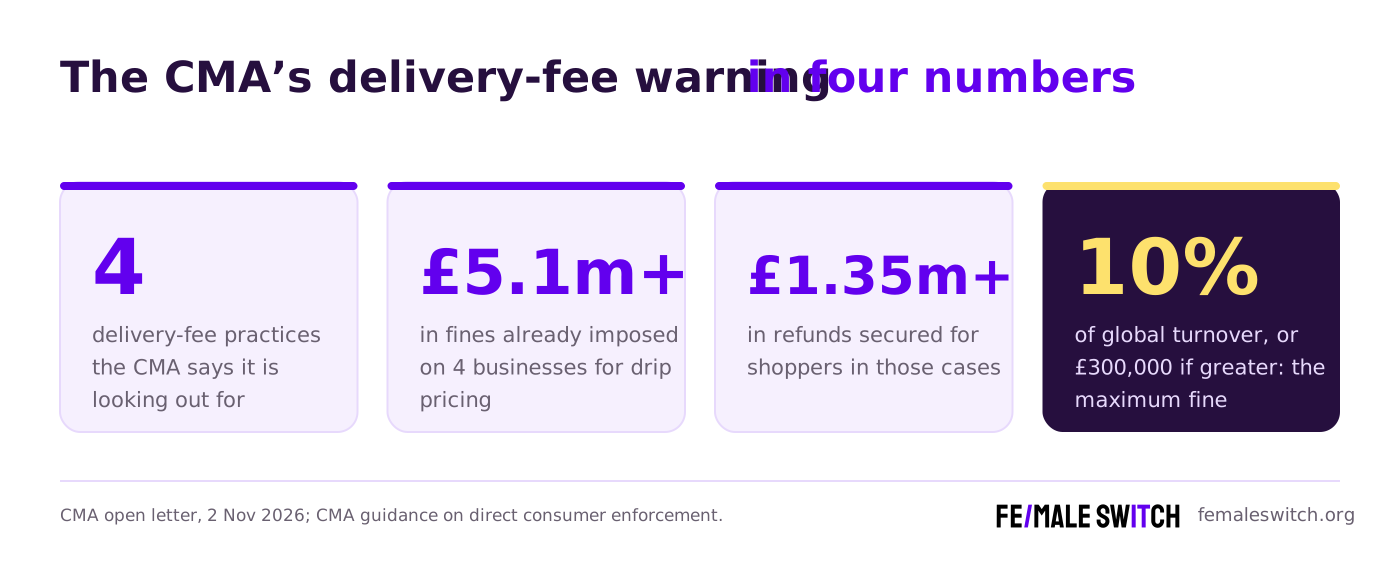
The letter names four examples of practices the CMA is looking out for:
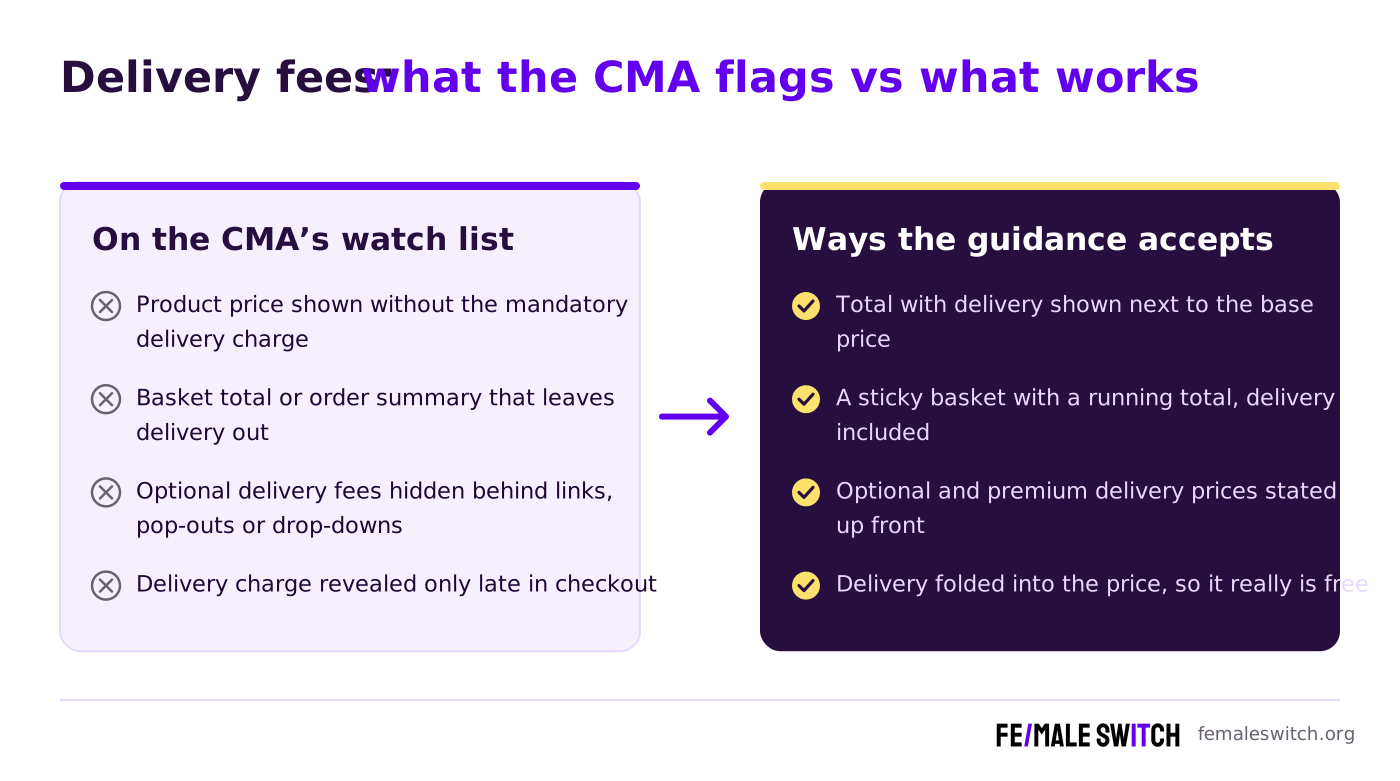
- showing a product price without including a mandatory delivery charge in the total price;
- leaving mandatory delivery charges out of basket totals or order summaries;
- not giving information about optional delivery fees, or placing it behind links, separate pages, pop-out pages, expandable sections or drop-down menus;
- giving information about delivery charges only late in the checkout.
None of this came out of nowhere. In a blog post on 14 October, the CMA wrote: “We are also reviewing how online retailers disclose delivery fees and expect to provide an update shortly.” The same day it fined three businesses £6 million for misleading sales tactics, a case we covered in our piece on fake countdown timers and drip pricing. This letter is that update.
What the law actually requires
Under the DMCC Act, whenever you give a consumer a price for a product they can buy, that price must be the total price, including mandatory delivery or collection fees and any other unavoidable fees, taxes and charges. The letter says it must be shown “at every stage of the purchase process where a price is given, including advertising, product pages, carts and baskets, checkout and payment pages.”
The detail sits in the CMA’s price transparency guidance (CMA209), first published in November 2025. Paragraphs 5.2 to 5.21 deal with delivery. The points that matter most for a small shop:
- Mandatory or optional? Delivery is optional only if the customer can get the product without paying for it, for example by collecting it for free. Premium options such as next-day delivery are optional extras.
- A choice of paid options is still mandatory. If customers must pay for some kind of delivery, the total price shown at the start should include the cheapest option. If they then pick express delivery, later prices include that.
- Free delivery thresholds. “Free delivery over £40” does not let you drop the fee from the price. You include the full fee in the total until the basket reaches £40, and you can tell customers it will be removed above that. Advertising the free threshold without saying what delivery costs below it may itself be a misleading omission.
- Flat fee per order. If one delivery charge covers the whole basket, you don’t have to add it to every product’s headline price. But the customer must see a total that includes delivery throughout.
- Optional delivery. If extras such as next-day delivery exist, say so clearly throughout, not in hidden menus or expandable sections.
Status: Adopted. The total-price rule has been law since the DMCC Act’s consumer provisions took effect in April 2025. The letter adds no new obligation; it tells businesses where the CMA is looking.
Three ways to show delivery correctly
The guidance accepts three main ways to show a total when one delivery fee covers the whole order: show the delivery-inclusive total alongside a more prominent base price, show a clear rolling total in the basket that updates as products are added, or fold delivery into your prices and offer genuinely free delivery. It also gives practical designs for the rolling total: a “sticky” basket that stays on screen as the customer scrolls, an “add to basket” button that shows the cost including delivery, or a basket pop-up after each item is added.
The CMA’s own examples are useful for small sellers. A clothing shop with a £4.50 minimum delivery charge advertises a £20 dress in a search engine’s results as £24.50. A homeware shop with a flat £5.99 fee shows a pop-up total of £30.99 after a £25 lamp is added, and £60.99 once £30 of plates join it. A marketplace shows a £10 photo frame with £2.99 delivery as £12.99.
Source: CMA open letter of 2 November 2026 and CMA209, chapter 5. Simplified; read the guidance for your exact case.
Who is at risk, and how big are the fines?
The letter is not an investigation into any named business. But the CMA says it “will continue to monitor pricing practices across the online retail sector” and will act if non-compliance continues. It has already enforced the drip-pricing rules against four businesses, with more than £5.1 million in fines and more than £1.35 million in refunds.
Size is no shield. One of the October cases was Gold’s Gym, a franchise running four gyms in London, fined £45,000 and ordered to refund £9,220 to 726 customers for leaving a joining fee out of its total price. Under the CMA’s direct enforcement powers, a penalty can reach 10% of global turnover or £300,000, whichever is greater, and the CMA can order refunds to customers on top.
Marketplaces and search engines are named too. That means platforms may tighten how they display seller delivery charges, so keep your shipping settings on Etsy, Amazon, eBay or Google Shopping accurate. Our recent piece on Etsy’s new AI and photo rules shows how fast platform rules can change for makers.
Does this apply if you sell from the EU?
The letter is about UK consumer law, aimed at businesses selling to UK shoppers. If UK customers are a real share of your sales, the safest course is to follow the UK rule on your UK-facing shop pages, ads and marketplace listings.
Inside the EU the rules are similar but not identical. The Consumer Rights Directive requires online sellers to give the total price “as well as, where applicable, all additional freight, delivery or postal charges” before the contract, and to show that information “in a clear and prominent manner” directly before the customer places the order (Articles 6 and 8). If you don’t, Article 6(6) says the consumer “shall not bear those charges”. The Unfair Commercial Practices Directive (Article 7(4)(c)) also treats delivery charges as material information in any ad or listing that invites a purchase.
The difference: EU law requires delivery charges to be stated alongside the price, while the UK now insists that mandatory delivery is added into a single total from the first price a shopper sees. National EU rules and courts add detail, so check your own country’s consumer authority.
Sources: CMA, Consumer Rights Directive 2011/83/EU, Unfair Commercial Practices Directive 2005/29/EC. Simplified.
Cross-border sellers have a second cost to watch: since 1 November, items in parcels sent to EU customers from outside the EU carry the EU’s new €2 handling fee, which matters for your prices if you ship from the UK into the EU.
What this means for you
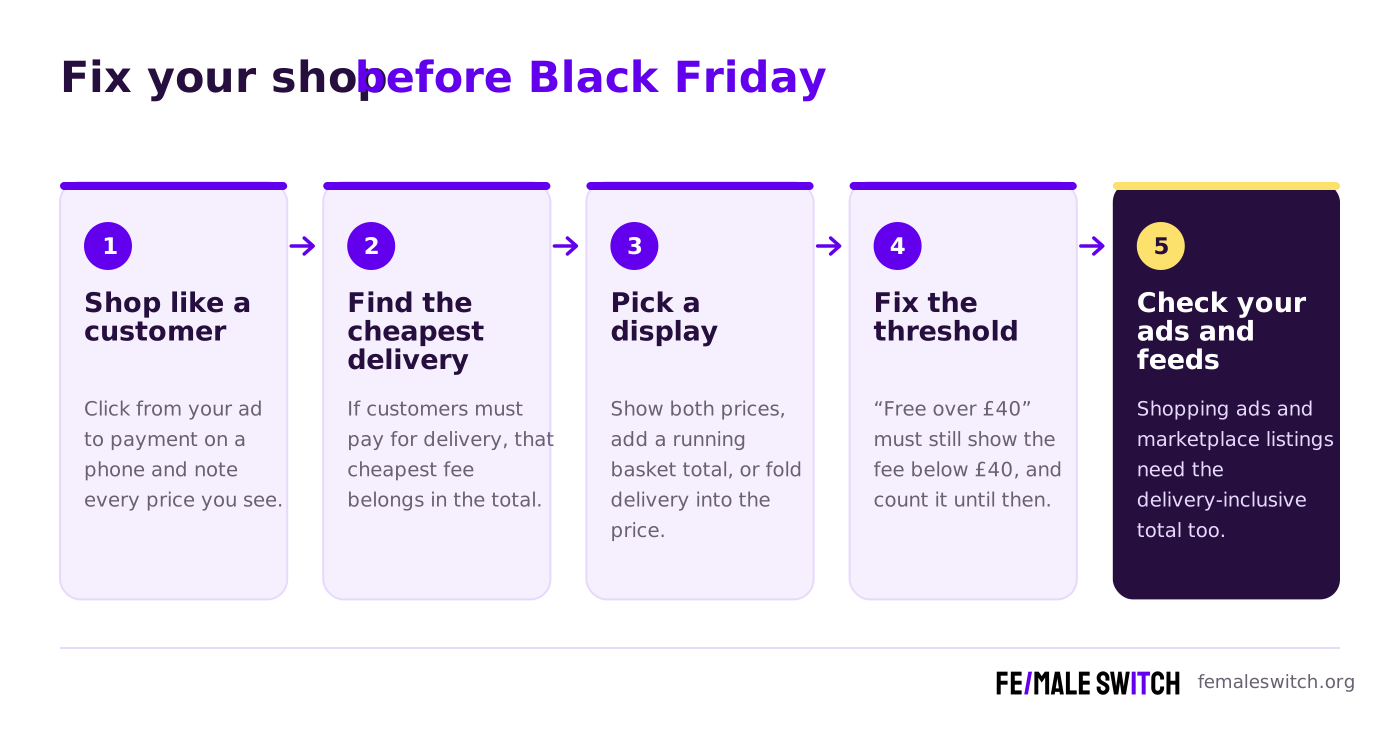
- Shop your own store this week. Start from an ad or a social post, go to payment on your phone, and write down every price you see. Each one should include mandatory delivery, or sit next to a total that does.
- Decide how you’ll show delivery. For many small shops, folding a typical delivery cost into prices and offering free delivery is the simplest fix. Our guide to product pricing psychology explains why a single clean price often converts better than a low price plus fees.
- Rewrite your free-delivery banner. “Free UK delivery over £40, £3.95 below” is clear. “Free delivery*” with the details in a footnote is not.
- Check your shop platform’s settings. Many website builders can show a running basket total or a sticky cart. If you’re still setting up, see our guide to launching an e-commerce shop without code.
- Fix ads and feeds, not just the website. Google Shopping, Meta catalogue ads and marketplace listings show prices too. The CMA’s own example puts £24.50, not £20, in a search ad for a £20 dress with £4.50 delivery.
- Keep promotions honest as well. Black Friday urgency messages are covered by the same law; see our tips on limited-time offers on social media that stay on the right side of the rules.
For the wider picture of UK rules landing on small businesses this autumn, read our summary of the Autumn Budget 2026 and our report on the CMA’s investigation into Meta’s business terms.
Want to test your pricing before real customers see it?
The Fe/male Switch startup game takes you from idea to first paying customers in weekly quests, with an AI co-founder, so you can try out prices, delivery offers and your first sales in a safe setting. The free trial lasts 2 weeks.
👉 Start the game
FAQ: delivery fees and the total price in the UK
Do UK online shops have to include delivery in the price?
Yes, if delivery is mandatory. Under the DMCC Act, the total price shown to UK consumers must include mandatory delivery or collection fees at every stage, from ads and product pages to the basket and checkout. The CMA repeated this in an open letter on 2 November 2026.
What did the CMA’s open letter of 2 November 2026 say?
It reminded online retailers, marketplaces, comparison sites and search engines that “the first price consumers see should be the price they pay”, and listed four practices it is looking out for: prices without mandatory delivery, basket totals without delivery, hidden optional delivery fees, and delivery charges revealed late in checkout.
Is offering free delivery over a minimum spend still allowed?
Yes, but under the CMA’s guidance you must include the full delivery fee in the total until the basket reaches the threshold, and say what delivery costs below it. Advertising free delivery over a threshold without that information may be a misleading omission.
Do I have to add the delivery fee to every product price?
Not when one flat fee covers the whole order. You can show the base price with a delivery-inclusive total next to it, a clear running basket total that includes delivery, or fold the fee into your prices.
How much can the CMA fine a small business?
Up to 10% of global turnover or £300,000, whichever is greater, and it can order refunds. A four-gym franchise, Gold’s Gym, was fined £45,000 in October 2026 for leaving a joining fee out of its total price.
Do EU rules also require delivery costs in the price?
EU law requires delivery charges to be stated in ads and listings that invite a purchase and before the order is placed, and a customer who wasn’t told doesn’t have to pay them. The UK goes further by requiring mandatory delivery to be added into one total from the first price shown.
