
TL;DR: why is the UK investigating Meta’s business terms?
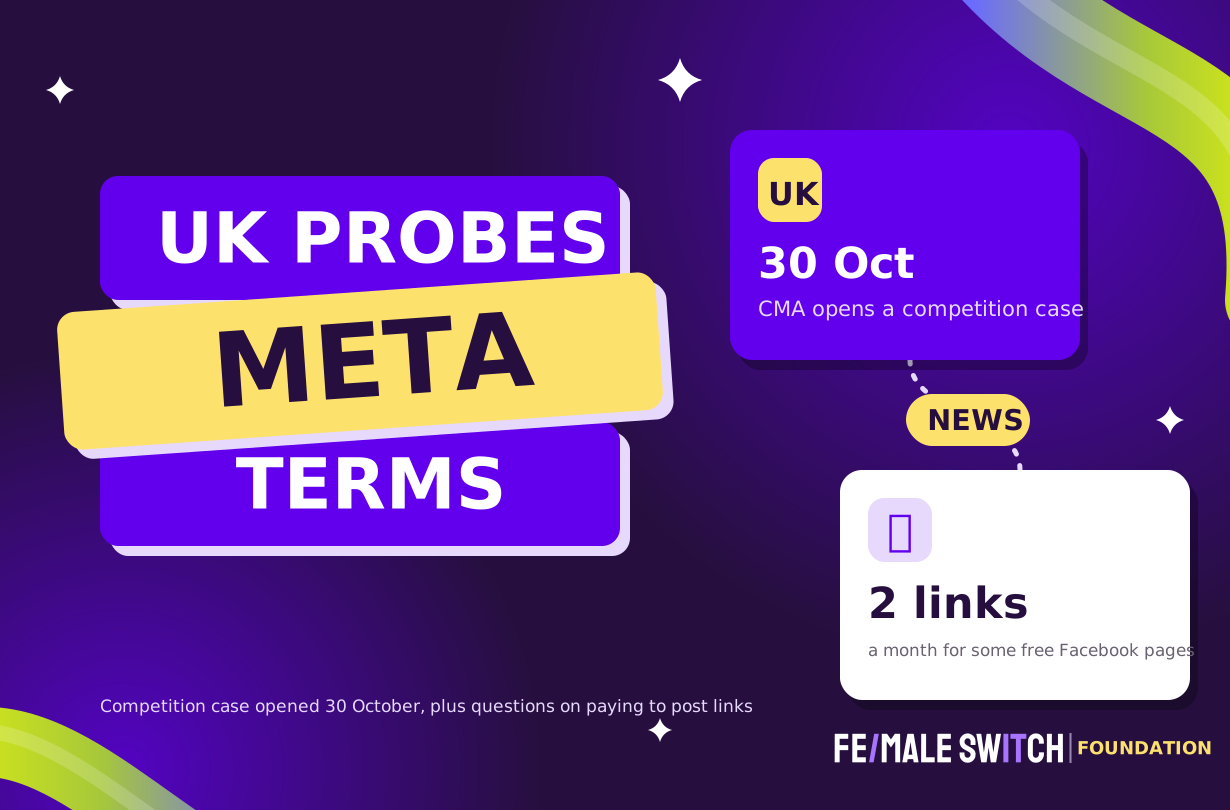
On 30 October 2026 the UK Competition and Markets Authority (CMA) opened a formal competition case into Meta’s terms for businesses. The terms could let Meta collect content from the websites of businesses that use Facebook, Instagram and its ad tools, and use it for its own products, including AI. Two days earlier Meta had paused the rollout, which was set for 20 November, so its existing terms still apply. The CMA is also asking Meta about Meta One, its new paid subscription, after small businesses complained that some Pages can post only a couple of links a month without paying. Nothing has been decided yet. If you followed our report on Meta’s delay to 20 November, that date is now on hold.
If you sell through Instagram or run a Facebook Page, two things just happened that touch your business. A regulator has started testing whether Meta can force businesses to accept its new crawling terms. And the same regulator is asking whether Meta should be charging small businesses to post links to their own websites.
The case is British, but the terms are global and Meta’s European business customers use the same contracts. Here is what the CMA opened, what Meta says, what is still unclear about paid links, and what to do while the regulators work.
What happened
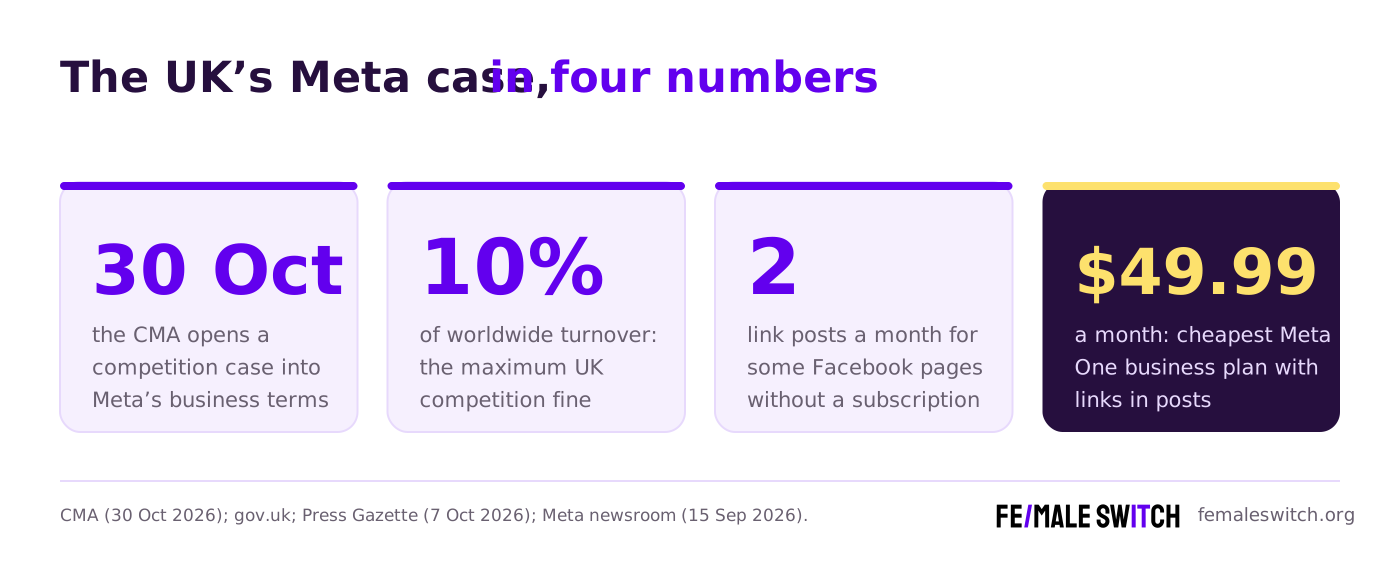
On Friday 30 October the CMA said it has “launched an investigation into whether Meta’s commercial terms for businesses using its platforms and services breach competition law.” According to the CMA’s press release, the terms could allow Meta to collect content from the websites of businesses and publishers that use its services and use it “to develop and provide its own products and services, including its AI features – without those businesses getting a choice on if or how their content is used.”
The CMA says forcing news publishers and other content businesses to accept such terms could be an unlawful imposition of unfair trading conditions “for thousands of UK businesses that rely on its services to reach customers and audiences.” It acted on concerns from the News Media Association and the Movement for an Open Web, a group of publishers and advertisers.
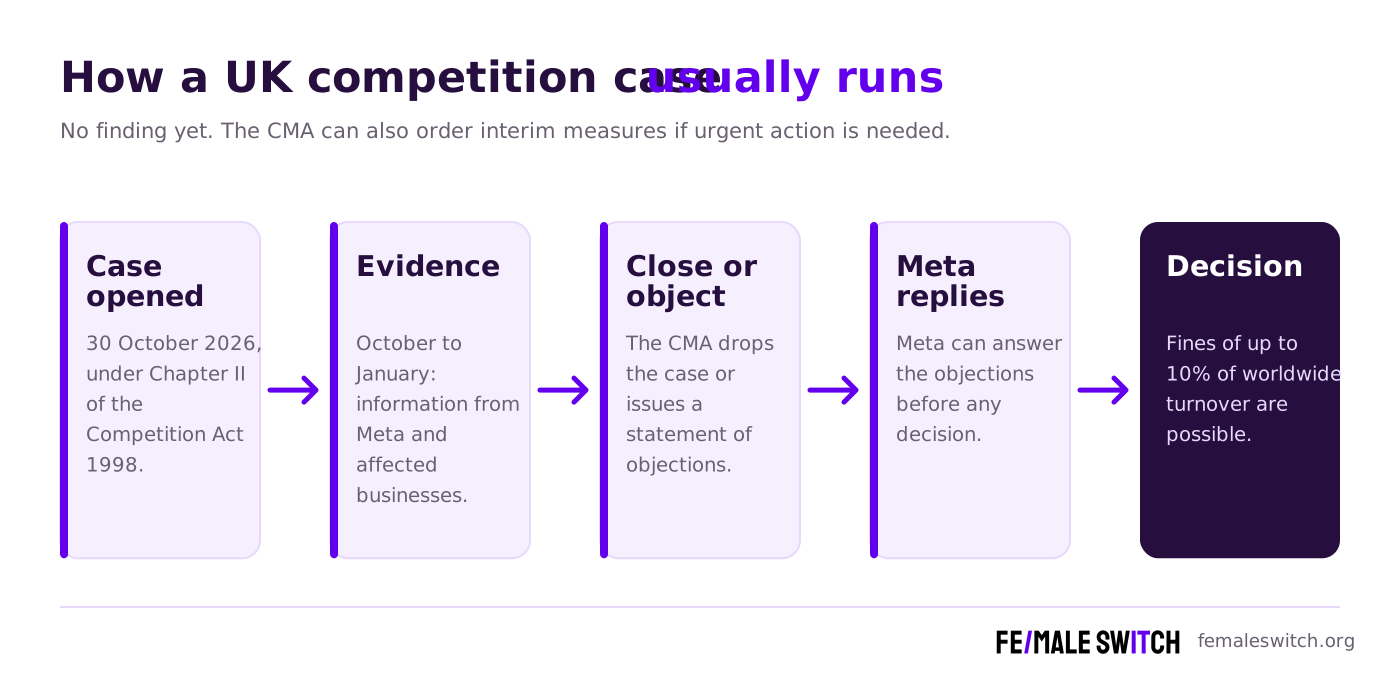
The case runs under Chapter II of the Competition Act 1998, which bans the abuse of a dominant position. The CMA will first test whether Meta is dominant in a UK market and, if so, whether its existing terms or the revised ones are an abuse. The case page names Meta Platforms, Inc., Facebook UK Limited and Facebook Ireland Limited, and plans “rapid initial information gathering” from October 2026 to January 2027.
Sarah Cardell, the CMA’s chief executive, said: “Digital platforms play an important role in helping UK businesses reach millions of customers around the world. But where a company holds a dominant position, it must not use that position to impose unfair terms.” She added that the CMA is “acting swiftly” and wants “a swift and satisfactory resolution to this case.”
No decision has been made on whether Meta broke the law. If the CMA finds an abuse, the penalty can reach 10% of a company’s worldwide turnover, the maximum for breaking UK competition law, according to gov.uk. The CMA can also impose interim measures where temporary action is needed to prevent significant damage.
Meta paused its terms two days earlier
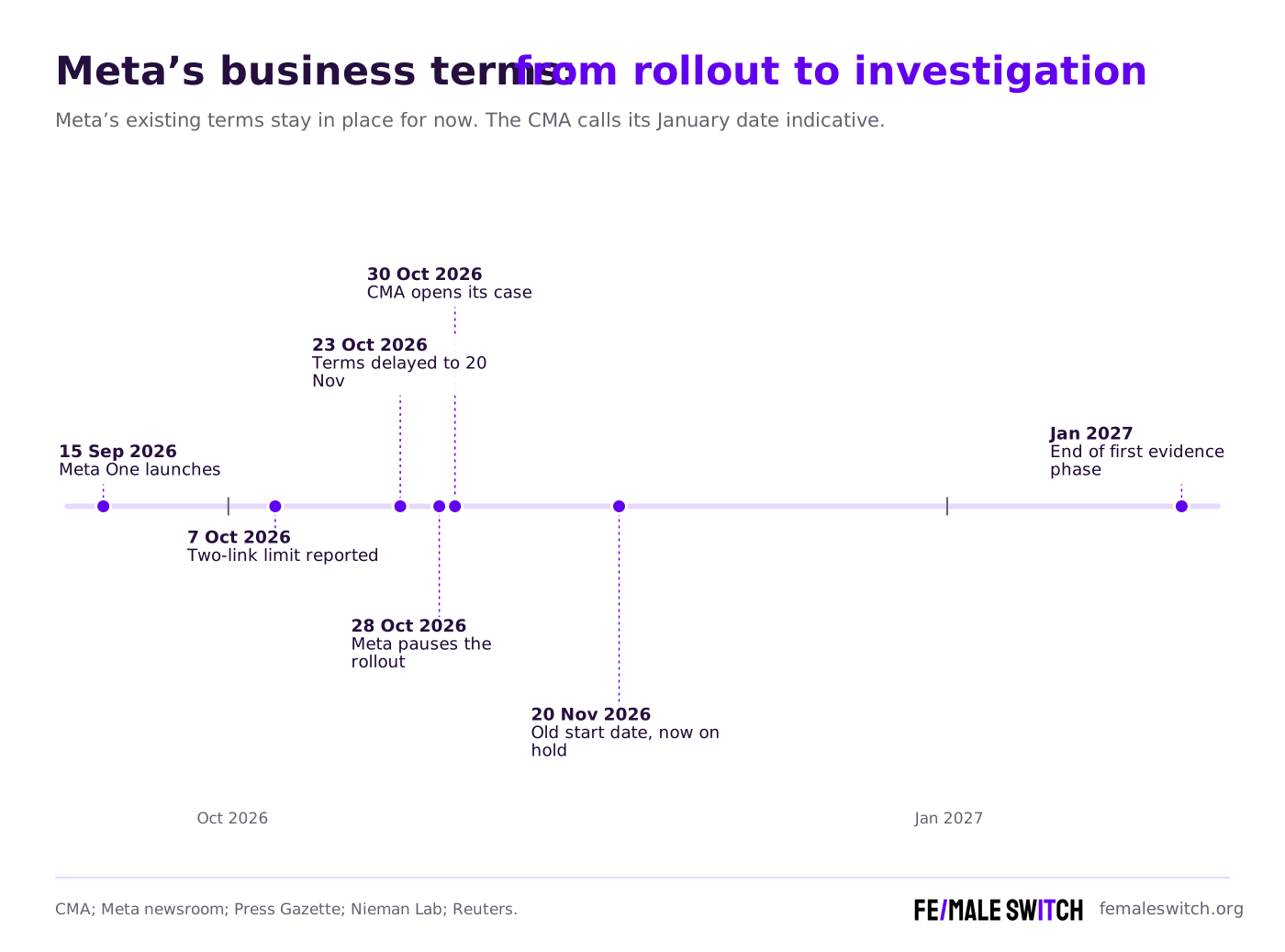
The CMA case lands on terms that are already frozen. Meta first planned to apply its updated Commercial Terms in Europe on 30 October, then moved them to 20 November on 23 October, as we reported when the new terms first appeared.
On Wednesday 28 October, Meta’s vice president of communications, Andy Stone, posted on X: “We’ve heard publishers’ feedback on our proposed ads and business terms update. We care deeply about our partners and do not plan to make policy changes without a full consultation with industry groups and leaders.” He added that the consultation “could extend beyond November 20, in which case we’d delay implementation of the updated terms. Until then our existing terms remain in place,” as Nieman Lab reported. Reuters described it as an indefinite delay.
Nieman Lab also reported that, shortly after Stone’s post, a Norwegian court blocked the terms from taking effect on 20 November until it had assessed their legality, citing the Norwegian broadcaster NRK. On 31 October Meta’s own Commercial Terms page still showed a banner saying the updates “will come into effect on 20 November 2026”, so check the page again before you rely on any date.
Meta rejects the case. “There are no grounds for a competition investigation,” a Meta spokesman told the Press Association. “We’ve already committed not to change our terms without consulting publishers and other stakeholders. We welcome the opportunity to explain our approach to the CMA.”
Paying to post links: the part that hits small businesses
The second part of the CMA’s announcement is the one most solo sellers will feel. The CMA is “seeking information from Meta on its new Meta One business subscription service” and on concerns raised by the Federation of Small Businesses “about the potential impact on small businesses of posting external links on Facebook and Instagram without paying a subscription fee.” The CMA has not decided whether to take formal action, and this question sits outside the competition case (Debated).
Meta launched Meta One on 15 September 2026 as a family of paid plans across Facebook, Instagram and WhatsApp, with “15 million subscriptions and trials to-date”. Business bundles start at $14.99 a month. The Advanced plan, from $49.99 a month, is the first to include “links in organic posts and reels”, alongside scheduling, analytics and team access. Meta says plans, prices and availability “may vary by region, by app, and by account”.
What changes for free Pages? Without a subscription, some Pages can post at most two posts with links a month, Press Gazette reported on 7 October. The limit applies to “select Facebook pages” and to profiles with Professional Mode switched on, not to everyone. Some links don’t count: extra links in the comments of a post that already has a link, links to Meta’s own apps including WhatsApp, links through Facebook’s affiliate partnerships, and links in ads. Meta told Engadget it has been “testing” whether sharing links should be part of Meta One and will keep changing the experience based on feedback.
Sources: Meta newsroom and Meta One business page (prices, charged per Facebook Page, Instagram profile or WhatsApp Business number); Press Gazette and Engadget (Facebook allowances, including UK prices of £37.65, £112.98 and £376.60); Meta Help Centre (Instagram). Meta’s business page says Meta One “is not available in all regions”, and we could not confirm which EU countries see the link limit.
Put simply: a ceramicist who posts a new collection twice a week, each post linking to her own shop, could hit the free limit in the first week of the month if her Page is one of the limited ones. At $49.99 a month, the cheapest plan with links costs about $600 a year for each Page or profile.
Who said what, and where things stand
The magazine and media trade body PPA welcomed the case. Its chief executive, Sajeeda Merali, said: “Access to audiences should not come at the price of publishers’ content.” The PPA asks the CMA to make sure the terms are not applied while it investigates and wants any revised terms to separate access to Meta’s services from consent to crawling. It also calls for Meta to be investigated under the UK’s new digital markets regime, where the CMA notes Meta has not yet been designated and the next proposals come in spring 2027.
In the EU, no regulator has opened a case on these terms. The European Commission welcomed Meta’s first delay on 23 October and said it is committed to making sure Meta complies with EU competition law and the Digital Markets Act. For the AI side of the crawling clause, see MeanCEO’s analysis of Meta’s terms and AI crawling.
What this means for you
For now, nothing in your Meta contract changes: the old terms apply and the CMA has decided nothing. The link limit is different, because it may already be shaping your reach. Use the pause to reduce your dependence on any one platform.
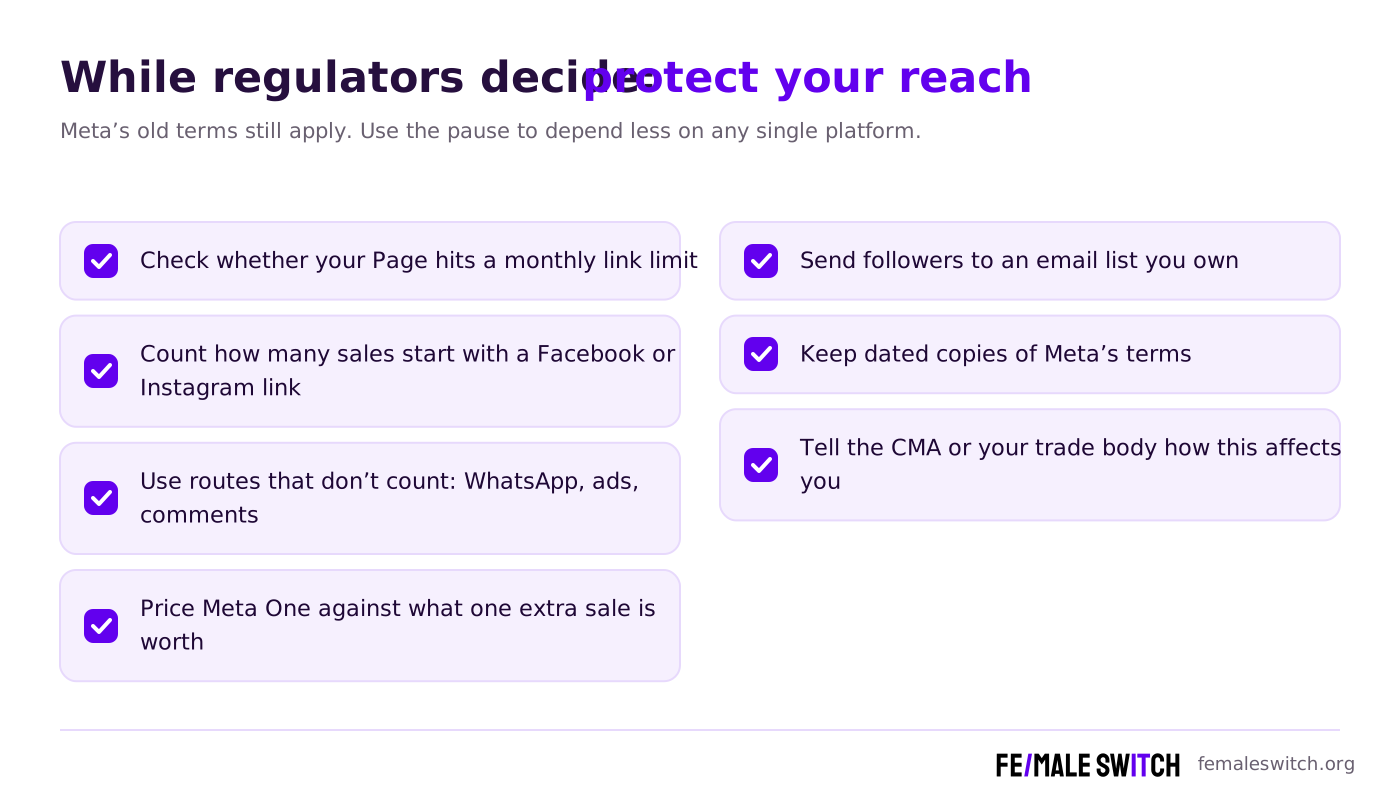
- Check whether your account is limited. The two-link cap hits only some Pages and Professional Mode profiles, so find out where you stand before you plan a month of link posts.
- Measure what links are worth to you. Count how many orders or bookings start with a click from Facebook or Instagram. Our guide to social media when you have little time shows how to focus on the channels that bring sales.
- Use the routes that don’t count. According to Press Gazette, links to WhatsApp, links in ads and extra links in comments under a post that already has one are outside the limit.
- Price Meta One honestly. If one extra sale a month covers $49.99, the Advanced plan may pay for itself. If not, put the money into channels you own.
- Grow an email list. Every follower you move to email is reach Meta can’t ration. Start with our guide to your first email subscribers, and make sure your website basics for search are in place so customers can find you without a social post.
- Keep dated copies of Meta’s terms. Save today’s Commercial Terms and the paused preview, so you can see what changes if a new version appears after the consultation.
- Make your case heard. The CMA is gathering evidence from affected third parties until January. UK businesses can contact the case team listed on the CMA case page or share examples through their trade body, such as the FSB.
This is the CMA’s second move this autumn that matters for small online sellers, after it fined retailers for fake countdown timers. For UK founders, our summary of the Autumn Budget 2026 for small businesses covers the tax side.
Want to build a business that doesn’t live or die by one platform?
The Fe/male Switch startup game takes you from idea to first paying customers in weekly quests, with an AI co-founder, so you can test your channels, pricing and first sales in a safe setting.
👉 Start the game
What to watch next
- Interim measures. Publishers want the CMA to keep the terms off while the case runs. With the rollout paused, the CMA may not need to act fast, unless Meta sets a new date.
- Meta’s consultation. Whether Meta narrows the crawling clause, writes a robots.txt promise into the terms or separates crawling consent from using its services.
- A decision on Meta One. The CMA has not decided whether to take formal action on paid links. Watch for an EU or national regulator asking the same questions.
- January 2027. The end of the CMA’s first evidence phase. The CMA says its dates are indicative and may change.
FAQ: the CMA’s Meta investigation and paid links
Why is the CMA investigating Meta?
The UK Competition and Markets Authority opened a case on 30 October 2026 to test whether Meta abuses a dominant position by making businesses accept terms that let it collect content from their websites and use it for its own products, including AI, without giving them a choice. No decision has been made.
Do Meta’s new Commercial Terms apply from 20 November?
Not for now. On 28 October Meta said it will not change its terms without a full consultation with industry groups and that, if the consultation runs past 20 November, it will delay again. Its existing terms remain in place. Meta’s terms page still showed a 20 November banner on 31 October, so check it before relying on a date.
Does Meta charge to post links on Facebook?
For some accounts, yes. Press Gazette reported that select Facebook Pages and profiles with Professional Mode can post at most two posts with links a month without a subscription. Meta One’s Advanced plan, from $49.99 a month, includes links in organic posts and reels. Links in ads, links to WhatsApp and extra links in comments don’t count.
Is the CMA investigating the paid links?
It is asking Meta for information about Meta One after the Federation of Small Businesses raised concerns. The CMA says it has not decided whether to take formal action, and this question is outside the competition case it opened on 30 October.
Does the UK case affect businesses in the EU?
Not directly: the CMA only rules on UK markets. But Meta uses the same business terms across Europe, the case names Facebook Ireland Limited, and any change Meta makes to settle it could apply more widely. No EU regulator has opened a case on these terms.
What can Meta be fined?
Under UK competition law, a business found to have broken the rules can be fined up to 10% of its worldwide turnover. The case is at the evidence stage, and the CMA may also close it without a finding.
