
TL;DR: How common is femicide in Europe?
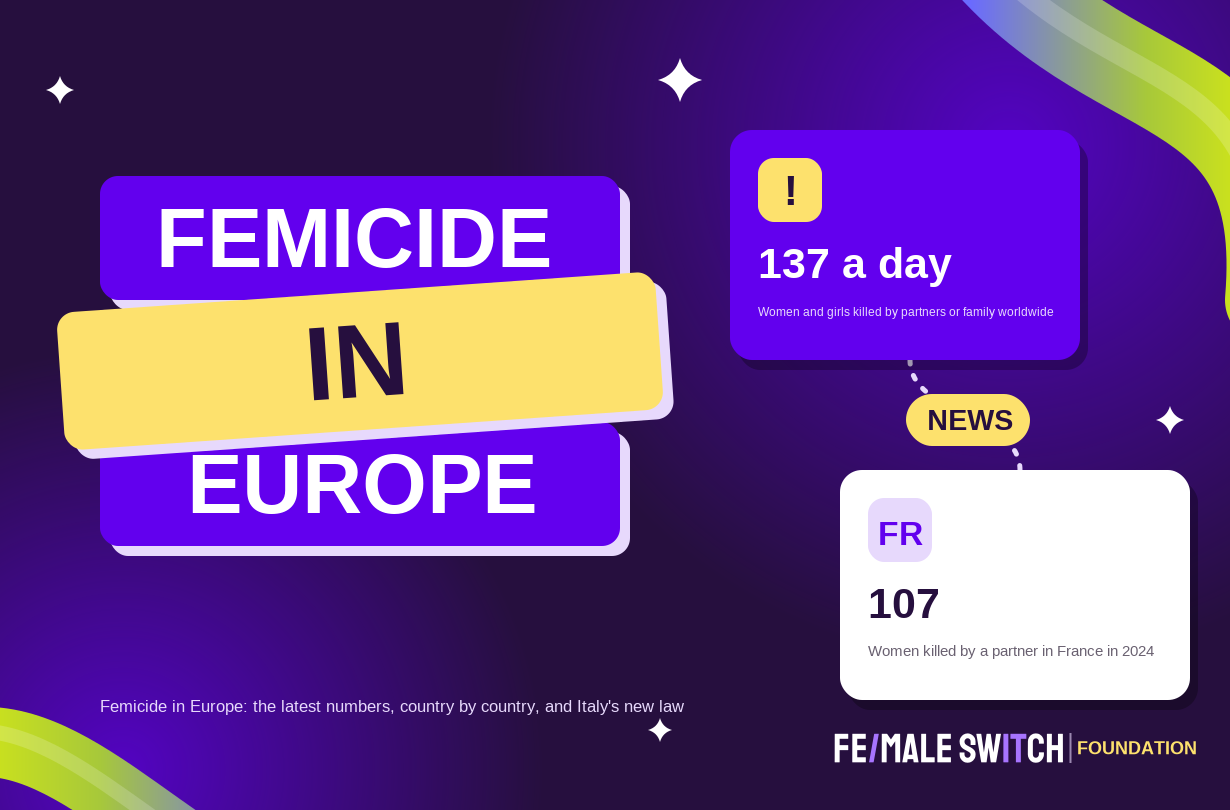
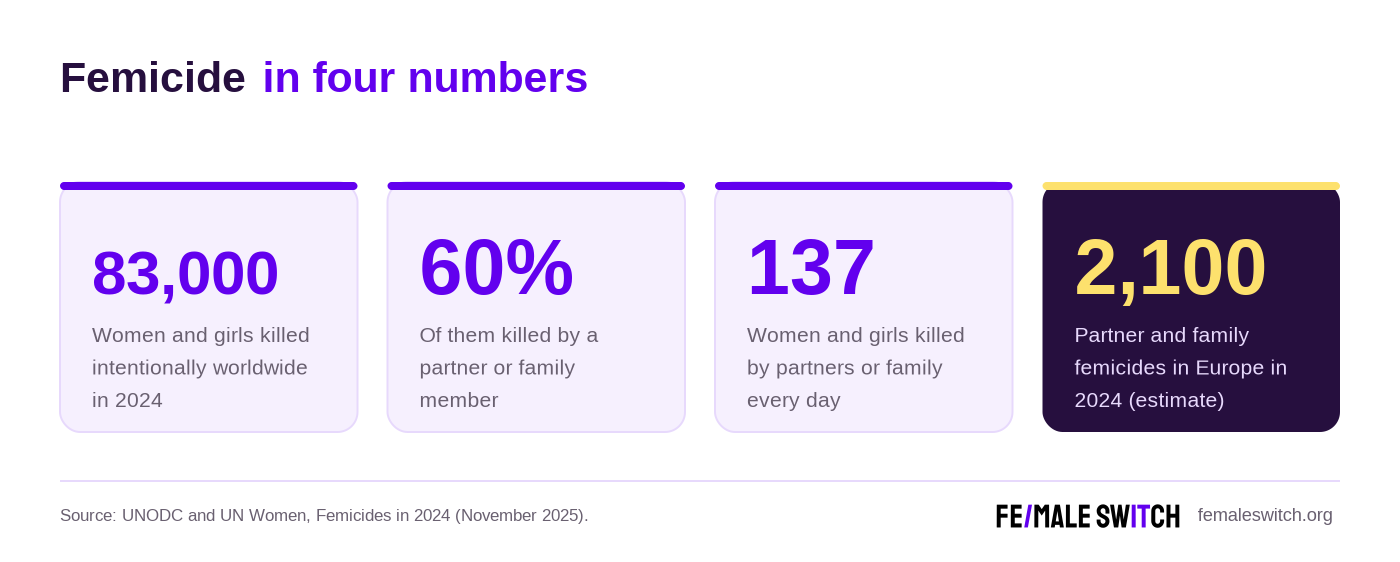
Femicide in Europe killed about 2,100 women and girls at the hands of partners or family members in 2024, according to UNODC and UN Women. Worldwide the number was about 50,000, or 137 a day. In 2024, 132 women in Germany and 107 women in France were killed by a current or former partner, and Italy has punished femicide with life imprisonment as a separate crime since December 2025. The EU has no femicide offence of its own, and its first law on violence against women has to be applied by 14 June 2027.
Femicide is the killing of a woman or girl because she is a woman, and most of these killings happen at home. Searches for the word grew by about 60% over the last year as Italy wrote it into its criminal code and new national figures came out across Europe. Ahead of 25 November, the UN International Day for the Elimination of Violence against Women, here are the latest numbers, the new laws, and what employers and founders can do.
What is femicide?
The UN defines femicide as the intentional killing of women and girls with a gender-related motive. Its statistics focus on the clearest group: women killed by an intimate partner or a family member, because police data in most countries records that relationship.
National definitions differ, and that matters for the numbers:
- Italy defines femicide in its criminal code as a killing driven by hatred, discrimination, domination or control, or linked to a woman refusing a relationship.
- France counts féminicides conjugaux, women killed by a current or former partner.
- Spain keeps an official count of women killed by partners or ex-partners since 2003.
- Germany publishes a yearly federal report on gender-specific crimes against women.
The word itself comes from the women's movement of the 1970s and became a legal term in Latin America first. Europe is catching up law by law.
How many women are killed by partners in Europe?
The UNODC and UN Women report Femicides in 2024, published in November 2025, gives the global picture. About 83,000 women and girls were killed intentionally in 2024. Around 50,000 of them, 60%, were killed by a partner or a family member. For men the share is about 11%. Europe has the lowest rate of any region, about 0.5 per 100,000 women, and still counts roughly 2,100 victims a year.
National figures show what that looks like country by country:
Sources as named in the table. Countries count differently, so compare trends within a country, not totals across borders.
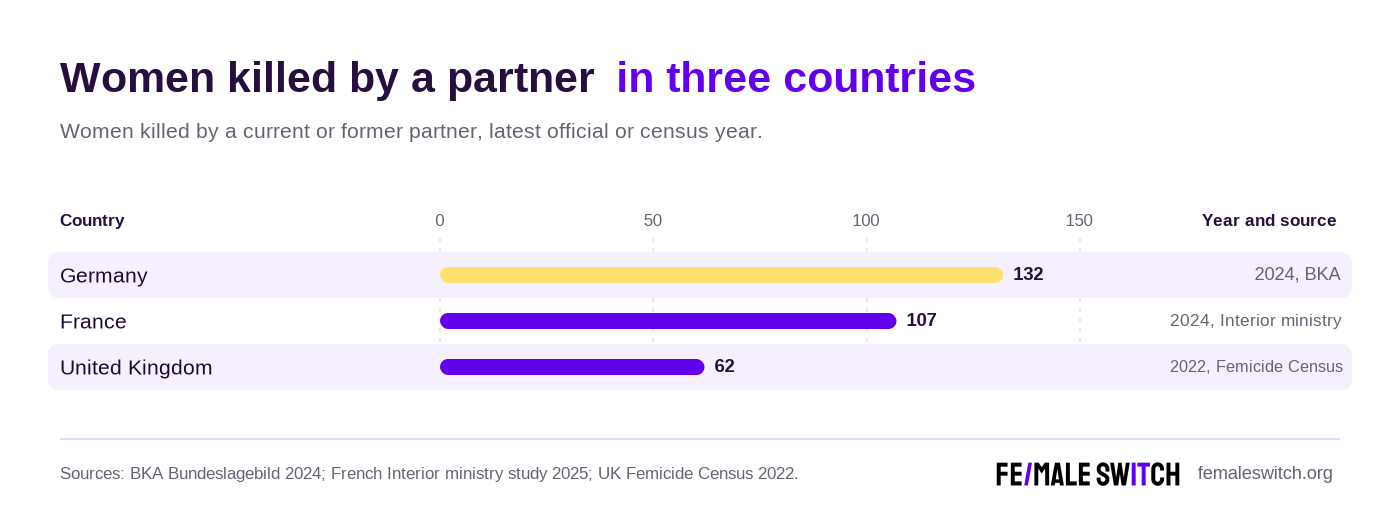
The French study holds the most painful detail. Of the women killed in 2024, 47% had already reported violence to the police or gendarmerie, and 81% of those had filed a formal complaint. Nine in ten of the killings took place at home. The warning signs were on file, and the system did not stop the killer in time.
What did Italy's femicide law change?
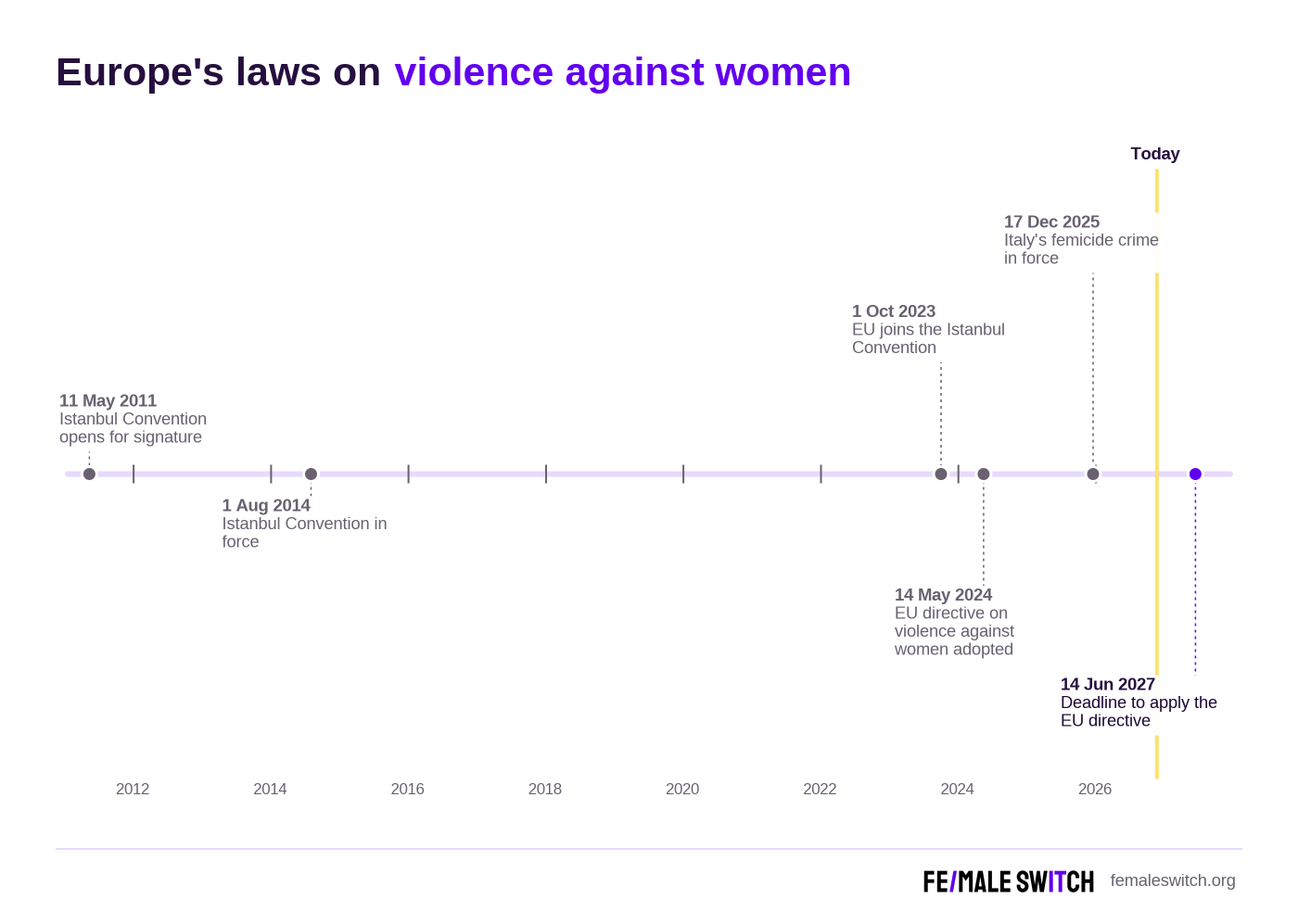
On 25 November 2025, Italy's Chamber of Deputies gave final approval to a law that makes femicide a crime of its own. It became Law no. 181 of 2 December 2025 and entered into force on 17 December 2025.
- A new article in the criminal code (577-bis) punishes femicide with life imprisonment.
- It applies when a woman is killed as an act of hatred, discrimination, domination or control, or because she refused to start or continue a relationship.
- The Justice Minister has to report to Parliament every year on how the law is applied.
- The law followed the killing of 22-year-old student Giulia Cecchettin by her ex-boyfriend in November 2023, which brought huge crowds onto Italy's streets.
Critics, including Italian criminal law scholars, say the definition is vague and hard for judges to apply, and that a longer sentence does little without money for shelters, prevention and police training. Italy already punished most of these killings with heavy sentences through aggravating circumstances. The new crime gives femicide a name in law, and the next test is whether it changes how early police and courts act.
Does the EU have a femicide law?
No. Femicide stays a matter of national law. The EU acts through two instruments:
- The Istanbul Convention of the Council of Europe, the first binding treaty on violence against women in Europe. It opened for signature in May 2011, entered into force in August 2014, and the EU itself joined in October 2023.
- Directive (EU) 2024/1385 on combating violence against women and domestic violence, adopted in May 2024. Member states must apply it by 14 June 2027. It makes cyber stalking, cyber flashing, sharing intimate images or deepfakes without consent, female genital mutilation and forced marriage crimes across the EU, and it requires support services, risk assessments and protection orders.
The directive names femicide as a form of violence against women and leaves the offence itself to each country. Our overview of EU policy changes that matter for women follows how each member state applies it.
Why does femicide matter for work and business?
Violence at home follows women to work. Abusers call the office, wait in the car park, take the salary and wreck the career. The EU gender-based violence survey found that 20.3% of women experienced economic violence by a partner, such as control over their money or being kept from working. Only 6.1% of women abused by a partner went to the police, so for many women a colleague or a manager is the first person who notices. Our guide to financial abuse, its signs and how to protect your money explains what economic violence looks like and what to do about it.
Money is protection. A woman with her own income, savings and work network can leave sooner and safer. That is one reason we keep writing about financial independence for women, from side hustles for women to bootstrapping as a female founder and grants for female entrepreneurs in Europe.
What can employers and founders do?
You don't need an HR department to help. A small team can put these in place in a week:
- Write a one-page policy that says employees affected by domestic violence can ask for flexible hours, a changed work location or paid time off for court dates and appointments, with no questions they don't want to answer.
- Know your country's leave rules. Italy gives employees who are victims of gender violence up to three months of paid leave. Check what your country offers before someone needs it.
- Protect contact details. Agree how the team answers calls and visitors asking for a colleague, and keep schedules and locations private.
- Post helpline numbers in the office and on the intranet, where people can read them without asking.
- Train one person to listen, believe and refer, and make it known who that is.
- Look after yourself and your team. Supporting someone through this is heavy. Our guides to mental health and wellbeing for founders and support systems for female entrepreneurs help.
For more on how violence shapes the way women move through the world, read our piece on the man vs bear question and what the data says.
Where can women get help in Europe?
In an emergency, call 112 anywhere in the EU. National helplines are free and confidential:
The EU has reserved 116 016 as a shared helpline number for women victims of violence, and more countries switch it on every year.
Financial independence starts with an idea you can test
The Fe/male Switch startup game takes you from idea to first paying customers in weekly quests, with an AI co-founder and a community of women founders. Build an income of your own at your own pace, and test it before you risk any savings.
👉 Start the game
What to remember about femicide in Europe
Femicide is the end point of violence that starts long before, at home, with control over money, movement and contact. Europe has the lowest rate in the world and still loses about 2,100 women and girls a year to partners and relatives. Italy now names the crime in law, France and Germany count it every year, and the EU directive arrives in June 2027. Laws matter, and so does the colleague, the friend and the employer who notices first.
FAQ: femicide in Europe
What is femicide?
Femicide is the intentional killing of a woman or girl with a gender-related motive. UN statistics focus on women killed by an intimate partner or a family member.
How many women are killed by femicide each year?
About 83,000 women and girls were killed intentionally worldwide in 2024, and about 50,000 of them, 60%, were killed by a partner or family member, according to UNODC and UN Women. That is 137 a day.
How many femicides are there in Europe?
Europe counted about 2,100 women and girls killed by partners or family members in 2024, a rate of about 0.5 per 100,000 women, the lowest of any region.
Which European country has a femicide law?
Italy made femicide a separate crime punishable by life imprisonment with Law 181 of 2 December 2025, in force since 17 December 2025. Spain has had a dedicated law on gender violence since 2004.
How many women were killed by partners in France in 2024?
107 women, an 11% rise on 2023, according to the French Interior ministry's national study. 47% of them had already reported violence to the police.
How many femicides were there in Germany in 2024?
The federal report counted 308 women and girls killed in 2024, and 132 women killed by partner violence.
Is femicide a crime under EU law?
No. Directive (EU) 2024/1385 covers cyber stalking, cyber flashing, image-based abuse, female genital mutilation and forced marriage, and leaves femicide to national law. Member states must apply it by 14 June 2027.
What can an employer do about domestic violence?
Offer flexible hours and paid time off, protect the employee's contact details and schedule, post helpline numbers, and name one trained contact person. Our guide to support systems for female entrepreneurs has more ideas.
