
TL;DR: What is financial abuse and how common is it?
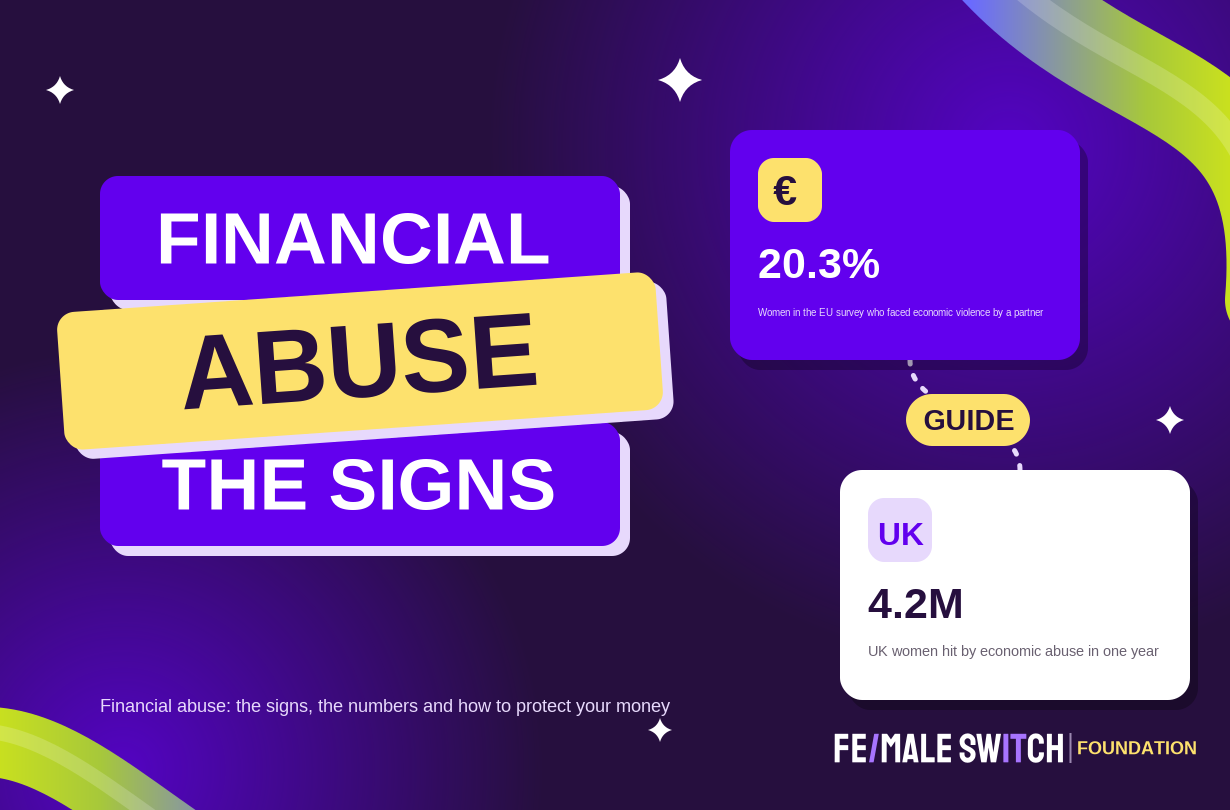
Financial abuse is when a partner or ex-partner controls, takes or sabotages your money, your job or your credit to keep power over you. In the EU gender-based violence survey, 20.3% of women who were asked about it had faced economic violence by a partner. In the UK, around 1 in 6 women, about 4.2 million, went through it in a single year, according to Surviving Economic Abuse. Half of UK adults say they know nothing about the term. Learn the signs, open an account only you control, check your credit report, and keep an income of your own.
Financial abuse is the quietest form of partner violence and one of the most common. It leaves no bruises, so friends, banks and employers miss it, and it traps women for years because leaving costs money. This guide comes out during the UN's 16 Days of Activism against Gender-Based Violence, which run from 25 November to 10 December, and the UK marks Economic Abuse Awareness Day on 26 November. Here are the definitions, the latest numbers, the red flags, the laws, and a plan to protect your money, your credit and your business.
What is financial abuse?
Financial abuse, also called economic abuse or economic violence, is a pattern of behaviour that limits a woman's power to earn, keep, use or decide about money. Three legal and statistical texts define it clearly:
- The UK Domestic Abuse Act 2021 lists economic abuse as a form of domestic abuse: any behaviour that seriously harms a person's ability to acquire, use or maintain money or other property, or to obtain goods or services.
- The Istanbul Convention of the Council of Europe defines domestic violence as physical, sexual, psychological or economic violence between current or former partners or family members.
- The European Institute for Gender Equality (EIGE) groups economic violence into three types: economic control, economic exploitation and economic sabotage.
Financial abuse sits inside coercive control, the wider pattern of isolating, monitoring and frightening a partner. Money is the tool, and control is the goal. Earning more than your partner is fine. The line is crossed when one person uses money to limit the other's choices, safety or freedom to leave. An unfair split of chores is a separate problem, and our article on weaponized incompetence and what it costs women explains where the line sits.
How common is financial abuse in Europe?
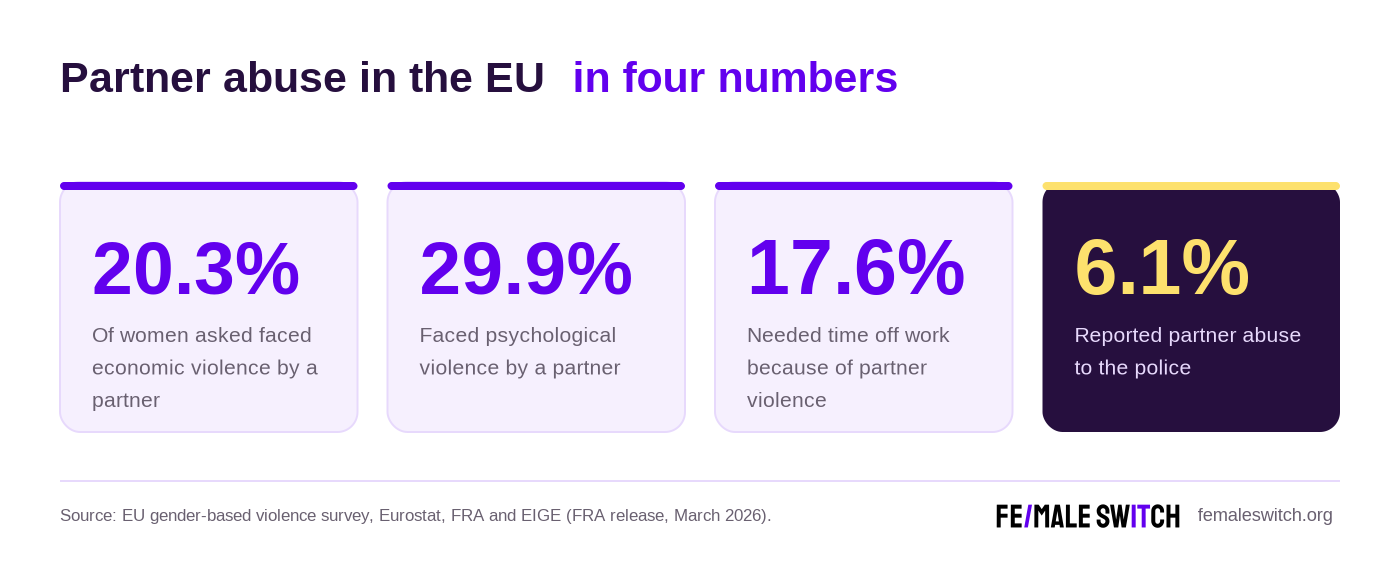
The largest source is the EU gender-based violence survey, run by Eurostat, the EU's rights agency FRA and EIGE, with more than 114,000 interviews between September 2020 and March 2024. FRA and EIGE published their analysis in March 2026. Where the extra questions on money were asked, 20.3% of women said a partner had committed economic violence against them, such as stopping them from working or keeping them away from family finances.
The same survey shows how economic abuse travels with other forms of control:
Sources as named in the table. The EU figure on economic violence covers only the women who were asked the extra questions, so read it as the rate within that group of women.
Awareness lags far behind. In the UK survey, half of adults said they know nothing about the term economic abuse, and 36% of 18 to 24 year olds missed at least one warning sign, double the rate of people aged 55 and over. Young women, the group hit hardest, are the least likely to spot it.
What are the signs of financial abuse?
The red flags fall into EIGE's three groups. Read them as a pattern: one tight month is normal life, and a steady loss of control over your own money is the warning.
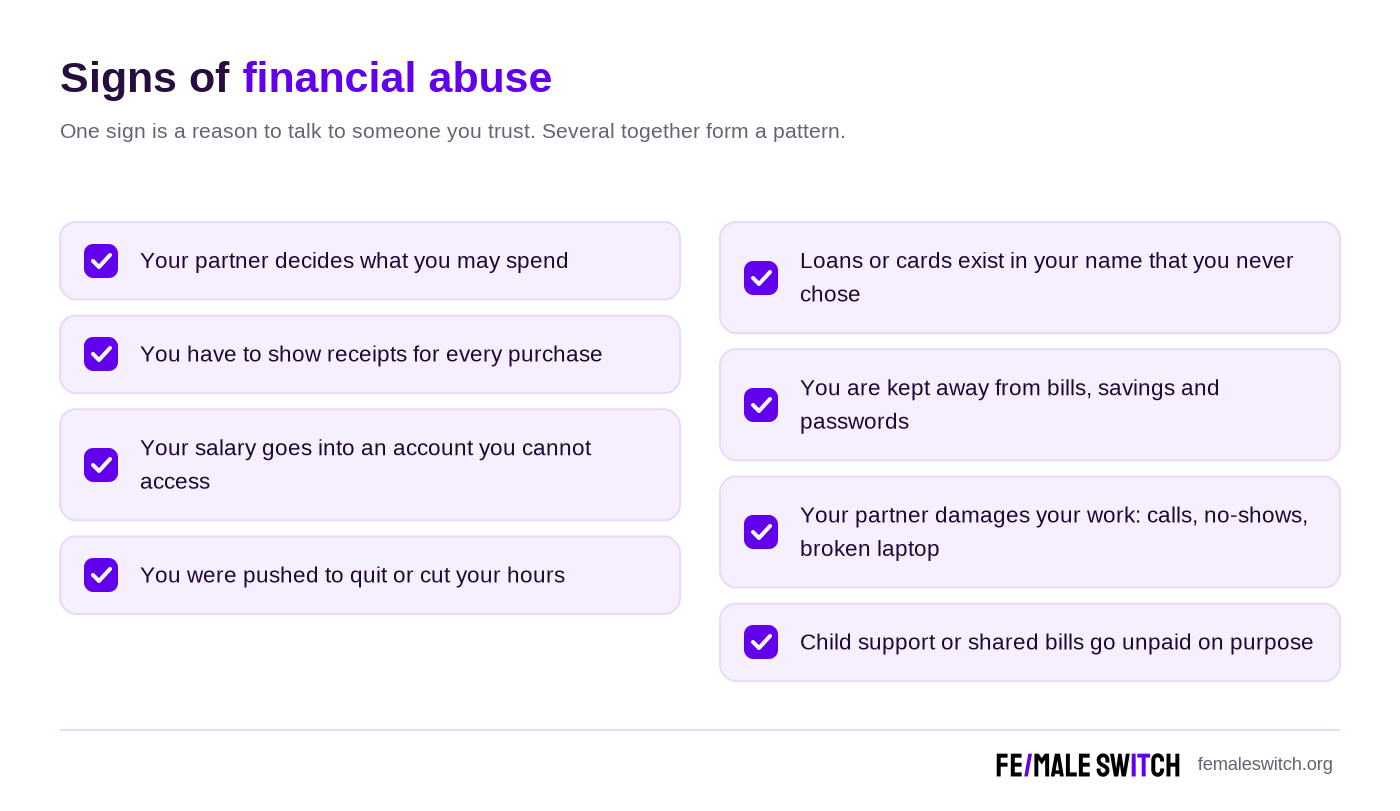
Coerced debt deserves its own warning. A partner who takes out credit in your name, or pressures you to sign as guarantor, leaves you with arrears and a damaged credit score long after the relationship ends. Surviving Economic Abuse names it as one of the clearest red flags, next to controlling spending and stopping a partner from working.
Abuse also continues after separation. Ex-partners drag out divorce settlements, refuse to sell a shared home, stop child maintenance or run up joint debts, because money is the last lever left.
Why does financial abuse hit women harder?
Women start with less, so control over money bites deeper. Eurostat data show the EU gender pay gap at 11.1%, and the gap widens to 24.5% in pensions for women aged 65 and over in 2024, with Malta at 40.3%. Women take more unpaid care work, more part-time jobs and more career breaks, and each break gives a controlling partner more say over the household money.
Violence also costs women their jobs. In the EU survey, 17.6% of women abused by a partner needed time off work because of it. Lost hours mean lost income, which makes leaving harder, and the loop closes. Our analysis of the gender pay gap in tech and the Gender Equality Index 2026 shows how slowly the underlying gaps move.
Is financial abuse a crime in Europe?
It depends on the country, and the law is moving:
- England and Wales. Controlling or coercive behaviour in an intimate or family relationship has been a criminal offence since 29 December 2015, with up to 5 years in prison. Since the Domestic Abuse Act 2021, economic abuse is part of the legal definition of domestic abuse.
- Council of Europe. The Istanbul Convention obliges the countries that ratified it to act against economic violence as part of domestic violence.
- European Union. Directive (EU) 2024/1385 on combating violence against women recognises economic violence as one of its forms. Member states must apply the directive by 14 June 2027. It leaves the exact offences to national law, and EIGE notes that the lack of a common EU definition keeps data on economic violence patchy.
Banks are starting to act too. UK Finance published its Financial Abuse Code in 2018, revised it in December 2021 with debt principles for victims, and released a third version on 30 April 2025. TSB runs a Flee Fund that gives survivors up to £500 to escape an abuser, and it has helped more than 800 people since December 2022. Our tracker of EU policy changes for women follows how each country applies the new directive.
How do you protect your money from financial abuse?
Safety first: if a partner monitors your phone or accounts, sudden changes can raise the risk. Talk to a specialist helpline before you act, and start with the steps that leave no trace.
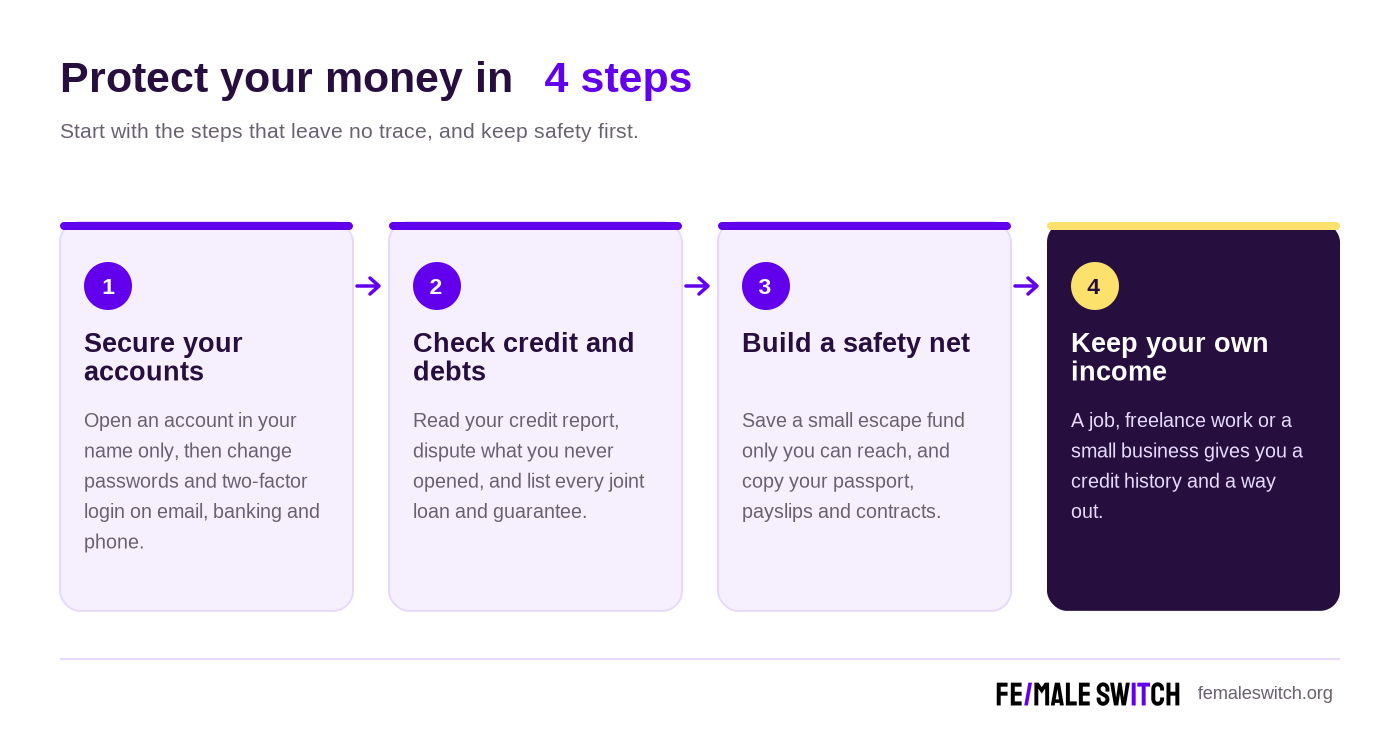
- Open a bank account in your name only, at a bank your partner does not use, with paperless statements. Our guide to business banking setup lists what to check in an account.
- Change passwords and two-factor authentication on email, banking and mobile accounts, and sign out every device you don't recognise.
- Check your credit report for loans, cards and contracts you never opened, and dispute them in writing.
- List every joint debt and guarantee with your name on it, and ask each lender what you are liable for.
- Build a small escape fund in a place only you can reach.
- Copy your documents: passport, payslips, tax returns, contracts and statements, kept with someone you trust.
- Keep an income of your own. A job, freelance work or a small business gives you a credit history and a way out. Start small with side hustles for women or self-funding a business while you work.
What does financial abuse mean for women founders?
Money of your own is the best protection against financial abuse, and founding a company is one of the fastest ways to build it. It also opens new doors for a controlling partner, so build your business with clear lines from day one:
- Separate business and household money. A business account in the company's name, with you as the only signatory, keeps revenue out of reach. Our guide to financial management for non-finance founders covers the setup.
- Put a partner's role in writing. If your partner invests, co-founds or lends money, a shareholder or loan agreement protects both of you. Start with our contracts and agreements basics.
- Think twice before personal guarantees. A guarantee signed under pressure can follow you after a breakup, and coerced debt wrecks the credit score you need for a business loan.
- Bootstrap with grants first. Non-dilutive money keeps control with you. See our guide to bootstrapping as a female founder and the list of grants for female entrepreneurs in Europe.
- Build your circle. A founder group, mentor or co-working community notices when something is wrong. Our overview of support systems for female entrepreneurs is a good place to start.
If you employ people, the same signs show up at work: a team member who has no access to her own pay, gets constant calls from a partner, or misses days without explanation. A one-page policy with flexible hours, paid leave for court dates and posted helpline numbers costs little. Our article on femicide in Europe lists more steps for employers, and what the man vs bear question tells us about safety explains why so many women stay quiet.
Where can women get help with financial abuse?
In an emergency, call 112 anywhere in the EU. These national helplines for women facing violence at home are free and confidential:
In the UK, the charity Surviving Economic Abuse publishes a free online guide to economic abuse, with advice on banking and debt. Ask your own bank whether it has a team for customers affected by domestic or economic abuse.
An income of your own starts with one idea you can test
The Fe/male Switch startup game takes you from idea to first paying customers in weekly quests, with an AI co-founder and a community of women founders. Build your own money at your own pace, and test the idea before you risk any savings.
👉 Start the game
What to remember about financial abuse
Financial abuse is control through money: an allowance you must beg for, a salary you never see, debts in your name and a career sabotaged. One in five women asked in the EU survey had faced it from a partner, and in the UK about 4.2 million women went through it in a single year. Learn the signs, open an account only you control, check your credit, and build an income of your own. A woman with her own money can leave sooner and more safely.
FAQ: financial abuse
What is financial abuse?
Financial abuse, also called economic abuse, is when a partner or family member controls, takes or sabotages your money, property, job or credit to keep power over you. The UK Domestic Abuse Act 2021 and the Istanbul Convention both treat it as a form of domestic abuse.
What are examples of financial abuse?
Being given an allowance, having to show receipts, a partner taking your salary, loans or cards opened in your name, being pushed to quit your job, and bills or child maintenance left unpaid on purpose.
How common is financial abuse?
In the EU gender-based violence survey, 20.3% of women who were asked had faced economic violence by a partner. In the UK, around 1 in 6 women, about 4.2 million, experienced economic abuse in the last year, according to Surviving Economic Abuse and TSB.
Is financial abuse a crime?
In England and Wales, controlling or coercive behaviour has been an offence since December 2015, with up to 5 years in prison, and economic abuse is part of the legal definition of domestic abuse. In the EU, national laws differ, and the 2024 directive on violence against women applies from June 2027.
What is coerced debt?
Coerced debt is credit taken out in your name, or signed by you under pressure, by an abusive partner. It leaves you with arrears and a damaged credit score after the relationship ends.
How can I protect my money from an abusive partner?
Open an account in your name only, change your passwords, check your credit report, list joint debts, save a small escape fund, copy your documents and keep an income of your own. Talk to a helpline first if your partner monitors your phone.
Can financial abuse continue after a breakup?
Yes. Ex-partners can delay settlements, refuse to sell a shared home, stop child maintenance or run up joint debts. Keep records of every payment and message.
How is financial abuse linked to femicide?
Financial abuse is one form of coercive control, and coercive control belongs to the wider partner violence that ends, at its worst, in femicide. Read our report on femicide in Europe for the country numbers and the new laws.
