
TL;DR: What is weaponized incompetence and what does it cost women?
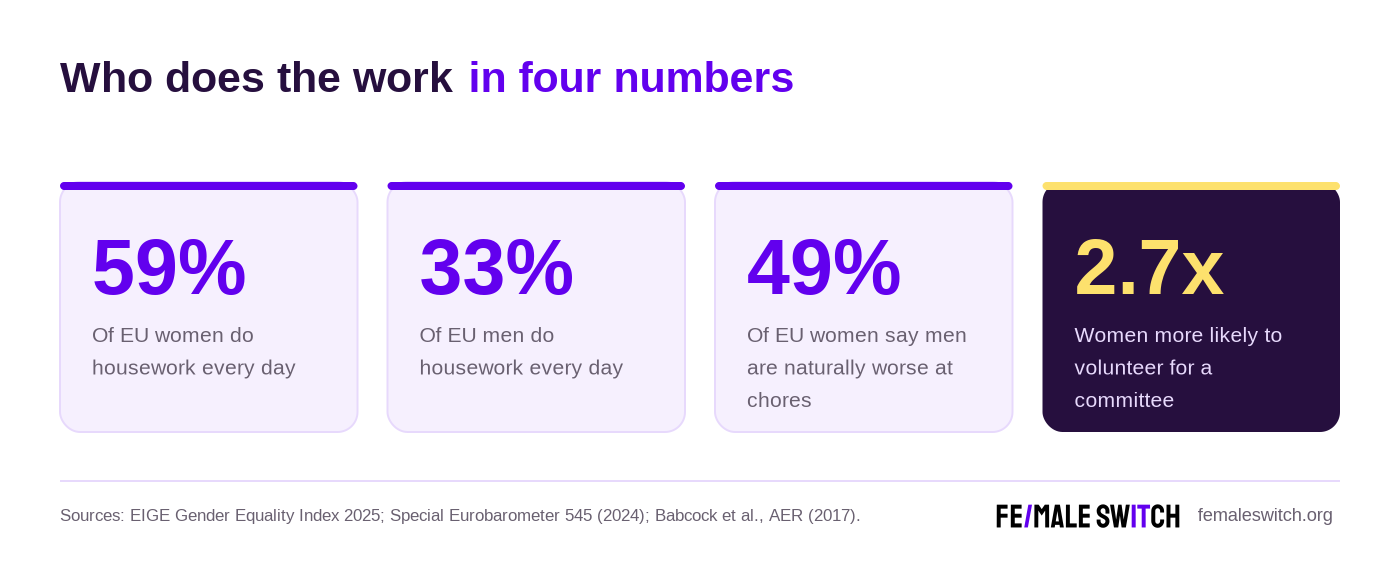
Weaponized incompetence is doing a task badly, or claiming you can't do it, so that someone else takes it over for good. In the EU, 59% of women do housework every day against 33% of men, according to EIGE's Gender Equality Index 2025, and nearly half of Europeans still believe men are naturally worse at chores. At work the same pattern pushes note-taking, event planning and committee seats onto women, and in one university study female faculty were 2.7 times more likely than men to volunteer for a committee. Spot the phrases, hand over whole tasks with the planning included, and guard the hours you need for paid and promotable work.
Weaponized incompetence is the gap between "I'm hopeless at laundry" and the person who quietly does all of it. The term went viral on TikTok as women posted the excuses they hear at home: the shrunken jumper, the forgotten school form, the "just tell me what you need". Behind the jokes sits hard data on who cooks, cleans, plans and takes the minutes. Here is what the term means, how big the gap is in Europe, the phrases to spot and the replies that work.
What is weaponized incompetence?
Weaponized incompetence, also called strategic incompetence, means faking or keeping a lack of skill so that a task moves to someone else. Psychology Today describes it as showing an inability to do a task, knowingly or unknowingly, so that others end up with more work. Psychologist Susan Albers told the Cleveland Clinic that social media has made far more people aware of the pattern. It is a popular-psychology term and no clinical diagnosis, so use it to describe behaviour, never to label a person.
The difference between real inexperience and weaponized incompetence is what happens next. A partner or colleague who is new to a task asks once, writes it down and gets better. Weaponized incompetence stays bad on purpose, and the reward is that the job never comes back. Meetings have their own version, and our guide to mansplaining, hepeating and manterrupting shows how women’s ideas get talked over or taken.
What does weaponized incompetence look like at home and at work?
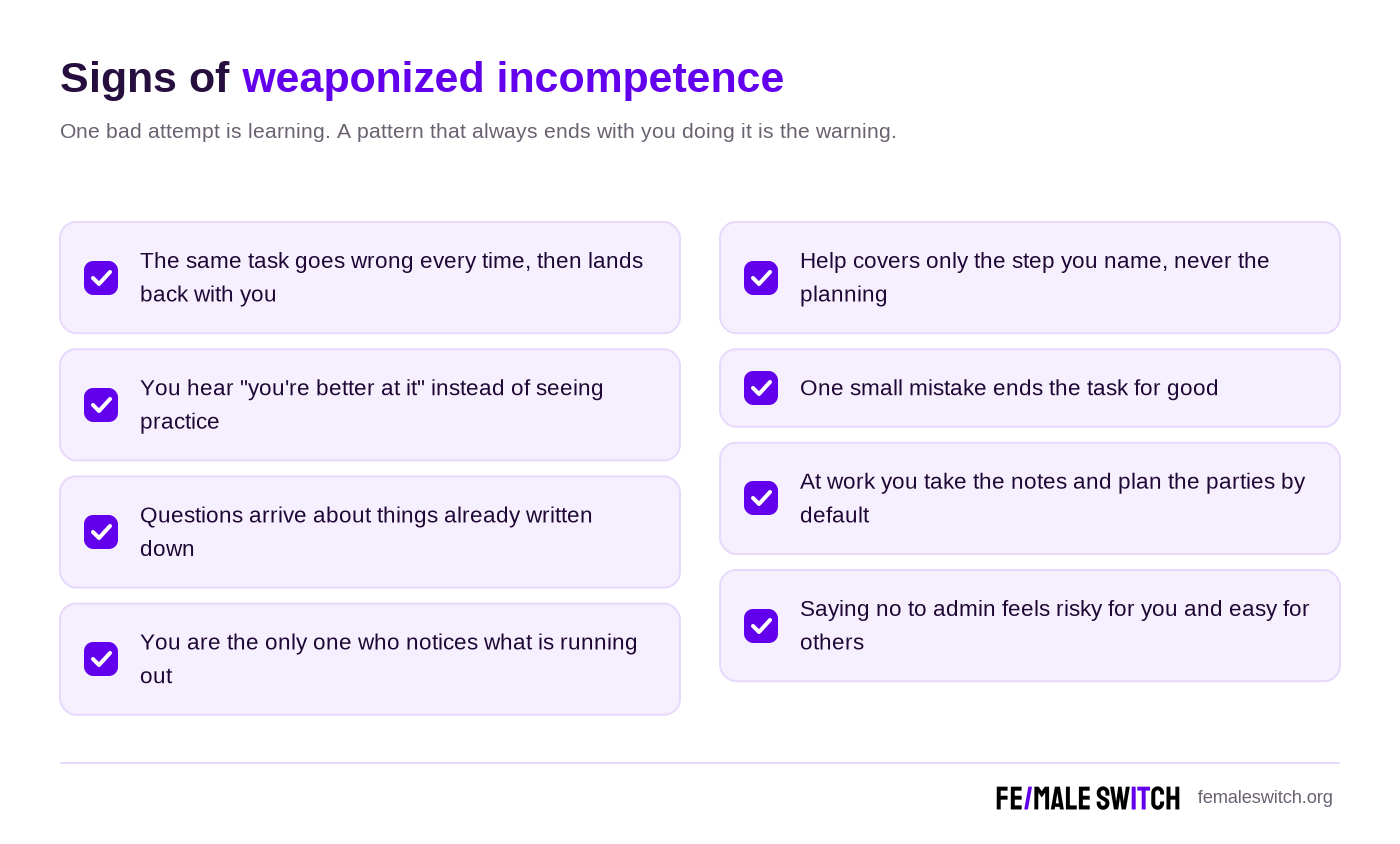
The tell is a phrase that ends with the task in your hands. These are the most common ones, what each one does, and a calm reply:
How big is the housework gap in Europe?
The newest numbers come from the European Institute for Gender Equality (EIGE), whose Gender Equality Index 2025 uses its own CARE survey from 2024. Across the EU, 59% of women aged 16 to 74 cook, clean or do laundry every day, compared with 33% of men. The gap is widest in couples with children, where 67% of women and 33% of men do daily housework, a gap of 34 percentage points.
Source: EIGE Gender Equality Index 2025, CARE survey 2024. The time domain, which measures care and free time, scores 65 out of 100 for the EU, and the whole Index sits at 63.4.
Men are 13 points more likely than women to get eight hours of leisure a week, and that free time is exactly what housework eats. Worldwide the picture is starker: the International Labour Organization (ILO) found in its 2018 care work report that women do 76.2% of all unpaid care work hours, more than three times as much as men.
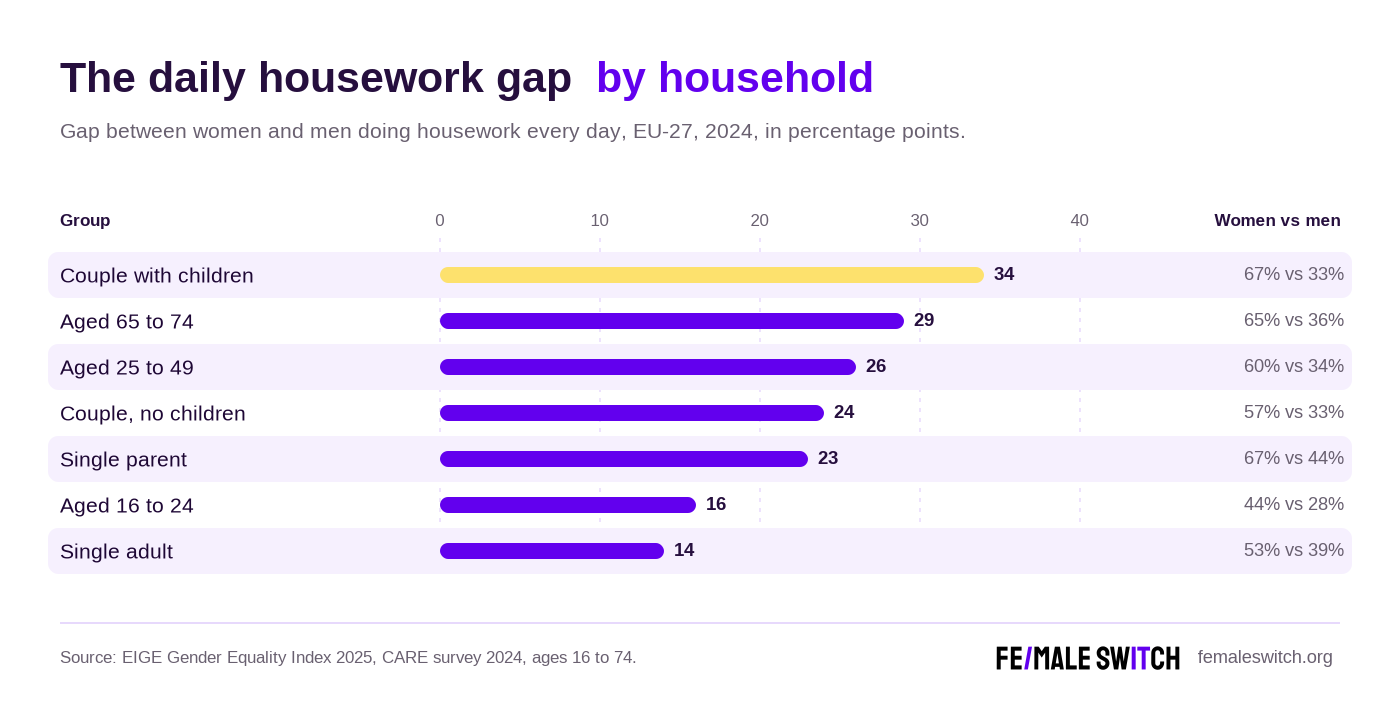
The gap starts young: 44% of women aged 16 to 24 do daily housework against 28% of young men. Our breakdown of the Gender Equality Index 2026 shows how slowly the time domain moves compared with work and money.
Why does the belief that men are bad at chores matter?
Weaponized incompetence works because people expect it. In the Special Eurobarometer 545 on gender stereotypes (2024), quoted in EIGE's report, 49% of women and 48% of men agreed that men are naturally less competent than women at household tasks. The belief is strongest in Hungary (74%), Poland (65% of women, 62% of men) and Slovakia (63%).
When half a society expects a man to fail at laundry, failing costs him nothing and pays off in free time. The good news sits in the age data: only 39% of young women share the belief, while young men are at 45%, so the expectation is fading fastest among the women who would otherwise inherit the work. Like the viral man vs bear question, the weaponized incompetence trend spread because women recognised their own lives in it.
What is the mental load behind weaponized incompetence?
Doing a chore is the visible part. Sociologist Allison Daminger's study in the American Sociological Review (2019), based on 70 interviews with 35 couples, split household thinking work into four steps: anticipating a need, identifying options, deciding and monitoring the result. Women did more of this cognitive labour overall, and far more of the anticipating and monitoring. Decision-making, the step that carries the most power, was roughly equal.
That explains why "just tell me what to do" lands so badly. The person saying it offers to do one errand and leaves the anticipating, planning and checking with you. Real sharing hands over all four steps, from noticing the empty fridge to checking what is left on Sunday.
How does weaponized incompetence show up at work?
Offices have their own version, and economists measured it. Linda Babcock, Maria Recalde, Lise Vesterlund and Laurie Weingart published the results in the American Economic Review in 2017. They call this work non-promotable tasks: jobs that help the organisation and do nothing for your career, such as taking minutes, organising events, sitting on committees and training new hires.
- The committee email. A request went to 3,271 faculty members at a large university. Only 3.7% volunteered for a faculty senate committee, and women were 2.7 times more likely to say yes than men.
- The lab test. In mixed groups of three, where one person had to take a low-paying task, women volunteered about 34% of the time and men about 23%. In single-sex groups the gap disappeared.
- The ask. Both men and women were 12 percentage points more likely to ask a woman to volunteer than a man.
- The hours. In their 2022 book The No Club, the four authors and Brenda Peyser report that at one professional services firm, women spent about 200 more hours a year on non-promotable work than men.
Two hundred hours is five working weeks a year spent on work that never shows up in a promotion case. "I'm terrible with the calendar" or "you're so organised" are the office forms of weaponized incompetence, and the research shows the request lands on women first. Our analysis of the gender pay gap in tech shows where those lost hours end up.
How do you respond to weaponized incompetence?
Labels start fights, and systems end them. These steps work at home and at work:
- Describe the pattern, skip the label. "The bins went out late three weeks running, and I ended up doing it" opens a talk. "You're weaponizing incompetence" ends one.
- Hand over whole tasks. Give the full job, from noticing to checking, so the planning moves too. "You own school forms" beats "sign this one".
- Write the standard once. A one-page note on how the laundry or the monthly report gets done removes the "I didn't know" defence.
- Accept a different result. Folded differently is still folded. Redoing someone's work teaches them that you will always step in.
- Count the hours. Track one normal week of chores, admin and office housework. Numbers move a conversation faster than feelings.
- At work, rotate and redirect. Propose a rotation for minutes and events, and answer requests with your current priority before you say yes.
If a partner refuses every change and also controls money, friends or your movements, the problem is bigger than chores. Our guide to financial abuse lists the signs of coercive control and where to get help.
Which companies are making equal sharing easier?
Leave policy shapes who becomes the default parent, and a few employers changed it. These are published company policies and company figures:
Attitudes are ahead of practice. EIGE's CARE survey found that 82% of women and 78% of men in the EU back equal sharing of parental leave, yet 17% of women and 21% of men still link a father's leave to a lack of career ambition. Our article on maternity leave and founding a startup covers what self-employed mothers can claim.
What does weaponized incompetence mean for women founders?
For a founder, time is runway. Every hour spent on chores someone else dodges, or on admin nobody else picks up, comes out of selling, building and resting. Here is how to protect it:
- Audit your week first. List the hours that go to home, to unpaid admin and to the business. Our guide to balancing work and life as a woman founder helps you set limits that match your stage.
- Watch for burnout signals. A double shift of startup and home is the fastest way to empty the tank. Read our burnout prevention guide for founders before the warning signs stack up.
- Split startup chores in writing. Bookkeeping, investor updates and event logistics are the office housework of a startup. Put them in the co-founder agreement. See how to find a co-founder as a woman.
- Automate what nobody wants. Invoices, reminders and scheduling can run without you. Start with automating your business without developers and time management for solo entrepreneurs.
- Build fair rules for your first hires. Rotate minutes and event duty from day one, and give every task an owner. Our guide to building a successful team shows how to set them up.
Founders also set the norm for everyone they hire. A company where the founder rotates the dull jobs and offers equal leave tells its first ten people that care work belongs to everyone. Find women who already run their companies this way through our support systems for female entrepreneurs.
Win back your hours and test your idea in weekly steps
The Fe/male Switch startup game takes you from idea to first paying customers in short weekly quests, with an AI co-founder that picks up the busywork and a community of women founders. Build at your own pace and spend your time on the tasks that move your business.
👉 Start the game
What to remember about weaponized incompetence
Weaponized incompetence turns low expectations into free time for one person and extra work for another. In the EU, 59% of women do housework every day against 33% of men, half of Europeans still think men are naturally worse at chores, and at work women get asked first for the tasks that never lead to promotion. Name the pattern calmly, hand over whole tasks with the planning included, stop redoing other people's work and count your hours. For a woman building a business, those hours are her runway.
FAQ: weaponized incompetence
What does weaponized incompetence mean?
Weaponized incompetence means doing a task badly, or claiming you can't do it, so that someone else takes it over. It is also called strategic incompetence. Psychologists use it as a popular term for a behaviour pattern, and it is no clinical diagnosis.
What are examples of weaponized incompetence?
Shrinking clothes so you are never asked to do laundry again, asking "just tell me what to do" instead of planning, "forgetting" school forms, and at work saying you are hopeless at taking notes or organising events so a colleague does it.
Is weaponized incompetence a gender issue?
Anyone can use it, but the work flows mostly one way. EIGE's 2025 data show 59% of EU women do housework every day against 33% of men, and 49% of women and 48% of men believe men are naturally less competent at household tasks.
What is the difference between weaponized incompetence and the mental load?
The mental load is the thinking work of running a home: anticipating needs, finding options, deciding and checking. Weaponized incompetence is one way that work stays with one partner, because the other offers to do single errands and leaves the planning behind.
How do you deal with weaponized incompetence at work?
Propose a rotation for minutes, events and committee seats, give every task a named owner, and answer new requests with your current priority before agreeing. Research by Babcock and colleagues shows women get asked first, so team leads have to share these tasks on purpose.
How do you talk to a partner about weaponized incompetence?
Describe specific events instead of using the label, hand over whole tasks including the planning, agree on a written standard and accept results that differ from yours. Track one week of chores so you both see the hours.
Is weaponized incompetence a form of abuse?
On its own it is an unfair split of work. When it comes with control over money, friends or movement, it can be part of coercive control. Read our guide to financial abuse for the signs and for helplines.
