
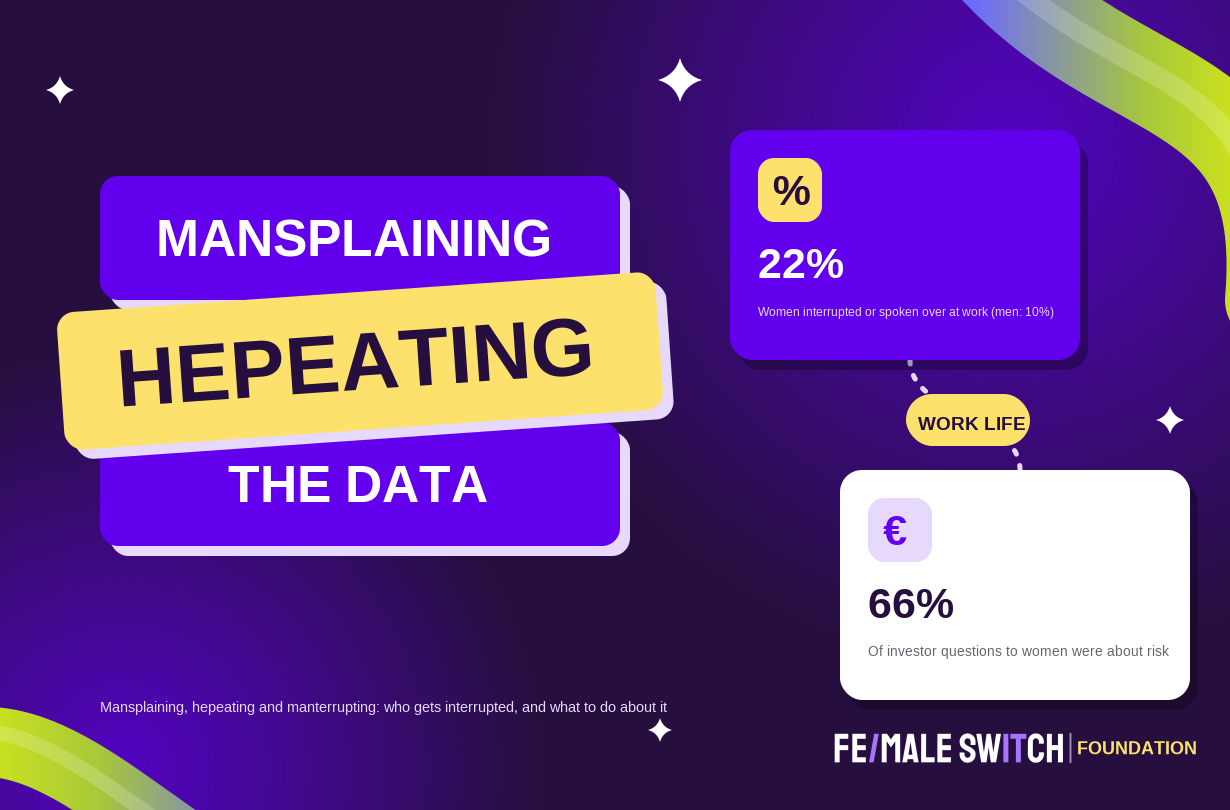
TL;DR: What do mansplaining, hepeating and manterrupting mean, and what does the data say?
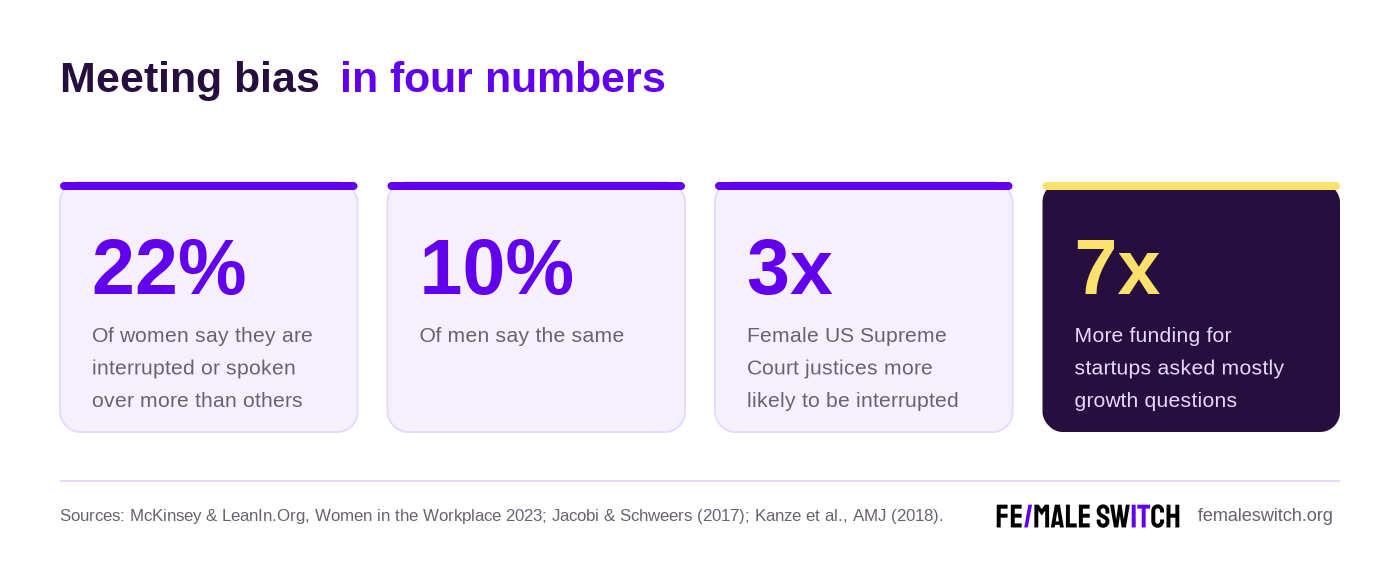
Mansplaining is a man explaining something to a woman, in a condescending way, that she already knows. Hepeating is a man repeating a woman's idea and getting the credit, and manterrupting is a man cutting a woman off without need. The numbers back the jokes: in McKinsey and LeanIn.Org's Women in the Workplace 2023 study, 22% of women said they get interrupted or spoken over more than others, against 10% of men. In pitch meetings, 66% of investors' questions to women founders were about risk, and startups asked mostly growth questions raised about seven times more money. Learn the words, use a few calm lines that win back the floor, and change how your own meetings run.
Mansplaining became a household word because almost every woman has a story to go with it: the man who explained her own research to her, the client who asked to speak to "the technical person", the colleague who repeated her idea ten minutes later and got the nods. Researchers have measured all of it, from office surveys to Supreme Court transcripts to startup pitch competitions. Here is what the three words mean, where they came from, what the data shows and what to say in the moment.
What is mansplaining?
Mansplaining is when a man explains something to a woman in a patronising way, assuming she knows less than he does, even on a subject she knows better. The word blends "man" and "explaining". It traces back to the essay Men Explain Things to Me by writer Rebecca Solnit, published on TomDispatch on 13 April 2008. Solnit described a man at a party who lectured her about a book on her own subject, without hearing that she had written it.
Solnit never used the word herself. Readers coined it online in the months after the essay went viral, and in 2014 Oxford Dictionaries added "mansplain" to its online dictionary. A single explanation is fine. Mansplaining is the repeated assumption that the woman in the room is the one who needs things explained.
What do hepeating and manterrupting mean?
Two newer words describe what happens to women's ideas in meetings. Both started as jokes between friends and spread because they named something people saw every week.
Gugliucci's tweet described the moment many women know: you suggest something, nobody reacts, a man says the same thing and everyone loves it. Bennett's Time article gave meeting interruptions a name the same way, and her definition was blunt: an unnecessary interruption of a woman by a man.
How many women get interrupted in meetings?
The largest workplace data set comes from Women in the Workplace, the annual study by McKinsey and LeanIn.Org of women in US companies. In the 2023 report, women were more than twice as likely as men to say they get interrupted or spoken over more than others. The same study tracks who gets promoted, and our glass ceiling glossary explains the broken rung, the glass cliff and the sticky floor with the 2025 numbers.
Source: McKinsey and LeanIn.Org, Women in the Workplace 2023. "Others got credit for their ideas" is hepeating in survey form, and one woman in five reports it.
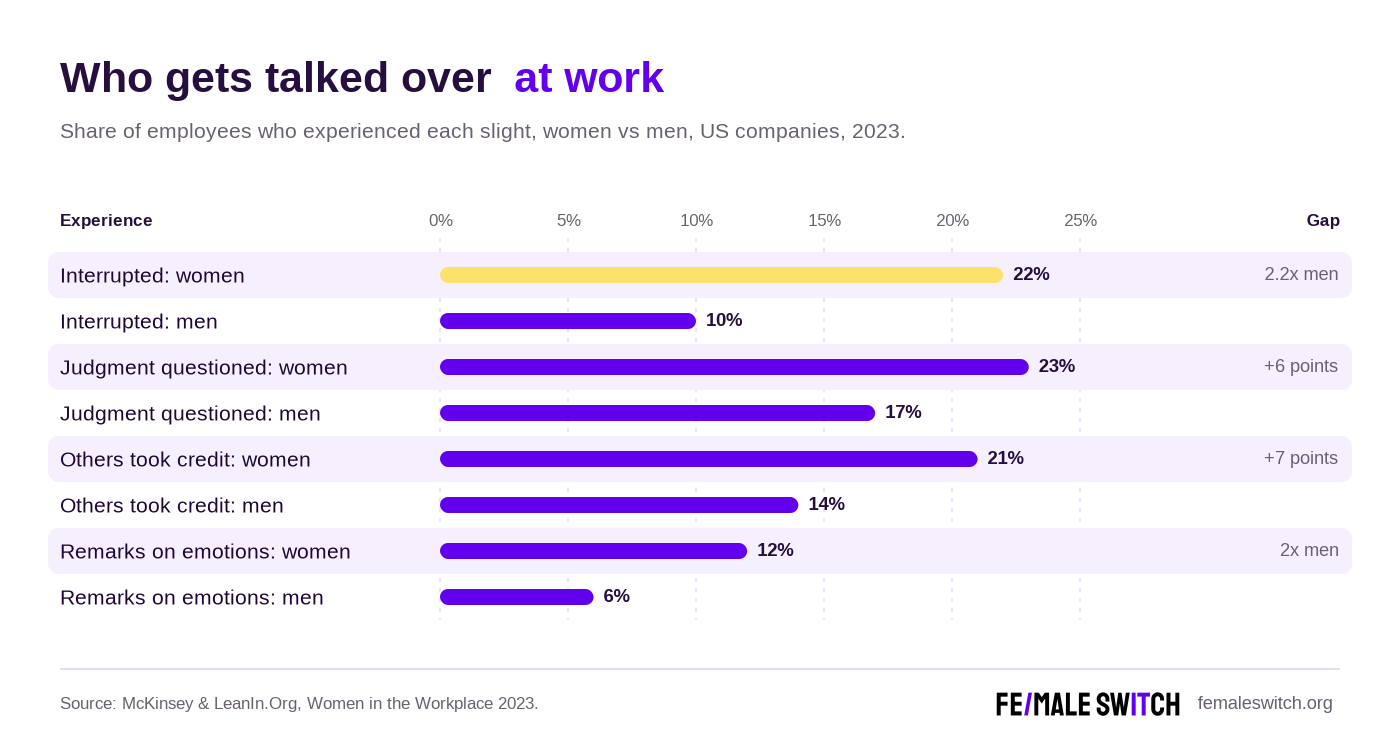
There is progress. The 2024 report found that both men and women were less likely to be interrupted than five years earlier, which the authors read as a sign that awareness changes behaviour. Women were still twice as likely as men to be talked over. The cost is real: women who faced three or more of these slights were 2.7 times more likely to consider leaving their company and 4.2 times more likely to feel burned out almost all the time. In 2023, 78% of women who faced them said they change how they look or act at work to protect themselves, and for many that means speaking up less.
Do women get interrupted more even at the top?
Rank does not switch it off. Law professor Tonja Jacobi and Dylan Schweers analysed oral arguments at the US Supreme Court and published the results in the Virginia Law Review in 2017. Women were interrupted at disproportionate rates, by their male colleagues on the bench and by male lawyers arguing before them.
- The share. From 2004 to 2015, women made up 24% of the justices on average, yet 32% of all interruptions happened to them.
- The other direction. Female justices made only 4% of the interruptions.
- The trend. From 2011 to 2015, with three women on the court, female justices were about three times more likely to be interrupted than male justices.
Women interrupt women too. In a lab study by researchers Hancock and Rubin in the Journal of Language and Social Psychology, 40 people held three-minute conversations. Men interrupted a female partner 2.6 times on average and a male partner 2.0 times. Women interrupted a female partner 2.8 times and a male partner just 1.0 times, according to The New Republic's report on the study. The habit belongs to the room, so the fix has to cover the whole room.
Why do women talk less in meetings?
Because speaking up carries a different price. Yale psychologist Victoria Brescoll tested it in a 2011 paper in Administrative Science Quarterly. First she measured floor time in the US Senate: powerful male senators spoke longer than junior ones, and for female senators power made no difference to how much they spoke.
Then she ran an experiment with 156 people who rated fictional CEOs. A female CEO who talked more than others was rated less competent and less fit to lead, by men and women alike, and a male CEO who did the same was rated higher. In a 2015 New York Times essay, Adam Grant and Sheryl Sandberg summed up the gap: talkative men got 10% higher competence ratings, talkative women 14% lower. Read together with the interruption data, the message women receive is clear: talk more and you look pushy, talk less and someone else takes the idea. Like weaponized incompetence, meeting bias works because everyone expects it.
How does meeting bias show up in pitch meetings?
For founders, the most expensive meeting is the pitch. Dana Kanze, Laura Huang, Mark Conley and E. Tory Higgins studied question-and-answer sessions at TechCrunch Disrupt New York City from 2010 to 2016: 189 entrepreneurs, 12% of them women, facing 140 investors and almost 2,000 questions. Their results appeared in the Academy of Management Journal in 2018.
Sources: Kanze et al., Academy of Management Journal (2018); London Business School; Fortune. A woman founder hears "How will you hold off bigger rivals?" while the man before her gets "How big can this get?". Each question sets the frame for the answer, and the answer sets the cheque.
What can you say in the moment?
Short, calm lines work better than a debate in the middle of a meeting. Pick the one that fits, say it in a neutral tone and carry on:
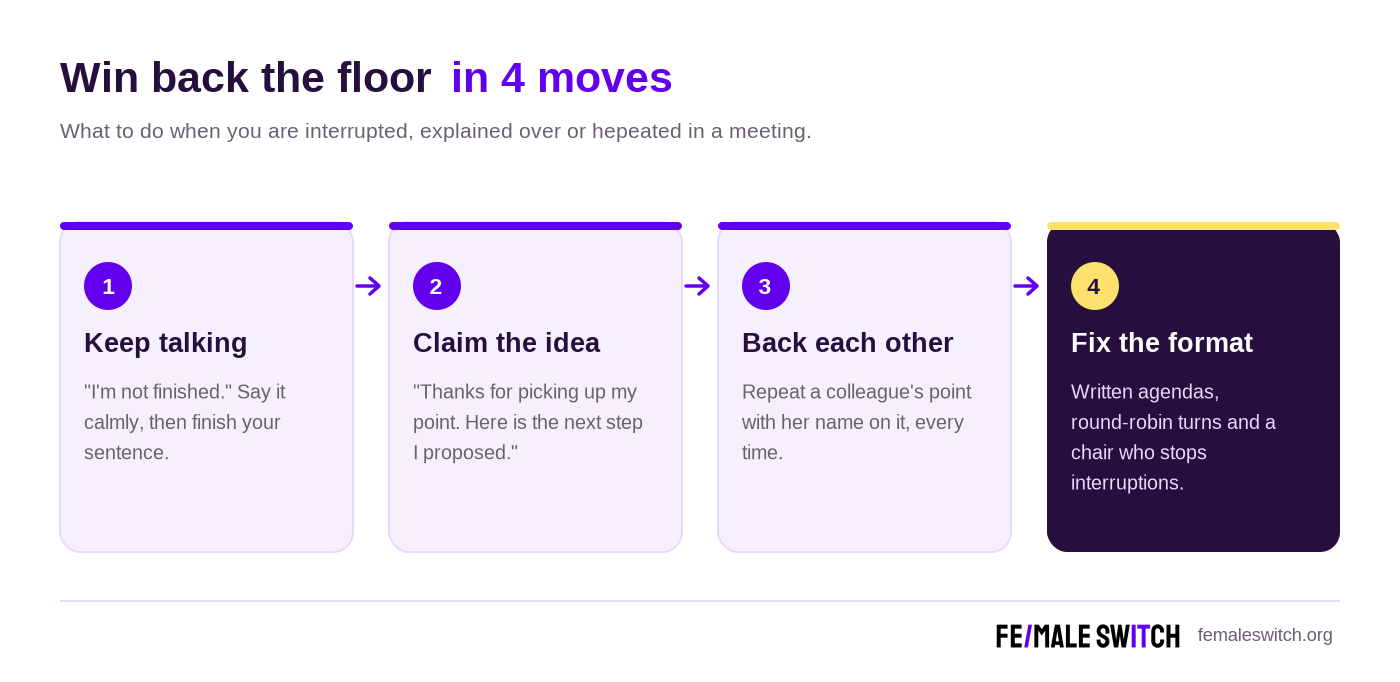
The last line in the table comes straight from the Kanze research: founders who answered prevention questions with promotion answers raised far more. You can't control the question, and you can always choose the frame of your answer.
How do you run meetings where nobody gets talked over?
Individual comebacks help one woman at a time. Changing the format helps everyone. These steps cost nothing:
- Send a written agenda with owners. When the doc says whose idea it is, hepeating gets harder.
- Collect ideas in writing first. Two minutes of silent notes before discussion gives quieter people a head start.
- Go round the table. Round-robin turns stop the loudest voice from taking all the time.
- Name a chair who protects the speaker. "Let her finish" from the person running the meeting works faster than any comeback.
- Agree on amplification. Ask colleagues to repeat good points with the author's name, the way the White House staff did in 2016.
- Credit in the minutes. Write the name next to every idea in the notes and the follow-up email.
What does meeting bias mean for women founders?
For a founder, being talked over costs deals, hires and funding rounds. Here is how to turn the research into an advantage:
- Prepare for the risk questions. Write your two-sentence answers to the likely prevention questions, each ending with a growth point. Our guide to pitching to investors as a woman covers the full pitch, and our pitch deck examples from women founders show how others framed it.
- Know the funding gap you face. The questions are one reason women get less money. Read our breakdown of the startup funding gender gap and the list of angel investors backing women.
- Research the room. Know who sits on the panel and what they funded before. Our guide to venture capital for female founders explains how to research a fund before you pitch.
- Own your name in public. A strong profile makes your ideas harder to take. See our guide to personal branding for founders.
- Build allies who repeat your name. Mentors and peers can repeat your point in rooms you are not in. Start with how to find female mentors and our communities for female entrepreneurs.
- Set the rules in your own company. Agendas, round-robin turns and credit in the minutes are easy to start with ten people and hard to add with a hundred. Our guides to diversity in startup teams and women in tech leadership show where to begin.
Practise your pitch before the real room
The Fe/male Switch startup game takes you from idea to first paying customers in short weekly quests, with an AI co-founder and a community of women founders. Test your story, rehearse the tough questions and walk into investor meetings ready to steer them.
👉 Start the game
What to remember about mansplaining
Mansplaining, hepeating and manterrupting are jokes with numbers behind them. Women in US companies are twice as likely as men to be talked over, female Supreme Court justices were three times more likely to be interrupted than their male colleagues, and women founders get questions about risk while men get questions about growth, at a cost of millions. Learn the calm lines, back up the women around you, change the format of the meetings you run and prepare growth answers for every risk question. The floor belongs to the person with the idea, and the research shows how to keep it.
FAQ: mansplaining, hepeating and manterrupting
What does mansplaining mean?
Mansplaining means a man explaining something to a woman in a condescending way, assuming she knows less, even on a topic she knows better. The word was inspired by Rebecca Solnit's 2008 essay Men Explain Things to Me and entered Oxford Dictionaries online in 2014.
Who coined the word mansplaining?
Nobody knows exactly. Rebecca Solnit's 2008 essay inspired it, but she never used the word. Readers coined it online soon after the essay spread.
What is hepeating?
Hepeating is when a woman's idea is ignored and then a man repeats it and gets the credit. Astronomer Nicole Gugliucci spread the word in a tweet on 22 September 2017 and credited her friends with coining it.
What is manterrupting?
Manterrupting is a man interrupting a woman without need. Journalist Jessica Bennett made the term popular in Time magazine in January 2015 and in her 2016 book Feminist Fight Club.
Are women really interrupted more than men?
Yes. In McKinsey and LeanIn.Org's Women in the Workplace 2023 study, 22% of women said they were interrupted or spoken over more than others, against 10% of men. A lab study by Hancock and Rubin found that both men and women interrupted female partners more.
How should you respond to mansplaining?
Stay calm and short: "I know this area well, the part I'd like input on is X." When someone talks over you, say "I'm not finished" and complete your point. When your idea is repeated, thank the person for picking up your suggestion and add the next step.
Do investors ask women founders different questions?
Yes. In a study of TechCrunch Disrupt New York City pitches from 2010 to 2016, 66% of questions to women were about risk and safety, and 67% of questions to men were about growth. Startups asked mostly growth questions raised about seven times more. Our guide to pitching to investors as a woman shows how to answer.
Is mansplaining a form of sexism?
Researchers count interruptions, credit-taking and patronising explanations as everyday slights, or microaggressions, rooted in assumptions about who is competent. For the bigger picture of how women are treated differently, read our articles on the man vs bear question and financial abuse.
