
TL;DR: What is the glass ceiling, and what do the glass cliff, broken rung and sticky floor mean?
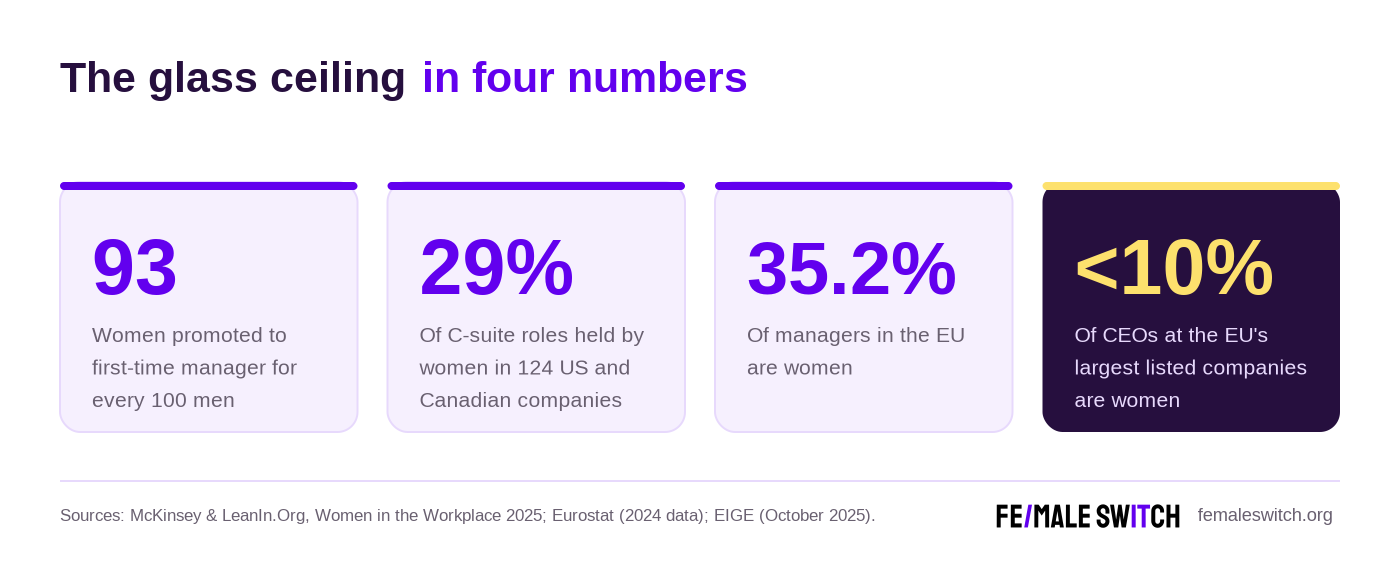
Glass ceiling is the name for the invisible barrier that keeps women out of the top jobs. The newer terms show where the barrier really sits: the broken rung at the first promotion to manager, the sticky floor of low-paid jobs, and the glass cliff of top jobs handed to women during a crisis. In 2025, only 93 women were promoted to manager for every 100 men in McKinsey and LeanIn.Org's study of 124 companies, and in the EU women hold just under 10% of CEO seats at the largest listed companies. The biggest lever is sponsorship: 65% of employees with a sponsor were promoted within two years, against 35% of those without one.
The glass ceiling is almost fifty years old as a phrase, and it still describes the view from most boardrooms. The picture has changed, though. Researchers found that the ceiling is only the last of several barriers, and the first one sits much lower, at the step from entry level to manager. This glossary explains every term for the career gap, where each one came from, what the latest European and American data shows, and what it means if you are building your own company.
What is the glass ceiling?
The glass ceiling is an invisible barrier that stops women, and people from minority groups, from reaching senior positions even when they have the skills and experience. It is called glass because nobody can see it in a policy or a job ad, and a ceiling because it caps how high people rise.
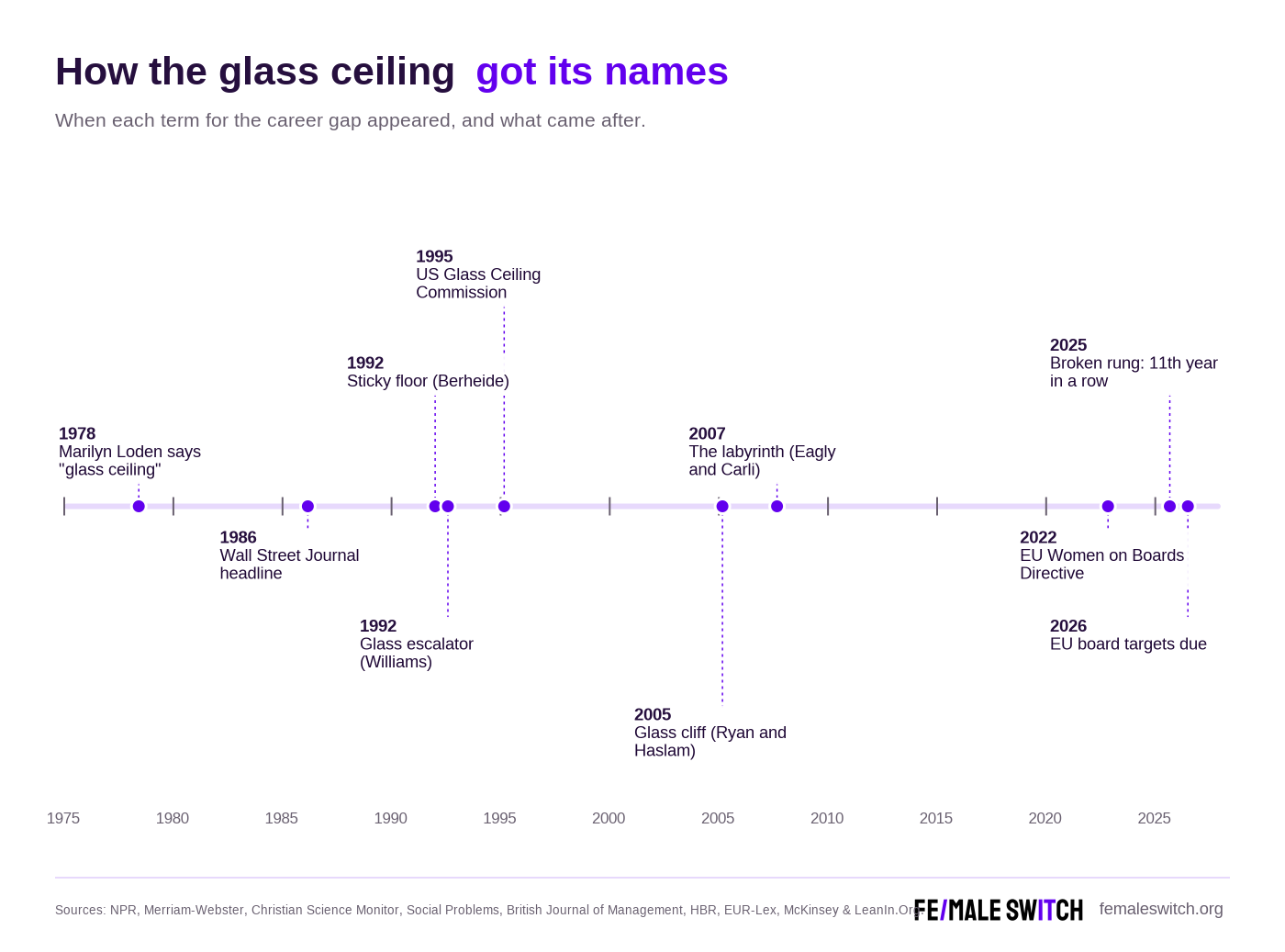
The phrase is credited to Marilyn Loden, a management consultant who used it on a panel at the 1978 Women's Exposition in New York, as NPR recalled in her 2022 obituary. She later said the phrase came to her in the moment, while she was speaking, to describe a barrier built into organisations that held women back no matter how well they performed. The phrase was in print by 1984, the year Merriam-Webster gives as its first known use, and in 1986 a Wall Street Journal headline took it to the mainstream: The Glass Ceiling: Why Women Can't Seem to Break the Invisible Barrier That Blocks Them From the Top Jobs.
By 1995 the US government had a Federal Glass Ceiling Commission. Its fact-finding report found that 95 to 97% of senior managers at Fortune 1000 industrial and Fortune 500 companies were men. That number has moved a lot since, and the ceiling still holds: women ran 55 of the Fortune 500 companies on the June 2026 list, about 11%, according to Fortune.
What is the difference between the glass ceiling, broken rung, sticky floor and glass cliff?
Each term points to a different part of the ladder:
What is the broken rung, and why does it matter more than the ceiling?
The broken rung is the first promotion, from entry level to manager. Women miss it at a higher rate than men, so men outnumber women at manager level and women never catch up higher up. In Women in the Workplace 2025, the annual McKinsey and LeanIn.Org study of 124 companies in the United States and Canada, only 93 women were promoted to manager for every 100 men. The gap was wider for women of colour: 82 Asian women, 82 Latinas and just 60 Black women.
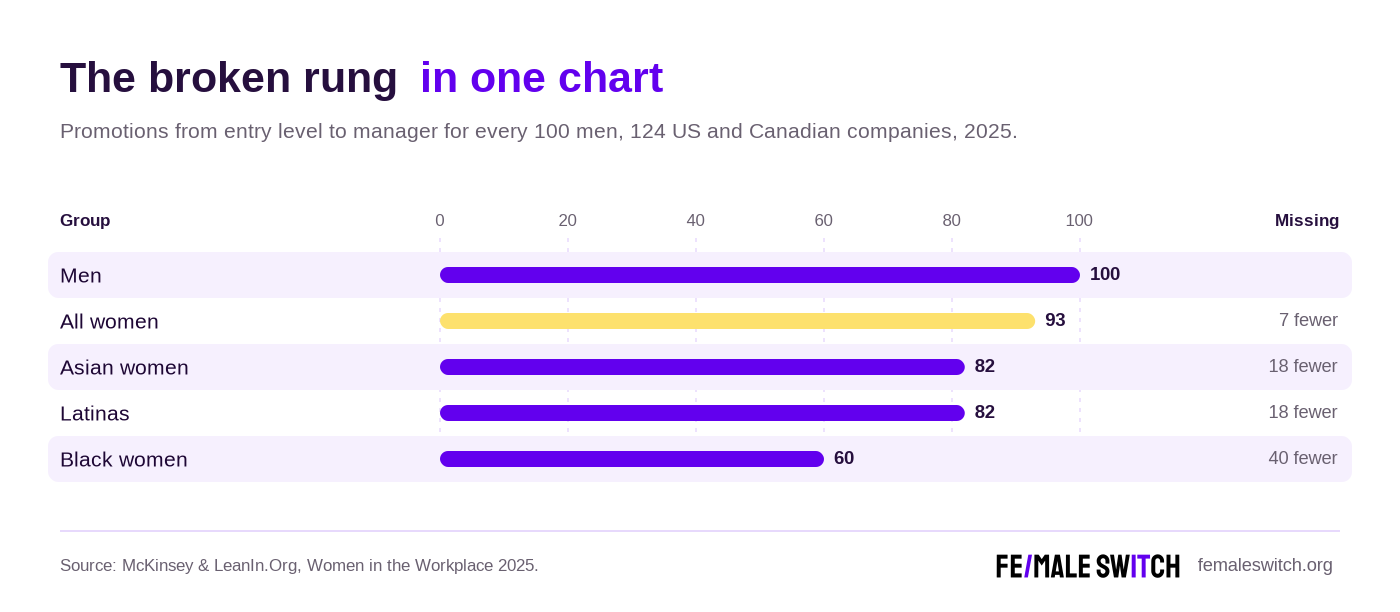
The report says the broken rung has held for 11 consecutive years. Women held 29% of C-suite roles in 2025, unchanged from 2024. The authors add a warning: the companies that shared data this year employ more women than typical companies did from 2021 to 2024, so the real gap is wider than these numbers show. Here is why the rung matters more than the ceiling. A company that fixes promotions only at the top is choosing from a pool that was already filtered years earlier.
Is there really an ambition gap between women and men?
For the first time in the study's history, the 2025 report found a gap in ambition: 80% of women wanted to be promoted to the next level, against 86% of men. The data underneath explains it.
A sponsor is a senior person, other than your manager, who argues for your promotion and opens doors for you. When women and men had sponsors and similar support from managers, the report found, the gap in desire to advance fell away at every career level. So the ambition gap is a support gap. Women who get less backing want the next step less, and anyone who has spent years asking for a promotion nobody argued for knows the feeling.
What is the glass cliff?
The glass cliff describes women getting top jobs at the worst moment: when a company, a team or a political party is already in trouble. The leader then takes the blame for a fall that had started before she arrived.
Psychologists Michelle Ryan and Alex Haslam of the University of Exeter named it in a 2005 paper in the British Journal of Management. They were answering a 2003 article in The Times, which claimed that companies with more women on their boards performed worse. Ryan and Haslam looked at FTSE 100 share prices before and after board appointments. Companies that appointed women had tended to perform badly in the months before the appointment. The poor results came first and the women came second, the reverse of the newspaper's story.
For anyone offered a big role, the lesson is practical: ask why the job is open, what the numbers look like, and what support and budget come with it, before you say yes.
What are the sticky floor and the glass escalator?
The sticky floor is the opposite end of the ladder. Sociologist Catherine White Berheide coined it in 1992 in work for the Center for Women in Government, as the Christian Science Monitor reported the next year. It describes women concentrated in low-paid jobs with short career ladders, where there is little to climb at all.
The glass escalator shows the same bias running in reverse. Sociologist Christine L. Williams interviewed 99 men and women in nursing, elementary school teaching, librarianship and social work for a 1992 paper in Social Problems. Men in these fields were carried up to the top administrative posts at higher rates than the women around them. In 2013 Williams revisited the idea and said her first paper missed race, class and sexuality: the escalator carries white, middle-class men most clearly.
How high is the glass ceiling in Europe?
Women held 35.2% of management jobs in the EU in 2024, up from 31.8% in 2014, according to Eurostat. Sweden led with 44.4%, followed by Latvia (43.4%) and Poland (41.8%). Cyprus had the lowest share at 25.3%, with Croatia (27.6%) and Italy (27.9%) close behind.
The higher the seat, the thinner the share. The European Institute for Gender Equality (EIGE) tracks the largest listed companies in every member state:
Sources: EIGE, Gender balance in business and finance 2025; EIGE director's note, June 2026. The board numbers moved because of law. The EU Women on Boards Directive, adopted in November 2022, required listed companies to reach 40% of each gender among non-executive directors, or 33% among all directors, by June 2026. Non-executive seats, where the quota applies, filled up fast. Executive roles and the CEO chair, which no quota touches, barely moved. The same pattern shows up in pay: read our breakdown of the gender pay gap in Europe and the Gender Equality Index 2026 for the wider picture.
What actually breaks the glass ceiling?
The research points to fixes at the bottom of the ladder as well as at the top. These are the moves with the strongest evidence behind them:
- Fix the first promotion. Track who gets promoted from entry level to manager, by gender, every cycle. The broken rung only closes when someone counts it.
- Write promotion criteria down. Clear, published criteria leave less room for gut feeling, and Women in the Workplace lists merit-based hiring and promotions as its first strategy.
- Turn mentors into sponsors. Mentors give advice, and sponsors put your name forward for the job. With a 65% vs 35% promotion gap between those with and without sponsors, this is the cheapest fix on the list.
- Ask about the cliff. Before you accept a rescue job, get the numbers, the budget and the board's support in writing.
- Back each other in public. Credit colleagues' work by name in meetings, the way our guide to mansplaining and meeting bias describes.
What does the glass ceiling mean for women founders?
Founding a company removes the corporate ladder, and the same patterns follow women into funding rounds, boardrooms and hiring. As a founder you also get to build the ladder yourself. Here is how to use the research:
- Find sponsors as well as mentors. Investors, advisors and senior founders who will say your name in rooms you are not in are worth more than general advice. Start with our guide on how to find female mentors and the role of advisors and mentors in a startup.
- Study the leadership gap in your sector. Our guide to women in tech leadership shows where women lead in tech and what helped them get there, and the gender gap in tech data gives the numbers.
- Expect the gap in funding too. The ceiling has a venture capital version. Read the startup funding gender gap before your first round.
- Build a promotion ladder from employee one. Written levels, pay bands and promotion criteria cost nothing at five people. Our article on career progression for female developers shows what women want from a ladder, and the pay gap in the tech industry shows what happens without one.
- Watch the work that never gets credit. Office housework and invisible tasks stall careers inside startups too. Our piece on weaponized incompetence covers how that work lands on women.
Skip the ladder and build your own company
The Fe/male Switch startup game takes you from idea to first paying customers in short weekly quests, with an AI co-founder and a community of women founders. Test your idea, practise the investor questions and build the company you would want to work for.
👉 Start the game
What to remember about the glass ceiling
The glass ceiling is real, and it starts lower than the name suggests. In 2025, 93 women were promoted to their first manager job for every 100 men, and only 60 Black women. In the EU women hold 35.2% of management jobs and fewer than one in ten CEO seats at the largest listed companies, even after a quota pushed boards close to 40%. The ambition gap disappears when women get the same sponsorship as men, so the fix is concrete: count first promotions, write down the criteria, and turn mentors into sponsors. If you run a company, you can build that ladder from day one.
FAQ: the glass ceiling and the career gap
What is the glass ceiling?
The glass ceiling is an invisible barrier that keeps women and people from minority groups out of senior jobs, even when they are qualified. It is not written in any policy, which is why it is called glass.
Who coined the term glass ceiling?
Management consultant Marilyn Loden is credited with the phrase, which she used on a panel at the 1978 Women's Exposition in New York. A 1986 Wall Street Journal headline made it widely known.
What is the broken rung?
The broken rung is the first promotion from entry level to manager, where women fall behind men. In McKinsey and LeanIn.Org's Women in the Workplace 2025, 93 women were promoted to manager for every 100 men, a pattern that has held for 11 years in a row.
What is the glass cliff?
The glass cliff is the pattern of women being appointed to top jobs when an organisation is already struggling. Michelle Ryan and Alex Haslam of the University of Exeter named it in 2005 after studying FTSE 100 board appointments.
What is the difference between the glass ceiling and the sticky floor?
The glass ceiling blocks women near the top. The sticky floor, a term coined by sociologist Catherine White Berheide in 1992, keeps women in low-paid jobs with little room to move up at all.
Do women want promotions less than men?
In the 2025 Women in the Workplace study, 80% of women and 86% of men wanted to be promoted. When women had the same sponsorship and manager support as men, the gap disappeared.
How many CEOs in Europe are women?
Fewer than one in ten. According to the European Institute for Gender Equality, women were just under 10% of CEOs at the EU's largest listed companies in October 2025, while they held 38.2% of non-executive board seats. Our article on the gender pay gap in Europe shows how the gap shows up in pay.
How does the glass ceiling connect to other ways women are treated differently?
Meeting bias, invisible housework and money control all slow women's careers. Read our articles on mansplaining, financial abuse and the man vs bear question for the rest of the series.
