
TL;DR: what did Spain announce for women-led startups?
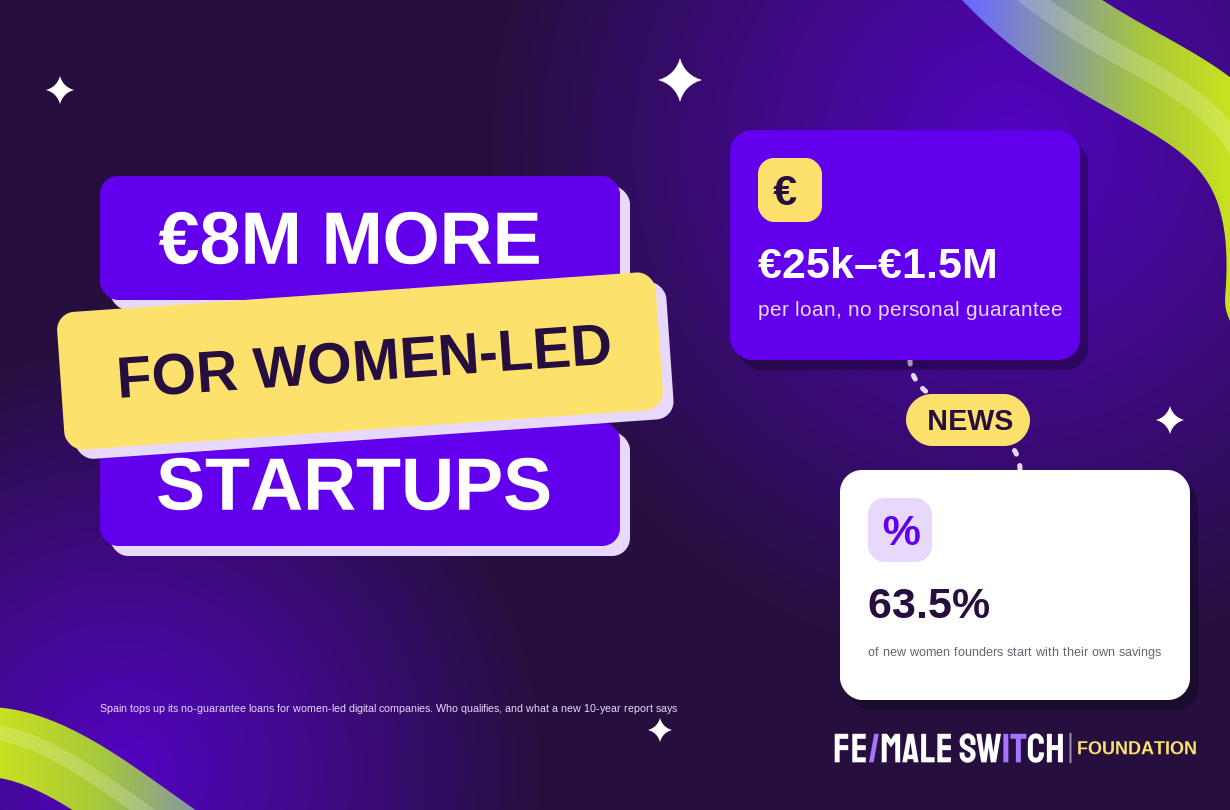
On 16 November 2026, Spain’s Ministry for Digital Transformation and the state lender Enisa agreed another €8 million for “Emprendedoras Digitales”, a programme of loans for digital companies led by women. Each loan is between €25,000 and €1.5 million, with no personal guarantee, up to 7 years to repay and interest partly linked to your results. Applications are open at enisa.es. A week earlier, a 10-year GEM Spain report showed why the money matters: since 2015, the share of women who start a business has risen, but the share running an established business has fallen to 5.9%, and 63.5% of new women founders pay for the start with their own savings.
More women in Spain are starting businesses than ten years ago. Fewer of them are still running one after three and a half years. Two pieces of news from the last week put that gap in numbers, and one of them comes with money.
Here is what the new funding offers, who can apply, what the report found, and how it compares with similar schemes in Italy, Germany and at EU level.
What happened
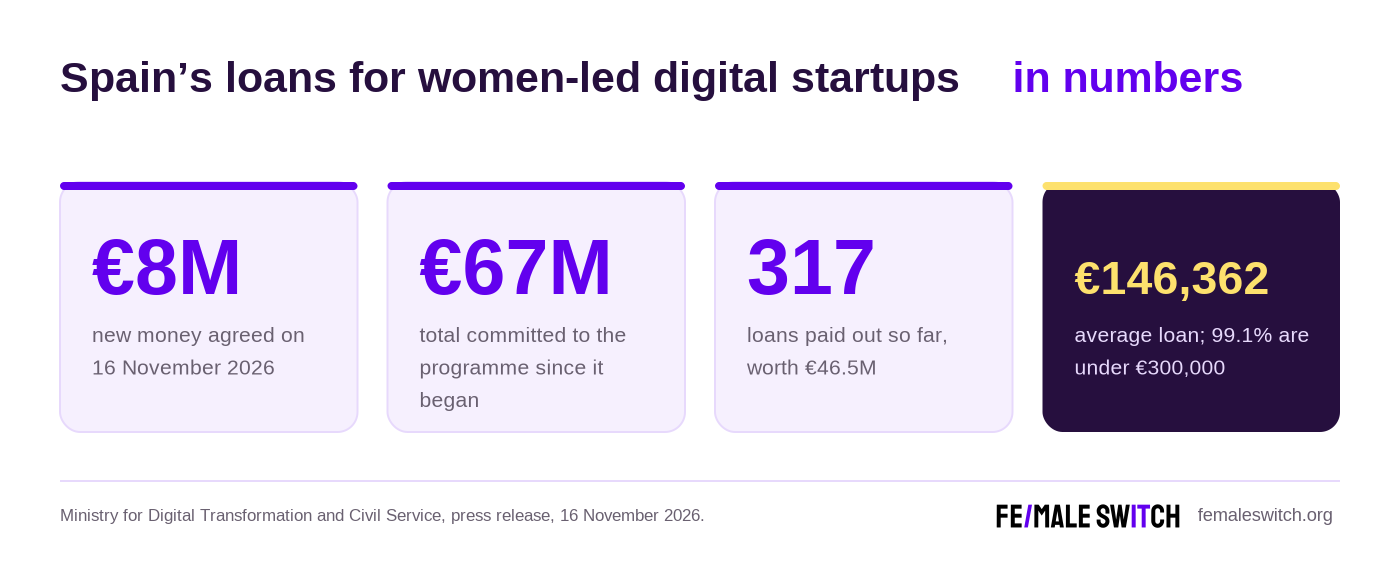
On Monday 16 November 2026, Spain’s Ministry for Digital Transformation and Civil Service announced that its Secretariat of State for Digitalisation and AI and Enisa, the state lender that sits under the Ministry of Industry and Tourism, had agreed a new contribution of €8 million to the programme Emprendedoras Digitales (Women Digital Entrepreneurs). Status: Adopted. It is a funded programme with a signed addendum, not a bill.
The money funds participative loans of €25,000 to €1.5 million per company. As a rule, they run for up to 7 years, with up to 2 years before you start repaying the capital, and must be repaid by 31 December 2035 at the latest. Companies can apply online now.
The programme dates back to Spain’s 2021 budget law (Law 11/2020). With four agreements and this addendum, the state has committed €67 million to it. So far, 317 loans worth €46.5 million have been paid out. The average loan is €146,362, 99.1% are below €300,000, and 75.4% went to companies no older than three years. By our own calculation, roughly €20 million of the committed money has not been paid out yet.
The companies funded so far work mostly in digital automation, artificial intelligence, cloud and data spaces, cybersecurity, blockchain and quantum computing, and are based in 15 of Spain’s 17 autonomous communities, led by Catalonia, Madrid and Valencia.
What a participative loan is, and why it suits bootstrappers
A participative loan sits between a bank loan and equity. Enisa lends you money but takes no shares and no seat in your management, so you keep full ownership. Its programme page lists the main terms:
- No guarantees. “No se requieren garantías reales ni personales”: you don’t put up your house or sign a personal guarantee. Enisa judges the viability of the business plan instead.
- Two-part interest. The first part is Euribor plus a margin. The second depends on your company’s financial profitability, so it costs more when you do well.
- Off the bank radar. The loan does not appear in CIRBE, the Bank of Spain’s credit risk register, so it doesn’t eat into what banks see as your borrowing capacity.
- Fees. A 0.5% opening fee, plus a fee if you repay early or the company changes hands.
For a founder who wants to stay independent, that is a rare mix. It works much like the revenue-based and debt options we compare with equity: you pay for the money, but you don’t sell part of the company.
Who can apply
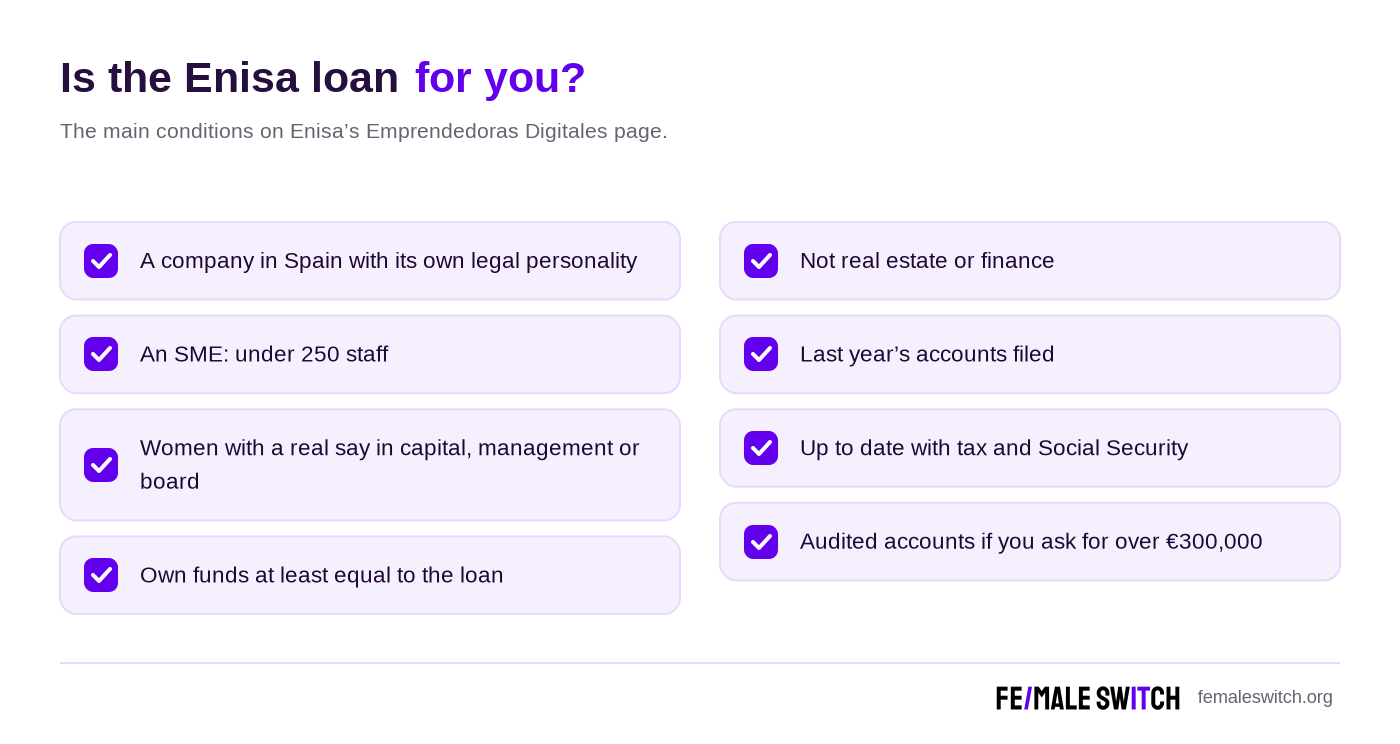
You need a company, not just a business idea. Enisa asks for a company legally set up in Spain, with its own legal personality and tax domicile there, that counts as an SME. A sole trader without a company doesn’t meet that condition, so you would have to incorporate first, for example as a limited company (SL).
“Led by women” is defined loosely: one or more women must have “una participación relevante” (a significant role) in the capital, the management team or the board. Enisa does not give a minimum percentage. The project must be digital or tech-based, and real estate and financial companies are excluded.
The condition that stops most early founders is own funds. They must be at least equal to the loan, so a company with €40,000 of equity and retained profits can ask for up to about €40,000. You also need last year’s accounts filed in the Mercantile Register, no debts with the tax office or Social Security, and audited accounts if you ask for more than €300,000.
The report: more women start, fewer stay
The money arrives a week after GEM Spain presented “Evolución del emprendimiento de las mujeres en España 2015–2025” on 10 November, written with Enisa and Coca-Cola Europacific Partners’ GIRA Mujeres programme. The findings reported by Innovaspain show a decade of growth at the start and stagnation later on.
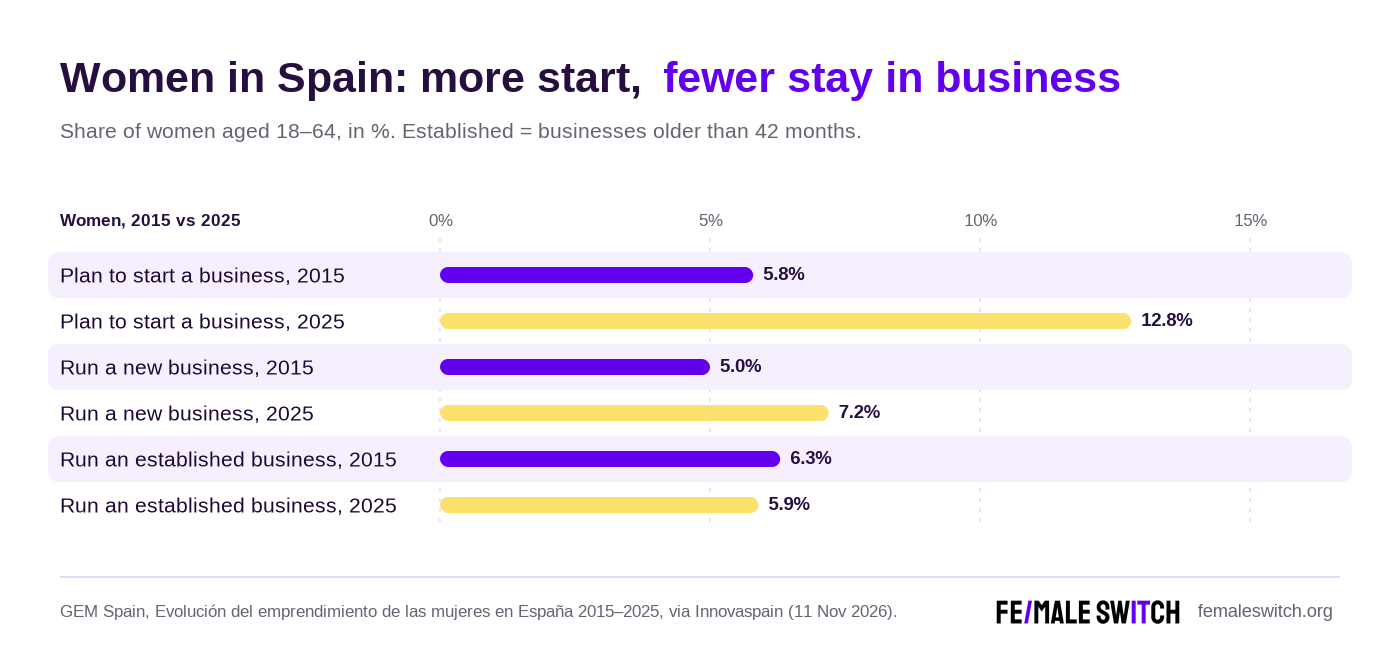
The share of women aged 18 to 64 who plan to start a business more than doubled, from 5.8% to 12.8%. The share running a new business, up to three and a half years old, rose from 5% to 7.2%. But the share running an established business, older than 42 months, slipped from 6.3% to 5.9%.
Source: GEM Spain 2015–2025 report, as reported by Innovaspain on 11 November 2026.
The gender gap is widest in established businesses: 8.9% of men run one, against 5.9% of women. Women also close businesses less often than men, 3.4% against 4.1%, so the gap is less about giving up and more about getting through the early years with enough resources. The global picture is similar, as our coverage of the GEM Women’s Entrepreneurship Report and the ILO’s 2026 report on women in business shows.
“Hoy, más mujeres que quieren emprender y son más las que lo hacen. Pero poner en marcha un negocio no basta, lo difícil es mantenerlo y hacerlo crecer.” (Today more women want to start a business and more actually do. But starting one isn’t enough; the hard part is keeping it going and growing it.) Ana Fernández-Laviada, president of Red GEM España
Bootstrapped by default
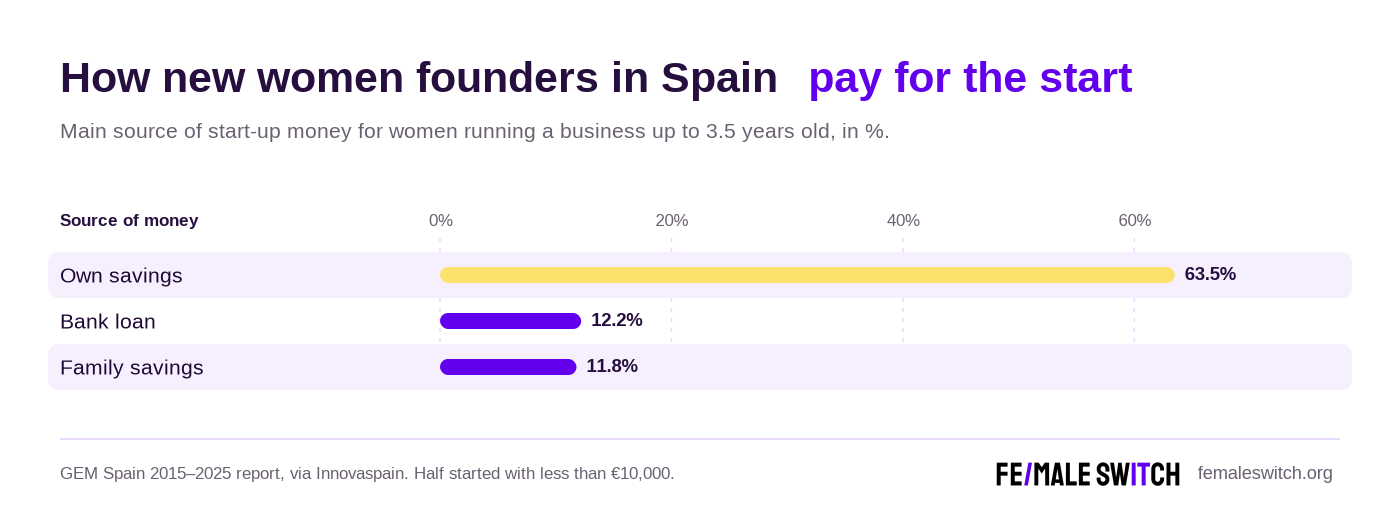
The report also shows how women in Spain pay for their start. 63.5% of recent women founders used their own savings, 12.2% a bank loan and 11.8% family savings. The average start-up capital was €45,197, but half started with less than €10,000.
That matches what we see across Europe: most women founders bootstrap, and our guide to start-up costs on a bootstrap budget shows how far €10,000 can go. The problem comes after launch, when growth needs more money than savings can cover. That is exactly the stage a loan that requires filed accounts and equity is designed for.
Other findings are worth knowing if you are building in Spain:
- Under-35s are the largest group among recent women founders (38.6%), while women over 44 lead 53.9% of established businesses.
- More than 20% of women running new businesses have a migrant background.
- 29.1% of new women-led businesses sell abroad, up from 19.7% in 2015.
- Rural women’s entrepreneurship rose from 5.3% to 8.9%.
- Many women kept working in their business during maternity leave, which the authors flag as a risk to both health and income. Our guide on founding a startup around maternity leave covers how to plan for it.
How Spain’s scheme compares across Europe
Spain is not alone in offering money that doesn’t cost you equity. Here is how it compares with three other schemes for women founders.
Sources: Enisa; Invitalia; exist.de FAQ; European Innovation Council (12 June 2026). Check each scheme’s page for current calls.
Italy’s ON scheme mixes a zero-interest loan with a grant. Germany’s exist Women pays a small stipend before you found a company. At EU level, Women TechEU funds deep tech only. If you are in Italy, also read our piece on Italy’s 2027 budget and the flat-tax ceiling. For more options country by country, see our guide to grants for female entrepreneurs in Europe and the list of business grants for women on our sister site Grant Grants.
What this means for you
- If you run a digital company in Spain, check the own-funds rule first. Your equity caps the loan. If you are close, retained profits or a small capital increase from the founders can lift the amount you can ask for.
- Get your paperwork in order before you apply. Filed accounts, no tax or Social Security debts and a business plan that shows how you will repay. If you are still a sole trader, plan the switch to a company first.
- Use the loan for growth, not for the launch. The report shows that women in Spain manage to start, but struggle to stay. A loan with 2 years’ grace fits the years 2 to 4, when savings run out and revenue isn’t big enough yet. Our guide to managing cash flow while you grow helps you size it.
- Read the interest terms carefully. The second interest part grows with your profitability, and repaying early or selling the company costs a fee. Model both before you sign.
- Outside Spain, look for the local equivalent. Italy, Germany and the EU all have money for women founders that doesn’t cost equity. The conditions differ a lot, so start with the official page of each scheme.
Want to test your business before you borrow for it?
The Fe/male Switch startup game takes you from idea to first paying customers in weekly quests, with an AI co-founder, so you can check your offer, your pricing and your numbers before you put savings or a loan on the line. The free trial lasts 2 weeks.
👉 Start the game
FAQ: Spain’s Emprendedoras Digitales loans
What is Emprendedoras Digitales?
It is a programme run by Enisa, Spain’s state lender for innovative SMEs, that gives participative loans of €25,000 to €1.5 million to digital companies led by women. On 16 November 2026, the government added €8 million, bringing the total committed to €67 million.
Do I need a guarantee for an Enisa loan?
No. Enisa says no real or personal guarantees are required. It assesses the viability of your business plan instead, and it takes no shares in your company.
Can a self-employed woman without a company apply?
Not as a sole trader. Enisa asks for a company legally set up in Spain with its own legal personality and tax domicile, so you would need to incorporate first, for example as a limited company.
How much can I borrow?
Between €25,000 and €1.5 million, but never more than your company’s own funds. The average loan so far has been €146,362, and 99.1% of loans were below €300,000.
What did the GEM Spain report find about women entrepreneurs?
Between 2015 and 2025, the share of women planning to start a business rose from 5.8% to 12.8% and the share running a new business from 5% to 7.2%, but the share running an established business fell from 6.3% to 5.9%. 63.5% of new women founders used their own savings to start.
Are there similar schemes outside Spain?
Yes. Italy’s Invitalia ON combines a zero-interest loan and a grant for companies owned mostly by women or young people, Germany’s exist Women pays a stipend to women preparing a start-up through a university, and the EU’s Women TechEU gives €75,000 grants to women-led deep tech startups.
