
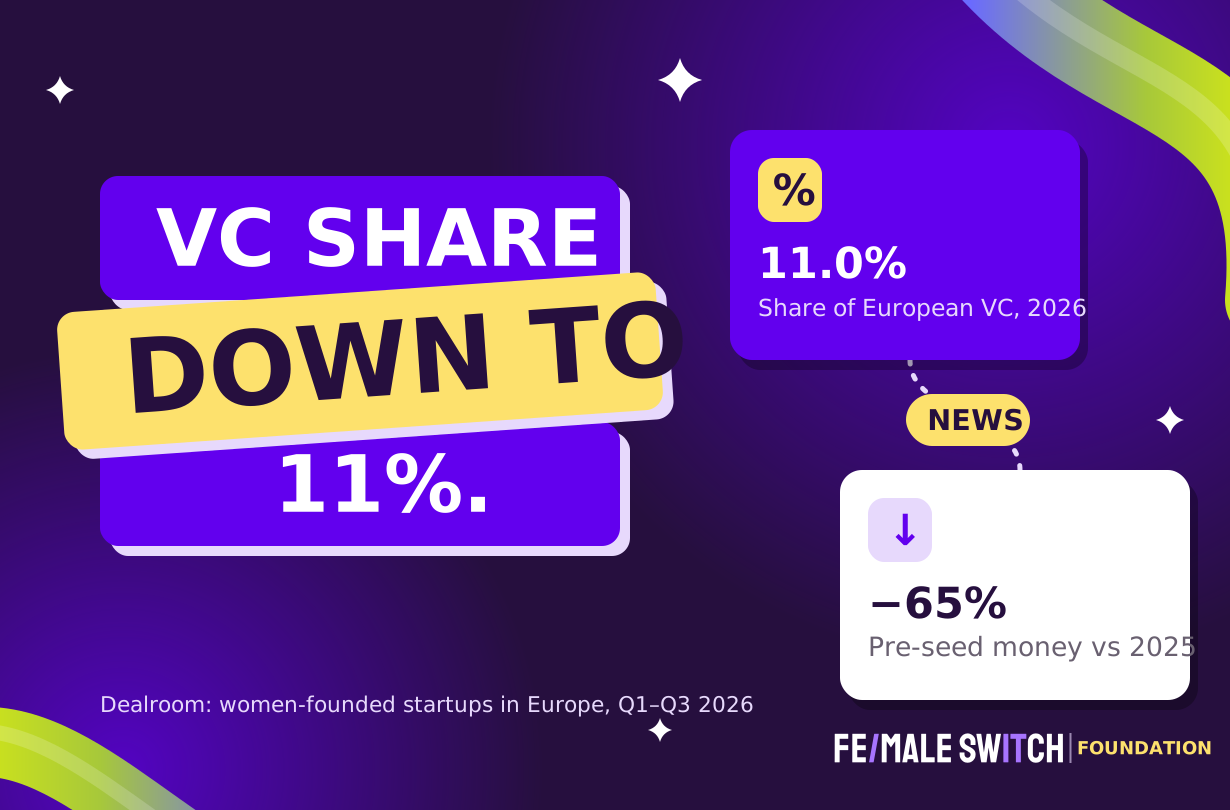
TL;DR: how much VC did women-founded startups in Europe raise in 2026?
Dealroom's update of 12 October 2026 shows women-founded startups in Europe raised $7.2 billion in the first nine months of 2026, about the same as a year earlier, and $1.9 billion in Q3. But their share of European venture capital fell to 11.0%, from 13.4% in 2025, the lowest since 2018. Small cheques are drying up: pre-seed money is down 65% and seed money 41% on the same period of 2025, while rounds of $100 million or more grew 18%. If you're bootstrapping, this is your signal to plan for revenue first and treat early VC as a bonus.
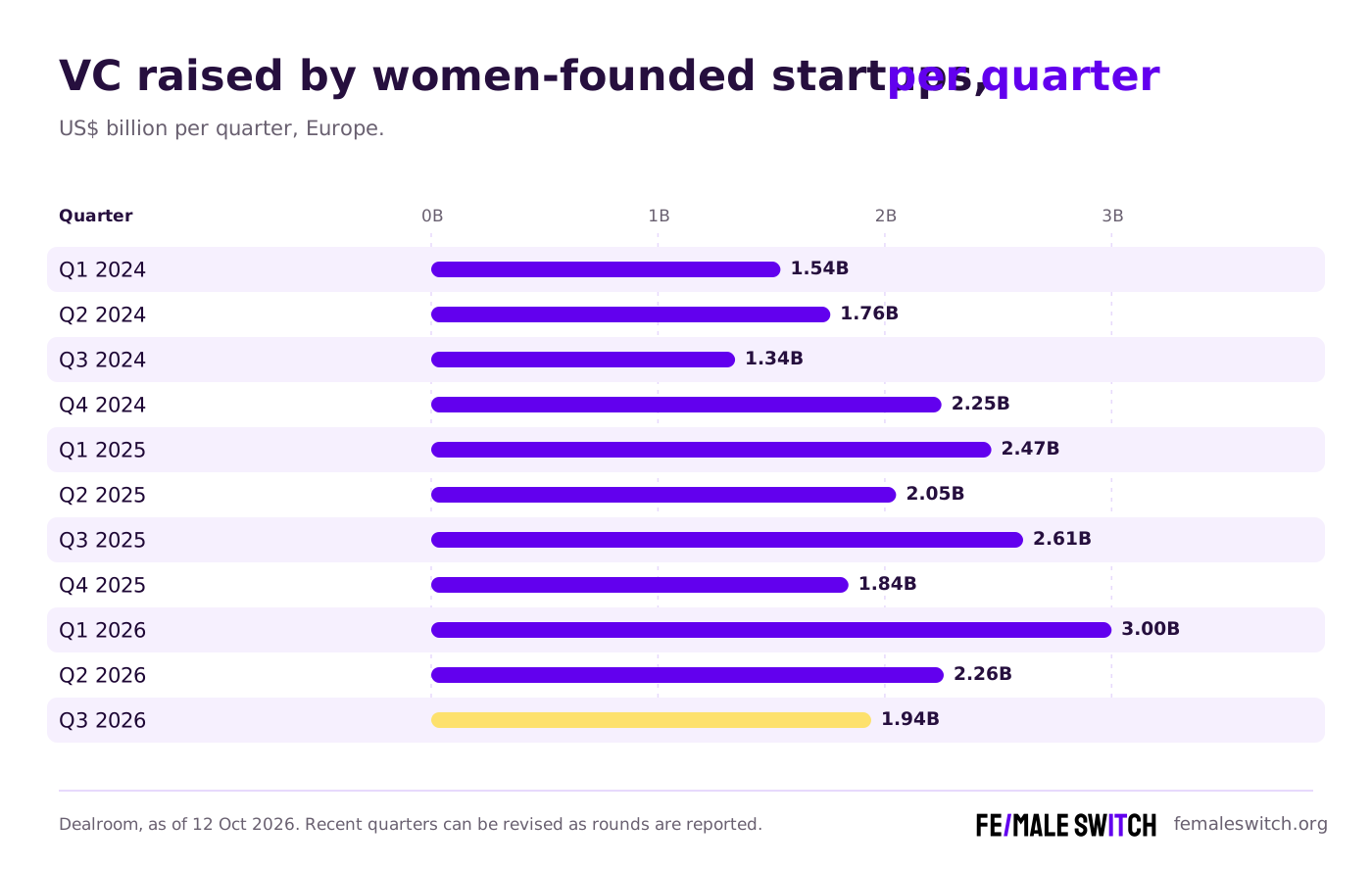
Here's a number that looks fine until you read the next line. Women-founded startups in Europe raised $7.2 billion in the first nine months of 2026, roughly what they raised in the same months of 2025.
The next line: their slice of European venture capital just shrank to 11%, and the money that's left is going into fewer, much bigger rounds. For a first-time founder hoping for a small pre-seed cheque, 2026 is the leanest year in Dealroom's round-size data, which goes back to 2022.
What happened
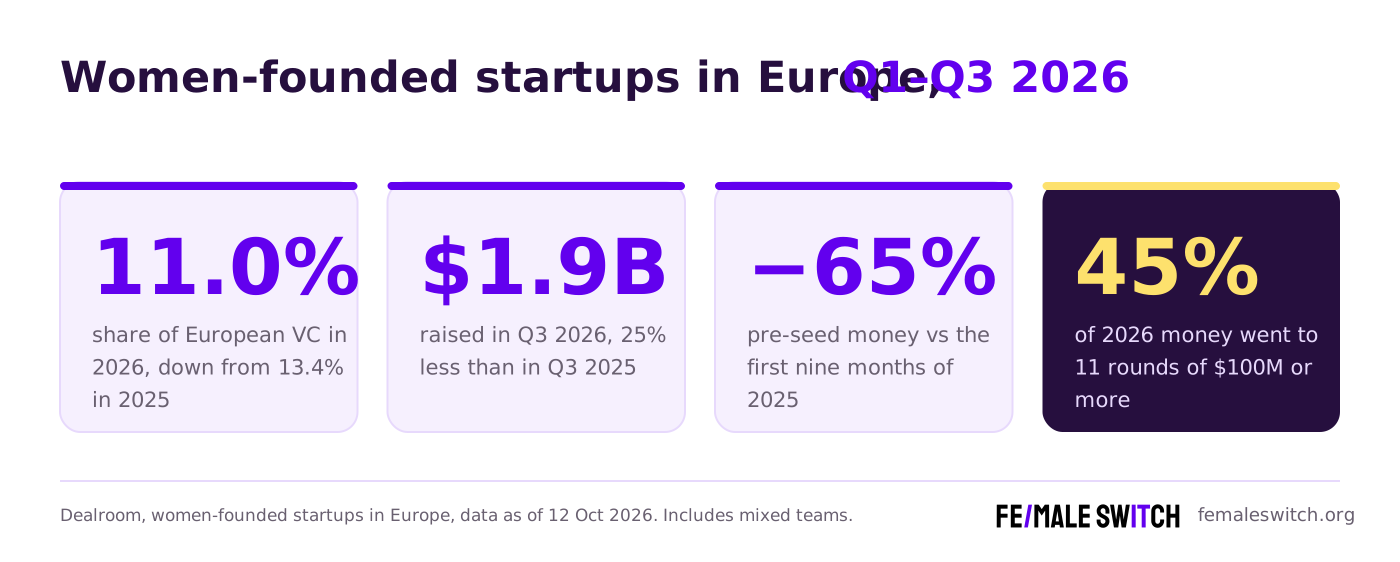
On 12 October 2026, Dealroom updated its guide to women-founded startups in Europe with data for the third quarter. Dealroom counts a startup as women-founded if at least one founder or co-founder is a woman, so mixed teams are included. The main figures:
- Q3 2026: $1.9 billion raised, down from $2.6 billion in Q3 2025 (−25%).
- First nine months of 2026: $7.2 billion, against $7.1 billion in the same period of 2025 (+1%).
- Full year 2026: Dealroom projects $9.6 billion, up 7% on 2025's $9.0 billion. This is an annualised estimate, not a closed year.
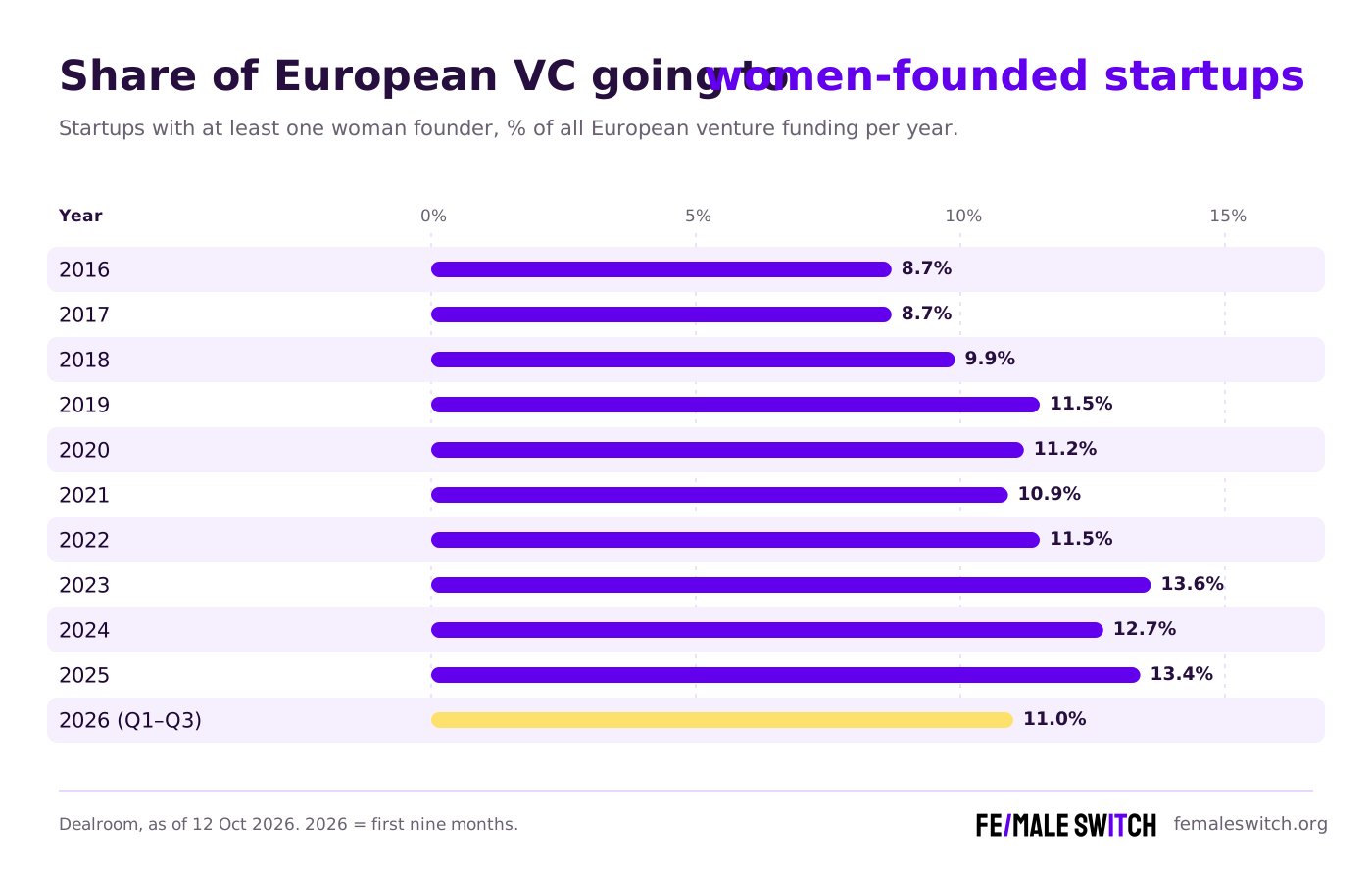
- Share of European VC: 11.0% in 2026, down from 13.4% in 2025 and a peak of 13.6% in 2023.
So the money in absolute terms held up, but the rest of the European market grew faster. That's the same pattern we saw in the Q3 2026 European VC numbers, where AI companies took about three-quarters of the money.
The share is back to 2018 levels
For most of the past decade, the share crept up: 8.7% in 2016, 11.5% in 2019, 13.6% in 2023. 2025 came close to that peak at 13.4%. Then 2026 dropped it to 11.0%, below every year since 2018.
You may have seen yesterday's story on Cherry Ventures' Heartbeat report, which found that 75% of new European companies start with one founder and women are 10.1% of founders. That report noted that the often-quoted 13% is a share of funding, not of founders. Dealroom's new data shows even that funding share has now dropped to 11%.
Where the money went: fewer, bigger rounds
The drop isn't spread evenly. Dealroom splits funding by round size, and comparing the first nine months of 2026 with the same months of 2025 shows the small end shrinking and the big end growing:
Source: Dealroom round-size data as of 12 Oct 2026; totals and changes are our calculation.
Rounds under $15 million made up 27% of the money in the first nine months of 2025. In 2026, it's 17%. Over the last four quarters, Dealroom says 38% of capital went into rounds of $100 million or more, 41% into $15–100 million rounds and only 21% into rounds under $15 million.
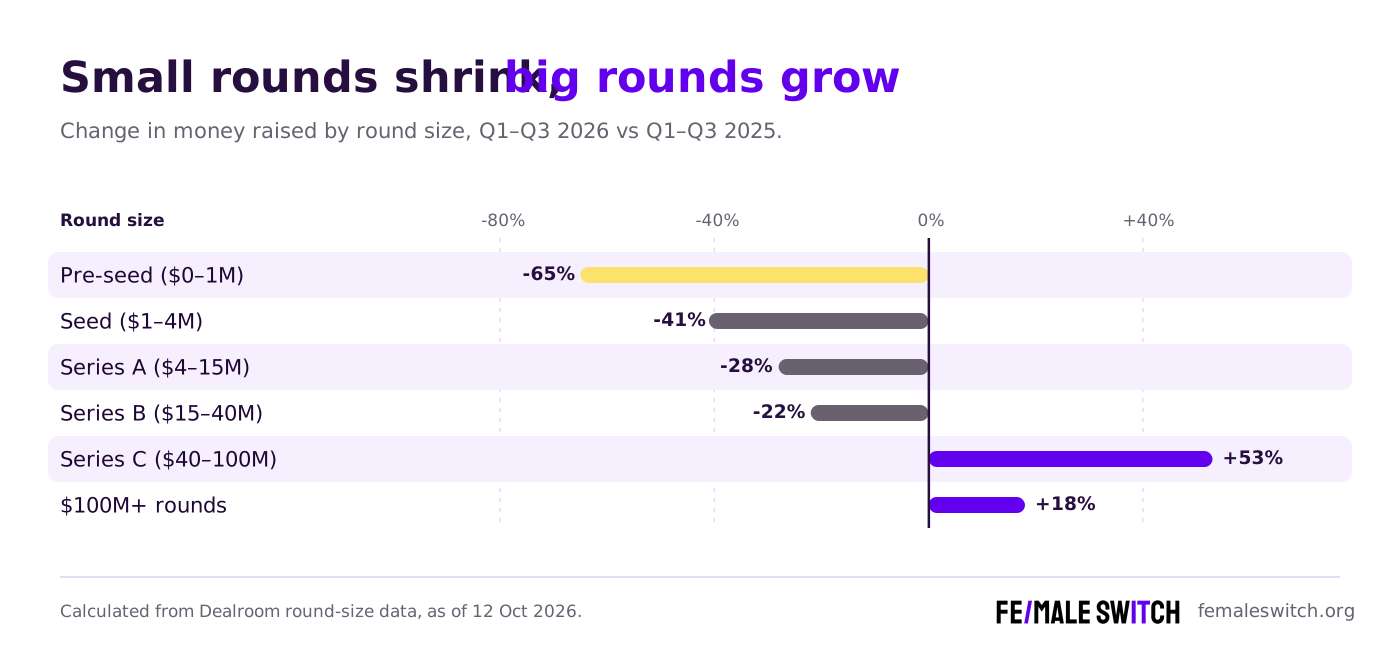
Pre-seed is the starkest. Rounds under $1 million brought in $39 million in Q3 2025 and only $7 million in Q3 2026. A caution: small rounds are often reported weeks or months late, so these latest numbers may be revised up. Even so, every quarter of 2026 so far is below every quarter of 2025 for pre-seed.
The ten rounds that make up 44% of the year
The 2026 total leans heavily on a few deals. The ten biggest rounds add up to about $3.1 billion, 44% of the $7.2 billion raised so far. The single largest, a $1 billion seed round for AMI (Advanced Machine Intelligence), is about 14% of the total on its own.
Source: Dealroom, biggest women-founded rounds, 2026 Q1–Q3, as of 12 Oct 2026.
In Q3 alone, four rounds (The Exploration Company, Volta, Skello and iPronics) brought in about $1.02 billion, just over half of the quarter's $1.94 billion.
Paris, London and Munich lead
By city, the Paris metro region leads for the first nine months of 2026 with $1.7 billion, ahead of London ($1.5 billion) and Munich ($602 million). Q3 alone looks different: Munich led with $457 million, ahead of London ($326 million) and Paris ($250 million), largely thanks to The Exploration Company's round.
Dealroom also lists the most active investors in women-founded startups by number of rounds. Two public bodies top the list: Enterprise Ireland (188 rounds) and Bpifrance (176). If you're in Ireland or France, those programmes are worth a close look.
What this means for you
If you're a first-time founder, the bit of the market you'd normally tap first, the small pre-seed and seed cheque, is the bit that shrank. Here's how to respond.
- Plan for revenue, not a round. Build your first year so it works without outside money, and treat a cheque as a bonus. Our guide on how to bootstrap as a female founder shows how.
- Reset your pre-seed expectations. If you do raise, expect smaller cheques, more proof and longer timelines. Here's what to expect in pre-seed funding as a first-time founder.
- Look at non-dilutive money first. Grants and public programmes don't depend on investors' appetite. Start with our list of grants for female entrepreneurs in Europe.
- Consider revenue-based financing. Once you have steady sales, you can borrow against them instead of selling equity. Compare revenue-based financing vs equity.
- Check the public backers in your country. Enterprise Ireland and Bpifrance are the two most active investors in women-founded startups on Dealroom's list. Find out what your national agency offers.
- Quote the right number. When you pitch or write about the gap, say "in 2026, about 11% of European VC went to startups with at least one woman founder". More context is in our female founder statistics for Europe.
This also fits what last week's GEM Women's Entrepreneurship Report found: women start businesses at nearly the same rate as men, but far fewer reach the scale stage where big rounds happen.
No investor yet? Build like you'll never need one
The Fe/male Switch startup game takes you from idea to first paying customers in weekly quests, with an AI co-founder and a community of founders.
👉 Start the game
FAQ: VC for women-founded startups in Europe, 2026
How much VC did women-founded startups in Europe raise in 2026?
According to Dealroom's data of 12 October 2026, they raised $7.2 billion in the first nine months of 2026, including $1.9 billion in Q3. Dealroom projects $9.6 billion for the full year.
What share of European VC goes to women-founded startups?
11.0% in 2026 so far, down from 13.4% in 2025 and the lowest share since 2018. The peak was 13.6% in 2023.
What counts as a women-founded startup in Dealroom's data?
A European startup founded or co-founded by at least one woman. Mixed-gender founding teams are included, so the figure is not limited to all-women teams.
Is pre-seed funding for women founders falling?
Yes. Money raised in rounds under $1 million fell from $123.8 million in the first nine months of 2025 to $42.9 million in the same period of 2026, a drop of 65%. Seed rounds ($1–4 million) fell 41%.
Why did the share fall if the total stayed flat?
Women-founded startups raised about the same as in 2025, but the overall European VC market raised more, so their slice got smaller. Within women-founded startups, money moved from small rounds to rounds of $40 million and more.
Will these numbers change?
Possibly. The 2026 full-year figure is a projection, and small rounds are often reported late, so recent quarters can be revised. Dealroom adds data each quarter.
