
TL;DR: AI reskinning, and what you can do about it
AI reskinning means taking a real creator's video and swapping the person for an AI-generated character, with the same joke, dance and background. BBC Verify reported on 22 November 2026 that women creators are turned into hypersexualised avatars that point viewers to paid fan pages. Instagram began rolling out Content Protection on 17 November; its AI-copy detection is still a test with a small group. Your defence today: keep your originals, report copyright as the owner, warn your audience.
If you sell through your own face, voice and videos, a copy can take your views, your followers and the trust you built.
What is AI reskinning?
Experts call the practice "reskinning", BBC Verify reported on 22 November 2026. Someone takes a popular video, keeps the music, movements and background, and uses cheap AI tools to replace the creator with a new character. Sometimes the AI version gets millions more views than the original.
Reports go back months. In August 2026, Tom's Guide quoted creator Paige Davis about an AI copy that kept her voice, outfit and background: "Literally all she did was change the face."
What did BBC Verify find about AI reskinning?
BBC Verify found no evidence that "Mila Vasari" is a real person. The account appears to be run from Canada and links to a page on Fanvue, a subscription platform that allows adult material. The bunny account that copied Krogstad promoted courses on making money from AI content.
Roberts compared the two videos side by side: "It was just me that had been altered."
Why are women creators turned into hypersexualised avatars?
Dr Tina Kendall, an expert in online culture at Anglia Ruskin University, links it to an online "hustle culture": accounts turn attention into money through subscriptions to fan pages with adult content, meme coins or platform monetisation. "Conventionally attractive, white, feminine" characters help, she told the BBC: "That's the kind of stuff that always floats to the top and is successful."
For a woman who built a personal brand on her own face, viewers meet a sexualised fake made from her work. Jasunas named the next problem: "people think that they're real people."
What did Instagram launch on 17 November 2026?
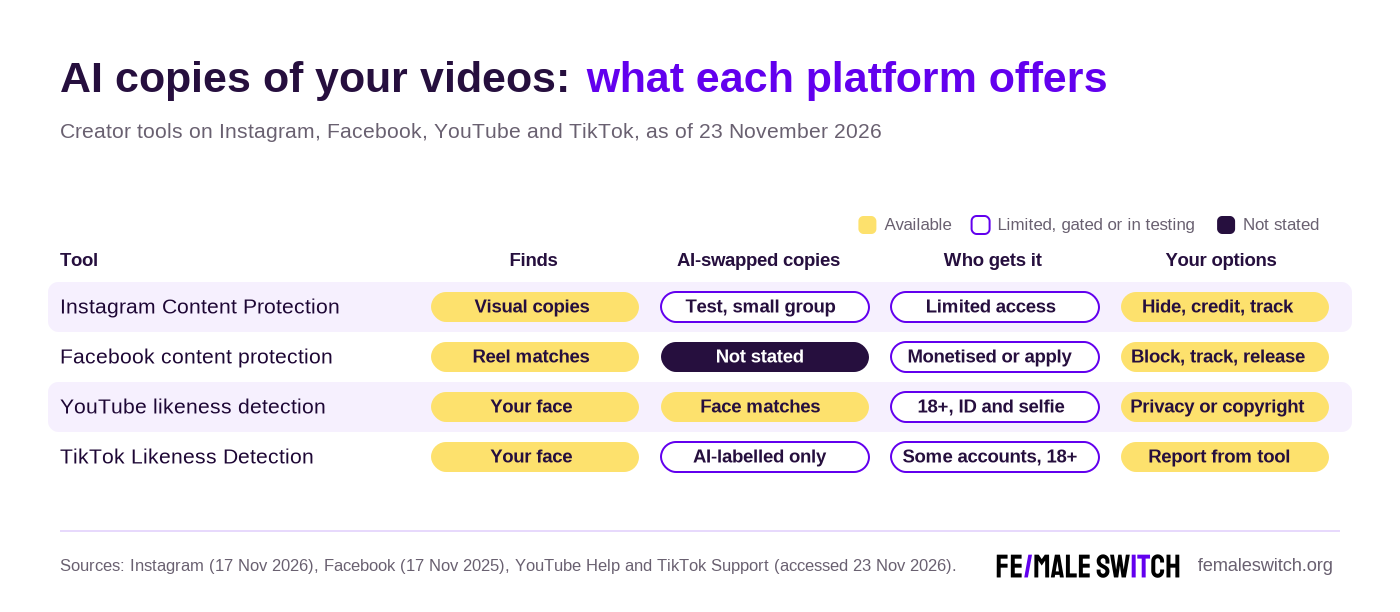
Adam Mosseri, the head of Instagram, wrote on Threads on 17 November that Instagram was "starting to roll out 'Content Protection'" to show creators copies of their videos. He added that it is "working quickly on ways to catch copies that are harder to spot", like jokes re-used with AI-swapped visuals. Instagram's announcement shows what works today:
Eligibility is "largely based on meeting our originality and integrity standards", with no published follower minimum or country list. Once enrolled, every new original video is protected automatically. Our sister site MeanCEO goes through Instagram Content Protection setting by setting.
What do Meta's unoriginal content rules say?
Facebook's unoriginal content rules (14 July 2025) say: "Unoriginal content reuses or repurposes another creator's content repeatedly without crediting them." Repeat offenders lose monetisation for a period and get reduced reach on everything they post. In the first half of 2025, Meta acted on about 500,000 accounts and removed about 10 million profiles impersonating large creators.
Meta told BBC Verify it alerts users when their videos are reposted without permission and is "exploring ways to limit the reach" of repeat offenders. Meta's business terms are also under a UK competition investigation.
Which platform tools protect creators from AI copies?
- YouTube likeness detection is open to creators with a channel who are over 18, after an ID check and a selfie video, per YouTube Help. It detects faces only; audio is planned for 2026.
- TikTok Likeness Detection is available to certain verified accounts and creators aged 18 or older. It scans only content labelled or detected as AI-generated, after you enrol.
- TikTok's rules ban "the likeness of adult private figures used without their permission", even with an AI label.
Is AI reskinning legal in Europe and the UK?
Copyright in your own video is the basis the platforms' report forms use. Equity, the UK's largest entertainment union, has called for new laws, arguing that existing copyright legislation is inadequate. Where new rules stand:
Under the AI Act text, Article 50(4) is a labelling duty, and the EU's Digital Omnibus did not move its date. Denmark's culture minister Zenia Stampe introduced the deepfake bill on 8 October 2026; on 2 November it was still before parliament, per Dansk Erhverv. The UK Report on Copyright and AI (18 March 2026) mentions "a new digital replica or personality right".
What this means for you: what should you do if your video is reskinned?
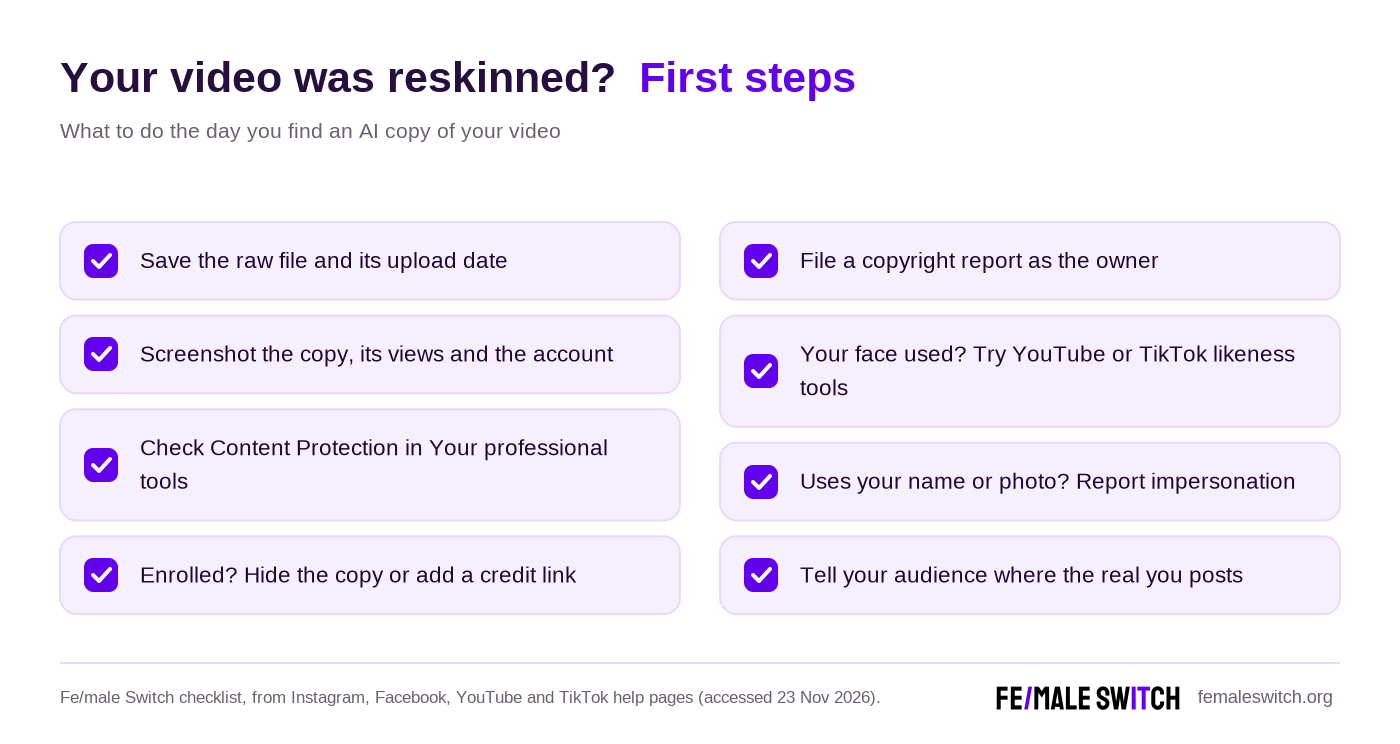
- Keep your originals. Save raw files and upload dates for every video. Tom's Guide reported that thousands of follower reports about Paige Davis's copy were rejected; it only came down after a manual IP claim with government ID and timestamps.
- Check Content Protection. On Instagram, look under Home tab, Tools, Your professional tools, or apply through Instagram's form if you think you qualify.
- Report copyright as the owner. Instagram, Facebook, TikTok and YouTube all have copyright forms. Instagram regularly passes your name and contact details to the poster, so use a business email. Our step-by-step guide to reporting an AI copy of your video walks through each form.
- Use likeness tools. YouTube's privacy complaint covers "a realistic altered or synthetic version of your likeness" and keeps your name from the uploader. On TikTok, report under Misinformation, then deepfakes. For a fake account using your name, file an impersonation report.
- Warn your audience. Post the original next to the copy and list your real accounts. Roberts and dozens of other creators called out AI accounts publicly.
- Know the limits of watermarks. A handle on screen helps viewers trace the original. It won't stop the copy: the reskins BBC Verify found replaced only the person.
- Treat your videos as business assets. Regulators notice income from social media, as Belgium's crackdown on Instagram side hustles shows, and platforms keep adding AI rules, like Etsy's new AI rules for sellers. Our solopreneur guide covers the business set-up.
Building a business on your own name?
The Fe/male Switch startup game takes you from idea to first paying customers in weekly quests, with an AI co-founder and a community of founders.
👉 Start the game
FAQ: AI reskinning
What is AI reskinning?
Copying a real creator's video and replacing the person with an AI-generated character, keeping the joke, dance, music or background.
Is AI reskinning illegal?
It depends on where you live and what was copied. Platform forms rely on copyright in your original video, and YouTube and TikTok also take likeness complaints. Denmark's bill L 49 is still a proposal.
Can Instagram detect AI copies of my videos?
Partly. Content Protection finds visual matches. Matching spoken words in AI-swapped copies is a test with a small group of creators.
Who can use Instagram Content Protection?
Access is limited and largely based on Instagram's originality and integrity standards. Check Your professional tools or apply through Instagram's form.
Does the EU AI Act protect me from deepfakes of my face?
Article 50(4), applying from 2 August 2026, requires whoever publishes a deepfake to disclose that AI made or changed it. It is a labelling rule.
What proof do I need to report a reskinned video?
Your original file and upload date, links to the copies and your contact details. Instagram's copyright form also asks for a signed good-faith declaration.
