
TL;DR: ChatGPT for business pays off fastest on the writing jobs a bootstrapped owner puts off: price rises, payment reminders, complaint replies, quotes, grant drafts, social posts and translations. In Europe the catch is privacy. Customer names, emails and IBANs are personal data under the GDPR, and OpenAI offers its data processing addendum only for ChatGPT Business, Enterprise and the API, so Free, Go and Plus chats get no customer data. Turn off model training today, brief your team (the AI Act asks for it), and run every text through the free paste-safe checker below, which hides personal data before you paste and puts it back afterwards.
ChatGPT for business is the tool I see women in the Fe/male Switch community open first and trust least. As a bootstrapping founder you have no assistant, no copywriter and no grant consultant, so a chatbot that drafts a payment reminder in ten seconds feels like a new hire. Then the doubt arrives: am I allowed to paste my customer's email into this thing?
That doubt is everywhere in Europe. Eurostat counted 17% of small EU enterprises using any AI in 2025, against 55% of large ones. Among companies that considered AI and stayed away, 52.5% blamed unclear legal consequences and 48.8% feared privacy violations.
This guide gives you prompts for the work you actually do, and explains three EU terms in plain words: the GDPR (General Data Protection Regulation, the EU privacy law), the AI Act (the EU law on artificial intelligence) and the DPA (data processing addendum, the contract that makes a provider handle your customers' data only on your instructions). Every OpenAI price and setting below was checked on OpenAI's own pages on 29 October 2026. Since 10 November 2026, OpenAI also lets eligible businesses claim their profile in ChatGPT and see how often it cites their website.
How does the paste-safe checker protect your customers' data?
Most privacy slips with ChatGPT happen in one move: you paste a whole email thread. Paste it into the checker first, add the names you want hidden, and it finds email addresses, phone numbers, IBANs, payment card numbers, EU VAT numbers, birth dates, street addresses, postcodes and links with personal tokens. Each one becomes a placeholder such as [EMAIL 1] or [NAME 2].
Here is my daily routine:
- Paste the text into the checker and type the names of the people and companies involved.
- Copy the cleaned version into ChatGPT and ask for the reply you need.
- Paste ChatGPT's answer into the second box, and the checker swaps the placeholders back to the real details.
Nothing you type leaves your device: no server, no account, nothing saved.
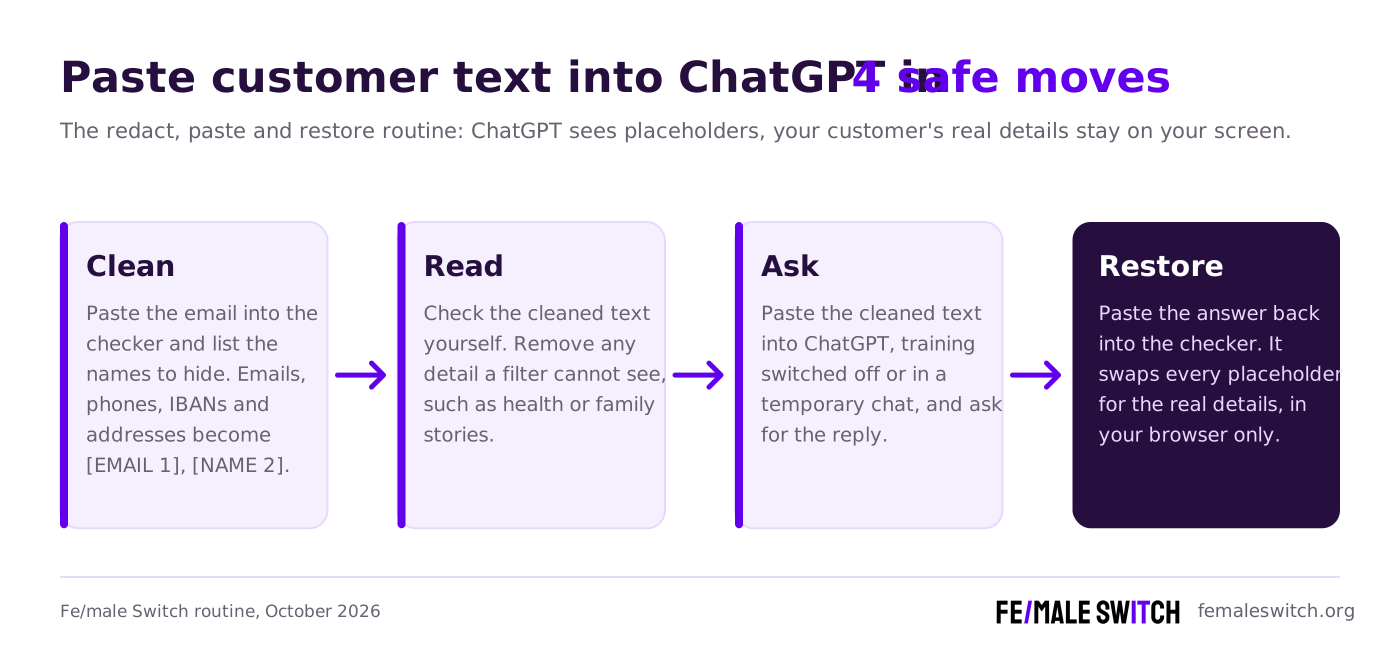
Read the cleaned text yourself before you paste it. A customer's health problem has no pattern a filter can spot, and context can still point at one person ("the only florist in a village of 300").
Which jobs should a bootstrapped owner hand to ChatGPT first?
Start with writing jobs where you can judge the answer in five seconds. ChatGPT states wrong facts in the same calm tone as right ones (the risk called hallucination), so keep it away from questions you cannot check yourself. Fill in the square brackets below, or let the checker create them.
How do you use ChatGPT for pricing without letting it guess your numbers?
ChatGPT has no idea what your materials cost, how many hours you can bill or what your customers earn, and it fills those gaps with internet averages from other countries. Feed it your numbers and ask it to reason; never ask it what to charge.
Prompt to copy (minimum price check): I run a one-person [TYPE OF BUSINESS] in [COUNTRY]. My fixed costs are [COSTS] a month, I can bill [HOURS] hours a month, and I want to pay myself [TARGET INCOME] a month before tax. Calculate my minimum hourly price step by step, then tell me which of my assumptions looks weakest and what I should measure to check it. Do not use market averages.
Check the maths with a calculator: a wrong decimal on a price page is the most expensive typo a small business can make. For a price rise, my favourite prompt makes ChatGPT argue against you:
Prompt to copy (objection test): Act as my most price-sensitive customer: [SHORT DESCRIPTION, NO NAME]. Read this price-rise email and give me the first three objections you would raise and the one sentence that would make you stay. Email: [YOUR DRAFT].
Rewrite your letter around those objections. For the thinking behind the numbers, read our guides to pricing psychology for your product and pricing services versus products.
How do you write customer emails with ChatGPT: late payments, complaints and quotes?
Give ChatGPT the facts, never the thread. A forwarded thread carries signatures, phone numbers and addresses, and three facts plus the tone you want are enough.
Late payments. Write the sequence once and reuse it:
Prompt to copy (reminder sequence): Write three payment reminders for invoice [INVOICE NUMBER] of [AMOUNT], due on [DATE]. Reminder 1: friendly, 3 days late. Reminder 2: clear, 14 days late, asks for a payment date. Reminder 3: final, 30 days late, says I will [NEXT STEP] on [DATE]. Each under 90 words, signed [YOUR FIRST NAME].
Keep legal consequences out of ChatGPT's hands. Statutory interest and collection costs differ by country, so add those lines yourself after checking your national rules.
Complaints. Decide what you will offer before you ask for the reply, and write it into the prompt. Without a stated remedy, ChatGPT invents refunds you never agreed to, and the customer will hold you to them. Run complaints through the checker first: they are full of names and delivery addresses. Our piece on AI-generated legal correspondence covers complaints that arrive written by AI, and customer service for startup founders covers service on a tiny team.
Quotes. The quote prompt above asks for three questions to put to the client first, and those questions save more money than the quote text itself.
Can ChatGPT write a grant application for you?
ChatGPT makes a grant application faster to write, and it cannot make it true. It structures sections around the criteria you paste in, turns notes into paragraphs and shortens a 400-word answer to a 250-word limit. It does not know this year's call rules unless you paste them, and when it lacks a number it invents a plausible one.
Funders already have rules. The European Commission's standard application form for Horizon Europe proposals, as quoted by the Netherlands Enterprise Agency (RVO), says applicants "are fully responsible for parts that are produced by an AI tool", must be transparent about their tools, must be able to list their sources and should watch for plagiarism. RVO adds that ignoring a programme's AI guidelines can make a proposal ineligible, and that typing a patentable idea into a chatbot can count as disclosing your invention.
My order for any grant draft:
- Read the call text and the funder's AI rules, and copy the evaluation criteria into a document.
- Write your facts list: revenue, customers, team, budget, with a source next to every number.
- Open a temporary chat (or a Business workspace) and remove partner and customer names with the checker.
- Ask for an outline that mirrors the criteria, then draft section by section from your facts only.
- Check every [SOURCE?] mark against your own documents.
- Rewrite in your own voice and note which tool helped with which section.
Find calls in our calendar of grants for women entrepreneurs in Europe, the overview of non-dilutive funding and our list of government support programmes for women entrepreneurs.
How do you use ChatGPT for social posts and for selling in other EU countries?
Social posts. Generic input gives generic posts. Paste three of your best posts as a voice sample, add one real story from your week and ask for three versions. A customer story is personal data too, so remove the name or ask first. Our plan for social media with limited time and the LinkedIn strategy for B2B founders cover the rest.
Translating for other EU markets. ChatGPT gives you a solid first draft in minutes. Three habits make it safe:
- Ask for a list of phrases it was unsure about and check those with a native speaker.
- Ask for a back-translation into your language to catch shifted meanings in product claims.
- Pay a professional for terms and conditions, return policies and safety text, because they carry legal weight.
Check decimal commas, date order and currency position on every translated page, and our guide to free and under-€20 AI tools for small businesses in Europe compares translation and writing tools with GDPR notes for each one.
Is it legal to paste customer data into ChatGPT under the GDPR?
The European Commission defines personal data as "any information that relates to an identified or identifiable living individual". Its examples include a name, a home address, an email address and an IP address. Company information counts too when it identifies a person, and a business address like forename.surname@company is personal data.
When you decide why and how customer data is used, you are the controller. A software provider that handles that data for you is a processor, and the Commission says the processor's duties "must be specified in a contract or other legal act that is binding on the processor". That contract is the DPA.
Here is how that maps onto ChatGPT:
- OpenAI signs a DPA for ChatGPT Business, ChatGPT Enterprise and the API, through a DPA form on its enterprise privacy page.
- On personal Free, Plus and Pro accounts, OpenAI's help centre says data sharing for model training is switched on by default, and OpenAI's Europe privacy policy names OpenAI Ireland Limited as the controller of your account data.
- So a customer's details pasted into a personal plan go to a company that has no processor contract with your business.
My rule for our community: customer personal data goes only into a Business workspace with a signed DPA, or it gets stripped out first. Placeholders only help when the story around them stays vague too, so leave out details that point to one person.
GDPR fines reach €20 million or 4% of worldwide annual turnover. For a micro business the bigger threat is quieter: a customer who finds their complaint, word for word, in a screenshot of your ChatGPT history. Read our guide to GDPR compliance for European startups, the Ogi Networks breach story on why the controller carries the blame when a provider slips, and the update on EU plans for simpler GDPR rules and fewer cookie banners.
What did Italy's data protection authority do about ChatGPT?
Italy's data protection authority, the Garante per la protezione dei dati personali, has taken the toughest public stand on ChatGPT so far. From its press release of 20 December 2024 and the note now on that page:
- 20 December 2024: the Garante fined OpenAI €15 million and ordered a six-month information campaign on radio, TV, newspapers and the internet. Its reasons: an unreported data breach from March 2023, training on users' personal data without an adequate legal basis, transparency failures and no age verification.
- March 2026: the Court of Rome accepted OpenAI's appeal (judgment No. 4153/2026), and the Garante took its decision off its website. With OpenAI's European headquarters now in Ireland, the Irish Data Protection Commission leads on OpenAI.
The lesson: OpenAI's fights with regulators will stay unsettled for years, and your duties as a controller do not depend on how they end.
What does the EU AI Act mean for a small business that uses ChatGPT?
The AI Act sorts AI uses into four risk levels: unacceptable (banned), high risk, transparency risk and minimal or no risk. A business that uses ChatGPT is a deployer (the user of an AI system), and drafting emails sits at the low end. Three parts still reach a small firm, with dates from the Commission's AI Act page (updated 19 October 2026):
- AI literacy, since 2 February 2025. Article 4 asks deployers to support their staff's AI literacy. The Commission's FAQ says staff who use ChatGPT for advertising copy or translation must learn about risks such as hallucination. No certificate is needed, an internal record is enough, and supervision starts 2 August 2026.
- Transparency, from August 2026. If you put a chatbot on your website, the Commission says people "should be made aware that they are interacting with a machine". A line above the chat window does the job.
- High-risk uses, from 2 December 2027. Employment and education are on the high-risk list, delayed to this date by the AI Omnibus amendments in force since 27 July 2026. Keep ChatGPT away from ranking job applicants.
Your AI literacy record can be one page: which AI tools you use, what never goes into them (list below), who checks output before a customer sees it, and the date each person read it. For training, the Commission points small businesses to its European digital hubs, and our list of entrepreneurship training programmes for women includes free AI courses.
Which ChatGPT settings should you change today?
Five minutes in the settings removes most of the risk on a personal account, following OpenAI's help centre:
- Turn off model training. On the web: account menu, Settings, Data controls, then switch off "Improve the model for everyone". On the phone: sidebar, profile icon, Data controls. Voice mode has its own switch.
- Use temporary chats for anything sensitive. They stay out of your history, create no memories and are not used for training, though OpenAI may keep them for up to 30 days for safety.
- Skip thumbs up and thumbs down on sensitive chats. OpenAI says that when you give feedback, the entire conversation may be used for training, even after you opt out.
- Clean your memory. Memory and training are separate settings. Open your saved memories and delete anything about customers, staff or money.
- Delete what you don't need. Switching training off does not delete old chats, so remove conversations that hold customer details.
On a Business workspace, sign the DPA, set how long chats are kept, and tell your team that workspace admins can view, export and delete members' conversations. Deleted Business conversations leave OpenAI's systems within 30 days unless the law requires longer.
Which ChatGPT plan should a small business pay for?
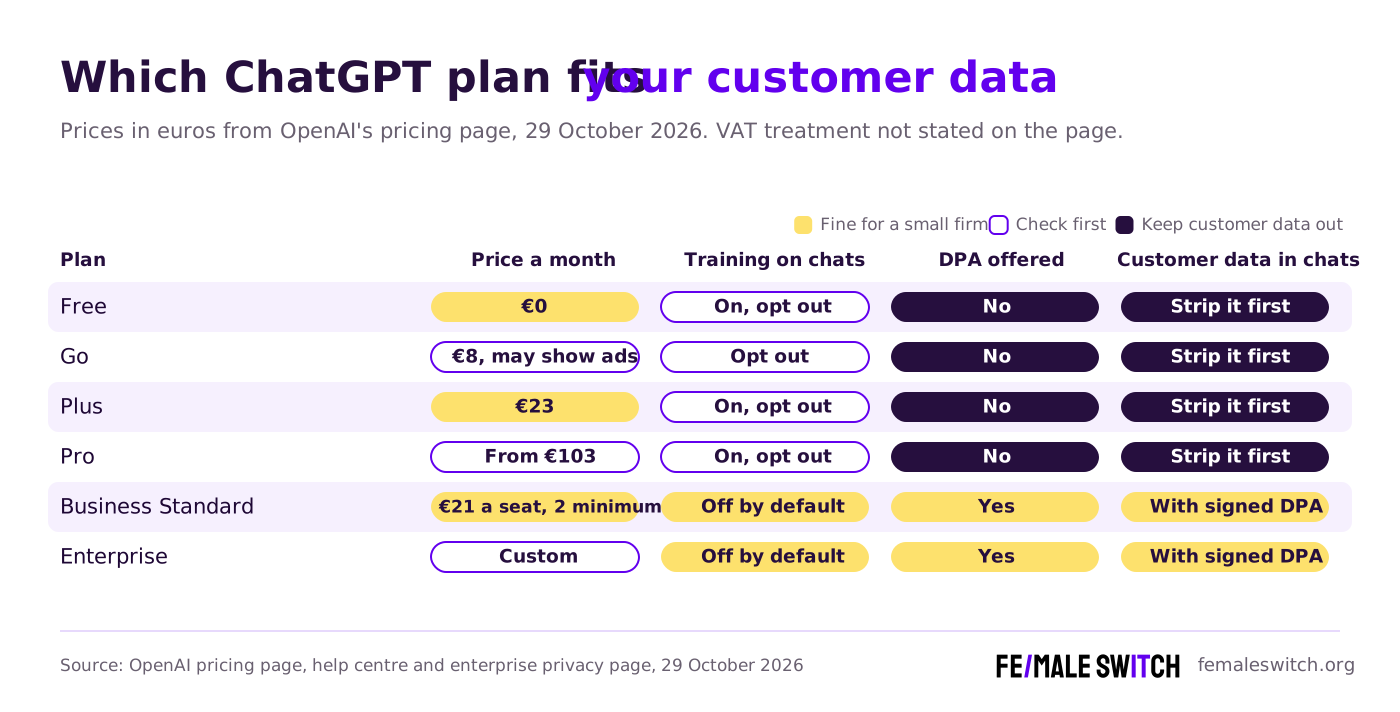
Euro prices from OpenAI's pricing page on 29 October 2026; the page does not say whether VAT is included.
My take for a bootstrapped business:
- Solo, no customer data in chats: Free or Plus with training off and the checker before every paste. Go is cheaper, and I would rather not see its possible ads next to customer emails.
- Customer data has to go in, or two people share the work: ChatGPT Business with a signed DPA, €42 a month for two Standard seats on a yearly bill.
- Registered nonprofits and foundations: OpenAI's pricing page mentions up to 75% off Business or Enterprise through OpenAI for Nonprofits.
Storing your content in Europe (data residency) is listed for eligible Enterprise, Edu, Healthcare and API customers, and Business is missing from that list.
What should you never paste into ChatGPT?
Print this list for your desk:
- Customer names together with contact details, order history or complaints
- IBANs, card numbers and payment links with tokens in them
- Passwords, login codes and access tokens for any of your tools
- ID numbers, passport scans and birth dates
- Health details, religion, sexual orientation or political views of anyone
- Staff matters: salaries, sick notes, performance reviews, CVs
- Ideas you may want to patent
- Contracts under an NDA and grant partners' confidential text
- Screenshots of your banking app, invoicing tool or inbox, which hold all of the above
Practise the business side before real customers see it. In the Fe/male Switch startup game you build a startup step by step with an AI co-founder: you test an idea, set a price, write your first customer emails and plan funding, and the mistakes cost game points instead of savings.
What should you do this week?
ChatGPT for business works best as a fast first-draft writer with clear rules around it. This week:
- Today: switch off "Improve the model for everyone" and test the checker on one real customer email.
- This week: save the eight prompts from the table above, and write your one-page AI note for the AI Act's literacy duty.
- Before your next grant: read the funder's AI rules and build your facts list before you open a chat.
- When a second person joins or customer data must go in: move to ChatGPT Business and sign the DPA.
Still choosing what to build? Our 13 business ideas European women started on their own money come with first-month budgets, and the guide to bootstrapping as a female founder covers the money side.
FAQ: ChatGPT for business
Is ChatGPT free to use for business?
Yes, the Free plan costs €0. It is built for individuals, training is on until you switch it off, and OpenAI offers no DPA for it, so keep customer personal data out.
How much does ChatGPT Business cost in euros?
€21 per Standard seat a month billed yearly, or €26 billed monthly, with at least two seats; Premium seats cost €105 or €130. OpenAI's page does not say whether VAT is included.
Is ChatGPT GDPR compliant?
GDPR compliance is your duty as controller. OpenAI supports it with a data processing addendum for ChatGPT Business, Enterprise and the API. Free, Go, Plus and Pro have no DPA, so strip personal data first.
Does ChatGPT use my business data for training?
On Free, Plus and Pro, training is on by default; switch it off under Settings, Data controls. On Business and Enterprise, OpenAI does not train on your data by default. Thumbs up or down can send a whole conversation to training even after you opt out.
Can I use ChatGPT to write a grant application?
Yes, for structure and drafts from your own facts. Horizon Europe applicants are fully responsible for AI-produced parts and must disclose their tools and sources. Check each funder's AI rules first.
Do I need to tell customers that ChatGPT helped write my emails?
The transparency rules the Commission describes cover chatbots, deepfakes and some AI-made content published for the public. An email you edit and send under your own name stays your responsibility, so check every word.
Is ChatGPT banned in Italy?
No. ChatGPT works in Italy. The Garante fined OpenAI €15 million in December 2024, and the Court of Rome accepted OpenAI's appeal in March 2026, after which the Garante took its decision off its website.
