
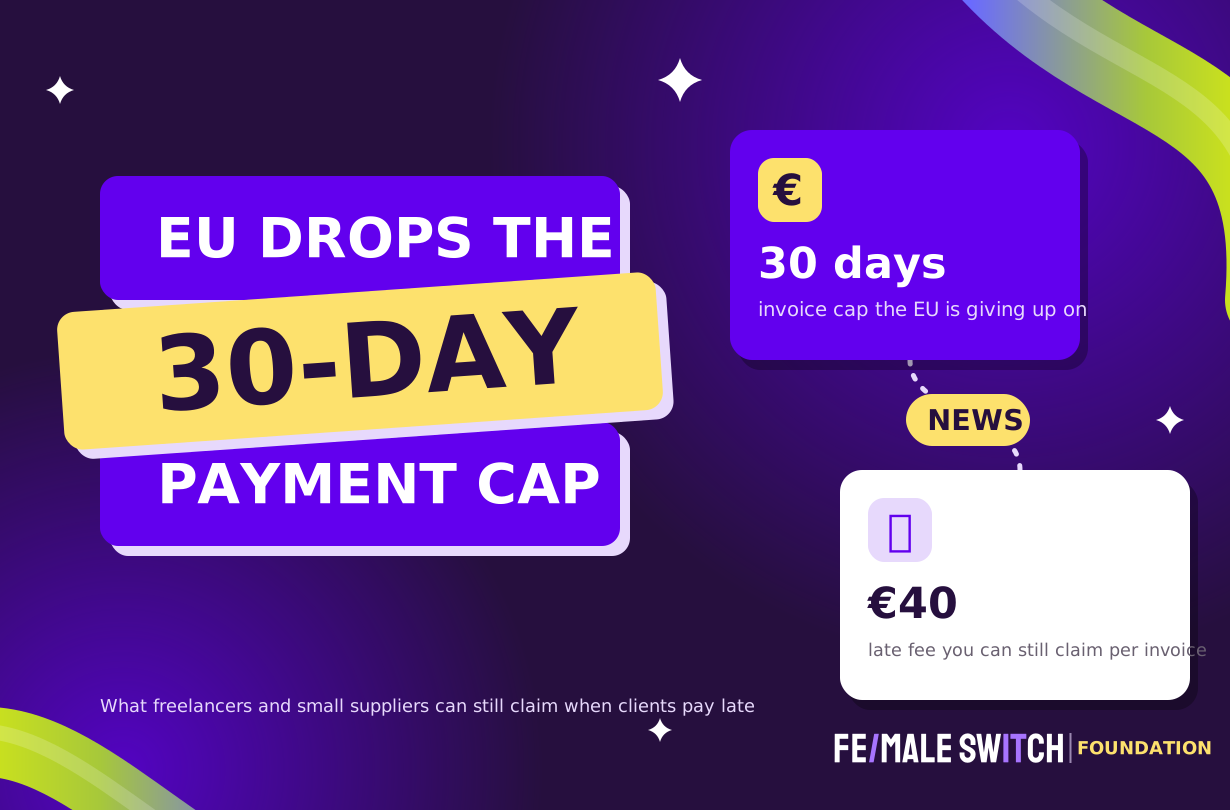
TL;DR: is the EU’s 30-day payment cap dead?
Almost. On 4 November 2026 the European Commission put its 2023 Late Payment Regulation on the list of proposals it intends to withdraw within six months. That law would have capped payment terms between businesses at 30 days, made late-payment interest automatic and raised the flat late fee to €50. The Commission says too many EU governments oppose it. Small-business group SMEunited called the move a broken promise to SMEs. Nothing changes in your contracts today: the 2011 rules still apply, so you can still charge statutory interest and at least €40 for every invoice paid late. You just have to claim it yourself.
If you freelance, run a small agency or supply bigger companies, you know the pattern. You deliver in March, invoice in April, and the money lands in June, if you chase it. The EU spent three years on a law that would have stopped that. This week it gave up.
Here is what happened, what the dropped law would have done, and what you can still do about clients who pay late.
What happened
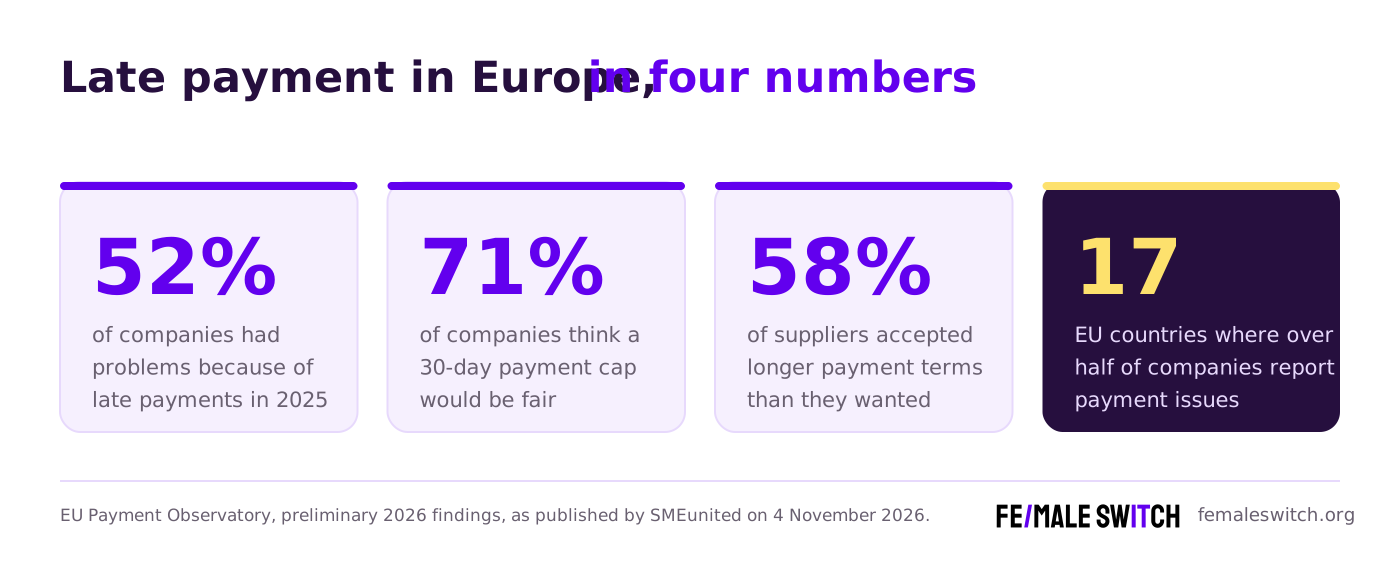
On Wednesday 4 November 2026 the European Commission adopted its work programme for 2027, its plan for the year ahead. Every work programme comes with a list of pending laws the Commission wants to pull. This year that list has 18 entries, and one of them is the proposal for a regulation “on combating late payment in commercial transactions”.
The annex to the work programme gives the reason in one line: the file “has been pending with co-legislators more than three years and a sizeable number of Member States opposes further work on the proposal.” The Commission adds that it is unlikely to win support in the Council, where national governments sit, “within a reasonable timeframe.”
Status: the regulation was Proposed and is now listed for withdrawal. The Commission says it intends to withdraw it within six months, so the formal step should come by about May 2027 (our estimate). In practice the file is over.
The European Parliament had done its part. It voted its position on 23 April 2024, according to the Parliament’s Legislative Observatory, and the file has sat at “Awaiting Council’s 1st reading position” ever since. The Council never agreed a negotiating position, so talks between the institutions never started.
What the dropped law would have changed
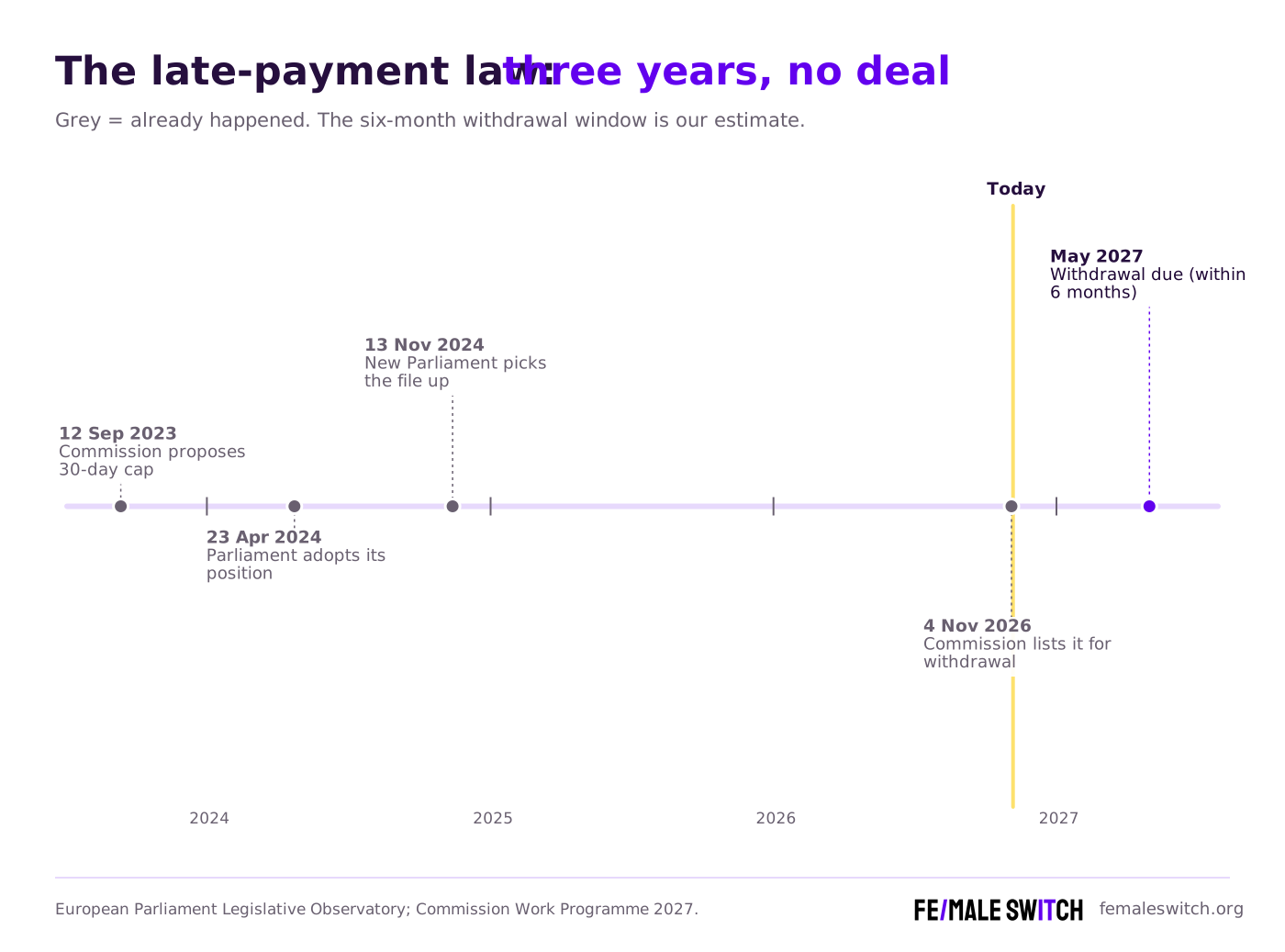
The Commission proposed the regulation on 12 September 2023. It noted that about 18 billion invoices are issued in the EU every year, more than 500 every second, and that delayed payments hit small companies hardest. The proposal would have replaced the current directive with one set of rules for the whole EU:
Source: proposal COM(2023) 533 and Directive 2011/7/EU on EUR-Lex; Your Europe.
The 30-day cap was the heart of the proposal. Under today’s rules a big client can still ask for 60 days, or longer if you expressly agree, and a two-person business rarely has the power to say no.
Small businesses are angry
SMEunited, the association of crafts and small and medium-sized enterprises in Europe, reacted the same day. Its president Davide Galli said withdrawing the proposal “goes against any commitments this Commission had toward SMEs”. He added: “Freedom of contract does not exist for SMEs.”
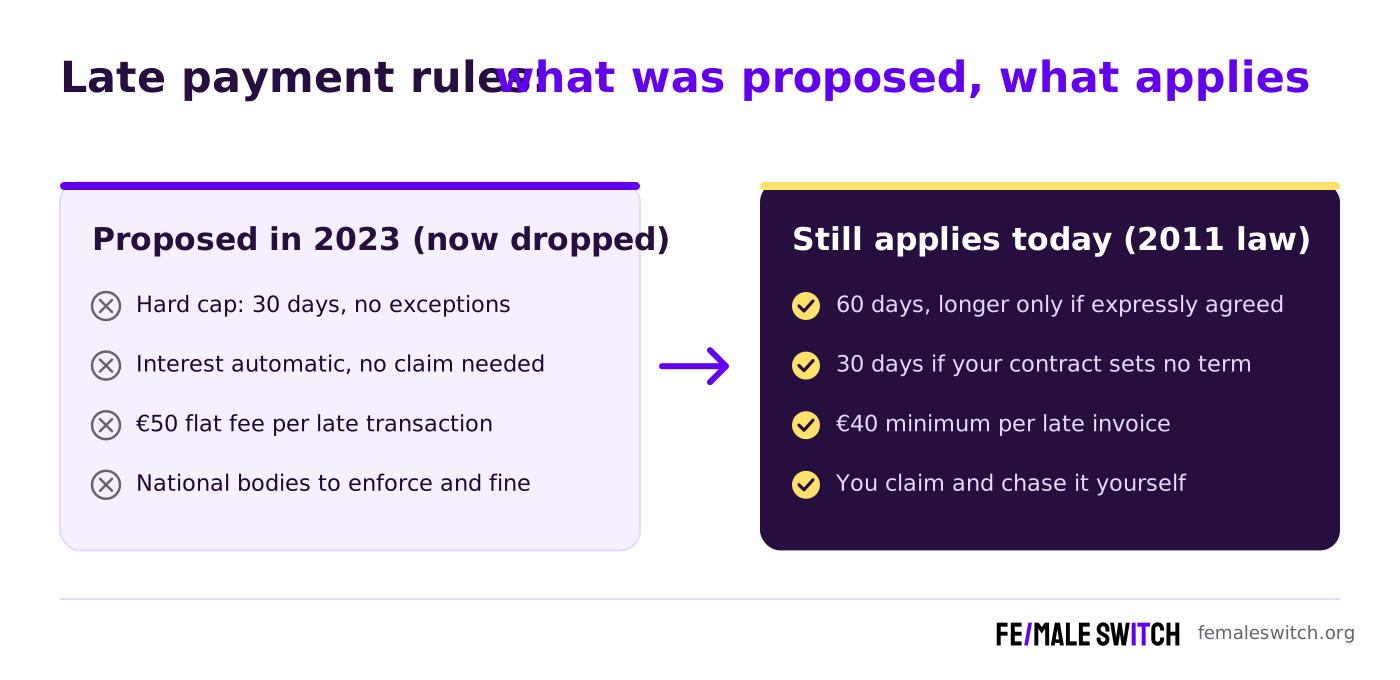
SMEunited pointed to preliminary findings from the EU Payment Observatory’s 2026 report, presented on 3 November: 52% of companies reported problems due to late payments in 2025, and 71% of the companies surveyed, large ones included, said a 30-day cap would be fair. 58% of suppliers said they had accepted longer payment terms than they were comfortable with. In 17 member states, more than half of all companies reported payment issues.
Galli also pointed across the Channel. In the UK, he noted, the Commercial Payments Bill will give the Small Business Commissioner powers to settle payment disputes and take enforcement action. “It is a shame that the EU still lags behind,” he said.
What else small firms lose, and what stays
Late payment is not the only small-business file on the withdrawal list. The Commission also plans to pull the Head Office Tax proposal, which would have let small companies with branches in other EU countries work out those branches’ taxable profits under the tax rules of their home country, and the BEFIT company-tax framework. Both have sat in the Council for almost three years, where tax decisions need every government to agree. The Green Claims Directive on environmental marketing claims is on the list too.
The Commission frames the programme as simplification. It says its 12 Omnibus packages so far could save €22.3 billion a year in administrative costs once fully in place; the Digital Omnibus on cookies and GDPR is one of them. And the EU Inc company form stays on the list of priority files, although governments and Parliament are still apart on it, as we covered when EU governments agreed their EU Inc position.
What you can still claim today
The withdrawal changes nothing in the law you already have. The 2011 Late Payment Directive (Adopted; EU countries had to apply it from March 2013) gives you three rights when a business or public body pays you late, as the EU’s Your Europe guide to late payments explains:
- Interest without a reminder. It runs from the day after the agreed due date. If your contract sets no date, it starts 30 days after the client receives your invoice.
- A flat €40 per late invoice, at least, for your recovery costs. Some countries set a higher amount for bigger invoices. If chasing costs you more, you can claim reasonable extra costs too.
- A 60-day ceiling on payment terms between businesses, unless a longer term is expressly agreed and is not grossly unfair to you.
Interest is charged on the full amount including VAT, and you don’t pay VAT on the interest. If no rate is agreed, the statutory rate applies. For the second half of 2026 it is:
Source: Your Europe, B2B late payments page. Rates for all EU countries are listed there, with an interest calculator.
A quick example (our calculation): a German client pays a €3,000 invoice 60 days late. At 10.52% a year, the interest is about €52, plus the €40 flat fee, so you can add about €92 to the bill. That rarely pays for the stress, but naming it on the invoice changes how fast many clients pay.
If your client is in another EU country, the contract’s chosen law decides. If you chose none, the rules of the country where you, the supplier, are based apply. Invoice formats are changing too: in France every business must already receive e-invoices through an approved platform, and an exemption for micro-businesses that MPs voted on 3 November fell with the budget a day later.
What this means for you
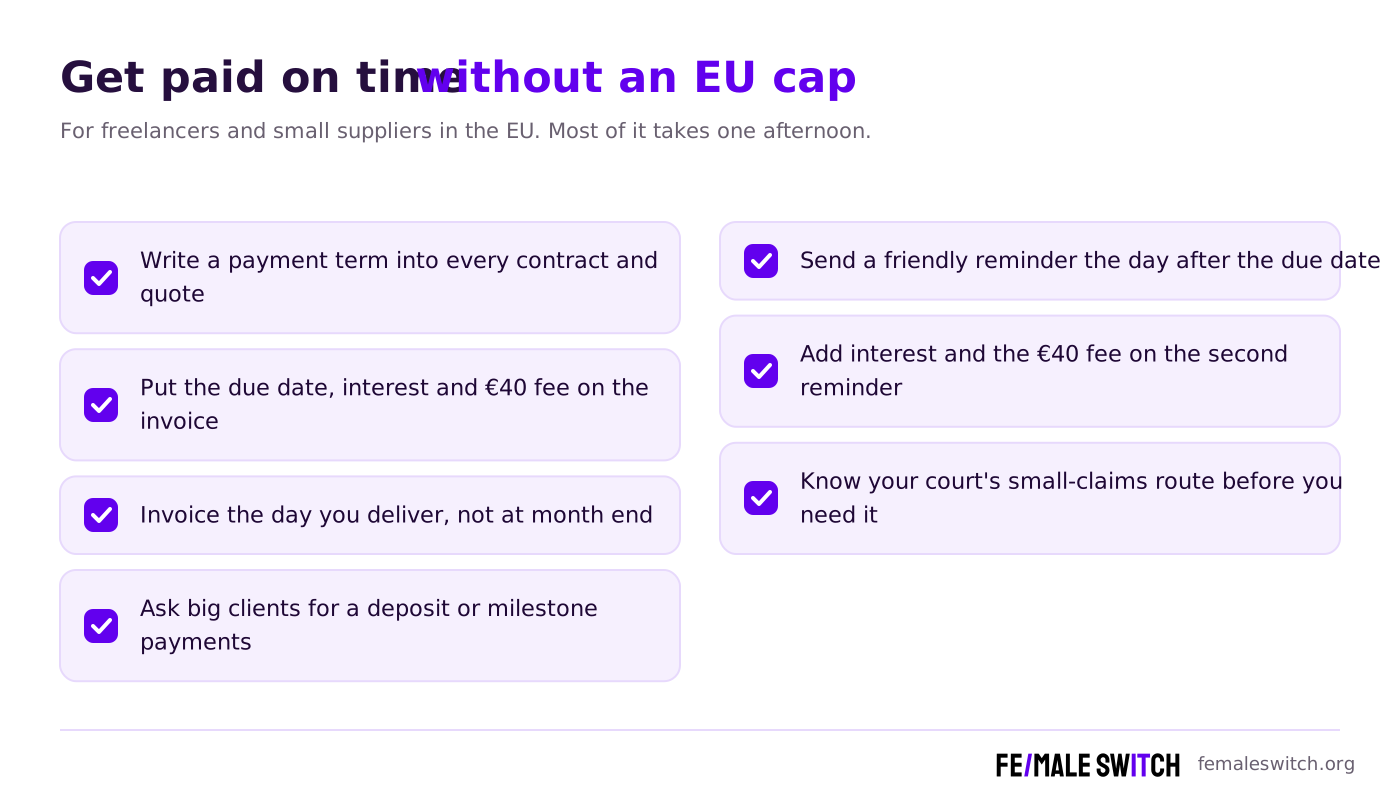
- Write your own 30-day rule. The EU won’t cap terms for you, so put “payment within 30 days of invoice” in every quote and contract. Only accept longer terms when you have priced them in. Our solopreneur guide for women in Europe covers contracts, VAT and pricing for one-person businesses.
- Put the consequences on the invoice. Show the due date, the statutory interest and the €40 fee. A ready-made clause from our legal templates and resources list saves you a lawyer’s hour.
- Protect your cash flow first. Ask large clients for a deposit or milestone payments, invoice the day you deliver, and keep a buffer for one late client. See how to manage cash flow while you grow.
- Automate the chasing. Invoicing tools can send reminders and add interest for you; compare options in our guide to financial management software.
- Check your national rules too. Some countries go further than the EU minimum, and budgets for 2027 change other costs for the self-employed; our overview of budget 2027 for freelancers in six countries has the details.
- Use the courts when you must. Many countries have a simplified procedure for unpaid invoices, and the EU has a European Payment Order for cross-border debts. Know your route before you need it, and use it for clients who ignore two reminders.
Also this week: Women TechEU grants double
One day later the Commission had better news for women founders in tech. On 5 November it adopted the European Innovation Council’s €1.8 billion plan for 2027, which doubles Women TechEU grants to €150,000 per start-up and adds a European Prize for Women Innovators in Quantum. Call dates are not published yet. With women-founded startups getting only about 11% of European venture capital this year, equity-free money matters. For who can apply, when the bigger grants arrive and the €75,000 round that is open now, see femaleswitch.com's report on the Women TechEU grant rising to €150,000.
Want to practise money conversations before a real client says “90 days”?
The Fe/male Switch startup game takes you from idea to first paying customers in weekly quests, with an AI co-founder, so you can practise pricing, payment terms and negotiations in a safe setting. The free trial lasts 2 weeks.
👉 Start the game
FAQ: the EU late payment law and your invoices
Has the EU withdrawn the Late Payment Regulation?
The Commission announced on 4 November 2026, in its 2027 work programme, that it intends to withdraw the proposal within six months. The formal withdrawal has not happened yet, but the file is effectively over because many EU governments oppose it.
Why did the Commission drop the 30-day payment cap?
The proposal had been pending for more than three years and a sizeable number of member states opposed further work on it, the Commission says. The Council of the EU never agreed a negotiating position, so talks with Parliament never started.
What payment terms are allowed in the EU now?
Under the 2011 Late Payment Directive, payment terms between businesses should not exceed 60 days unless a longer term is expressly agreed and is not grossly unfair to the supplier. If the contract sets no term, payment is due 30 days after the client receives the invoice.
Can I charge a client for paying late?
Yes. When a business client pays late, you can claim statutory interest without sending a reminder, plus a flat compensation of at least €40 per invoice and reasonable extra recovery costs. This does not apply to consumers.
How much late-payment interest can I charge in 2026?
If your contract sets no rate, the statutory rate applies. From 1 July to 31 December 2026 it is, for example, 10.52% in Germany, 12.40% in France, 10.40% in Spain and Ireland and 10.15% in Italy and the Netherlands. The EU’s Your Europe site lists every country.
Does the change affect freelancers in the UK?
No. The UK left the EU and has its own late-payment law. SMEunited points out that the UK Commercial Payments Bill will give the Small Business Commissioner powers to settle payment disputes and take enforcement action.
