
TL;DR: are French micro-entrepreneurs exempt from e-invoicing?
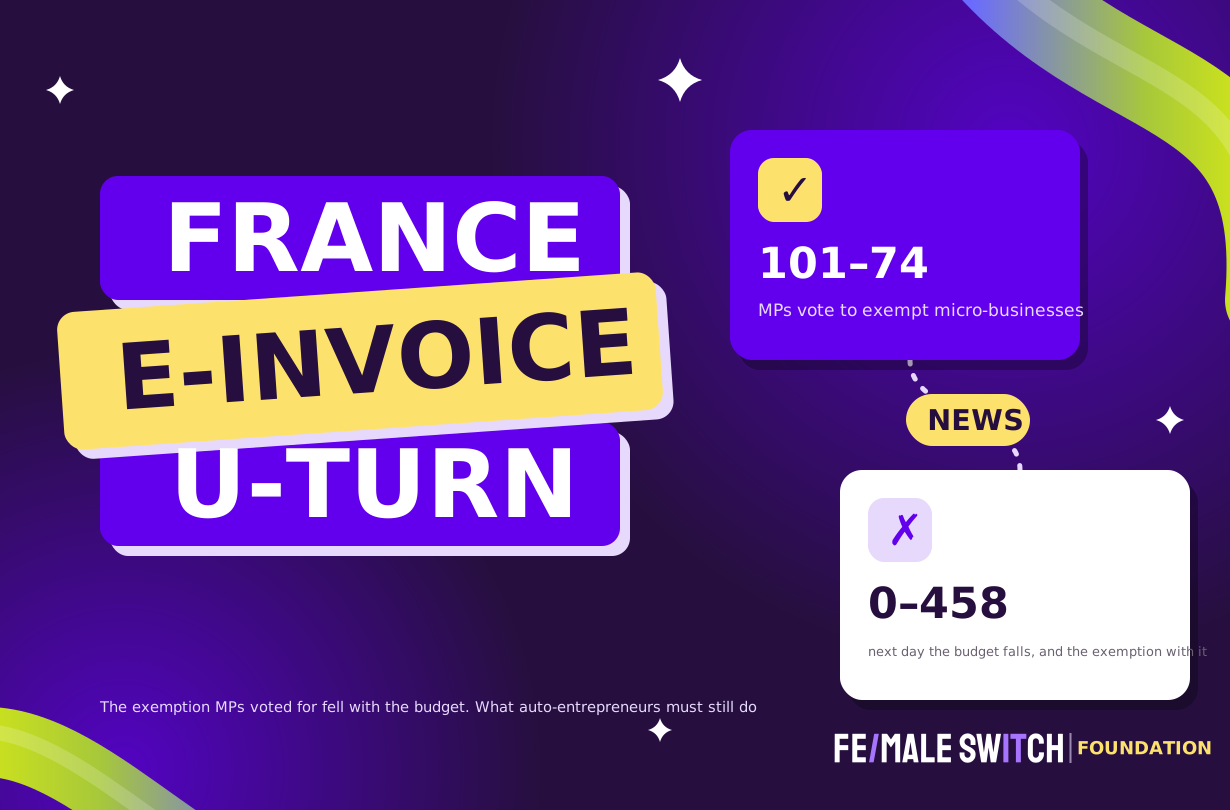
No. On 3 November 2026 France’s National Assembly voted, 101 to 74, to free micro-businesses, small and medium-sized companies and farmers from e-invoicing. The next evening MPs rejected the first part of the 2027 budget by 458 votes to none, so the whole bill fell, and that exemption fell with it. The law has not changed: every business, auto-entrepreneurs included, must already be able to receive e-invoices through an approved platform, and micro-businesses must start issuing them on 1 September 2027. The Sénat now debates the government’s original text, which has no exemption, from 20 November.
If you run a micro-entreprise in France, this week’s headlines may have made you think you can cancel your e-invoicing platform. Please don’t. For about 24 hours, MPs had voted you an exemption. Then they threw out the budget it was written into.
Here is what happened in the National Assembly, what still applies, what it costs to ignore it, and how France compares with the rest of Europe.
What happened
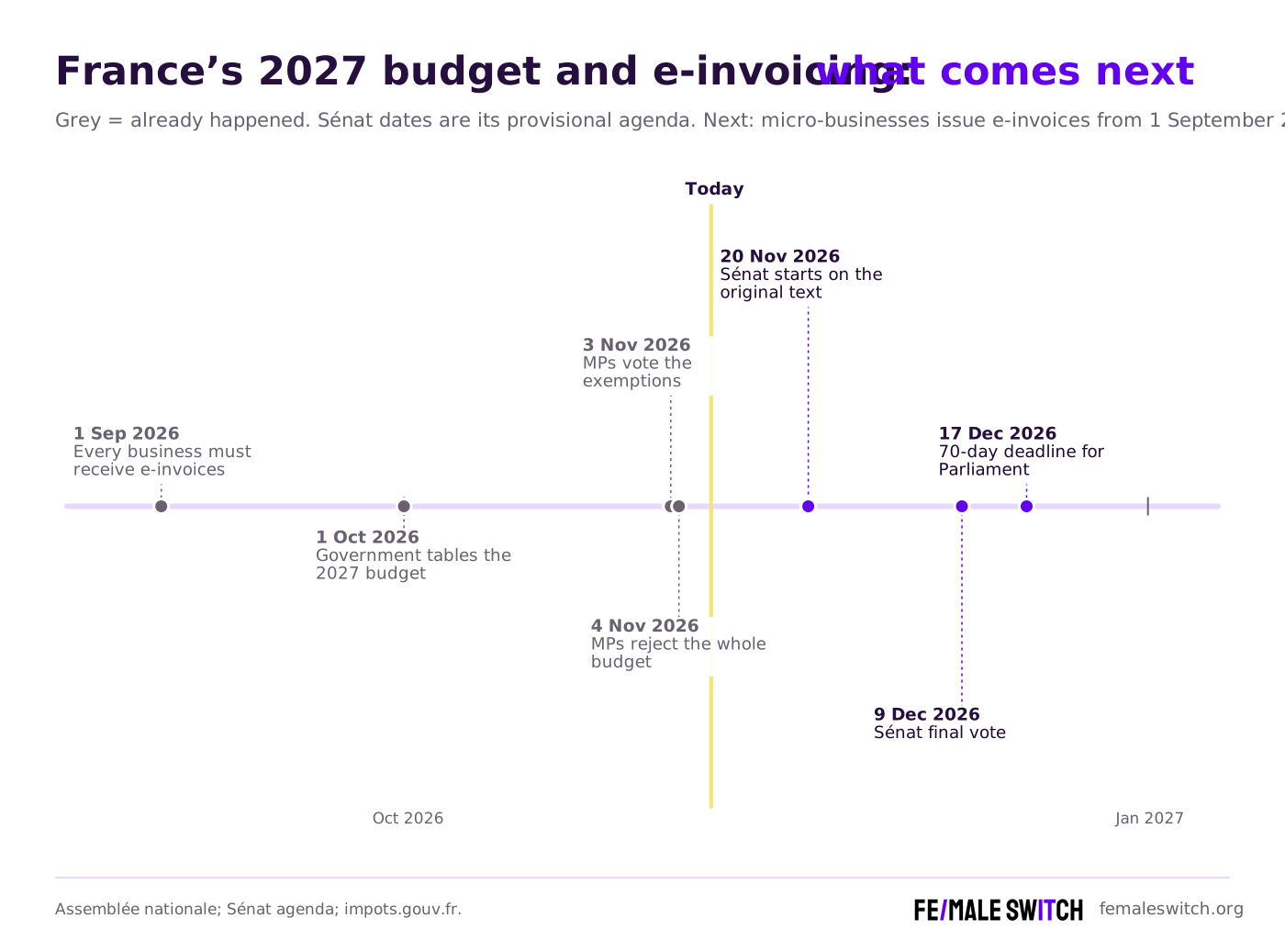
The government tabled its budget bill for 2027 on 1 October 2026. MPs then spent a month amending its first part, the revenue side. On Tuesday 3 November, late in the evening, two votes went against the government on e-invoicing.
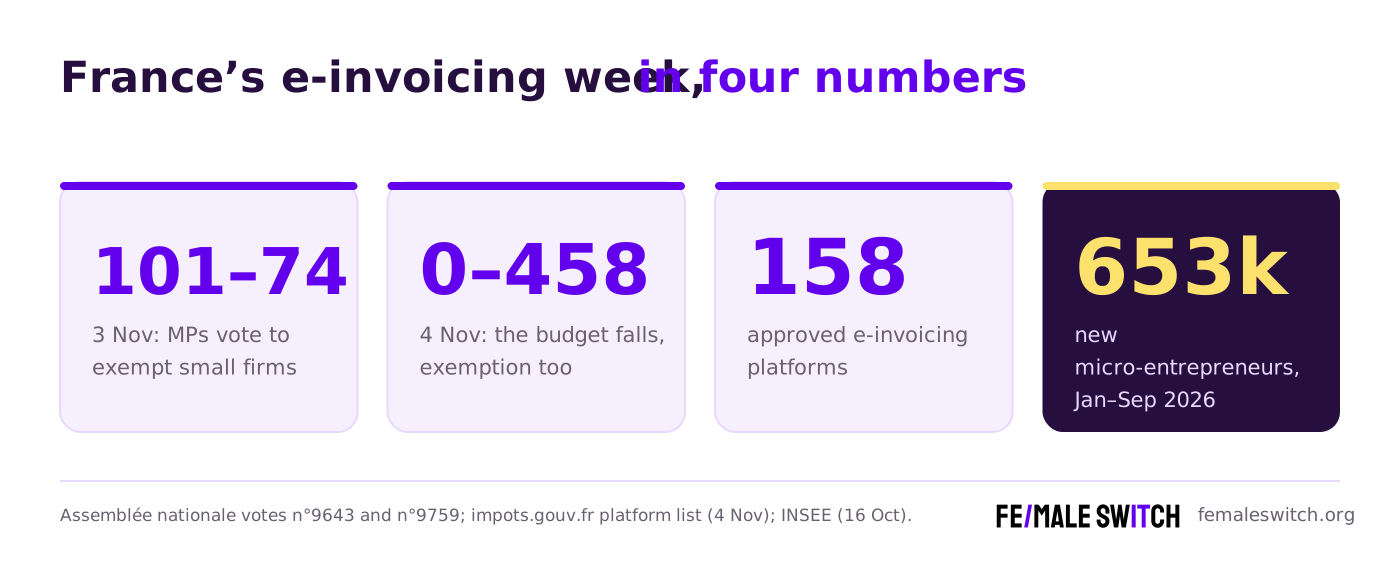
First, MPs adopted an amendment from the Droite Républicaine group (Philippe Gosselin, amendment 1729, and an identical one from Vincent Rolland). From 1 January 2027 it would have freed businesses below the VAT threshold, in the “franchise en base” regime, from having to receive their invoices through an approved platform. The vote was 74 to 70.
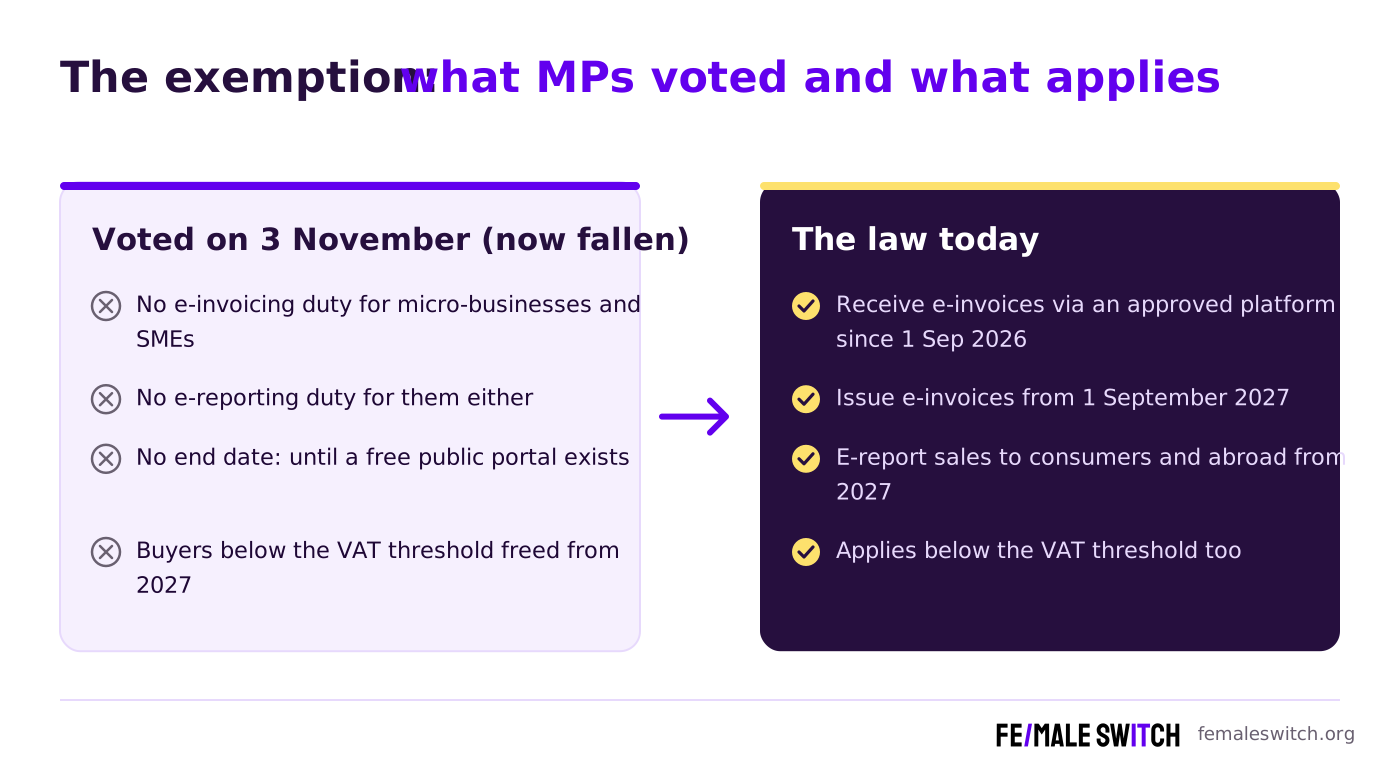
Then came the bigger one. MPs adopted amendment 3426 from Mathilde Hignet (La France insoumise) by 101 votes to 74, with 5 abstentions. It switched off the e-invoicing and e-reporting duties entirely for micro-enterprises, SMEs and farmers, with no end date. Its stated aim was a pause until the state offers a free public portal. Most votes for it came from the Rassemblement National, La France insoumise, the Greens and the Communist-led group; the government’s own camp and most Socialists voted against.
It did not last. On Wednesday 4 November, the National Assembly rejected the first part of the 2027 budget: 458 votes against, none in favour and 2 abstentions. Under the Assembly’s rules, when the first part falls, the whole bill counts as rejected at first reading. Every amendment adopted since 13 October went with it, including both e-invoicing exemptions.
Status: the e-invoicing obligations are Adopted law and unchanged. The exemptions are now only Debated: they are in no bill text.
Source: Assemblée nationale votes and sitting records of 3 and 4 November 2026.
What the government said
The government opposed both amendments. Answering the threshold amendment, public accounts minister David Amiel said: “E-invoicing applies to everyone liable for VAT, from the first euro” (our translation). He added that 75% of the businesses the reform mainly targets have already chosen a platform.
He also defended the choice of private platforms over a state portal: free or nearly free offers for businesses with few needs, which he called much more efficient than “a single, costly platform financed by taxpayers”. Mathilde Hignet cited a September study in which 19% of business owners reported late payments after e-invoicing began and 25% reported significant extra costs. “It is therefore important to offer a free public portal,” she said.
After the budget fell, the Prime Minister’s office said the time for compromise would come after the Sénat’s reading, franceinfo reported. Neither the government nor the tax administration has announced any change to the e-invoicing calendar.
What still applies to auto-entrepreneurs
The tax office answers the question directly. Asked whether a micro-entrepreneur in the franchise en base is affected, its e-invoicing FAQ says: “Yes, you are concerned.” The reform applies to everyone liable for VAT, whether or not they actually charge it, so being under the VAT threshold does not take you out. In practice:
- Since 1 September 2026: every business, whatever its size, must be able to receive e-invoices from suppliers through an approved platform (plateforme agréée).
- From 1 September 2027: small and medium-sized companies and micro-businesses must also issue their business-to-business invoices electronically.
- Also from 1 September 2027: e-reporting, which means sending the tax office data on sales that are not domestic B2B invoices, such as sales to consumers and to clients abroad, plus payment data where it applies.
There is no free state platform. France chose private approved platforms instead of a single public portal, and the tax office’s e-invoicing FAQ document says that, as of 1 August 2026, more than ten of the approved platforms offered free plans or plans at no extra cost. The official list of approved platforms is updated regularly: the version of 4 November names 158 operators, plus 8 still waiting for interoperability tests. If yours is not on it, it is not an approved platform.
The fines, if you ignore it
The penalties were raised by the 2026 budget law, and they are in force:
- No platform to receive invoices: after a formal notice giving you three months, a €500 fine, then €1,000 for every further three months without one.
- Invoice not issued electronically (from your September 2027 start date): €50 per invoice, capped at €15,000 a year.
- Missing e-reporting: €500 per missed transmission, capped at €15,000 a year.
A first mistake on invoices or e-reporting is not fined if you put it right on your own or within 30 days of a request. For 2026, the tax office says it will not apply sanctions and is taking a teaching approach; the minister promised no penalties at the start for businesses acting in good faith. That is a promise, not a legal exemption, so don’t build your plans on it.
What happens next
The Sénat received the bill as text no. 362 and will work on the government’s original version (see the Sénat’s bill file). Its provisional agenda has the general debate on Friday 20 November, the vote on the first part on 28 November and the final vote on 9 December. Senators’ amendments to the first part are due by 19 November.
Senators could table their own e-invoicing relief, and a joint committee of MPs and senators is expected in mid-December to try to agree a final text. Parliament’s 70-day deadline runs out on 17 December 2026. No senator had announced an e-invoicing amendment for micro-businesses by 8 November.
How France compares in Europe
France is not alone, but it is one of the strictest for the smallest businesses. In Germany, the finance ministry’s e-invoice FAQ says small businesses under the Kleinunternehmer rule don’t have to issue e-invoices, and an email inbox is enough to receive them.
Source: national tax and finance ministry pages; Spain: Orden HAC/1028/2026. From 1 July 2030, EU rules add digital reporting for cross-border B2B sales everywhere.
Other countries are moving too: the UK Autumn Budget 2026 set e-invoicing from 2029, and our roundup of budget 2027 for freelancers in six countries covers France’s other changes for the self-employed.
What this means for you
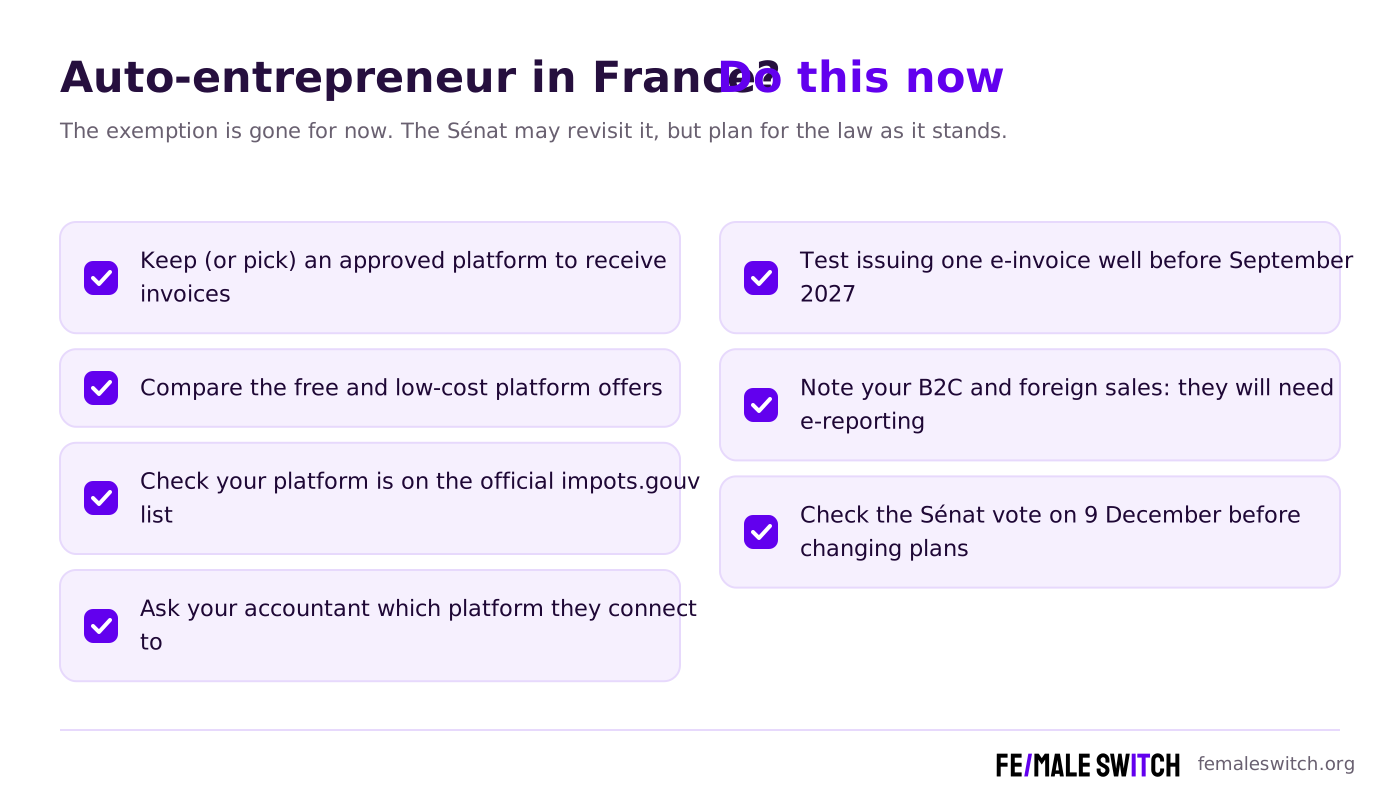
- Keep your platform. If you signed up with an approved platform to receive invoices, keep it. If you haven’t, pick one now: the receiving duty already applies, and the €500 fine follows a three-month notice.
- Shop for a cheap plan. More than ten approved platforms had free or no-extra-cost plans in August. Check that your choice is on the official list and works with your accountant. Our guide to financial management software helps you compare invoicing tools.
- Check who holds your data. Hignet’s amendment cited data leaks at invoicing providers. Ask your platform where it stores data and how it alerts you; our guide to a supplier data breach covers the first 72 hours.
- Prepare to issue in 2027. Send a test e-invoice months before September 2027, and list your sales to consumers and foreign clients: they will need e-reporting.
- Fix your basics. Payment terms, late fees and invoice wording still matter in an e-invoice. Our news on the EU dropping its 30-day payment cap explains what you can still charge late payers, and our solopreneur guide for women in Europe covers VAT thresholds and legal forms.
- Watch 9 December. If the Sénat brings back an exemption, it still has to survive the joint committee and the final vote. Until it is in the published budget law, plan for the current rules. Italy shows how budgets shift late: its 2027 flat-tax ceiling change still depends on Parliament too.
Learning the admin side of a business is easier when you can practise it first.
The Fe/male Switch startup game takes you from idea to first paying customers in weekly quests, with an AI co-founder, so you can practise pricing, invoicing and the boring-but-vital admin in a safe setting. The free trial lasts 2 weeks.
👉 Start the game
FAQ: France’s e-invoicing rules after the budget vote
Are micro-entrepreneurs exempt from e-invoicing in France?
No. MPs voted an exemption on 3 November 2026, but it was part of the 2027 budget bill, which the National Assembly rejected on 4 November. The exemption fell with it. The law in force still covers micro-entrepreneurs, including those below the VAT threshold.
Do I need an approved platform if I don’t charge VAT?
Yes. The tax office says the reform applies to everyone liable for VAT, whether or not they charge it, so micro-entrepreneurs in the franchise en base must be able to receive e-invoices through an approved platform since 1 September 2026.
When must a micro-entreprise start issuing e-invoices?
From 1 September 2027, for invoices to other businesses in France. E-reporting of sales to consumers and to clients abroad starts on the same date.
What is the fine for not having an e-invoicing platform?
After a formal notice giving three months to comply, the fine is €500, then €1,000 for each further three-month period without a platform. The tax office has said it will not apply sanctions in 2026 and will take a teaching approach.
Is there a free e-invoicing platform in France?
There is no free state portal. As of 1 August 2026, more than ten approved private platforms offered free plans or plans at no extra cost, according to the tax office. The official list on impots.gouv.fr names 158 approved operators.
Can the Sénat bring the exemption back?
Yes, senators can table amendments until 19 November, and the Sénat votes on the whole budget on 9 December. Any exemption would then need to survive the joint committee of MPs and senators and the final vote, so plan for the current rules until a law is published.
