
TL;DR: what does the end of the €150 VAT import limit mean for small online sellers?
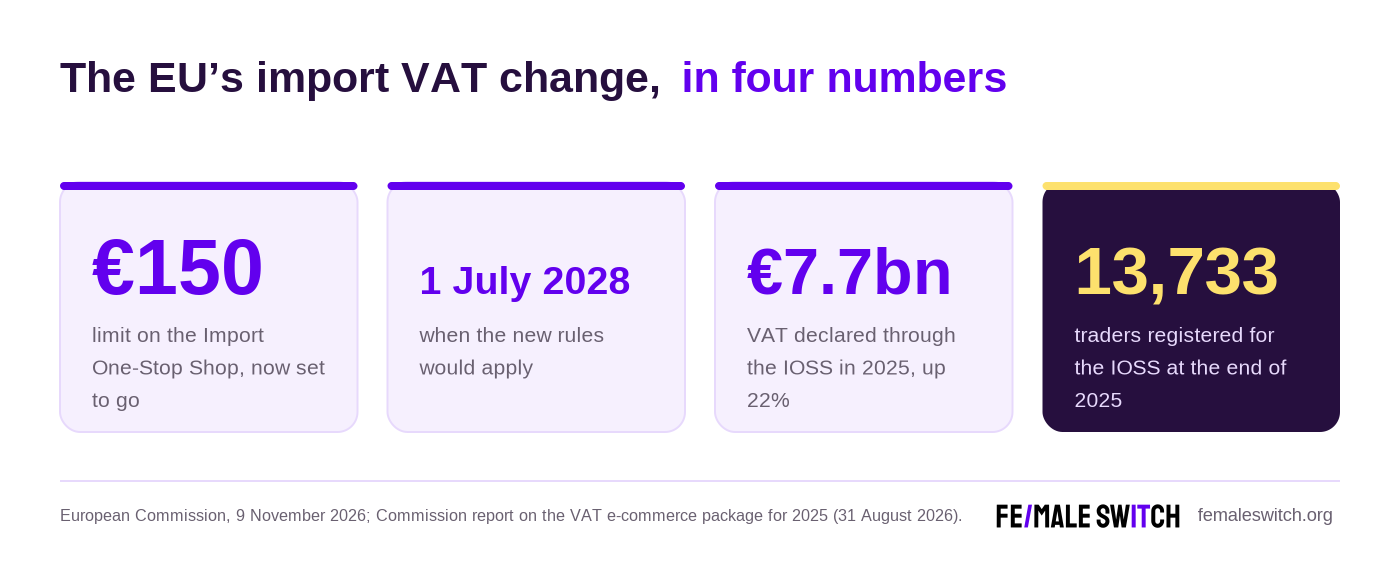
On Monday 9 November 2026, EU finance ministers agreed to remove the €150 limit from the VAT Import One-Stop Shop (IOSS). From 1 July 2028, one IOSS registration would cover goods of any value sold online from outside the EU to EU consumers, and marketplaces would collect the VAT on every such order they facilitate, not only on orders up to €150. It is not a new tax: VAT is already due on all imports. What changes is who collects it and when, at checkout instead of on delivery. Status: Proposed. The Council has agreed its text; the European Parliament gives its opinion again, then the Council formally adopts it.
If you dropship from China, ship from the UK or the US, or sell imported goods through a marketplace, the EU has just agreed how VAT will work on your orders from mid-2028. It is the last piece of the plan to end the €150 tax break for parcels, after the €3 duty that started in July and the €2 handling fee that started on 1 November.
Here is what EU countries agreed, who it affects, and what small sellers should do now, two years before it starts.
What happened
At their meeting on Monday 9 November, the EU’s finance ministers (the ECOFIN Council) reached a general approach on a directive that removes the €150 limit from two VAT rules for imported goods. The European Commission welcomed the agreement the same day, saying it “completes the package of legislative changes for the removal of the €150 de minimis threshold for e-commerce”.
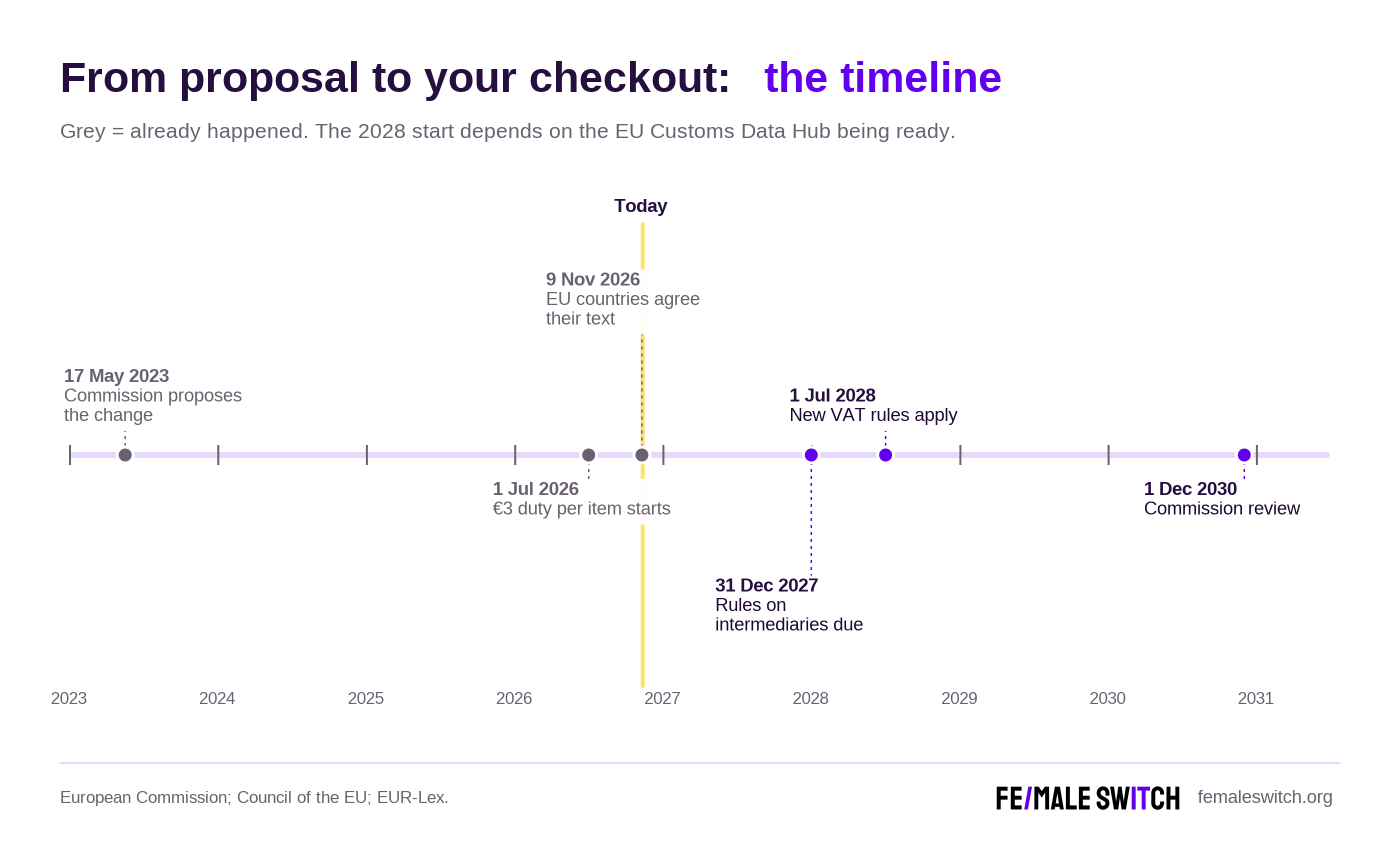
The text the ministers approved is public. The Council’s note of 4 November shows the draft directive in full: the Commission proposed it on 17 May 2023 as part of its customs reform, the European Parliament gave its opinion on 22 November 2023, and member states have negotiated it since. Because the text changed, Parliament will now be asked for its opinion again. After that, the Council can formally adopt the directive.
Status: Proposed. VAT laws need the agreement of all 27 governments, and they have now agreed on the wording, so big changes are unlikely. But it is not law until the Council formally adopts it and it is published in the Official Journal.
What changes, in plain words
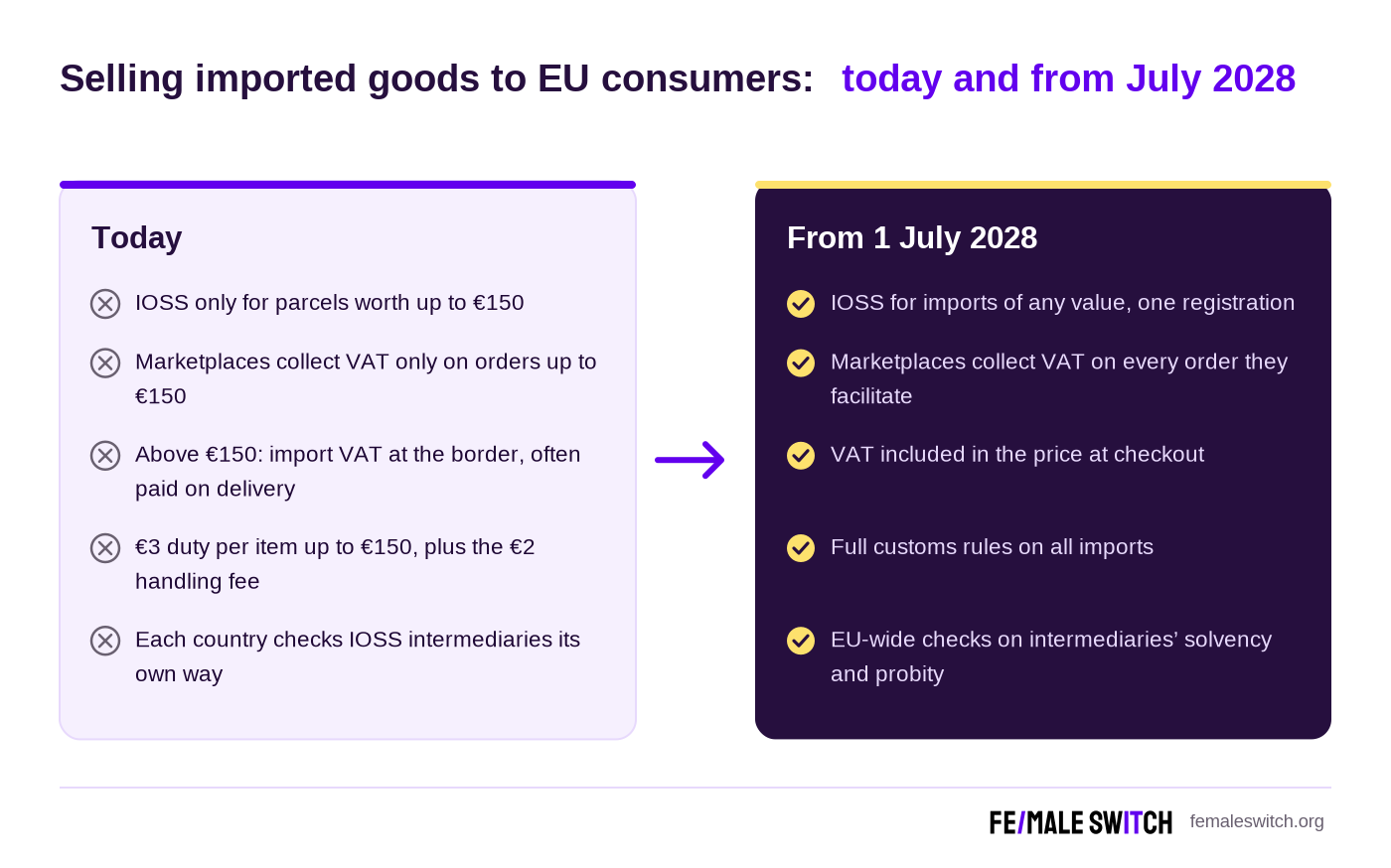
The Import One-Stop Shop, or IOSS, lets a seller charge EU VAT at checkout on goods shipped from outside the EU and pay it through one registration in one EU country, instead of registering in every country where customers live. Under a second rule, the “deemed supplier” rule, a marketplace that facilitates such a sale is treated as the seller for VAT, so the platform collects the VAT, not the small seller. Both rules have stopped at €150 since July 2021. The draft directive removes that limit:
- IOSS for any value. One registration would cover imported goods of any value sold online to EU consumers. Above €150 today, import VAT is collected at the border, and where a seller doesn’t use the IOSS, it is usually paid by the customer on delivery.
- Marketplaces collect VAT on every order. Platforms would be responsible for the VAT on all the sales of imported goods they facilitate, “not only those of up to €150”, as the Commission puts it.
- Customs warehouses for distance sales. The IOSS would also cover goods sold from the new special customs warehouses created by the EU’s new customs code, which customs can check more easily.
- Tighter rules on intermediaries. Many non-EU sellers can use the IOSS only through an EU intermediary. Member states would have to check that intermediaries have enough administrative capacity, financial solvency and probity, under EU-wide criteria the Commission must propose by 31 December 2027.
- Excise goods stay out. Alcohol, tobacco and other products subject to excise duty remain excluded.
For shoppers, the Commission stresses, there is no new tax: “VAT is already due on all imported goods, whatever their value.” What changes is how it is collected, with VAT “included in the price at checkout instead of being paid on delivery” where sellers use the IOSS.
The last piece of the €150 package
The €150 limit has been taken apart in three steps. The customs side went first: Council Regulation (EU) 2026/382 ended the duty exemption for parcels up to €150, with a temporary flat duty of €3 per item for IOSS sellers and postal parcels from 1 July 2026 until 1 July 2028. Then the new Union Customs Code added a €2 handling fee per item line from 1 November, which we explained in our report on the EU’s €2 parcel handling fee. This week’s VAT deal aligns the tax rules with the customs ones.
Sources: European Commission, EUR-Lex and the Council’s draft directive.
The start date has a condition. The new VAT rules apply from 1 July 2028 only if the IOSS part of the EU Customs Data Hub, the new central customs IT system, is running by 1 June 2028. If it isn’t, the start moves back until the system works. The customs regulation has a matching check: by 1 December 2027, the Commission must assess whether the central IT will be ready for 1 July 2028.
Why the EU wants this: the IOSS numbers
The IOSS already carries a lot of money. According to the Commission’s report on the VAT e-commerce package for 2025, sellers and platforms declared €7.7 billion of VAT through it in 2025, up 22% from €6.3 billion in 2024, which the report links to the continued growth of low-value imports. The Commission says the scheme has collected more than €21 billion since it started in July 2021.
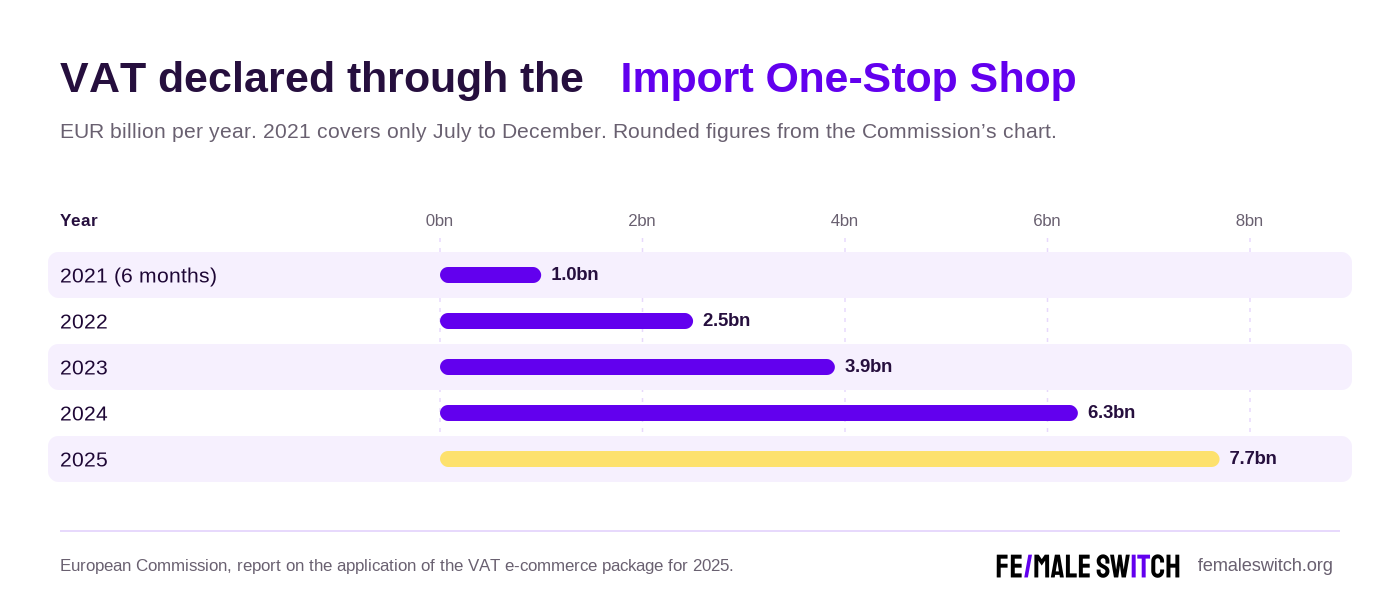
At the end of 2025, 13,733 traders were registered for the IOSS, next to 173,630 in the Union One-Stop Shop that EU sellers use for sales to other EU countries, and 1,394 intermediaries acting for non-EU sellers. To keep VAT collection safe once higher-value goods come in, the Commission must review the whole scheme by 1 December 2030 and propose changes if needed.
Who is affected, and who isn’t
This is a change for imports sold to consumers. If you hold stock in the EU and sell it to EU customers, nothing changes for you; your cross-border EU sales still go through the Union One-Stop Shop. It matters if goods travel from outside the EU straight to your customer:
For a small brand outside the EU, such as a UK maker selling to EU customers, the change is mostly good news: today, an order above €150 often means the customer pays the import VAT on delivery. With the IOSS for any value, the price at checkout can be the final price. If you sell on a marketplace, the platform takes over the VAT on these orders, so watch for changes to its pricing and payout rules. Platforms are also under pressure on product safety: on 17 November 2026 the Commission preliminarily found that Temu does too little to stop unsafe products, which points to stricter seller checks on every marketplace.
For EU sellers who compete with cheap imports, the change is about collection, not a new cost for importers: VAT on parcels above €150 is due today too. The new costs for imports come from the customs side, the €3 duty and €2 fee. The VAT deal adds tighter checks on IOSS intermediaries, which the Commission says are there to limit VAT fraud.
What this means for you
- Map where your goods ship from. If any order travels from outside the EU straight to an EU customer, these rules apply to you. If you sell from EU stock, they don’t. Our guide to international expansion in Europe covers the bigger choices about where to hold stock.
- Use the IOSS now if you ship low-value orders from outside the EU. It already lets you show the full price at checkout for parcels up to €150, and from 2028 it would cover every order.
- Price for the 2026 charges first. The €3 duty and €2 handling fee already apply. Add them to your landed cost before you think about 2028. Our bootstrap start-up cost guide shows how to build a cost sheet.
- Check your intermediary. If you sell from outside the EU through an IOSS intermediary, ask how it plans to meet the new EU criteria once the Commission proposes them.
- Read your marketplace’s updates. Platforms will change how they collect VAT on higher-value imports. Marketplaces are already rewriting their rules on returns and refunds and AI-made listings, so build a habit of checking seller notices monthly.
- Keep the rest of your compliance list in view. Packaging rules are moving too: see our report on the packaging rules for small online sellers. If you are just starting a shop, our no-code e-commerce launch guide walks through the setup.
Want to practise pricing and selling before real customers pay?
The Fe/male Switch startup game takes you from idea to first paying customers in weekly quests, with an AI co-founder, so you can test prices, costs and sales channels without risking your savings. The free trial lasts 2 weeks.
👉 Start the game
FAQ: the end of the €150 VAT import limit
Is the removal of the €150 IOSS threshold law yet?
Not yet. EU finance ministers agreed the text on 9 November 2026. The European Parliament will be consulted again, then the Council formally adopts the directive. Member states must apply it from 1 July 2028, if the EU Customs Data Hub is ready by then.
Is this a new tax on imported goods?
No. VAT has been due on all imported goods, whatever their value, since 1 July 2021. The change is in how it is collected: through one IOSS registration or by the marketplace, with VAT included in the price at checkout instead of being paid on delivery.
What is the IOSS?
The Import One-Stop Shop is an EU scheme that lets sellers of goods shipped from outside the EU charge VAT at checkout and declare it in one EU country. Until the new rules apply, it only covers consignments worth up to €150.
What changes for marketplaces?
Under the deemed supplier rule, a marketplace that facilitates a sale of imported goods is treated as the seller for VAT. Today that applies up to €150. Under the agreed text, platforms would be responsible for the VAT on all such sales, whatever their value.
Does this affect EU sellers who sell EU stock?
No. The change covers distance sales of goods imported from outside the EU to consumers. Sellers who ship EU stock to EU customers keep using domestic VAT rules or the Union One-Stop Shop.
Do the €3 customs duty and the €2 handling fee still apply?
Yes. The €3 duty per item on parcels up to €150 applies from 1 July 2026 until 1 July 2028, and the €2 Union handling fee per item line has applied since 1 November 2026. The VAT change is a separate rule.
